Why Movement Planning Is More Than Just Owning a Vehicle
Mobility is one of the most deceptively complex areas of preparedness. Many people assume transportation planning begins and ends with a reliable vehicle, but in Canada, mobility is a system, not a possession. Winter weather, fuel distribution, long rural distances, limited road redundancy, and fragile digital infrastructure all combine to make movement during an emergency far more dangerous than most people anticipate.
Preparedness is not about moving fast — it’s about maintaining choice when others have lost it.
The Canadian Mobility Reality
Canada’s geography works against rapid movement during crises. Urban centres funnel traffic through predictable choke points, while rural areas depend on long stretches of secondary highways that may not be plowed for hours or even days.
During recent winter storms across Ontario and Quebec, we saw:
- Multi-hour highway standstills
- Fuel stations closing despite having fuel (no power, no payments)
- Emergency services overwhelmed or delayed
These are not extreme events. They are normal Canadian winter failures, and mobility planning must assume they will happen again.
For context, this ties closely to our earlier breakdown of winter storm risks:
- https://canadianpreppersnetwork.com/canada-winter-storm-preparedness/
- https://canadianpreppersnetwork.com/dealing-with-extreme-cold-grid-down/
Mobility does not exist in isolation — it intersects directly with energy, shelter, and communications.
Bug-In vs Bug-Out: The Mobility Decision That Matters Most
The most important transportation decision is whether you should be moving at all.
In Canada, the default assumption should be bug-in first, not bug-out. Leaving too early exposes you to:
- Traffic congestion
- Fuel depletion
- Cold exposure
- Mechanical failure far from assistance
Bug-out only becomes the correct choice when remaining in place becomes more dangerous than movement itself. Fire, structural collapse, or forced evacuation are examples — inconvenience and fear are not.
If you haven’t already reviewed it, this article lays the groundwork for that decision:
Mobility planning should support both options, not force one.
Vehicles: Boring Is Good
Prepared mobility favours vehicles that start every time, not vehicles that look impressive.
In Canadian conditions, reliability comes from:
- Proper winter tires (not all-seasons)
- A strong battery and working block heater
- Conservative driving range and fuel efficiency
- Regular maintenance, not aftermarket accessories
Many winter breakdowns are not dramatic failures — they’re dead batteries, frozen fluids, or overheating from snow-packed grilles.
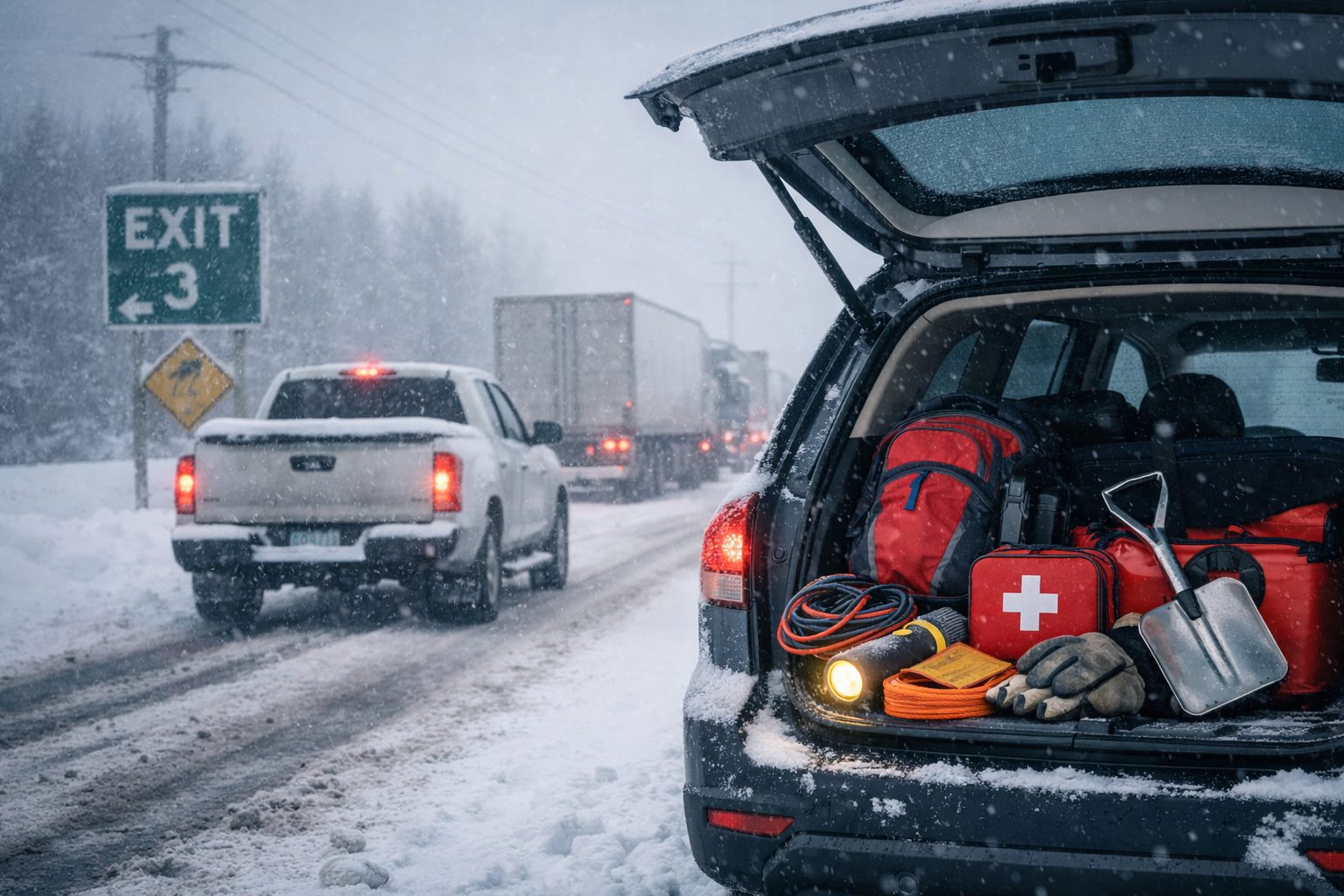
A properly stocked winter vehicle kit turns minor problems into manageable delays. Items like insulated gloves, traction aids, and emergency lighting matter more than tactical gear. A compact, winter-specific kit like this one is a good baseline:
👉 https://www.amazon.ca/dp/B0B8J3WZ7N/?tag=canadpreppn01a-20
Fuel: The Silent Mobility Killer
Fuel scarcity is the single most common reason Canadians lose mobility during emergencies.
When storms or outages hit:
- Fuel deliveries stop
- Payment systems fail
- Stations close even if tanks are full
This pattern was documented repeatedly during past blackouts and winter storms:
- https://canadianpreppersnetwork.com/fuel-storage-basics-canada/
- https://canadianpreppersnetwork.com/energy-resilience-grid-down/
Prepared households quietly mitigate this risk by:
- Maintaining a never below half-tank rule
- Storing small, legal fuel quantities rotated seasonally
- Using fuel stabilizer to extend shelf life
A basic stabilizer is inexpensive insurance:
👉 https://www.amazon.ca/dp/B000CCMZP2/?tag=canadpreppn01a-20
Fuel planning is not hoarding — it is continuity.
Winter Travel: Exposure Is the Real Threat
Most winter travel fatalities are not caused by collisions — they are caused by exposure.
A stranded vehicle becomes a shelter problem within minutes once the engine stops. This is why mobility planning must include:
- Insulation (blankets, sleeping bags)
- High-calorie food that won’t freeze-spoil
- Light and visibility equipment
- The ability to dig out, not just drive out
Freeze-dried emergency food performs well in vehicles because temperature swings do not destroy it:
👉 https://www.amazon.ca/dp/B09MZJ1T3R/?tag=canadpreppn01a-20
If conditions deteriorate, stopping early and sheltering is often safer than pushing forward blindly.
When Vehicles Fail: Alternative Mobility Options
Prepared Canadians do not rely solely on vehicles.
Depending on terrain and season:
- Snowshoes and skis outperform vehicles in deep snow
- Fat-tire bikes remain viable on plowed secondary roads
- Snowmobiles and ATVs bypass traffic choke points entirely
Human-powered mobility should always be part of the plan, even if only for short distances. A vehicle may get you most of the way — your body may need to finish the job.
A durable cold-weather pack allows you to move essentials if you must abandon a vehicle:
👉 https://www.amazon.ca/dp/B07RZ5G9QD/?tag=canadpreppn01a-20
This connects directly with our shelter planning content:
Route Planning: Local Knowledge Beats GPS
Navigation systems fail when:
- Cell towers lose power
- Mapping data doesn’t reflect closures
- Everyone is routed onto the same roads
Prepared individuals study:
- Secondary and tertiary routes
- Seasonal road closures
- Bridges, rail crossings, and flood zones
- Which roads drift, ice, or wash out first
Paper maps matter. Familiarity matters more.
Mobility planning works best when combined with communications redundancy:
Mobility Is About Control, Not Escape
The goal of transportation preparedness is not speed — it is choice under pressure.
When others are immobilized by empty tanks, dead phones, or blocked highways, the prepared household still has options. Sometimes the correct choice is movement. Often, it is staying exactly where you are.
Mobility supports every other preparedness pillar — but only when it is realistic, seasonal, and grounded in Canadian conditions.
📘 Further Reading
For a long-term, land-based view of access roads, seasonal logistics, and rural transportation planning, Acres of Preparedness: Planning the Last Safe Place documents how mobility fits into sustainable preparedness, not panic response.
👉 https://amzn.to/4iLrm9Y