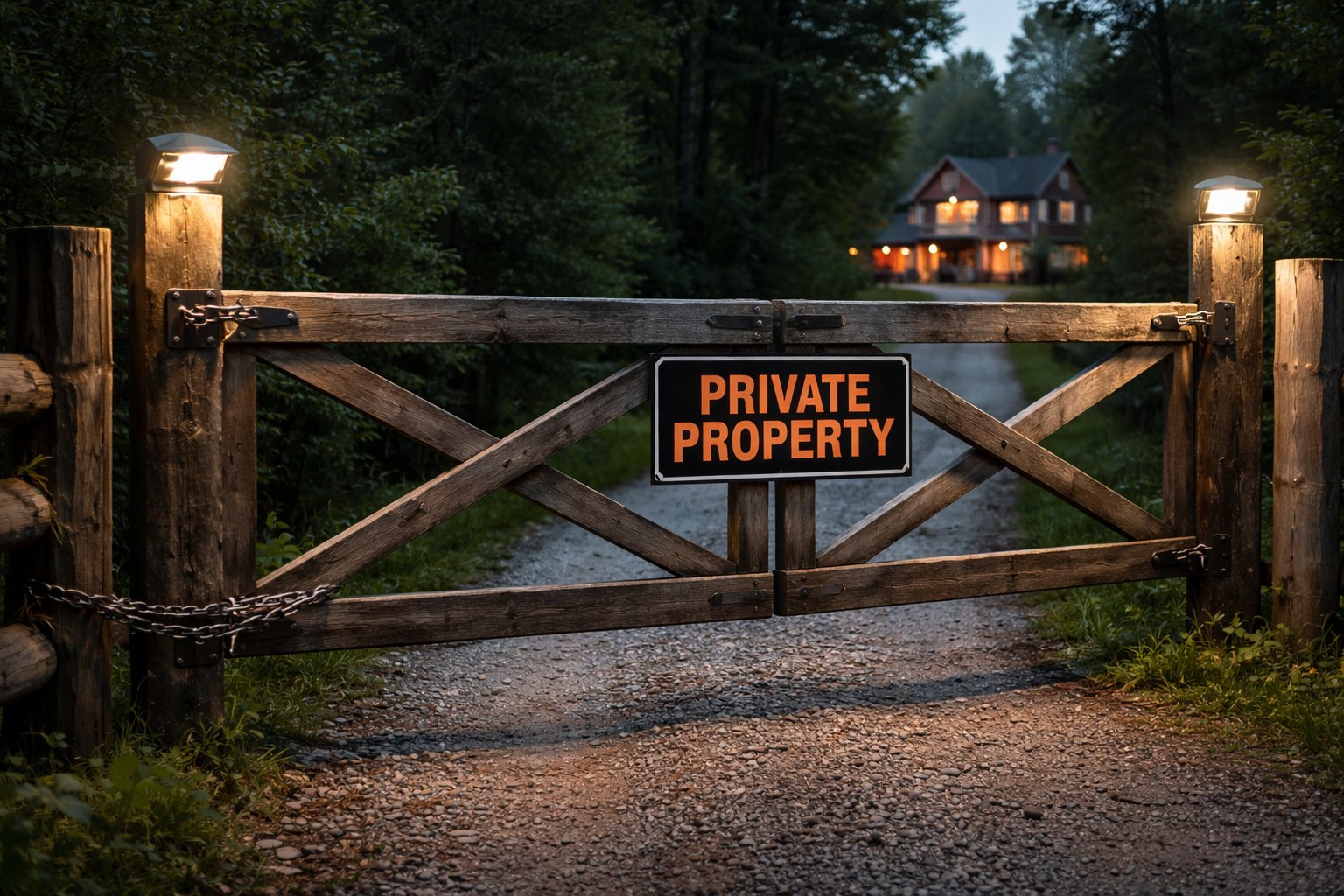
Most “home security” starts at the door. That’s backwards.
If someone can walk or drive onto your property freely, they get time. They get options. They get to test angles, check sightlines, and decide if they want to commit—while you’re still assuming everything is normal.
Exterior barriers flip that script. They don’t just “detect” movement. They shape movement. They force a stop, a detour, noise, or exposure—before anyone ever touches a knob or checks a window.
This is the core idea:
You don’t secure your home. You secure access to your home.
The Exterior Barrier Mindset: Deny Easy Movement, Not Every Movement
A barrier doesn’t have to be a fortress wall. It just has to do one of these things:
- Stop vehicles from rolling up casually
- Funnel foot traffic where you can see it
- Make 접근 (approach) slow, noisy, and uncomfortable
- Prevent lingering near doors/windows
If a person has to climb, cut, drag, rattle, or commit time, most opportunistic threats evaporate on the spot. They’ll pick an easier target.
And if you’re thinking “that sounds extreme,” remember: most losses happen in the grey zone—when order exists on paper but response is slow and everyone is stressed. That’s exactly the gap you covered in your previous security piece, and this article is the practical follow-through: physical access control.
(For your “security gap” framing, link this as context:)
When order still exists but help is slow: the security gap most Canadians ignore
https://canadianpreppersnetwork.com/when-order-still-exists-but-help-is-slow-the-security-gap-most-canadians-ignore/
1) Driveway Denial: The Highest-Value Barrier on Most Properties
An open driveway is a permission slip.
Vehicles create the biggest problem because they combine speed + anonymity + easy exit. If someone can roll in, “turn around,” and roll out, your property becomes a low-risk scouting target.
Your goal is simple: force a stop.
DIY driveway barriers that work
A. Heavy chain across the entrance (fastest “good enough” option)
Two solid anchor points (posts, large trees, or heavy eye-bolts into something that won’t budge) and a thick chain across the lane. It’s crude—but it forces a decision and makes noise when tested.
Use a real outdoor-rated lock, not a tiny luggage padlock.
Amazon: Heavy-duty weatherproof padlock (example)
https://www.amazon.ca/dp/B08LZQ4Z4P/?tag=canadpreppn01a-20
B. DIY timber swing gate (strongest DIY “permanent” option)
A pair of deep-set posts (6×6) and a framed gate (2×6) with bracing. The gate doesn’t need to look fancy—weight and hinge strength matter more than appearance.
Hardware matters. Oversize hinges, structural screws, and a latch you can secure with a lock or drop bar.
Amazon: Heavy-duty gate hinge set (example)
https://www.amazon.ca/dp/B0B3JQ8B4H/?tag=canadpreppn01a-20
C. “Mass + chain” obstacles (surprisingly effective in real life)
Concrete blocks, gravel-filled tires, large rocks, or heavy logs chained together across the entrance. Nobody “accidentally” drives through that—and moving it takes time, tools, and loud effort.
This is ugly security. Ugly security works.
2) Foot Traffic Control: Stop Wandering, Create Funnels
Most break-ins and snooping don’t start with a direct approach. They start with wandering: side yard, back door, basement windows, deck access, garage checks.
If your property allows “free exploration,” you’re giving away your advantage.
Your job is to make wandering difficult.
DIY funnel methods
A. Temporary fencing that doesn’t look like “security”
Welded wire fencing on T-posts is cheap, fast, and reconfigurable. You don’t need a perfect perimeter—just block the easy “walk-around” routes that lead to your back door and ground-floor windows.
Amazon: T-post driver (makes setup 10x faster)
https://www.amazon.ca/dp/B07G2M4WQ8/?tag=canadpreppn01a-20
B. “Work piles” used as barriers
Firewood stacks. Pallets. Lumber. Brush piles. These create friction without screaming “I’m defending my property.” Place them deliberately along walls and in side yard routes so movement becomes awkward and loud.
C. Natural denial (thorn + density beats “pretty landscaping”)
Thorny shrubs and dense low growth under windows and along fences are low-maintenance passive barriers. People avoid discomfort instinctively—especially when they’re trying not to be noticed.
If you want to tie this into general preparedness mindset and why “normal” assumptions fail, this internal piece pairs well:
https://canadianpreppersnetwork.com/why-prepping-in-canada-isnt-paranoia-its-pure-common-sense/
3) Gates That Don’t Need Power: Mechanical Wins When Everything Else Gets Weird
Powered gates and “smart” access controls look great right up until:
- the power’s out,
- the battery dies,
- the connection drops,
- the system faults “open.”
Mechanical gates don’t care about any of that.
DIY mechanical gate patterns
A. Drop-bar gate (simple, brutally effective)
A heavy bar (wood or steel) that drops into brackets/saddles. It’s fast to secure and slow to defeat.
B. Chain gate (quiet to install, loud to defeat)
A chain across the opening with a strong lock. This is best when you need quick deployment without building a full gate.
C. Angled approach
Even a small change—placing a gate so vehicles can’t approach straight-on—reduces momentum and forces careful maneuvering. That means time, noise, and exposure.
4) Window and Basement Access: Exterior Denial Without “Prison Bars” Vibes
This article is exterior-only, so we’re not doing interior bracing here—but we absolutely are denying exterior access to common entry points.
Basement windows and window wells are a classic vulnerability because they’re often hidden from the street and surrounded by convenient footholds.
DIY options
A. Reinforced window well covers
Instead of flimsy plastic covers that pop off, use a reinforced polycarbonate sheet or a screwed-down plywood cover that requires tools and time.
B. Exterior “anti-linger” zones under windows
Loose gravel, uneven ground, dense shrubs, or awkward obstacles placed directly under windows make it hard to stand there quietly and work.
C. Secure outbuildings and ladders
If someone can grab a ladder or step stool from your yard, you’ve provided a tool kit. The “best” barrier is often just controlling what’s available outside.
5) Make Noise a Feature: The Cheapest Force Multiplier
Exterior barriers should sound wrong when disturbed.
Silence favors someone trying to move unnoticed. You want the opposite: rattle, crunch, clank, scrape.
DIY noise upgrades:
- chain draped on gates (rattles when moved)
- gravel strips near likely approaches (crunches underfoot)
- loose metal on fencing (clatters if grabbed)
- “hanging objects” on a gate line (even small movement makes noise)
This isn’t about booby traps. It’s about obvious disturbance.
6) Cameras Support Barriers — They Don’t Replace Them
Cameras don’t stop anyone. They’re still useful when paired with barriers because they help you see:
- where people are testing your perimeter
- which access points get attention
- what time patterns repeat
But cloud-only cameras can fail exactly when you want them most. Local recording is a better baseline.
This internal link is directly relevant and should be included:
https://canadianpreppersnetwork.com/off-grid-security-cameras-protecting-your-property-when-the-power-goes-out/
Amazon: Local-recording NVR camera kit (example)
https://www.amazon.ca/dp/B0BVMF5C8L/?tag=canadpreppn01a-20
7) Put It Together: A Simple Exterior Barrier Plan That Works
If you do nothing else, do this in order:
- Block vehicles at the driveway (gate/chain/mass obstacle)
- Funnel foot traffic (block side-yard and back-yard wandering routes)
- Deny window access (anti-linger zones + covers where needed)
- Add noise at choke points (gate lines, gravel zones)
- Watch the pressure points with local recording cameras
That sequence turns your property from “easy access” to “high-friction.”
The Hard Truth
If someone can walk right up, poke around, and decide what to do next… your security plan starts too late.
Exterior barriers aren’t about intimidation. They’re about making your property inconvenient, loud, slow, and exposed to approach.
That’s what stops problems before they become problems.
- Heavy timber swing gate
Two pressure-treated 6×6 posts set deep, with a framed gate made from 2×6 lumber and exterior screws. It doesn’t need to be pretty — it needs to be heavy. Add a simple drop bar or chain-and-padlock system. - Removable steel pipe barrier
Steel pipe or thick galvanized fence posts set into ground sleeves or concrete-filled buckets. Drop-in posts block access when needed and can be removed for normal use. - Chained obstacles
Large rocks, concrete blocks, or surplus tires filled with gravel, chained together across the driveway. Loud, slow to move, impossible to “just drive through.”
The goal isn’t permanence. It’s forcing a stop.
2. Funnel Foot Traffic (Don’t Let People Wander)
Most properties fail because they allow unrestricted wandering.
Side yards, rear access, and wraparound paths let someone approach windows and doors without being seen.
Homemade funneling techniques:
- Temporary fencing panels
Farm fencing, snow fencing, or welded wire panels mounted to T-posts. Cheap, fast, effective. They don’t stop forever — they guide movement. - Material piles as barriers
Firewood stacks, lumber piles, pallets, or brush piles placed deliberately to block routes. These don’t look like “security,” which is exactly why they work. - Landscape denial
Thorny shrubs, dense brush, or scrap material placed under windows and along walls. No one casually pushes through discomfort.
A person forced onto one visible path is easier to observe, easier to hear, and harder to surprise with.
3. Gates Without Electronics (The Right Way)
Electronic gates fail at the worst time.
Mechanical gates fail only when physically defeated — and that takes effort.
Effective DIY gate methods:
- Drop-bar gates
A horizontal steel or hardwood beam dropped into brackets or saddles on either side of a gate opening. Simple. Brutally effective. - Chain gates
Heavy chain across an opening, anchored to eye bolts set into posts or masonry. Add a quality padlock. Loud when disturbed, slow to bypass. - Angle gates
Gates installed at a slight angle rather than straight across an opening. This prevents vehicles from building momentum.
If it can’t be opened quietly or quickly, it’s doing its job.
4. Window Access Denial (Without Commercial Bars)
Ground-level and basement windows are the easiest access points — and often ignored.
Homemade options:
- Removable bar panels
Steel conduit or rebar welded or bolted into a simple grid, mounted with carriage bolts and interior nuts. Can be removed from inside if needed. - Wooden cross-bracing
2×4 frames bolted into masonry or framing around window wells. Not elegant, but extremely time-consuming to defeat. - Window well covers that fight back
Reinforced polycarbonate or plywood covers screwed down instead of clipped. Add noise-making elements (chain, loose fasteners).
Windows don’t need to be impregnable — they need to be annoying.
5. Noise Is a Barrier (Use It Deliberately)
Silence favors intruders. Noise favors defenders.
Low-tech noise barriers:
- Hanging chain sections across gates or fences
- Loose gravel zones under windows and along walls
- Scrap metal strips wired to fencing
- Suspended objects that clatter when moved
Noise forces hesitation. Hesitation causes abandonment.
6. Temporary Barriers for Elevated Risk Periods
Not all barriers need to be permanent.
During outages, unrest, or high-risk periods, temporary denial is often enough.
Examples:
- Vehicles parked sideways to block access
- Portable construction fencing
- Pallets screwed together and anchored
- Concrete blocks repositioned as chokepoints
Security that adapts beats security that looks nice.
Final Principle
Exterior security is not about stopping everyone.
It’s about stopping anyone who expects easy access.
If someone must:
- Climb
- Cut
- Drag
- Make noise
- Commit time
Most will choose another target.
That decision happens outside your home — or not at all.