

This was a 3-part series posted on American Preppers Network blog in April 2010 but posting all here as fyi. Please note, there are Safety Tips in part 3. And feel free to add your comments, links and tips here too! itsa
As the Earth Hurls (part 1 of 3 - Iceland)
Iceland’s Eyjafjallajökull (also known as Eyjafjöll) eruption has been causing headaches for many in Europe and around the world due to flight cancellations, ashfall and gases.

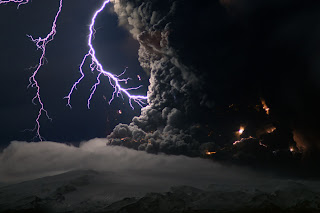
Incredible photo by Dr. Marco Fulle
Some of the comments on recent articles have been amusing like “climate change is causing the eruptions” (implying it’s man’s fault) or “how could something like this happen in Iceland”. People … stop, take a deep breath, look at history, and remember we live on a violent planet.
For example, did you know Iceland - which has 30 volcanic systems and more than 600 hot springs - straddles tectonic plates on the mid-Atlantic ridge, making it one of the most geologically active places on the planet?!
The last time Eyjafjoll erupted [in 1823] it spewed for 14 months straight. And history shows the eruptions may trigger its far more powerful neighbor Katla. According to the CS Monitor, the last major eruption of Katla – a volcano that averages 2 eruptions a century – was in 1918 which is why scientists are watching this very closely. And Katla is just one of the "Angry Sisters" … its even-more active twin is Heckla. Heckla, known in early times as the Mountain of Hell, has erupted 14 times between 1104 and 1970.
According to the BBC, one of the most influential volcanic eruptions in Iceland was the 1783-1784 event at Laki (a fissure with 130 craters) where an estimated 120 million tons of sulfur dioxide were emitted, approximately equivalent to 3 times the total annual European industrial output in 2006.
And the above statistics are just from 1 tiny island. Now, how many active volcanoes are there in the world? According to the Smithsonian Institute’s Global Volcanism Program, the answer to this question depends upon use of the word "active" …
- At least 20 volcanoes will probably be erupting as you read these words (Italy's Stromboli, for example, has been erupting for more than a thousand years);
- roughly 60 erupted each year through the 1990s;
- about 450 historically active volcanoes are in the Ring of Fire around the Pacific Ocean;
- about 1300 (and perhaps more than 1500) have erupted in the Holocene (past 10,000 years);
- and (our favorite statistic) … some estimates of young seafloor volcanoes exceed one million.
And remember, all active volcanoes spew and seep sulfur dioxide, carbon dioxide and other nasty stuff … and there are hydrothermal vents (and black smokers) deep underwater around Antarctica and all across the ocean floors. So… instead of blaming mankind for global warming or climate change, just realize Mother Nature belching and releasing gas impacts our planet immensely.
Stay current on Iceland’s Eyjafjallajökull at Institute of Earth Science Nordic Volcanological Center http://www2.norvol.hi.is/page/ies_Eyjafjallajokull_eruption
Be Aware... Be Prepared... and Have a Plan!
As the Earth Hurls (part 2 of 3 - Supervolcanoes)
Although there are only a handful of supervolcanoes, every 100,000 years or so their catastrophic eruptions typically cover huge areas with lava and ash and can potentially cause a mini ice age or threaten extinction. For example, it’s possible the Toba caldera on Sumatra, Indonesia caused enough climate change to almost wipe out humanity 74,000 years ago. And the Siberian Traps are thought to have wiped out 90% of species over 250 million years ago.
Please understand the reason we are covering this topic is not to intimidate or fear monger, but rather to educate people about the existence of these since they play a role in our planet’s history.
Some data and statistics from The Sydney Herald …
The last time a supervolcano erupted was 74,000 years ago, when the Toba caldera threw out nearly twice the volume of Mount Everest in magma. And Toba was more than 5000 times as explosive as the eruption of Mount St Helens in 1980.
Possible contenders for the next eruption include Yellowstone volcano in Wyoming, the Phlegrean fields volcano west of Naples, Italy, and Lake Taupo in New Zealand. However, there are many other areas where a supervolcano could pop up, including Indonesia, the Philippines, several Central American countries, the Andes, Japan, the Kamchatka peninsula in eastern Russia, and even Europe (the area around Kos and Nisyros in the Aegean Sea might be a supervolcano). And a few other supervolcanoes in the U.S. are Long Valley (CA) and Valles Caldera (NM).
Yellowstone National Park sits on top of a supervolcano, which erupted 3 times forming 3 massive calderas (or huge craters). According to USGS, the first caldera-forming eruption occurred about 2.1 million years ago. The eruptive blast removed so much magma from its subsurface storage reservoir that the ground above it collapsed into the magma chamber and left a gigantic depression in the ground - a hole larger than the state of Rhode Island. Later, activity shifted to a smaller region in eastern Idaho, just southwest of Yellowstone National Park, and produced another large caldera-forming eruption 1.3 million years ago. A third huge eruption occurred 640,000 years ago forming the Yellowstone caldera which is more than 60 miles (100 km) across. Together, the three catastrophic eruptions expelled enough ash and lava to fill the Grand Canyon.

Yellowstone Caldera courtesy of USGS
According to USGS/Cascades Volcano Observatory, about 760,000 years ago a cataclysmic volcanic eruption in eastern California blew out 150 cubic miles of magma from a depth of about 4 miles beneath the Earth's surface. Rapidly moving hot ash flows covered much of east-central CA, and airborne ash fell as far east as Nebraska. The Earth's surface sank more than 1 mile into the space once occupied by the erupted magma, forming a large caldera. And Long Valley Caldera is only one part of a large volcanic system in eastern California that also includes the Mono-Inyo Craters volcanic chain. This chain extends from Mammoth Mountain at the southwest rim of the caldera northward 25 miles to Mono Lake. The volcanic system is still active. Recent measurements at Mammoth Mountain indicate that the rate of CO2 gas emission is close to 300 tons per day.
But what could be the largest lava flow in history was a massive eruption that occurred in the Siberian Traps about 250 million years ago. According to The Discovery Channel and Wikipedia, the massive eruptive event continued for a million years and spanned the Permian-Triassic boundary, about 251 to 250 million years ago. It is estimated to have killed 90% of species existing at the time. "This is the numero uno candidate for a mass extinction caused by volcanism," said paleontologist Spencer Lucas, a curator at the New Mexico Museum of Natural History. "There's good reason to believe it had something to do with that extinction."
Not all scientists agree that the Siberian Traps were the main reason for the mass extinctions, but the timing of the eruption closely matches up with the P-T extinction.

Photo courtesy of Wikimedia Commons
Resources:
USGS Yellowstone Volcano Observatory http://volcanoes.usgs.gov/yvo/index.php
BBC Supervolcano: The Truth About Yellowstone
http://www.bbc.co.uk/sn/tvradio/programmes/supervolcano/programme.shtml
Discovery Channel Supervolcano – Siberian Traps
http://dsc.discovery.com/convergence/supervolcano/others/others_07.html
Univ of Wisconsin’s The Why? Files (Volcanic Violence: Ultimate volcano)
http://whyfiles.org/031volcano/5.html
The Sydney Morning Herald
http://www.smh.com.au/world/science/volcanoes-be-afraid-be-very-afraid--the-supervolcano-is-coming-20100416-sj01.html
Be Aware... Be Prepared... and Have a Plan!
As the Earth Hurls (part 3 of 3 - Safety tips)
A volcano is a mountain that opens downward to a reservoir of molten rock (like a huge pool of melted rocks) below the earth’s surface. Unlike mountains, which are pushed up from the earth’s crust, volcanoes are formed by their buildup of lava, ash flows, and airborne ash and dust. When pressure from gases and molten rock becomes strong enough to cause an explosion, it erupts and starts to spew gases and rocks through the opening.
Volcanic eruptions can hurl hot rocks (sometimes called tephra) for at least 20 miles (32 km) and cause sideways blasts, lava flows, hot ash flows, avalanches, landslides and mudflows (also called lahars). They can also cause earthquakes, thunderstorms, flash floods, wildfires, and tsunamis. Sometimes volcanic eruptions can drive people from their homes forever.
Fresh volcanic ash is not like soft ash in a fireplace. Volcanic ash is made of crushed or powdery rocks, crystals from different types of minerals, and glass fragments that are extremely small like dust. But it is hard, gritty, smelly, sometimes corrosive or acidic (means it can wear away or burn things) and does not dissolve in water.
The ash is hot near the volcano but is cool when it falls over great distances. Ashfall is very irritating to skin and eyes and the combination of ash and burning gas can cause lung irritation or damage to small infants, the elderly or people with breathing problems
Some tips to think about and do Before / During / After a Volcanic Eruption:
Prepare - Try to cover and protect machinery, electronic devices, downspouts, etc. from ashfall.
Learn alert levels - Ask emergency management office which volcano warnings or alert levels are used since they vary depending on where you live (can be alert levels, status levels, condition levels or color codes).
Make a plan - Develop a Family Emergency Plan and Disaster Supplies Kits / BOBs. (Note: Put in goggles or safety glasses and dust masks for each family member to protect eyes and lungs from ash.)
Be ready to evacuate - Listen to local authorities and leave if you are told to evacuate.
Watch out - Eruptions cause many other disasters:
* flying rocks - hurled for miles at extremely fast speeds
* mudflows, landslides or lahars - they move faster than you can walk or run
* fires - hot rocks and hot lava will cause buildings and forests to burn
* lava flows - burning liquid rock and nothing can stop it
* gases and ash - try to stay upwind since winds will carry these -- they are very harmful to your lungs
* vog - volcanic smog forms when sulfur dioxide and other pollutants react with oxygen, moisture and sunlight – can cause headaches, breathing difficulties and lung damage
IF INDOORS - Stay in, but be aware of ash, rocks, mudflows or lava!
-- Close all windows, doors, vents and dampers and turn off A/C and fans to keep ash fall out.
-- Put damp towels under doorways and drafty windows.
-- Bring pets inside (if time, move livestock into shelters).
-- Listen for creaking on your rooftop (in case ashfall gets heavy -- could cause it to collapse!)
IF OUTDOORS - Try to get indoors, if not…
-- Stay upwind so ash and gases are blown away from you.
-- Watch for falling rocks and, if you get caught in rockfall, roll into a ball to protect your head!
-- Get to higher ground - avoid low-lying areas since poisonous gases collect there and flash floods could happen.
-- Use dust-mask or damp cloth to help breathing, wear long-sleeved shirts and pants, and use goggles.
-- Ashfall can block out sunlight and may cause lightning.
IF IN A VEHICLE - Avoid driving unless absolutely required.
-- Slow down -- keep speed at 35 mph (56 km/h) or slower, mainly because of thick dust and low visibility.
-- Shut off engine and park in garage (driving stirs up ash that can clog motor and damage moving engine parts).
-- Look upstream before crossing a bridge in case a mudflow or landslide is coming.
Water - Check with authorities before using water, even if eruption was just ash fall (gases and ash can contaminate water reserves). Don’t wash ash into drainpipes, sewers or storm drains since wet ash can wear away metal.
What to wear - If you must be around ash fall, you should wear long sleeve shirts, pants, sturdy boots or shoes, gloves, goggles (or safety glasses) and keep your mouth and nose covered with a dust-mask or damp cloth.
Ash - Dampen ash before sweeping or shoveling buildup so it’s easier to remove and won’t fly back up in the air as much - but be careful since wet ash is slippery. Wear protective clothing and a dust mask too. Realize ash can disrupt lives of people and critters for months.
Protect - Cover machinery and electronic devices like computers.
Above extracted from IT’S A DISASTER! …and what are YOU gonna do about it? A Disaster Preparedness, Prevention & Basic First Aid Manual (a majority of the proceeds benefit APN (and IPN) – learn more)
Additional Resources:
USGS Volcano Hazards Program http://volcanoes.usgs.gov/ash/
Smithsonian Institute’s Global Volcanism Program http://www.volcano.si.edu/
Volcanoes of the World map http://www.volcano.si.edu/world/find_regions.cfm
Final thoughts: Consider including wind power (or hydro, etc) in your prepping plans since any type of major volcanic eruption could reduce sunlight for days, weeks or longer.
Be Aware... Be Prepared... and Have a Plan!