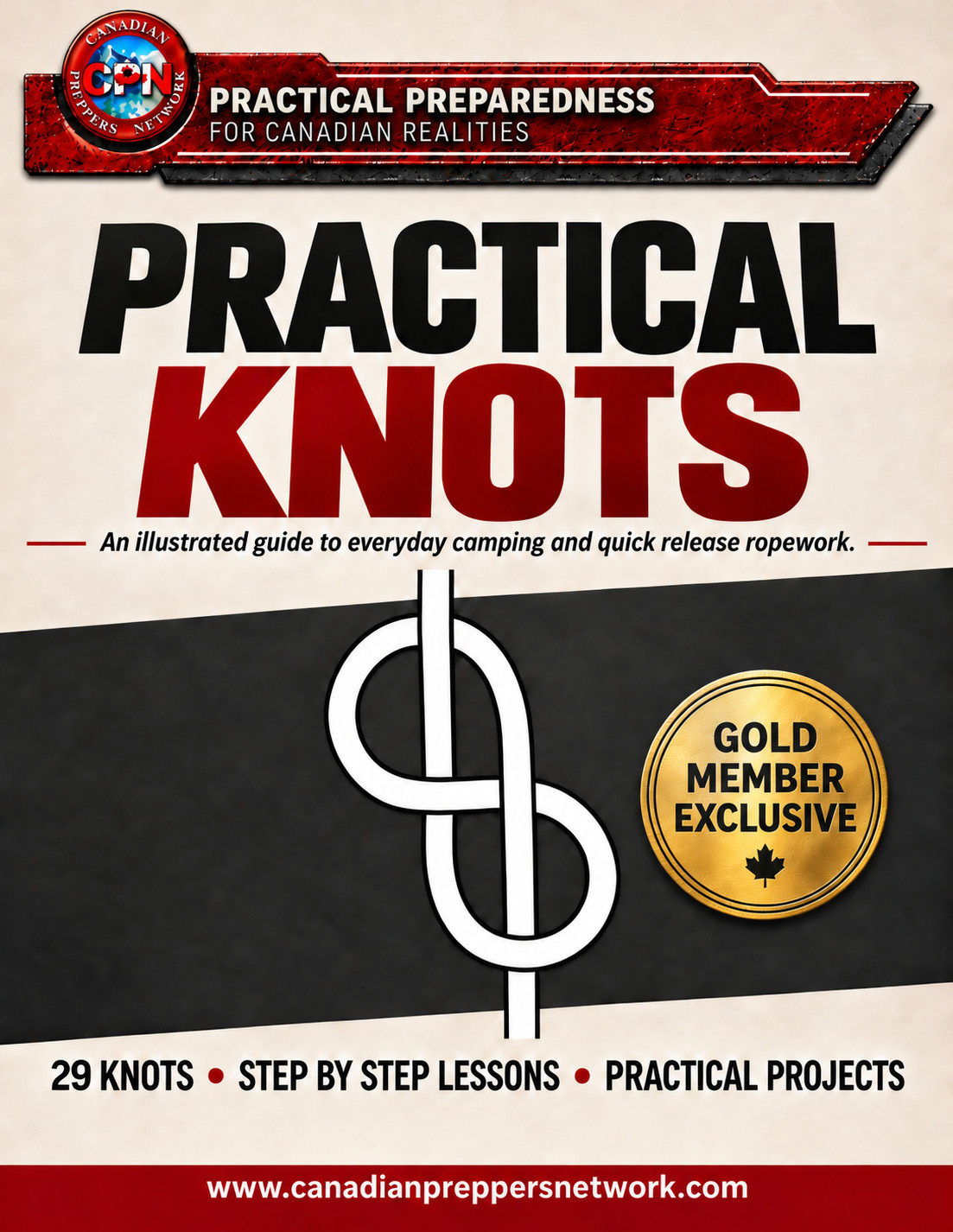
A 137-page illustrated guide to useful ropework, available exclusively to Gold members.
Practical Knots, our new illustrated knot tying ebook, is now available exclusively to Canadian Preppers Network Gold members. It brings 29 useful knots together in a 137-page reference, with tying instructions, illustrations, finished-knot checks and practical projects.
A tarp line keeps slipping. The cord around your bedroll jams so tightly that you reach for a knife. You need to join two ropes, but the knot you remember from childhood does not look quite right. Having rope available is useful. Knowing what to do with it makes that rope part of your preparedness.
The ebook is included with active Gold membership at no additional charge. Sign in and find it in the Gold member Exclusive Preparedness Guides collection.
Practical Knots for Real Preparedness Tasks
A knot that works well for one task may be a poor choice for another. Binding a bundle, joining two ropes, making a fixed loop and tensioning a guyline each call for different methods.
Practical Knots is organised around those jobs. Its lessons cover:
- Stopper knots that add bulk to a rope end.
- Binding knots for bundles and rolled equipment.
- Bends for joining two ropes.
- Fixed loops at a rope end or along its length.
- Attachment hitches for supports, poles, rings and cleats.
- Friction hitches and adjustable guylines.
- Tensioning systems, including the trucker’s hitch.
- Quick release knots and hitches for temporary arrangements.
- Fishing knots for compatible line and tackle.
The opening section explains the working end, standing part, bights, loops and crossings. You can start with a length of practice rope and build your skills from there.
Illustrated Lessons You Can Follow With Rope in Hand
Remembering a knot’s name is one thing. Following the working end through the correct opening is another.
The book pairs tying instructions with illustrations that show the rope’s route. Blue movement arrows and guides help explain the next action, while finished-knot checks draw attention to crossings, turns and tail placement. Each lesson also covers practical uses, common mistakes, untying and an exercise to try.
That inspection step matters. Pulling an incorrectly tied knot tighter does not correct its route. Learning to trace the rope gives you a better way to recognise mistakes before putting the knot to work.
A Dedicated Quick Release Knots Section
Temporary camp arrangements should be straightforward to dismantle when their work is done.
The quick release section includes the slip knot, Siberian hitch, mooring hitch, tumble hitch and slipped buntline hitch. The tensioning section also explains a slipped finish for the trucker’s hitch.
These lessons identify which loose end operates the release and explain what remains afterward. Some releases open the securing knot while leaving rope wrapped around the support. Others allow the rope to be retrieved completely.
The distinction is useful when taking down a camp line—and when deciding where to keep a release tail so it cannot be pulled accidentally.
Put Your Practical Knots to Work
The practical projects section helps you combine individual knots into useful arrangements. Exercises include pitching a low practice tarp, adjusting tent guylines, setting up a removable camp line, binding a bedroll and extending a utility line.
A practice schedule, troubleshooting guidance, rope-care section and printable practice record help you continue learning beyond the first attempt.
For quick reference, the ebook includes a knot-selection guide, a quick release comparison, a finished-knot gallery and a linked index. PDF bookmarks make it easier to jump directly to a lesson.
Download a copy to your phone, tablet or computer so you can consult it without an internet connection. The book focuses on general utility and fishing ropework; climbing, rescue and other life-support applications require appropriate equipment and training.
Get Practical Knots With CPN Gold
Practical Knots is available to active Gold members at no additional charge. The full ebook remains in the Gold members section, and its download requires an active Gold membership.
Gold membership costs $5 per year and supports the research, writing and technical work behind Canadian Preppers Network. Members also receive access to exclusive preparedness resources and the monthly intelligence briefing.
Your Next Preparedness Skill Starts With a Length of Rope
Already a Gold member? Sign in, open the Exclusive Preparedness Guides collection and select Download Practical Knots PDF.
Want access? Join CPN Gold for $5 per year and add this illustrated reference to your preparedness library.
Then pick up a length of rope, choose a lesson and practise until you can tie it, check it and explain how it comes apart.