
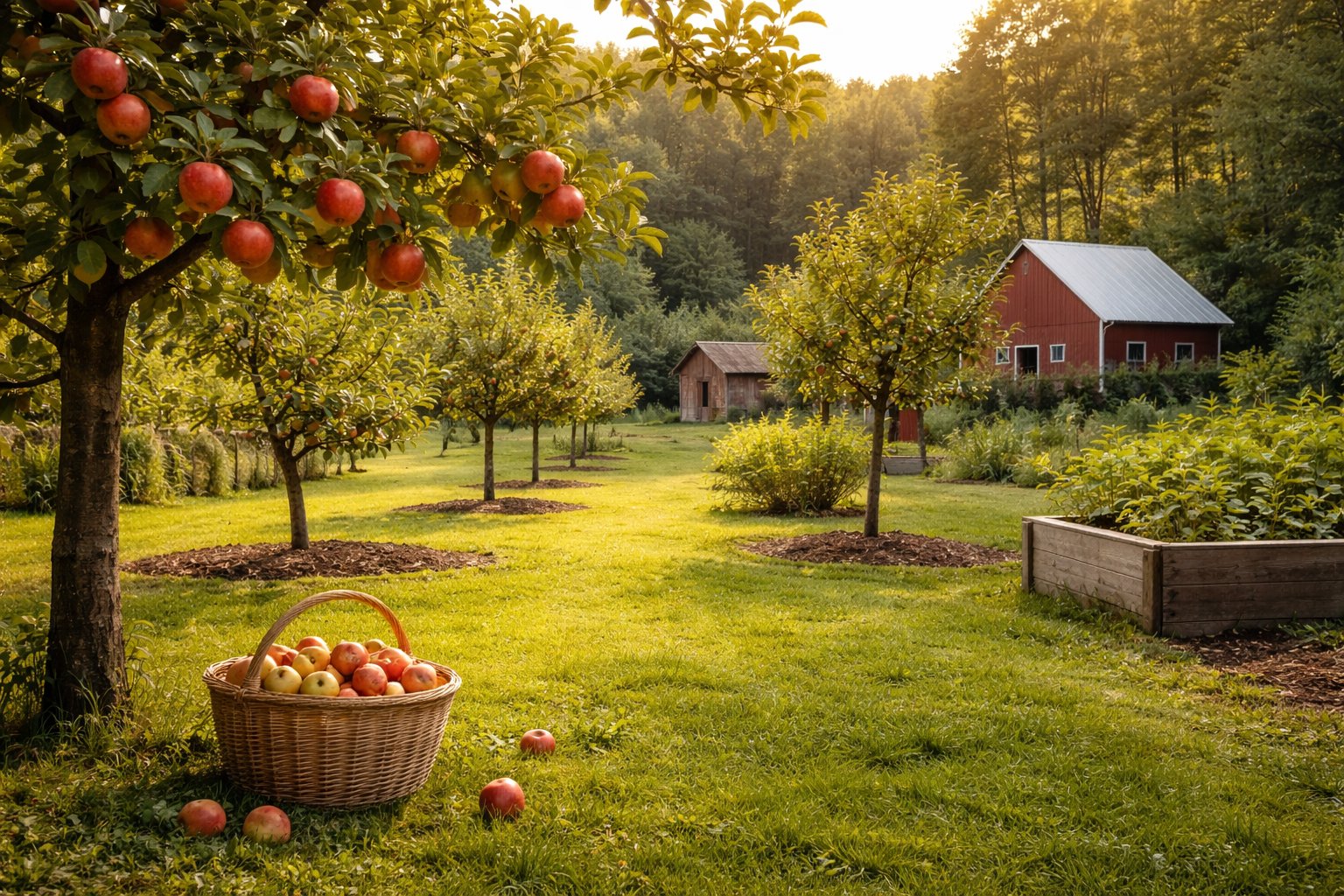
Most preppers focus heavily on gardens, and for good reason. Annual vegetables provide immediate food production and can be scaled quickly. But gardens require constant replanting, seed supply, and labour every season.
Fruit trees operate on a different timeline.
A well-planned orchard can produce food for 40 to 60 years or more, often with relatively little maintenance once established. For those thinking seriously about long-term resilience, planting fruit trees may be one of the most reliable investments you can make.
A mature apple tree alone can produce 150 to 300 pounds of fruit per season, providing food that can be eaten fresh, stored in a root cellar, dried, canned, or turned into cider and vinegar.
For preppers focused on long-term food security, a small orchard quietly becomes one of the most dependable food systems on the property.
Choosing Cold-Hardy Fruit Trees for Canada
Not all fruit trees tolerate Canadian winters. Selecting hardy varieties is critical for long-term success.
Apples
Apples are the backbone of most Canadian orchards because they tolerate cold climates and store well.
Reliable varieties include:
- Honeycrisp
- Liberty
- Cortland
- Haralson
- McIntosh
Apples can be stored fresh for months, dried for long-term storage, or processed into cider, vinegar, and preserves.
During harvest season, tools like an orchard picking bag make collecting fruit much faster and prevent bruising:
Pears
Pears grow well in many Canadian regions, though they take several years to begin producing.
Hardy varieties include:
- Ure
- Golden Spice
- Luscious
Once established, pear trees can produce heavy yields for decades.
Plums
Plums are often overlooked but perform extremely well in colder climates.
Good choices include:
- Mount Royal
- Brookgold
- Pembina
These trees produce fruit ideal for fresh eating, jam, and canning.
Cherries
Sweet cherries struggle in harsh climates, but sour cherries thrive in Canada.
Popular hardy varieties include:
- Evans Cherry
- Romeo Cherry
- Juliet Cherry
These are excellent for baking, preserves, and wine making.
Planning Your Orchard Layout
Fruit trees need adequate sunlight and airflow to remain productive and disease resistant.
General spacing guidelines are:
- Standard trees: 20–30 feet apart
- Semi-dwarf trees: 12–18 feet apart
- Dwarf trees: 8–12 feet apart
Many homesteaders prefer semi-dwarf trees, which produce large harvests while remaining manageable in size.
Planting rows north–south allows sunlight to reach both sides of the trees throughout the day.
Mulching around the base of trees helps retain moisture, suppress weeds, and improve soil health.
Pollination: The Step Many Beginners Miss
Most fruit trees cannot pollinate themselves.
That means planting at least two compatible varieties of the same fruit.
For example:
- Two different apple varieties
- Two different pear varieties
Without cross-pollination, trees may grow well but produce little fruit.
Encouraging pollinators also helps. Clover, wildflowers, and nearby gardens can significantly improve fruit yields.
Protecting Young Trees
Newly planted fruit trees are extremely vulnerable to wildlife.
Common threats include:
- Deer browsing
- Rabbits and mice chewing bark
- Winter sun damage
- Heavy snow accumulation
One of the simplest protections is installing trunk guards to prevent rodents from destroying the bark during winter:
In rural areas, deer fencing may also be necessary until trees mature.
Pruning for Long-Term Productivity
Fruit trees require periodic pruning to maintain healthy growth and maximize fruit production.
Pruning improves:
- Sunlight penetration
- Airflow through the canopy
- Fruit size and quality
Good pruning tools designed for orchard work make the process much easier:
Annual pruning quickly becomes part of the normal rhythm of maintaining a productive orchard.
Processing the Harvest
When fruit trees begin producing, harvests can arrive quickly and in large quantities. Having preservation methods ready prevents waste.
Common methods include:
- Root cellar storage
- Dehydrating apple slices
- Canning apple sauce or pie filling
- Pressing cider
- Making vinegar
A manual fruit press allows homesteaders to turn surplus apples into juice or cider without electricity:
Preserving fruit in multiple forms extends the usefulness of the harvest throughout the year.
The Long-Term View
An orchard is not a short-term prep. It is an investment measured in decades.
Trees planted today may not produce heavily for five or six years, but once mature they will provide food for generations.
Many preparedness supplies eventually run out.
A healthy orchard does the opposite. Every year it produces more food with less effort.
For those serious about long-term resilience, planting fruit trees may be one of the most valuable preparedness steps you can take.
For more preparedness guides, visit the Canadian Preppers Network:
You may also enjoy:
Garden Planning for Food Security
https://canadianpreppersnetwork.com/garden-planning-for-food-security/
Top 5 Medicinal Plants Every Canadian Prepper Should Know
https://canadianpreppersnetwork.com/top-5-medicinal-plants-every-canadian-prepper-should-know/