
Disclosure: This article contains Amazon affiliate links. As an Amazon Associate, Canadian Preppers Network may earn from qualifying purchases.
Homestead skills are where preparedness stops being storage and starts becoming capability.
A pantry buys time. Stored water buys time. Backup power buys time. But skills are what let a household keep working when normal systems become slower, weaker, more expensive, or unavailable. That does not mean every Canadian prepper needs a farm, a barn, livestock, and forty acres. It means the household should be able to produce, preserve, repair, maintain, adapt, and solve ordinary problems without depending on perfect convenience.
For Canadian preppers, homestead skills are not about nostalgia. They are practical household infrastructure. Gardening, seed starting, composting, food preservation, basic carpentry, tool maintenance, root cellaring, water handling, animal care where appropriate, winter chores, and no-power repair skills all reduce dependency. They also expose weak assumptions.
A person who has tried to grow food through a bad spring, preserve a harvest safely, maintain tools without power, or keep systems working in winter understands preparedness differently than someone who has only stacked supplies.
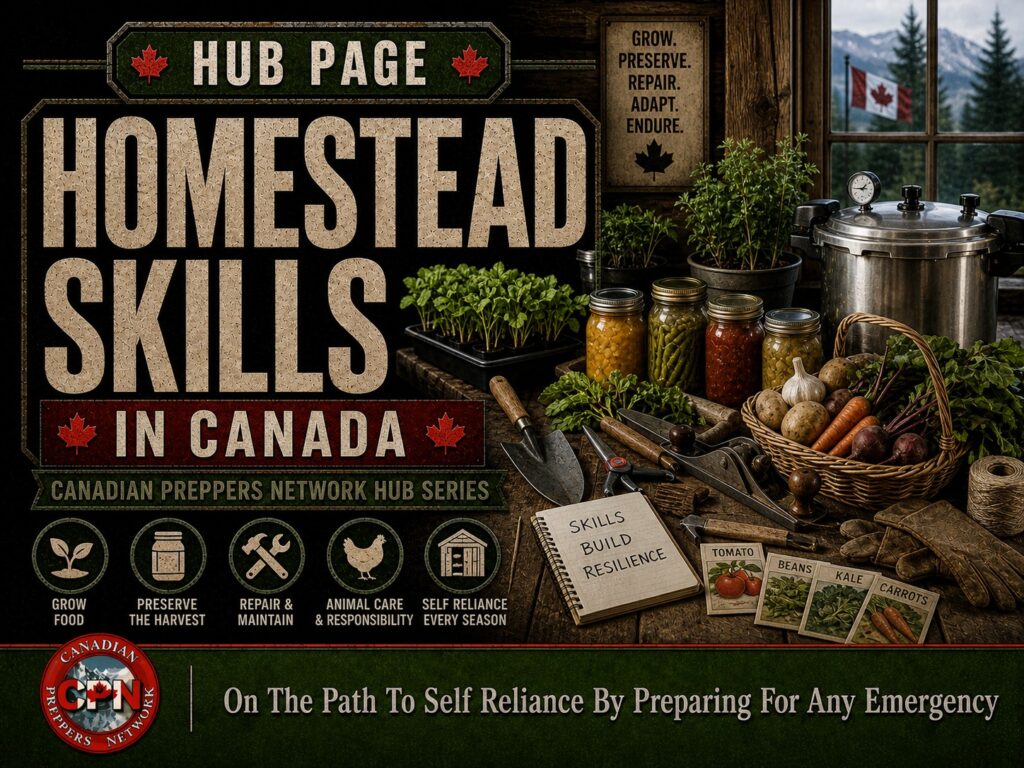
This page is the Canadian Preppers Network hub for homestead skills. It connects the major parts of the subject into one practical Canadian framework: producing food, extending the harvest, maintaining tools, working through winter, using hand-powered systems, managing soil, preserving safely, and building skills that still matter when stores, deliveries, power, and convenience are no longer reliable.
Why Homestead Skills Matter in Canada
Canadian households face a wide range of conditions. A backyard in southern Ontario, a rural property in Quebec, a Prairie acreage, a Maritime garden, a northern community, and a small urban balcony all create different limits. The common thread is that every household can build some level of productive skill.
Homestead skills matter because they create options. A household that can start seeds, grow even part of its own food, preserve seasonal produce, compost organic matter, repair tools, organize storage, and maintain basic systems has more flexibility than a household that only buys and consumes.
They also matter because Canadian seasons are unforgiving. Short growing seasons, late frosts, early frosts, heavy snow, wet springs, drought pockets, pests, heat waves, high winds, and winter access problems all test household systems. CPN’s own homestead archive has repeatedly framed winter as the season that proves whether homestead systems actually work, because cold weather exposes convenience dependency quickly. In winter, skills are either used constantly or missed immediately.
Homestead skills do not replace food storage. They strengthen it. Stored food gives you a buffer. Production and preservation extend that buffer. Repair and maintenance keep the rest of the household from falling apart around it.
Homestead Skills Begin With Production, Not Fantasy
The first mistake many people make is imagining the full homestead before building one useful skill.
They picture gardens, greenhouses, orchards, chickens, root cellars, outdoor kitchens, tool sheds, rain barrels, compost piles, woodpiles, cold rooms, and off-grid workshops all working together. Those things may have value, but they are not the starting point. The starting point is one repeatable skill that produces a result.
Can you start seeds indoors and keep them alive until transplanting? Can you grow a crop your household actually eats? Can you preserve that crop safely? Can you sharpen and maintain hand tools? Can you compost without attracting pests or creating a mess? Can you repair a loose hinge, broken handle, damaged shelf, or simple water line? Can you work without relying on plug-in tools for every task?
Homestead capability grows through repetition. A small garden that improves every year is better than a huge garden abandoned after one exhausting season. A few jars preserved safely are better than a pantry full of questionable experiments. A tidy tool bench used often is better than expensive tools nobody knows how to maintain.
For a practical first skill, CPN’s Mastering One Homestead Skill Before Spring: Starting Seeds Indoors is a strong place to begin.
The Three Layers of a Prepared Homestead Skills System
A serious homestead skills plan should be built in layers. Each layer solves a different problem.
The first layer is household production. This includes seed starting, container gardening, raised beds, small gardens, herbs, sprouts, perennial food plants, small orchards where possible, rainwater for utility use, and soil improvement. This layer produces food, learning, and confidence.
The second layer is preservation and storage. This includes canning, dehydrating, freezing where appropriate, fermenting, root cellaring, dry storage, seed saving where practical, and rotation. This layer turns seasonal surplus into stored resilience.
The third layer is maintenance and continuity. This includes hand tools, no-power repair skills, sharpening, basic carpentry, sewing, mending, small-engine awareness where relevant, winter access, animal care where legal and appropriate, and the ability to keep systems working when convenience disappears.
Most households should build those layers in order. Production without preservation wastes opportunity. Preservation without safe methods creates risk. Tools without maintenance become clutter. A productive homestead skill system is not one impressive project. It is a set of ordinary skills that work together.
The First 30 Days
A practical starting target is thirty days of homestead skill improvement.
That does not mean transforming the property in one month. It means choosing one useful capability and moving it from idea to practice.
The first week should focus on assessment. Look at your actual household, not the fantasy version. How much space do you have? How much sunlight? What tools already exist? What foods does the family actually eat? What preservation equipment is already available? What repairs are always being delayed? What tasks depend entirely on electricity, deliveries, or outside help?
The second week should focus on one production skill. Start seeds indoors, set up a container garden, prepare a small bed, plan a cold-hardy herb section, improve compost handling, or choose one crop to grow seriously. Keep the scale small enough that it can be maintained.
The third week should focus on one preservation or storage skill. Learn safe canning principles, organize jars and lids, set up a dehydrator, prepare a cool storage area, improve dry storage, or build a rotation system. Do not try to preserve everything at once. Choose one food and one method.
The fourth week should focus on maintenance. Sharpen hand tools. build a simple work surface, organize fasteners, repair something small, label storage areas, clean garden tools, inspect hoses and watering equipment, or set up a no-power repair corner.
A month of actual practice is worth more than a year of watching videos.
Seed Starting and Garden Planning
Seed starting is one of the most accessible homestead skills because it does not require land ownership. A windowsill, grow light, shelf, or small indoor setup can begin the food-production cycle while snow is still on the ground.
In Canada, timing matters. Starting too early can create weak, leggy plants that outgrow the indoor setup before the weather is ready. Starting too late can waste the short growing season. The skill is not simply putting seeds into trays. It is learning light, temperature, timing, transplanting, hardening off, watering, and restraint.
CPN’s seed-starting article makes this point clearly: the value of seed starting is not just the plants. It is independence from retail timing and availability. When garden centres are short on selection or prices rise, the household that can start its own seedlings has more control.
Useful seed-starting gear:
- Seed starting trays are useful for organizing starts before the outdoor season begins.
- Seedling heat mats can help with germination for crops that benefit from warmer soil conditions.
- LED grow lights help prevent weak seedlings when natural light is not enough.
- Plant labels prevent confusion once multiple varieties are started.
Food Gardens Should Be Designed for Use
A food garden is not automatically a preparedness garden.
A recreational garden may produce food when the season is kind. A preparedness garden has to be designed around calories, storage, reliability, water, labour, pests, soil, preservation, and household use. That does not mean every plant has to be survival food. It means the garden should be honest about its purpose.
For many households, the best preparedness crops are the ones they already eat and can store or preserve. Potatoes, beans, squash, onions, garlic, carrots, beets, tomatoes, herbs, greens, peas, and hardy fruit may all have a place depending on region and skill. But the crop list matters less than the system. A garden that nobody waters, weeds, protects, harvests, or preserves is only a seasonal hope.
Urban households can still build production skills through containers, balcony gardens, sprouts, herbs, community gardens, indoor starts, and small preservation projects. Rural households may have more room, but more space can also mean more weeds, more fencing, more watering, more labour, and more ways to overbuild.
Food production should start at a scale the household can maintain even in a stressful year.
For a harder look at this subject, read CPN’s You Don’t Own Food Security Until You Can Produce It.
Useful garden gear:
- Stainless steel garden tool sets are useful for basic planting, transplanting, weeding, and small-bed maintenance.
- Garden kneeling pads make repeated garden work easier on knees and backs.
- Soil thermometers help match planting to actual soil conditions instead of calendar guesses.
- Drip irrigation kits can reduce watering labour and improve consistency where appropriate.
Soil, Compost, and Garden Safety
Soil is the foundation of homestead food production.
Poor soil turns gardening into frustration. Good soil improves water retention, plant health, crop performance, and resilience during dry or wet periods. Compost, mulch, organic matter, cover crops where appropriate, and careful bed management all help build the system over time.
Composting is also a way to turn household waste into a productive resource. Statistics Canada reported that just over three-quarters of Canadian households composted either kitchen or yard waste in 2019, up from 61 percent in 2009. That does not mean every compost system is well managed, but it does show that composting is already a familiar practice for many Canadian households.
Garden safety matters as well. Ottawa Public Health advises people not to garden or grow food close to busy roads, to use clean soil, and not to repot soil from land that is known to be contaminated or of unknown quality. This is especially relevant for urban gardens, older properties, industrial areas, and unknown fill soils.
Useful soil and compost gear:
- Backyard compost bins help contain composting and keep the system more organized.
- Garden soil test kits can provide a basic starting point for understanding soil conditions.
- Compost thermometers help monitor larger compost piles.
- Mulch mats and landscape fabric staples can help manage beds and reduce labour where appropriate.
Food Preservation Turns Harvest Into Security
Growing food is only half the skill. Preserving it is what turns a good season into stored resilience.
Canning, dehydrating, fermenting, freezing, drying herbs, root cellaring, and cold storage all have a place, but each method has limits. Some methods require electricity. Some require safe recipes. Some require specific storage conditions. Some are better for flavour than long-term resilience. Some are easy to learn, while others demand caution and proper equipment.
Home canning deserves special care. Health Canada warns that improperly prepared or bottled home-canned foods can cause botulism. Québec’s home canning guidance explains that low-acid foods such as many vegetables, meats, and some sauces require pressure sterilization, and that only a pressure canner can reach the required conditions for those foods.
The practical rule is simple: preserve food safely or do not preserve it that way. Guesswork has no place in canning. Use current, tested recipes and proper equipment, especially with low-acid foods.
For a CPN-specific companion article, read Mastering Pressure Canning: The One Homestead Skill That Turns Food Into Security.
Useful preservation gear:
- Pressure canners are essential for households that want to learn safe preservation of low-acid foods using proper tested methods.
- Canning jars and lids are basic supplies for seasonal food preservation.
- Food dehydrators can preserve fruits, vegetables, herbs, and lightweight meal ingredients.
- Jar lifters and canning tool sets make canning work safer and more organized.
Root Cellaring and Low-Energy Storage
Root cellaring is one of the most practical homestead skills because it reduces dependence on freezers, batteries, and powered refrigeration.
A root cellar does not have to be a romantic underground room with stone walls and wooden bins. It can be a basement corner, insulated cold room, buried container, crawlspace adaptation, unheated entry, or other cool storage arrangement if conditions are suitable. The principle is controlled coolness, humidity, ventilation, separation of incompatible foods, and regular inspection.
In Canada, root cellaring has obvious value because many storage crops fit cold-weather eating: potatoes, carrots, beets, turnips, cabbage, squash, onions, garlic, apples, and similar foods depending on conditions. The challenge is not only keeping food cold. It is preventing freezing, rot, mould, rodents, excessive dryness, and mixing crops that should not be stored together.
For more practical approaches, read CPN’s 3 Ways to Build a Root Cellar and Small Orchard Planning for Long-Term Food Security.
Useful storage gear:
- Produce storage crates help keep stored crops organized and inspectable.
- Hygrometers and thermometers help monitor cool storage areas.
- Food storage bins with lids can help protect some stored foods from dust and pests.
- Mesh produce bags support airflow for certain crops and short-term storage.
Small Livestock Requires Responsibility
Small livestock can be valuable, but it should never be treated as an easy shortcut.
Chickens, rabbits, ducks, goats, bees, and other small-scale animals all require legal permission, housing, feed, water, health management, predator protection, winter care, waste handling, neighbour consideration, and daily attention. Animals are not stored food. They are living systems.
For poultry, disease prevention is a major responsibility. The Canadian Food Inspection Agency urges small flock owners to use biosecurity measures such as preventing contact with wild birds and other animals, cleaning coops, waterers, feeders, clothing, and boots, limiting visitors, keeping new birds separate when entering the flock, and reporting signs of illness early.
That matters for preparedness because a flock that depends entirely on purchased feed, fragile housing, poor sanitation, or constant outside inputs may become a liability during disruption. Animal systems should be built slowly, legally, and responsibly.
This hub does not treat livestock as a beginner requirement. For many households, gardening, preservation, compost, hand tools, and storage skills should come first.
Hand Tools and No-Power Repair Skills
Homestead resilience depends heavily on repair.
When power tools are unavailable, batteries are dead, fuel is scarce, or a storm makes a trip to town difficult, hand tools matter. A no-power workshop is not a hobby space. It is the household’s ability to fix, modify, maintain, and adapt.
CPN’s How to Set Up a No-Power Workshop makes this point directly: when the power is out for more than a few days, the problem is not only what you own, but whether you can fix, modify, and build with your hands.
The first step is not buying every hand tool imaginable. It is building a simple, usable repair area: a sturdy work surface, a way to hold material, basic measuring tools, screwdrivers, hand saws, files, clamps, a brace or hand drill, wrenches, pliers, sharpening tools, spare fasteners, repair materials, and good lighting.
Useful no-power workshop gear:
- Bench vises turn a workbench into a usable repair station.
- Hand saws allow basic cutting without power tools.
- Manual hand drills support small drilling tasks without electricity.
- Tool sharpening stones help keep cutting and garden tools useful.
Sewing, Mending, and Household Repair
Homestead skills are not only outdoor skills.
Clothing repair, patching, sewing buttons, fixing seams, mending work gloves, repairing packs, maintaining tarps, replacing snaps, and basic textile repair can extend the life of supplies. During normal times, many people replace instead of repair. During disruptions, replacement may be expensive, delayed, or unavailable.
A household sewing kit is not glamorous, but it is one of the simplest resilience tools available. It supports clothing, bedding, gear bags, curtains, workwear, and emergency repairs. The skill is small, quiet, and useful.
Useful repair gear:
- Heavy-duty sewing kits support repairs on clothing, bags, canvas, and household fabric.
- Waxed thread is useful for stronger hand-sewn repairs.
- Assorted sewing needles help match the tool to the fabric.
- Canvas repair patches can support tarp, pack, and workwear repairs.
Water Handling on the Homestead
Homestead skills connect directly to the water hub.
Gardens need water. Animals need water. Cleaning, preservation, compost, tools, and household systems all use water. A homestead that produces food but has no water plan is fragile.
Rain barrels, gravity-fed watering, drip irrigation, mulch, water storage, hand pumps where appropriate, and water conservation habits can all reduce dependence on municipal supply or powered pumps. But collected water must be used according to its quality. Rain barrel water may be useful for gardens and cleaning, but it should not be treated as automatically safe for drinking.
The homestead mindset is simple: use the cleanest water for the highest-value use, and do not waste potable water where utility water will do.
Winter Homestead Skills
Winter is the real Canadian test.
A system that works in September may fail in February. Hoses freeze. Lids crack. paths disappear under snow. Tools become brittle. batteries weaken. Fuel handling becomes harder. Compost slows. Stored food is harder to access. Outdoor chores take longer. Animals need unfrozen water. Greenhouses and cold frames require management. Hand tools matter more when powered systems struggle.
The CPN article Homestead Skills Are What Carry You Through Winter is the right companion piece for this topic because it frames winter as a recurring stress test rather than an abstract scenario.
Winter homestead readiness should focus on access, storage, repairs, water, fuel, lighting, hand tools, and routine. If a critical task cannot be done in snow, darkness, or cold, it needs a better plan before winter arrives.
Common Homestead Skill Failures
Most homestead failures are ordinary.
The garden is too big. The soil was never improved. Seeds were started too early. Tools are dull. The compost attracts pests. The canning method is unsafe. The root cellar freezes. Stored produce is never inspected. The rain barrel is frozen solid when needed. Livestock are added before the household understands the daily responsibility. The workshop is full of tools but has no bench, no organization, and no routine. Everyone talks about self-reliance, but nobody practises the skills.
The solution is not to build everything at once.
Start small. Repeat the skill. Make the system easier to maintain. Keep records. Fix one failure each season. Build around real household food, real climate, real space, and real time.
Homestead skills are not a performance. They are maintenance.
Practical Gear Mentioned In This Guide
If your homestead plan is still mostly ideas, start with gear that supports repeatable skills rather than expensive systems.
- Seed starting trays help begin food production before outdoor planting season.
- LED grow lights support stronger seedlings where natural light is limited.
- Stainless steel garden tool sets are useful for small-bed and container gardening.
- Backyard compost bins help keep composting organized.
- Pressure canners support safe preservation of low-acid foods when used with current tested methods.
- Canning jars and lids are basic supplies for seasonal preservation.
- Food dehydrators help preserve fruits, vegetables, herbs, and lightweight meal ingredients.
- Hygrometers and thermometers help monitor storage areas, cold rooms, and root cellar conditions.
- Bench vises support a functional no-power repair station.
- Heavy-duty sewing kits help repair clothing, packs, tarps, and household fabric.
Recommended CPN Reading
To keep building your homestead skills system, continue with these CPN articles:
- Homestead Skills Are What Carry You Through Winter
- Mastering One Homestead Skill Before Spring: Starting Seeds Indoors
- You Don’t Own Food Security Until You Can Produce It
- Mastering Pressure Canning: The One Homestead Skill That Turns Food Into Security
- Small Orchard Planning for Long-Term Food Security
- 3 Ways to Build a Root Cellar
- How to Set Up a No-Power Workshop
Canadian Sources Used
- Health Canada: Home canning safety
- Québec: Home canning preparation and prevention
- Canadian Food Inspection Agency: Biosecurity basics for small flock owners
- Canadian Food Inspection Agency: Protect your flock from bird flu
- Ottawa Public Health: Gardening and growing food safety
- Statistics Canada: Household composting in Canada
- Canadian Preppers Network homestead skills archive
Final Thought
Homestead skills are not about pretending the modern world does not exist.
They are about becoming more useful when modern systems become less reliable.
A prepared household can grow something, preserve something, repair something, maintain something, and adapt when convenience disappears. It does not need to be perfect. It does not need to be rural. It does not need to become a full-scale farm.
It needs practical skills that get used.
One tray of seedlings.
One safe canning project.
One repaired tool.
One organized workbench.
One improved garden bed.
One storage area that actually works.
That is how homestead resilience begins in Canada: not with fantasy, but with capability built one ordinary skill at a time.