
Disclosure: This article contains Amazon affiliate links. As an Amazon Associate, Canadian Preppers Network may earn from qualifying purchases.
Preparedness is usually discussed in physical terms.
Food. Water. Heat. Power. Security. Communications. First aid. Tools. Gear. Supplies.
Those things matter. But they are not the whole system. A household can have stocked shelves, full water containers, radios, batteries, first aid supplies, and backup heat, then still fall apart because nobody can think clearly, communicate calmly, make decisions, sleep, manage fear, handle boredom, support each other, or work with neighbours.
Mental resilience is not a motivational slogan. It is a practical preparedness skill.
Community building is not a soft extra. It is one of the oldest survival systems humans have.
For Canadian preppers, mental resilience and community building belong together because emergencies are rarely solved by gear alone. A winter outage, wildfire evacuation, flood, extended supply disruption, medical delay, or communications failure affects people before it affects inventory. Stress changes judgement. Isolation magnifies fear. Unclear roles create conflict. Boredom lowers morale. Fatigue leads to mistakes. Poor communication turns small problems into household fights.
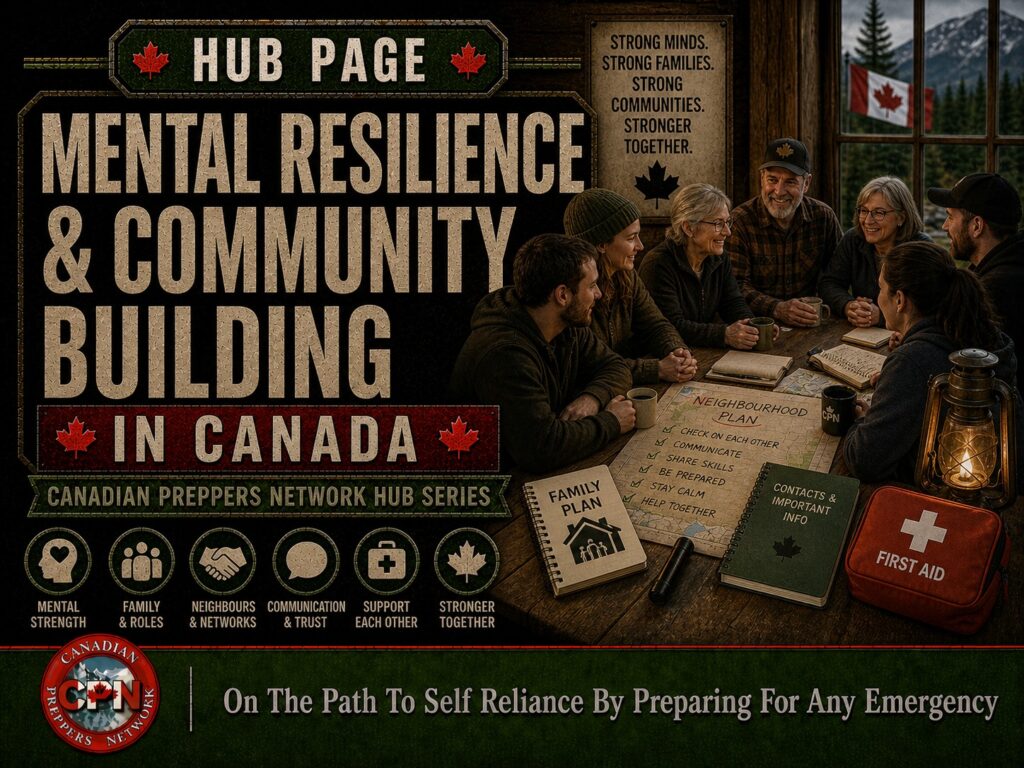
This page is the Canadian Preppers Network hub for mental resilience and community building. It connects the human side of preparedness into one practical Canadian framework: stress management, household roles, emergency routines, Psychological First Aid, neighbour networks, community events, morale, mutual support, privacy, leadership, and the common failures that break preparedness plans from the inside.
Why Mental Resilience and Community Matter in Canada
Canada’s emergency risks are diverse. Wildfires, floods, winter storms, freezing rain, power outages, evacuations, supply interruptions, extreme heat, and local infrastructure failures do not only create physical problems. They create psychological and social strain.
The Government of Canada’s emergency planning guidance encourages households to make a plan before emergencies occur, including information about household members, emergency contacts, health information, safe locations, and responsibilities. The point is not paperwork for its own sake. Planning reduces confusion when stress is high.
The Canadian Red Cross also treats Psychological First Aid as a practical emergency skill. Its program teaches people how to anticipate stress, recognize distress, respond early, and support confidence, connection, and coping during difficult moments.
That matters because preparedness is not only about what a household owns. It is also about how people behave when conditions are uncertain.
A family that has already discussed roles, routes, contacts, stress responses, vulnerable members, pets, neighbours, and fallback plans will usually function better than a family trying to invent those answers during a crisis.
Mental Resilience Begins Before the Emergency
The first layer of mental resilience is not toughness.
It is preparation.
People often imagine mental resilience as the ability to endure anything silently. That is not the best model. Real resilience is the ability to stay functional, flexible, honest, and useful under pressure. It is the ability to notice stress early, reduce avoidable confusion, accept changing conditions, communicate clearly, and make the next good decision.
That begins before the emergency.
A household that has never talked through a power outage, evacuation, water advisory, medical delay, or winter road closure will experience those events differently than one that has rehearsed the basics. The difference is not courage. It is familiarity.
Preparedness reduces stress by removing unknowns. Where are the flashlights? Who checks the sump pump? Who contacts relatives? Who picks up children? Where is the medical binder? What room becomes the warm room? What happens if the internet is down? What neighbour should be checked on? What supplies are not to be used casually?
Those decisions become much harder when everyone is cold, tired, hungry, worried, or receiving bad information.
Mental resilience begins with making fewer decisions under pressure.
The Three Layers of a Prepared Resilience and Community System
A serious resilience and community plan should be built in layers. Each layer solves a different problem.
The first layer is personal and household resilience. This includes sleep, routines, role clarity, calm communication, stress awareness, household meetings, realistic expectations, children’s needs, elder care, pet planning, and decision-making habits. This layer keeps the family from becoming its own emergency.
The second layer is local connection. This includes neighbours, family contacts, community groups, faith groups, volunteer organizations, local clubs, radio nets, preparedness events, skills exchanges, and trusted local relationships. This layer prevents isolation.
The third layer is organized community capability. This includes neighbourhood emergency planning, mutual aid agreements, local training, resource mapping, community events, communication trees, shared skills, and practical ways to check on vulnerable people without exposing private household supplies. This layer creates resilience beyond one property.
Most households should build those layers in order. A person who cannot communicate calmly at home should not expect to organize a neighbourhood under stress. A family that has no written plan should not assume a community group will solve its internal confusion.
The First 30 Days
A practical starting target is thirty days of resilience and community improvement.
That does not mean turning your street into an emergency response organization in one month. It means making the human side of preparedness less fragile.
The first week should focus on the household. Hold one short preparedness conversation. Do not turn it into a lecture. Ask what worries people most, what would confuse them during an outage, where supplies are located, who depends on whom, and what decisions need to be made before trouble starts. Write down the answers.
The second week should focus on routines. Create a simple emergency checklist. Decide who checks lights, water, pets, heat, phones, medications, elderly relatives, and local alerts. Establish a basic household communication plan. Make sure important numbers are printed, not trapped in phones.
The third week should focus on stress control. Identify what normally makes the household irritable or disorganized: hunger, cold, noise, lack of sleep, boredom, too much social media, unclear roles, or fear-driven arguments. Then build small controls around those weak points. Food, warmth, quiet, information discipline, games, tea, coffee, tasks, and sleep can all be preparedness tools.
The fourth week should focus outward. Learn the names of nearby neighbours. Identify who may need help during storms or outages. Find out what local groups, community events, first aid courses, amateur radio clubs, emergency preparedness programs, or volunteer opportunities exist nearby. The goal is not to tell everyone your business. The goal is to stop being completely isolated.
A month of human preparation can make every other preparedness category work better.
Household Roles Reduce Conflict
Stress creates conflict when nobody knows who is responsible for what.
During an emergency, people may talk over each other, repeat tasks, forget tasks, or wait for someone else to act. One person may try to control everything while another shuts down. Children may ask the same questions repeatedly. Elderly relatives may resist leaving. Pets may complicate movement. Small problems become arguments because there is no structure.
A simple role system helps.
One person monitors official information. One checks heat, power, and water. One manages food and meals. One handles medications and medical needs. One checks on pets. One communicates with relatives or neighbours. Roles can shift depending on who is home, but the idea should be discussed before the emergency.
This is not about rigid command. It is about reducing confusion.
The Canadian Red Cross says a household emergency plan helps everyone know what to do, where to go, and how to stay in contact when an emergency occurs.
That is the point of roles: fewer assumptions, fewer arguments, and fewer missed tasks.
Useful household planning gear:
- Emergency planning binders help keep household plans, contacts, copies, and checklists in one place.
- Dry erase boards can help track tasks, updates, battery charging, water use, and household roles during an outage.
- Clipboards are useful for printed checklists, inventory sheets, and neighbourhood contact lists.
- Waterproof notebooks help preserve notes, messages, and records during storms, floods, and field conditions.
Psychological First Aid Belongs in Preparedness
First aid is not only physical.
Emergencies create stress, fear, loss, grief, fatigue, uncertainty, and emotional overload. That does not mean everyone needs therapy during a blackout. It means prepared people should understand that stress is real and that early support can help people stay functional.
The Canadian Red Cross Psychological First Aid program teaches practical skills that can be used at home, at work, and in the community. Its training focuses on helping people anticipate stress, recognize distress, respond early, and support confidence, connection, and coping.
The Red Cross also describes PFA as a way to prepare for and respond to the mental health impacts of emergencies by recognizing stress in ourselves and others, taking practical steps to reduce distress, and supporting recovery through information, support, and connection to services.
For preppers, this matters because the emotional side of an emergency affects behaviour. Someone who is panicked may make poor decisions. Someone who is ashamed may hide a problem. Someone who is overwhelmed may become passive. Someone who feels useless may create conflict. Someone who is supported early may recover enough to help.
Psychological First Aid is not about diagnosing people. It is about practical support.
Listen. Reassure. Connect. Reduce confusion. Encourage simple next steps. Keep people informed. Protect dignity. Know when professional help is needed.
Information Discipline Protects Morale
Bad information damages resilience.
During emergencies, people refresh feeds, repeat rumours, argue over predictions, misread old posts, share dramatic claims, and confuse speculation with facts. This can make the household more anxious without making it better informed.
Information discipline is a preparedness skill.
Choose trusted sources before the emergency. Use official alerts, municipal updates, provincial emergency information, local radio, weather tools, and direct communication with known contacts. Assign one person to monitor updates instead of having everyone doom-scroll. Record key information with time and source. Do not treat every social media post as intelligence.
The communications hub already covers tools like Alert Ready, WeatherCAN, AM/FM radio, and low-tech backups. The mental resilience point is different: too much unfiltered information can become a stress amplifier.
A calm household does not ignore reality. It controls how reality is received.
Useful information-control gear:
- Battery-powered AM/FM radios help receive local information without everyone relying on phones.
- USB power banks help keep phones available for communication instead of wasting battery on constant scrolling.
- Printed wall calendars help track rotation, check-ins, appointments, training, and household readiness tasks.
- Index cards are useful for quick contact cards, task cards, and message drops.
Routine Keeps People Functional
Routine is underrated.
During a disruption, people need more than supplies. They need rhythm. Meals, chores, check-ins, sleep, hygiene, information updates, quiet time, and simple tasks can keep people from drifting into anxiety or conflict.
This is especially true for children, seniors, and people who rely on predictable care. A child may cope better if there is a simple explanation, a warm room, a familiar meal, a game, and a known bedtime routine. An elderly relative may cope better if medications, meals, movement, and communication remain structured. Adults cope better when they know what happens next.
A prepared routine does not need to be complicated.
Morning check: heat, water, power, pets, medications, weather, neighbours.
Midday check: food, batteries, messages, sanitation, repairs, fuel, information.
Evening check: doors, lights, warmth, tomorrow’s plan, sleep setup, charging, quiet.
The purpose is not to pretend everything is normal. The purpose is to keep the household from becoming chaotic.
Morale Is a Practical Supply
Morale is not entertainment.
Morale affects whether people keep working, keep cooperating, keep making good decisions, and keep caring about the plan. During a short outage, morale may mean hot drinks, board games, lantern light, and a warm room. During a longer disruption, it may mean useful work, shared meals, music, reading, faith practices, humour, routines, privacy, small comforts, and a sense that people still have a role.
Preparedness culture sometimes treats comfort as weakness. That is a mistake. Comfort used wisely can preserve mental energy.
A deck of cards, notebooks, books, tea, coffee, puzzles, simple games, printed recipes, storybooks for children, and small seasonal rituals can all help. The goal is not luxury. The goal is stability.
Useful morale gear:
- Playing cards are small, cheap, and useful during outages or shelter-in-place periods.
- Board games for families can help keep children and adults occupied without screens.
- Puzzle books provide quiet, no-power activity.
- LED lanterns help create safe shared space without relying on candles or phone flashlights.
Community Starts Before Crisis
Community cannot be improvised instantly.
You do not need to tell everyone what you store, where your supplies are, or how prepared your household is. In fact, discretion still matters. But there is a difference between privacy and isolation.
A prepared household should know nearby people well enough to understand who may need help, who has useful skills, who may be vulnerable, who can check on a property, who has medical training, who has tools, who knows local roads, who owns a generator, who has a radio licence, who watches weather closely, and who can be trusted with basic coordination.
The Regional District of Nanaimo’s Neighbourhood Emergency Preparedness Program puts the point simply: meeting your neighbour can help you cope in a disaster, and neighbourhood programs help communities build self-resilience together.
This does not require a formal organization at first. It can start with names, phone numbers, a shared snowstorm check-in, a conversation at a community event, a local skills day, a radio club meeting, a church group, a gardening group, or something like Preppers Meet where people already gather around practical preparedness skills.
Community begins with contact.
Mutual Aid Without Losing Privacy
Many preppers struggle with community because they fear becoming the neighbourhood supply depot.
That concern is understandable. Good community building does not require advertising your pantry, fuel, medical supplies, security setup, or retreat plans. It requires useful relationships and clear boundaries.
Mutual aid can be skill-based rather than supply-based. One person knows first aid. Another has a chainsaw and experience clearing storm debris. Another can preserve food. Another checks on elderly neighbours. Another has radio skills. Another has childcare experience. Another knows local roads. Another can repair tools. Another has a truck. Another can organize information.
A community network does not need to know what is in your basement. It needs to know who can do what.
The safest community-building model is based on skills, communication, training, and trust developed slowly over time.
Leadership Is Service, Not Control
In emergencies, informal leadership often appears before formal help arrives.
That does not mean bossing people around. It means staying calm, sharing accurate information, organizing simple tasks, listening, reducing confusion, and helping people focus on the next practical step.
Good emergency leadership is usually quiet. It avoids panic. It avoids drama. It does not turn every disagreement into a power struggle. It does not make promises it cannot keep. It respects people’s dignity. It knows when to step back and when to act.
For CPN readers, this matters because preparedness often puts you in a position to be useful. If you have light, water, information, first aid, tools, or local knowledge, others may look to you. The question is whether you can help without creating dependency, resentment, or unnecessary exposure.
Leadership is not about being the loudest person in the room.
It is about making the room more functional.
Community Events Build Real Capability
Preparedness events matter because they turn ideas into contact, training, and practice.
Online discussion has value, but people build trust faster when they work together. A community event can teach skills, introduce local contacts, reveal gaps, and show who is serious. Workshops, field days, first aid courses, amateur radio nets, gardening exchanges, canning demonstrations, navigation practice, emergency planning nights, and events like Preppers Meet all help turn preparedness from private theory into shared capability.
The key is to make events practical.
A lecture is useful if it leads to action. A workshop is better if people leave with a skill. A gathering is stronger if people exchange contacts. A demonstration is better if people understand how to apply it at home.
Community resilience grows through repeated, useful contact.
Children and Family Stress
Children do not experience emergencies the same way adults do.
They may not understand the risk, but they can feel the stress in the room. They notice tone, arguments, darkness, cold, disrupted routines, and uncertainty. A prepared household should include children in age-appropriate ways without overwhelming them.
That may mean simple explanations, small jobs, familiar comfort items, games, routines, and reassurance. Children can carry a flashlight, help check pet water, sort batteries, mark a calendar, pack a small comfort bag, or practise a family contact plan. The goal is to make preparedness normal, not frightening.
Family resilience improves when children know that adults have a plan.
Supporting Vulnerable People
Every community has people who may need extra help.
Seniors, people with disabilities, people with medical equipment, people who live alone, new Canadians, people without vehicles, people with limited English or French, single parents, people with pets, and people with chronic health needs may all be affected differently during emergencies.
Public Safety Canada’s Emergency Management Strategy notes that disaster impacts are not uniform across society and that variables such as age, disability, gender, and socioeconomic conditions can intersect and affect vulnerability.
For preparedness, this means community planning should not assume everyone has the same capacity. A neighbour who seems fine in normal times may struggle if elevators stop, roads freeze, prescriptions run low, or evacuation becomes necessary.
A strong community knows who may need a check-in before the crisis exposes it.
Conflict Management During Stress
Emergencies make people harder to deal with.
Some people become controlling. Some become passive. Some become irritable. Some deny the problem. Some spread rumours. Some make jokes at the wrong time. Some become demanding. Some take risks because they cannot tolerate waiting.
This is normal enough that a prepared household should expect it.
The best conflict management is prevention: clear roles, routines, food, rest, warmth, privacy, and honest communication. When conflict happens anyway, slow the pace. Lower voices. Focus on one decision at a time. Separate facts from fears. Give people useful tasks. Avoid humiliating anyone in front of others. Do not argue endlessly over things that cannot be solved immediately.
Mental resilience is partly the ability to stay practical when emotions are high.
Faith, Culture, and Meaning
Many households draw strength from faith, culture, family tradition, community identity, or service.
This belongs in preparedness. People endure more when hardship has meaning, when routines connect them to something familiar, and when they feel part of something larger than fear. For some, that may mean prayer, scripture, hymns, or church community. For others, it may mean family meals, seasonal traditions, language, music, local service, or a shared commitment to neighbours.
Preparedness should leave room for meaning.
Supplies keep the household alive. Meaning helps people keep going.
Common Resilience and Community Failures
Most failures are ordinary.
The household has gear but no roles. Everyone assumes someone else knows the plan. Children are frightened because nobody explains what is happening. Adults doom-scroll until they are anxious and useless. Neighbours are strangers. The family has no printed contacts. The person with all the knowledge is away. The group has no meeting place. A community event creates interest but no follow-up. Someone tries to lead by controlling instead of serving. Privacy concerns turn into total isolation.
Comfort is dismissed until morale collapses.
The solution is not complicated.
Make the plan. Print the contacts. Talk to the household. Learn the neighbours. Take Psychological First Aid. Build routines. Create small morale supplies. Practise calm communication. Attend community events. Share skills carefully. Keep privacy without becoming invisible.
Preparedness is stronger when people can function together.
Practical Gear Mentioned In This Guide
If your resilience plan is mostly “we’ll handle it,” start with simple tools that support planning, routine, morale, communication, and household coordination.
- Emergency planning binders help keep contacts, copies, plans, checklists, and household information organized.
- Dry erase boards are useful for household tasks, outage updates, water use, battery charging, and daily routines.
- Clipboards support printed checklists, neighbourhood contact sheets, and event planning.
- Waterproof notebooks help preserve notes, field messages, and check-in records.
- Battery-powered AM/FM radios help reduce rumour dependence by keeping local information available.
- USB power banks keep communication devices running longer.
- Playing cards support morale during outages and shelter-in-place periods.
- Family board games provide no-internet activity that can help keep households settled.
- Puzzle books offer quiet, low-power activity for long evenings or shelter periods.
- LED lanterns help create safe, shared living space without relying on candles.
Recommended CPN Reading
To keep building your mental resilience and community preparedness system, continue with these CPN articles:
- Why Panic Is Not a Plan
- The Quiet Skill That Keeps Families Together in a Crisis
- Preparedness Is a Family Culture, Not a Shopping List
- The Role of Community Events Like Preppers Meet
- Building a Local Preparedness Network Without Advertising Your Supplies
- What Every Canadian Family Should Discuss Before the Next Emergency
- When the Tone Blares: Canada’s Alert System at a Glance
Canadian Sources Used
- Government of Canada: Make an Emergency Plan
- Government of Canada: Emergency plan form
- Canadian Red Cross: Make an emergency plan
- Canadian Red Cross: Psychological First Aid courses
- Canadian Red Cross: Mental Health and Psychosocial Support preparedness in emergencies
- Public Safety Canada: Emergency Management Strategy for Canada
- Regional District of Nanaimo: Neighbourhood Emergency Preparedness Program
- Health Canada: Evacuations and your mental health
- Canadian Mental Health Association: Coping with disaster stress
- Canadian Preppers Network mental resilience and community archive
Final Thought
Preparedness is not only about what you own.
It is about who you become when the normal systems stop working.
A prepared household can stay calm enough to think, organized enough to act, humble enough to adapt, and connected enough to avoid isolation. It knows its roles. It protects morale. It limits rumours. It supports vulnerable people. It builds useful relationships before the emergency.
Food keeps people fed.
Water keeps people alive.
Heat keeps people safe.
Power keeps systems running.
But resilience keeps people from breaking under the weight of the situation.
Community keeps them from facing it alone.
That is the final layer of preparedness: not the gear, but the people who can still function when the gear is being tested.