There’s a quiet mistake many people make when they begin taking security seriously.
They build strength—but they also build attention.
Tall fences. Cameras everywhere. Warning signs. Reinforced doors that look like they belong on a bunker. It all works… until it doesn’t. Because while you’re making your property harder to break into, you may also be sending a different message:
There’s something here worth taking.
In a stable world, that might not matter. In a stressed system—extended power outages, supply disruptions, or economic pressure—it matters a great deal.
The goal isn’t just to be secure.
The goal is to be quietly difficult.
The Psychology of Being Passed Over
Most problems don’t start with force—they start with observation.
People look for:
- Easy access
- Predictable routines
- Low risk
- Visible reward
They avoid:
- Uncertainty
- Delay
- Exposure
- The unknown
You don’t need to look fortified to create those conditions. In fact, subtle resistance is often more effective. A property that feels inconvenient, unclear, or slightly “off” is usually skipped in favour of one that looks easier—even if both are equally prepared.
We saw this pattern clearly during early-stage disruptions, where behaviour shifted long before systems fully failed (https://canadianpreppersnetwork.com/covid-19-our-bug-in-day-41/).
Control Movement Without Obvious Barriers
Instead of building walls, guide movement.
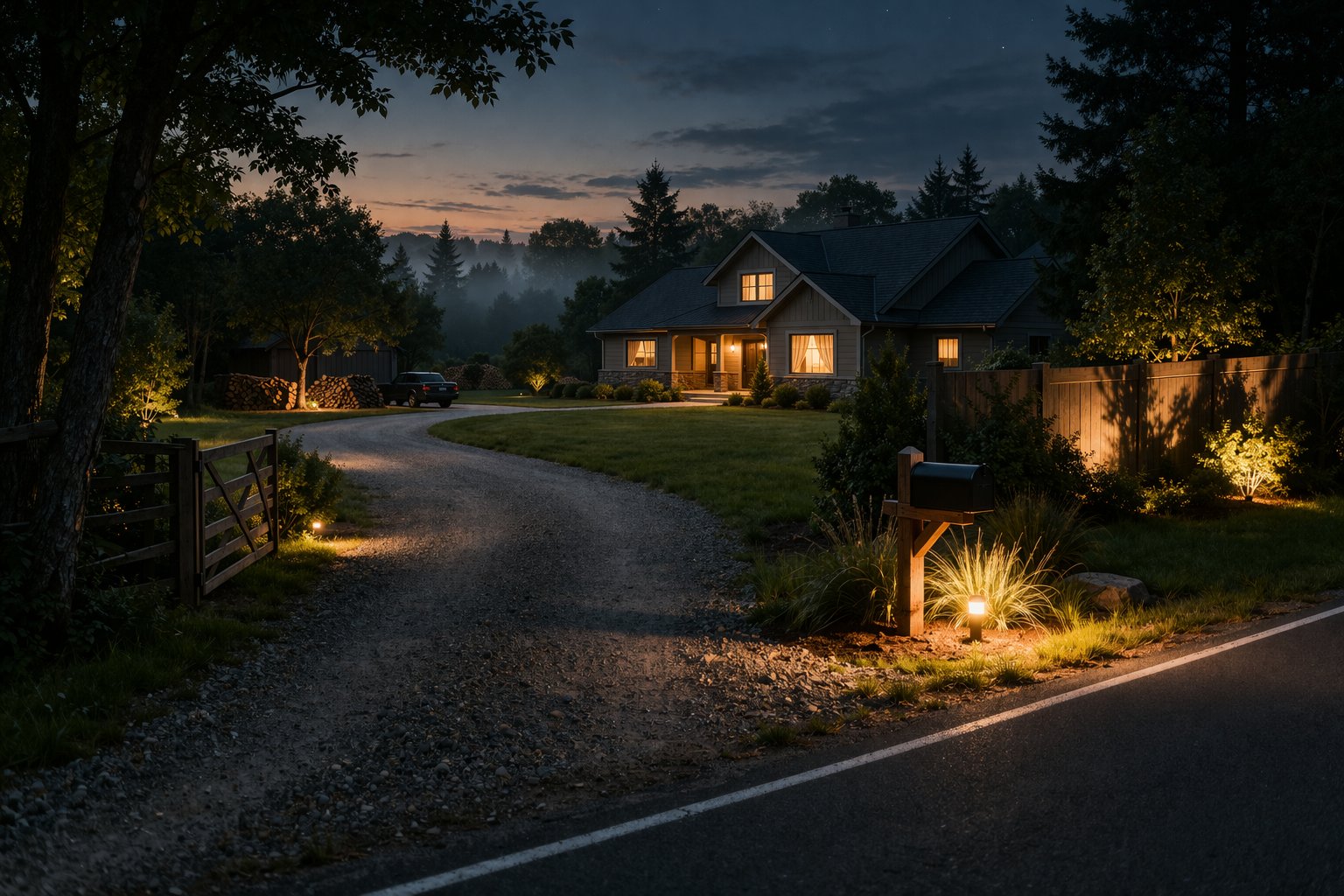
Long driveways that narrow slightly. Natural choke points created with trees, fencing, or landscaping. Entry paths that force people to approach from specific angles rather than straight lines.
You’re not blocking access—you’re shaping it.
This matters because once movement becomes predictable, your awareness improves without increasing visibility.
A well-placed motion light can reinforce this without turning your property into a spotlight. Something like a LITOM solar motion light (https://www.amazon.ca/s?k=LITOM+solar+motion+light&tag=canadianprep-20) works best when it activates at a decision point—not when someone is already at your door.
You’re exposing commitment, not presence.
Reinforce Without Signalling
A strong door that looks ordinary is far more valuable than one that advertises its strength.
Most entry points fail at the frame, not the lock. Reinforcing strike plates, hinges, and door frames adds real resistance without changing appearance.
A system like a door reinforcement kit (https://www.amazon.ca/s?k=door+armor+max+door+reinforcement&tag=canadianprep-20) strengthens the structure from the inside—completely invisible to anyone outside.
Windows can follow the same logic. Security film won’t stop glass from breaking, but it delays entry. And delay—especially in uncertain conditions—is often enough to push someone elsewhere.
Use Light With Intent
More light isn’t always better.
A fully illuminated property can actually make things easier—for anyone watching.
Instead, create contrast:
- Keep most of the property naturally dark
- Use motion lighting at transition points
- Avoid constant floodlighting
This forces movement into uncertainty while exposing it only when necessary.
It also preserves your own night vision, which becomes an advantage if the grid stays down longer than expected.
Break the Routine Signal
Routine is one of the strongest signals you broadcast—often without realizing it.
Lights on at the same time every night. Vehicles parked in the same place. Predictable comings and goings. Regular deliveries left in the same spot.
These patterns make your property readable.
Small adjustments change that:
- Vary exterior lighting timing
- Change where vehicles are parked
- Avoid predictable delivery routines
- Shift visible activity patterns
As covered in previous real-world observations (https://canadianpreppersnetwork.com/covid-19-our-bug-in-day-40/), people react to uncertainty faster than they wait for confirmation—and patterns are the easiest thing to exploit.
Presence Without Exposure
An empty-feeling property attracts attention.
But constant visible activity can do the same.
What you want is subtle presence:
- Occasional interior lighting shifts
- Signs of recent activity (moved items, fresh tracks, cut wood)
- Low-level ambient sound at irregular intervals
Even a compact emergency radio like the FosPower weather radio (https://www.amazon.ca/s?k=FosPower+emergency+radio&tag=canadianprep-20) can serve a dual role—information and controlled background noise when needed.
The goal isn’t to prove you’re home.
It’s to make it unclear whether you’re not.
Avoid the Prepper Tell
This is where many people undo their own efforts.
Visible fuel storage. Bulk food deliveries. Overbuilt exterior structures. Equipment left in plain view.
All of it sends a message.
Preparedness should not be visible from the road.
- Keep supplies out of sight
- Store bulk items discreetly
- Blend improvements into existing structures
- Avoid anything that signals “stockpile”
This is the same behavioural pattern seen during supply concerns, where perception drives action faster than facts (https://canadianpreppersnetwork.com/are-we-about-to-see-food-shortages/).
The Real Objective
You don’t need to be the most secure property in your area.
You need to be the one that causes hesitation.
If someone has to stop and think—even briefly—you’ve already shifted the outcome. Most will move on to something easier, faster, and less uncertain.
That’s the advantage.
Not confrontation. Not visibility.
Just enough friction to become the wrong choice.
Final Thought
Security isn’t about how strong you look.
It’s about how little attention you attract while still resisting pressure.
In the early stages of any disruption, the people who avoid problems aren’t always the most heavily defended.
They’re the ones who were never selected in the first place.
Promoted Resource
📘 Acres of Preparedness: Planning the Last Safe Place
https://amzn.to/4mRu7b5
A grounded approach to building a property that sustains, protects, and avoids becoming a target when systems start to strain.