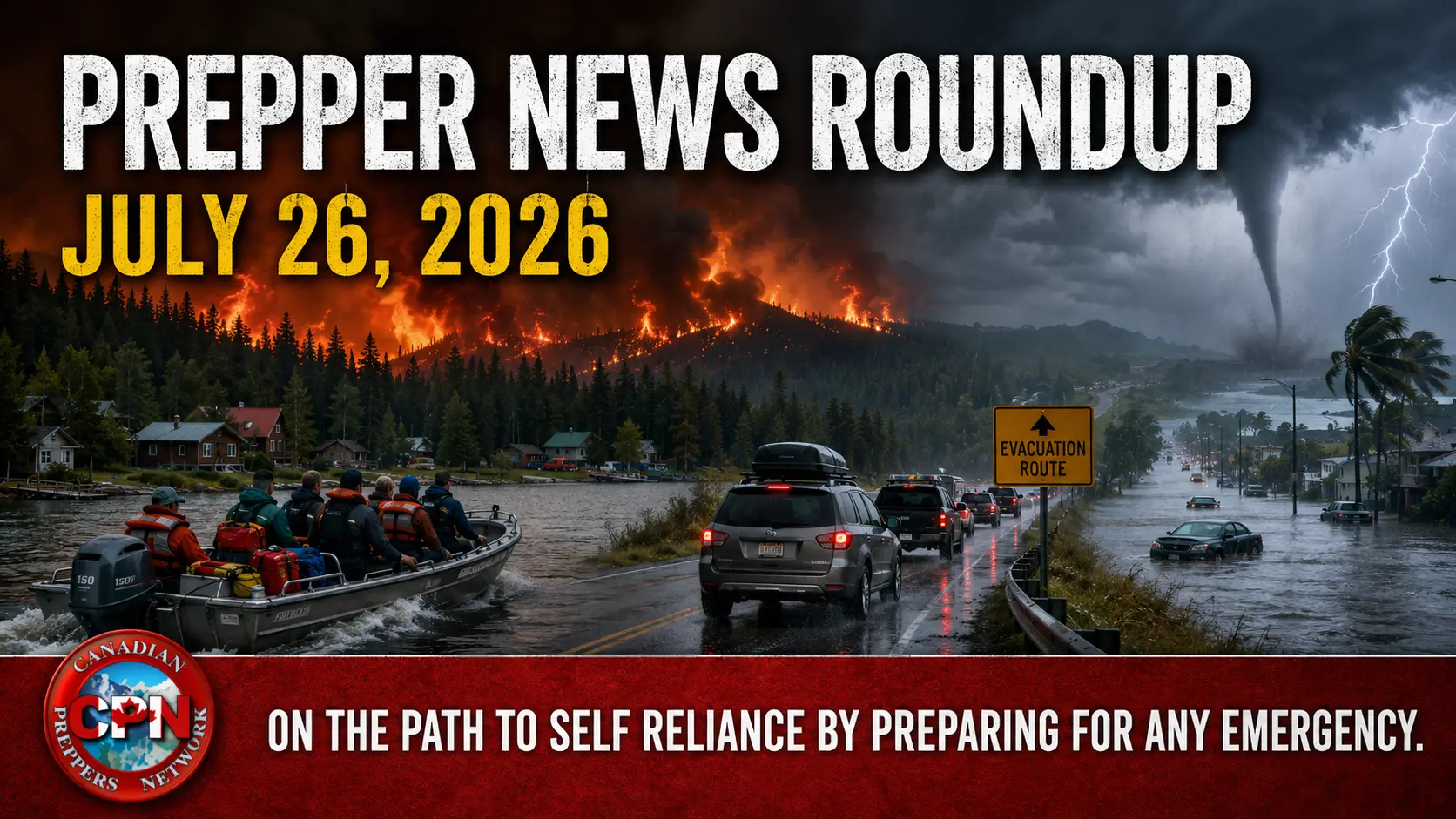
Wildfire evacuation failures, tornado outbreaks, border health measures and mass evacuations dominate this week’s preparedness news.
Wildfires, tornadoes, a tropical cyclone and new disease-control measures dominated preparedness news this week. The individual hazards were very different, but nearly every story revolved around the same question: how quickly can people move when remaining in place is no longer safe?
The most important story for Canadians is not simply that Ontario continues to burn. It is that some northern communities reportedly received little warning and insufficient help before fire destroyed homes and forced residents to organize parts of their own escape.
Ontario First Nations Demand an Inquiry
Ontario’s wildfire emergency continued during the past week, with thousands of people displaced across Northern Ontario and additional fires being discovered in the Northwest Region.
The deeper concern is how several remote First Nations were treated as the fires approached.
Leaders from Namaygoosisagagun and Whitewater Lake First Nations say their communities did not receive adequate warnings, evacuation assistance or firefighting support. Residents of Namaygoosisagagun reportedly began leaving by boat before an official evacuation was properly organized. Both communities subsequently suffered extensive destruction.
First Nations leaders are now calling for an independent public inquiry into Ontario’s wildfire response. They want to know why warnings and assistance did not reach threatened communities sooner and why sufficient resources were not positioned before the fires arrived.
This is more than a dispute over government administration. It reveals the danger of building an evacuation plan around the assumption that outside help will arrive on schedule.
Remote communities face an especially difficult combination of limited roads, small airstrips, long travel distances and communications that can fail at the worst possible moment. When fire blocks the only road or smoke prevents aircraft from landing, the practical evacuation options can disappear very quickly.
The lesson applies well beyond Northern Ontario. Every household should know more than where officials intend to send evacuees. Families also need to know how they will receive warnings, what would cause them to leave voluntarily, which routes could become unusable and where they could go if the designated reception centre cannot accommodate them.
Waiting for an official order may be appropriate in many emergencies. Waiting without independently watching conditions is something else entirely.
Read the report on calls for an Ontario wildfire inquiry
Wildfire Displacement Extends Across Canada
The evacuation problem is not confined to Ontario.
Federal tracking has shown wildfire evacuations affecting First Nations in British Columbia, Saskatchewan, Manitoba and Ontario. At one point, Indigenous Services Canada listed 15 evacuated First Nations and 3,593 displaced residents.
Those figures will change as people leave and return, but they demonstrate the scale of the logistical problem. Thousands of evacuees require transportation, temporary housing, food, medical support, prescription replacement and reliable information. Host communities must often organize these services with little notice.
Evacuation also becomes harder the longer displacement lasts. A household may manage comfortably for one night in a reception centre but struggle after several days without adequate clothing, medication, money, pet arrangements or access to normal communications.
A useful evacuation kit must therefore support more than the drive out. It should help a household function at its destination. Identification, medications, chargers, hygiene supplies, clothing, food that can be eaten without cooking and written contact information may prove more valuable than equipment intended for wilderness survival.
The continuing evacuations also reinforce the value of leaving early when the threat is credible. Roads that are clear in the morning can become congested, smoke-covered or closed later in the day.
View the federal wildfire evacuation status
Tornadoes Confirmed in Wisconsin
Severe storms on July 20 produced three confirmed tornadoes across central Wisconsin.
The National Weather Service confirmed two EF-U tornadoes and one EF0. An EF-U designation means that insufficient damage was available to estimate the wind speed accurately; it does not mean the tornado was harmless.
One tornado remained on the ground for approximately 12 minutes and travelled a little more than six miles. Another covered nearly eight miles, while the third travelled approximately 8.7 miles. Damage included fallen branches, affected farm equipment and damage to a residential garage door.
Wisconsin has now recorded 42 confirmed tornadoes during 2026, compared with an average of 23 in an entire year.
No reliably confirmed Canadian tornado from July 20 through July 26 was found during this week’s search. However, the Prairie season has already been unusually active, providing a good reason to review shelter procedures before the next warning.
Tornado planning does not require complicated equipment. The essential decision is identifying the best available shelter before severe weather arrives. That generally means a basement or a small interior room on the lowest floor, away from windows. People living in mobile homes, trailers or other vulnerable structures need a stronger nearby building identified in advance.
Warnings may provide only minutes to act. That is not enough time to begin deciding where to go, locate shoes, gather pets and move sleeping family members.
Read the Wisconsin tornado confirmation report
Canada Expands Ebola Border Measures
The Public Health Agency of Canada announced additional temporary border measures in response to the Ebola disease outbreak in the Democratic Republic of the Congo.
As of July 20, foreign nationals who had been in the DRC during the preceding 21 days are prohibited from entering Canada. Air carriers are required to prevent affected foreign nationals from boarding flights bound for Canada.
Canadian citizens, permanent residents and people registered under the Indian Act can still enter after recent travel in the DRC, Uganda or South Sudan. They are subject to a health assessment and a 21-day quarantine after arrival.
PHAC continues to assess the risk to people in Canada as low, and no travel-related Canadian cases had been reported when the announcement was issued.
That distinction matters. The new measures do not mean that Ebola is spreading in Canada. They represent an attempt to reduce the possibility of an outbreak being imported and to keep the number of travellers requiring monitoring within manageable limits.
For preparedness purposes, the story demonstrates how public-health controls can affect travel before a disease becomes a domestic threat. Border restrictions, screening requirements and quarantine rules can be implemented rapidly when officials believe the consequences of an imported case would be serious.
Read the Public Health Agency of Canada statement
France and Spain Conduct Massive Evacuations
Wildfires in France and Spain forced more than 250,000 people from their homes as strong winds pushed fires toward heavily populated areas.
Approximately 197,000 people were evacuated in France, including residents around Bordeaux, while roughly 70,000 were evacuated from central Spain. Spain declared its first national emergency specifically for a wildfire, allowing the national government to take a larger role in coordinating the response.
France called on military assistance, deploying approximately 1,500 soldiers and an A400M military transport aircraft alongside civilian firefighting resources. Authorities also distributed masks because of dangerous smoke conditions.
Police went door to door in threatened French communities. Some coastal residents reportedly escaped by boat when fire threatened normal road routes.
The European emergency is a reminder that even developed regions with substantial firefighting resources can be overwhelmed. Aircraft, military personnel, interstate assistance and mass shelters were all required, yet some residents still had very little time to leave.
Preparedness cannot guarantee that a home will survive a major fire. It can improve the likelihood that its occupants are already moving before visibility disappears and roads become unusable.
Read the France and Spain wildfire report
China Moves More Than 700,000 People Before Typhoon Noul
China relocated more than 700,000 people in Guangdong before and during the arrival of Typhoon Noul, the country’s strongest typhoon of the year.
The storm brought gale-force winds and torrential rain while authorities issued their highest alert for flash flooding in several provinces. Flights in Hong Kong were largely suspended for more than 12 hours, while officials warned of flooding near mountains, rivers, valleys, bridges and construction areas.
The most significant detail is that the enormous relocation began before the worst flooding developed.
Moving hundreds of thousands of people is disruptive and expensive. It can also prevent an emergency from becoming a mass rescue operation. Once roads are submerged, bridges are closed and electrical service fails, every person still inside the hazard zone becomes harder to reach.
The same principle works at household scale. Leaving six hours early may feel excessive. Attempting the same trip after dark, through traffic and deteriorating weather, can be impossible.
Read the Reuters report on Typhoon Noul
The Preparedness Lesson
This week’s events show that evacuation is not a single action initiated by an alert. It is a chain of decisions involving warning, transportation, routes, destination, supplies and timing. A failure anywhere in that chain can leave people stranded.
Every household should be able to answer five questions:
- What warning sources will we monitor?
- What conditions would cause us to leave before an order?
- What are our primary and alternate routes?
- Where will we go if the official destination is unavailable?
- What must be packed to remain away for at least several days?
Governments have resources that individuals do not. Individuals have one major advantage: they are responsible for moving only their own household.
The fires in Northern Ontario demonstrate what can happen when outside assistance comes too late. The European wildfires and Typhoon Noul demonstrate the scale of movement possible when evacuation begins early. The difference is not merely the size of the emergency. It is whether people still have usable routes and enough time to act.