Fix the weaknesses in your stored-water plan before freezing temperatures expose them.
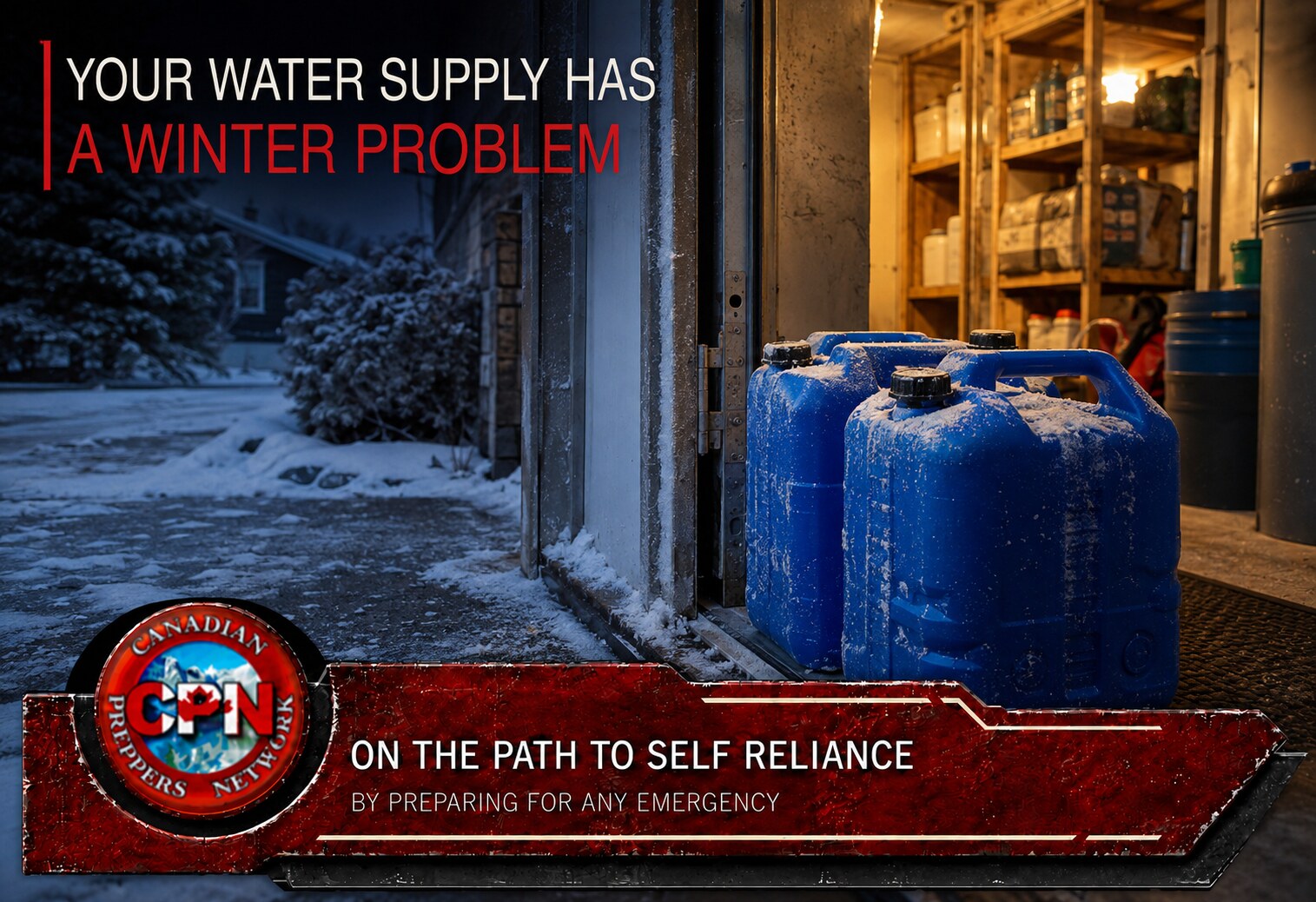
Most emergency water plans are designed on paper and stored wherever space happens to be available. In Canada, that often means a garage, shed, barn, vehicle or unheated outbuilding.
That arrangement may work in August. By January, it can leave you surrounded by water you cannot drink, pour or even remove from its container.
Water expands by roughly nine per cent when it freezes. Containers can swell, split, leak or force water past their caps. Large frozen containers may require many hours—and considerable fuel—to thaw. Filters that have already been used can suffer hidden damage when they freeze. Even water that remains liquid may be trapped behind frozen doors, snowbanks or unsafe outdoor conditions.
The time to correct these problems is before the first hard freeze.
Start With a Realistic Quantity
Four litres per person per day is a reasonable starting point for drinking, basic cooking and very limited hygiene. Even that is a restrictive allowance.
It does not provide much room for rehydrating dried food, washing cookware, cleaning wounds or maintaining sanitation. Pets and livestock need their own supply.
Calculate water in separate categories:
- Drinking
- Cooking and food preparation
- Basic washing and hygiene
- Medical or caregiving needs
- Pets and livestock
- A reserve for spills, contamination and unexpected delays
Know both your absolute survival minimum and your practical daily requirement. Multiply each figure by the number of days you intend to operate without a reliable tap.
Do not count snow as stored water. Snow can supplement a plan, but collecting and melting it consumes time and fuel. Clean-looking snow may also contain dirt, animal waste, road salt or other contaminants.
Divide the Supply Into Two Layers
A winter water plan should not depend on one location or one giant container.
The first layer is a smaller supply kept inside the heated portion of the home. It should be immediately accessible during the first days of an outage. These containers must be light enough for household members to lift, carry and pour safely.
The second layer is the larger reserve. It may be stored in a basement, cold room or another protected location, provided the temperature remains above freezing and the containers are kept away from fuel, paint, pesticides, cleaning chemicals and other contaminants.
This division matters because a winter outage may force a household to close unused rooms and concentrate heat in a smaller living area. Water stored against an exterior wall or in an isolated basement corner may freeze even though the occupied part of the house remains tolerable.
Keep at least several days of water inside the area you expect to heat during an extended outage.
LIMITED-SPACE OUTDOOR EVENT
PLINKIN’ IN THE WOODS
With Frugal Gunnie
Spend a full day developing practical outdoor rimfire marksmanship skills in a controlled setting.
Saturday, September 12, 2026 · 8:00 a.m.–5:00 p.m.
Great Ape Empire · 267 Highway 6, Wiarton, Ontario
Admission: $250 CAD · Weekend camping: $20 per person
Inspect Every Container Before Freeze-Up
Stored water should not be treated as a forgotten stack of supplies. Inspect it now, while leaking containers can be replaced without urgency.
Check for:
- Bulging, cracking or brittle plastic
- Loose, damaged or leaking caps
- Cloudiness, particles or unexpected odours
- Missing fill dates
- Containers sitting beside chemicals or fuel
- Containers too large to move without equipment
- Water stored directly against cold exterior walls
- Supplies blocked by seasonal equipment or clutter
Use containers manufactured for food or drinking-water storage. Clean and sanitize reusable containers before filling them, and never use a vessel that previously held fuel, chemicals or non-food products.
Label each container with the filling date and “drinking water.” Establish a regular rotation schedule instead of trying to remember when the water was stored.
Do Not Completely Fill Containers That Could Freeze
The best solution is to move drinking water into a location that will not freeze. When some water must remain in an unheated location, the container needs room for expansion.
A rigid container filled to the cap may split as the water freezes. Leaving roughly ten to fifteen per cent empty reduces that risk, although it does not make every container freeze-safe. Glass containers are especially poor choices where freezing is possible.
Small containers are generally more useful than one enormous frozen block. They are easier to move into the heated area, thaw more quickly and limit the loss if one fails.
Stand containers upright inside shallow trays or bins where practical. A slow leak discovered after several weeks can damage flooring, stored food and other supplies.
FREE CANADIAN PREPAREDNESS DOWNLOAD
Canadian Grid-Down Starter Kit
Use this printable first-72-hours checklist to test your household’s water, food, sanitation, power, communications and operating routines before a short outage becomes a prolonged emergency.
Your Water Filter May Be Vulnerable Too
Many hollow-fibre water filters retain moisture after their first use. If that moisture freezes, expanding ice can damage the fibres. The filter may look normal afterward while no longer providing reliable protection.
That makes freezing more than a storage inconvenience—it can quietly defeat part of your purification system.
Once a filter has been used, follow its manufacturer’s cold-weather instructions. In field conditions, keep vulnerable filters close enough to body heat to prevent freezing. At home, store them within the heated portion of the building.
Maintain a second treatment method that does not depend on an intact filter. Boiling, appropriate water-treatment products and securely stored potable water provide different layers of protection.
None of these methods will reliably remove every chemical contaminant, fuel or heavy metal. Questionable source water cannot automatically be made safe simply by boiling or filtering it.
Our Water Collection and Purification in Canada hub explains how to combine stored water, collection and treatment rather than depending on a single method.
Plan How You Will Thaw Water
If part of the reserve freezes despite your precautions, you need a safe way to recover it.
Move frozen containers into a heated space gradually and place them in a tub or waterproof tray. A container weakened by freezing may begin leaking as it thaws. Do not place sealed plastic containers directly on a woodstove, open flame or hot burner.
Thawing a large mass of ice requires significant energy. During a grid-down winter emergency, that energy may already be needed to heat living space, prepare food and prevent plumbing damage.
This is why “we can just melt it” is not a complete plan. The fuel required to turn kilograms of ice into usable water must be included in your winter energy budget.
SPECIAL TRAINING WEEKEND
Barefoot Bushcraft Archery Intensive
Hands-on archery training presented by Barefoot Bushcraft in partnership with Canadian Preppers Network, PreppersMeet, Great Ape Empire and Off Grid School.
Protect Water Before the House Gets Cold
When a winter outage begins, fill clean containers while the water system is still operating and the water remains safe. If you use a private well, remember that the pump normally depends on electricity. Once the pressure tank is depleted, the tap may stop.
Avoid waiting until the indoor temperature is approaching freezing. Consolidate your protected water supply early, close off unnecessary rooms and monitor storage areas with thermometers.
Water systems and plumbing can freeze quickly during extreme cold. Our article on dealing with extreme cold during a grid-down emergency covers the wider heating and shelter decisions that accompany this problem.
Conduct a Pre-Winter Water Drill
Before freeze-up, shut off normal household water use for one day. Use only the containers, pouring equipment and treatment methods included in your emergency plan.
The drill will reveal problems that an inventory cannot:
- Containers that are too heavy
- Caps that are difficult to open
- No convenient way to pour from large containers
- Much higher sanitation use than expected
- Pets consuming more than budgeted
- Insufficient water for dried foods
- Filters or treatment supplies stored in the wrong place
- No workable way to move reserves into the heated area
Record the amount actually used, then revise the household reserve.
BUILD KNOWLEDGE THAT SURVIVES THE EMERGENCY
CPN Gold Membership
Gold Membership includes access to the CD3WD collection and hundreds of practical manuals covering water, sanitation, food production, energy, repairs, health and self-reliance. Members also receive the monthly Canadian Preparedness Intelligence Briefing.
Fix It While the Tap Still Works
A Canadian winter water plan must survive more than a municipal interruption. It must survive frozen rooms, failed well pumps, inaccessible outbuildings, damaged filters and limited heating fuel.
Before the temperature drops, relocate the first several days of water into protected space, inspect every container, create room for expansion where freezing remains possible and test the system for a full day.
Stored water is useful only if you can reach it, thaw it and trust it when the tap stops running.
Winter Water-Storage Kit
These supplies support a layered water plan that can be moved, monitored and used without depending on one fragile component.
- Food-grade water-storage containers
- Container spigots and manual transfer pumps
- Portable water filters
- Water-purification tablets
- Indoor/outdoor thermometers
- Waterproof utility trays
Disclosure: This article contains Amazon affiliate links. As an Amazon Associate, Canadian Preppers Network may earn from qualifying purchases.
Related Reading on CPN
- Water Collection & Purification in Canada
- Your Well Is Not a Water Plan
- Dealing With Extreme Cold During a Grid-Down Emergency
- Getting Prepared for Winter
Where is your emergency water stored—and will you still be able to use it after three days below freezing?