A reliable wet-weather fire begins with preparation—not a more powerful flame
A fire is easy when the ground is dry, the kindling snaps cleanly and every piece of wood seems eager to burn.
Three days of cold autumn rain create a different problem.
Free Canadian Preparedness Download
Canadian Grid-Down Starter Kit
Use this printable first-72-hours checklist to test your household’s food, water, sanitation, power, communications and operating routines before a short outage becomes a prolonged emergency.
The forest floor becomes a sponge. Bark drips. Dead branches feel heavy. Tinder produces smoke instead of flame. Matches are wasted one after another while increasingly desperate hands dismantle and rebuild the same pile of wet sticks.
The common mistake is to treat this as an ignition problem. It usually is not.
A lighter, ferrocerium rod or stormproof match can provide plenty of heat for a few seconds. The real challenge is preparing enough dry material to capture that heat, enlarge the flame and carry it into progressively heavier fuel.
Wet-weather fire building is therefore less about the spark and more about fuel preparation, sequencing and patience.
Rain Does Not Wet Every Part of the Wood Equally
After prolonged rain, exposed bark and surface fibres absorb moisture first. The centre of a sound branch may remain considerably drier.
Research into wood moisture confirms that previously dried wood can develop a reversed moisture gradient after being rained on: the outside becomes wetter than the interior. That principle explains why splitting wet wood is so important.
Do not spend an hour wandering through the bush hoping to find a miraculous pile of perfectly dry sticks. Look for wood with a recoverable dry core.
The best candidates are usually:
- dead branches still suspended above the ground;
- lower dead limbs protected beneath dense conifers;
- sound standing deadwood where collection is permitted;
- larger fallen branches that remain solid beneath the bark;
- split or broken wood trapped above wet soil;
- resin-rich wood from dead pine or spruce; and
- dry material found inside an old stump or protected cavity.
Avoid punky wood that compresses like a sponge. Rotten material may appear dry on the surface but lacks the density needed to produce sustained heat.
A useful test is to break or cut into the wood. A pale, firm interior with a cleaner smell and a sharper shaving is more promising than dark, soft or waterlogged material.
Build the Fire Site Before Processing Fuel
Wet ground can rob heat from a small flame almost as quickly as damp kindling.
Scrape away loose saturated debris and establish the fire on mineral soil, an existing fire pit or another appropriate non-combustible location. Never light a fire on deep organic soil, roots or peat, where heat can travel underground and remain hidden.
When the surface is saturated, create a simple platform using several pieces of split wood laid tightly beside one another. The platform separates the first flame from wet soil and eventually becomes fuel itself.
Consider the wind before placing the fire. A light airflow supplies oxygen, but strong gusts can strip heat from the tinder and push sparks into surrounding vegetation. Use terrain, a large log or a properly positioned windbreak to reduce wind without sealing the fire off from oxygen.
Do not build beneath low branches, against a tree trunk or directly under a tarp. A shelter can protect the person preparing fuel, but it needs enough separation from flame, sparks and rising heat.
Before lighting anything, identify how the fire will be controlled and extinguished. Check current restrictions whenever normal authorities remain functional. Parks Canada requires campers to obey fire bans, keep fires attended and extinguish them completely. A survival situation does not make an escaped wildfire any less dangerous.
Stop Thinking in Terms of “Kindling”
A wet-weather fire needs more fuel stages than the familiar tinder-kindling-firewood sequence suggests.
Prepare distinct piles before producing the first flame:
- Tinder: Material fine and dry enough to ignite directly.
- Matchstick fuel: Very thin curls, shavings and split slivers.
- Pencil-sized fuel: Pieces capable of catching from a small established flame.
- Finger-sized fuel: The first material that begins producing useful coals.
- Thumb-to-wrist-sized fuel: Split pieces that establish a durable fire.
- Larger fuel: Added only after a strong coal bed exists.
The quantities matter. In dry conditions, a handful of kindling may be enough. In prolonged rain, prepare several times more small split fuel than you think you need.
That extra material buys time. The young fire can recover from a damp piece without collapsing, and you are not forced to abandon it while searching for another armful of sticks.
Wet-fire rule: Do not ignite the tinder until every fuel stage required to reach wrist-sized wood is prepared and within reach.
That single habit prevents more wet-weather failures than carrying another expensive fire starter.
Split Your Way to the Dry Core
A compact axe, hatchet or sturdy fixed-blade knife becomes far more important after prolonged rain.
Cut larger sound branches into manageable lengths. Split them to expose the inner wood, then split those pieces again. Use the driest inner sections for the smallest fuel stages.
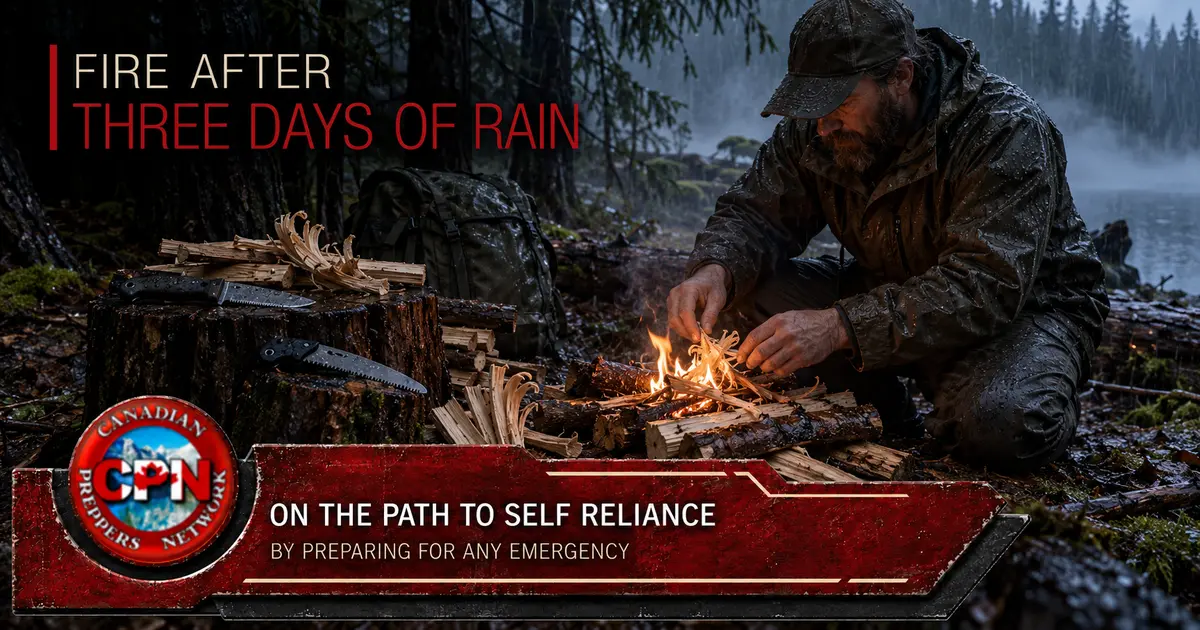
Produce long, thin splinters with square edges. These ignite more readily than round twigs because splitting exposes fresh wood and creates more surface area for the flame.
Some pieces should be reduced to narrow curls or feather sticks. A well-made feather stick keeps a cluster of thin shavings attached to a larger piece of wood. The curls ignite first and begin heating the stem from which they were cut.
The curls do not need to look decorative. They need to be:
- thin enough to ignite;
- numerous enough to sustain one another;
- protected from rain and wet ground; and
- cut from the driest available interior wood.
Make more than one. A single feather stick is a demonstration. A bundle is a fire system.
If using a knife to split wood, work on a stable surface and keep hands, legs and other people out of the blade’s path. Wet, cold hands reduce grip strength and make careless techniques increasingly dangerous.
Carry Tinder That Does Not Depend on the Weather
Natural tinder is a useful skill, but a serious preparedness kit should not require the forest to provide perfectly dry material on demand.
Reliable carried tinder might include:
- commercial waxed tinder;
- cotton impregnated with petroleum jelly;
- waxed jute or cotton cord;
- resin-rich wood shavings;
- a small piece of bicycle inner tube for emergency outdoor use;
- waterproof storm matches; and
- a butane lighter protected inside a waterproof bag.
Keep the primary tinder and ignition tools in separate waterproof packaging. A kit that allows one leaking bottle or unsealed pocket to soak everything contains no real redundancy.
A ferrocerium rod is durable and useful, but it does not eliminate fuel preparation. Sparks that burn at a high temperature still contain very little total energy. They can ignite fine tinder; they cannot force a pile of damp pencil-sized sticks to burn.
A lighter provides a sustained flame and is often the most efficient primary tool. Carry two. Add matches and a ferrocerium rod as independent backups.
The objective is not to prove that a fire can be started using the most primitive method available. The objective is to establish heat before cold, fatigue and deteriorating judgement become the larger threat.
Build Upward Without Smothering the Flame
Place the tinder on the prepared platform and surround it loosely with the driest matchstick-sized material. Leave openings for air and for adding more fuel.
Light from the side protected from the wind. Once the tinder is burning, feed the flame gradually.
The correct sequence is deliberate:
- Establish the tinder flame.
- Add dry shavings and very thin split pieces.
- Wait for those pieces to burn strongly.
- Add pencil-sized fuel in small amounts.
- Continue adding material without covering the flame.
- Introduce finger-sized pieces only when the flame is rising through the pile.
- Add split wrist-sized fuel after the fire begins forming coals.
Do not dump an armful of prepared kindling onto the first promising flame. Every added piece absorbs heat. Too much fuel at once can cool the fire below the temperature needed to continue combustion.
Place damp larger fuel near the fire so radiant heat begins drying it, but do not stack it precariously over the flame. Rolling logs, falling branches and trapped smoke create new problems.
Split larger fuel whenever possible. The open faces ignite more predictably than wet bark.
Learn to Diagnose a Failing Fire
| What You See | Likely Problem | Correction |
|---|---|---|
| Tinder burns but the wood never catches | The first fuel is too large, wet or sparse | Add finer dry-core shavings and splinters |
| Thick smoke with little flame | Too much damp material was added | Improve airflow and return to smaller fuel |
| Flame disappears into the ground | The wet base is absorbing heat | Rebuild on a split-wood platform |
| Fire dies when finger-sized pieces are added | The previous fuel stage is not established | Build a larger mass of burning pencil-sized fuel |
| Flame is blown flat or away from the fuel | Excessive wind exposure | Improve the windbreak while preserving airflow |
| Every branch hisses | You are relying on saturated surface wood | Split larger pieces and expose their cores |
Do not respond to every failure by applying another match. Correct the fuel problem first.
The Fire Is Not Established When It First Looks Impressive
A tall flame can be produced by tinder and fine kindling, but it may contain very little durable heat.
A wet-weather fire is established only when it has enough burning mass and coals to dry the next fuel load. Until that point, it still requires close attention.
Continue preparing fuel while the fire grows. Rotate damp pieces near the heat. Split anything that refuses to ignite. Protect the reserve kindling from rain.
Never let the entire supply of fine fuel enter the fire. Keep a protected restart bundle containing tinder, shavings and pencil-sized pieces. If the main fire collapses, that bundle prevents the process from returning to zero.
In a prolonged emergency, use the established fire to prepare tomorrow’s fuel. Dry split wood near the heat, then move it beneath cover. Maintaining a protected reserve is far more efficient than rebuilding from saturated materials every morning.
Conduct the Three-Day-Rain Drill
Do not wait for an involuntary overnight in the bush to learn whether this method works.
Choose a legal and controlled location after several days of rain. Use an established fire pit, observe all restrictions and bring extinguishing water before beginning.
Then impose the following rules:
- Use only the ignition equipment normally carried.
- Do not use prepared household firewood.
- Recover usable inner wood from locally permitted material.
- Prepare every fuel stage before lighting the tinder.
- Establish a fire capable of sustaining split wrist-sized fuel.
- Boil a measured quantity of water.
- Protect enough material to restart the fire.
- Extinguish everything until it is cold to the touch.
Record how long each stage required and which tool became the bottleneck.
The important result is not merely whether flame appeared. Determine whether the fire produced useful heat before cold hands, fading daylight or worsening rain would have made the task significantly harder.
Fire-Making Ability Is a Production System
In a short recreational emergency, a fire can provide warmth, light, signalling and hot water.
After a broader collapse, the demand becomes much greater. Fire may be needed daily for cooking, sanitation, drying clothing, heating water, preserving food and supporting work around a camp or remote property.
That changes the required skill.
The group must be able to locate suitable wood, process it safely, protect it from rain, maintain a dry reserve and extinguish fire without creating another disaster. Tools need maintenance. Labour needs to be divided. Fuel consumption needs to be understood.
A person who can produce one dramatic flame with a ferrocerium rod has demonstrated ignition.
A person who can turn saturated woodland material into dependable heat has demonstrated firecraft.
The difference appears after the rain has been falling for three days.
Field question: What part of your current fire kit would become the first bottleneck after several days of continuous rain: tinder, cutting tools, protected kindling or the ability to carry fuel?
Research Sources
- USDA Forest Products Laboratory — Drying and Control of Moisture Content
- Parks Canada — Campfire Safety
Related Reading
Preparedness Buying Box
Build a Wet-Weather Fire Kit
These supplies support the fuel preparation, protected ignition and redundancy described in this article. Skill remains essential, but the right tools make practising—and succeeding in poor conditions—far more realistic.
- Waterproof storm matches
- Ferrocerium rods and fire starters
- Waxed and waterproof fire tinder
- Fixed-blade bushcraft knives
- Compact folding saws
- Small waterproof dry bags
As an Amazon Associate, Canadian Preppers Network may earn from qualifying purchases.