
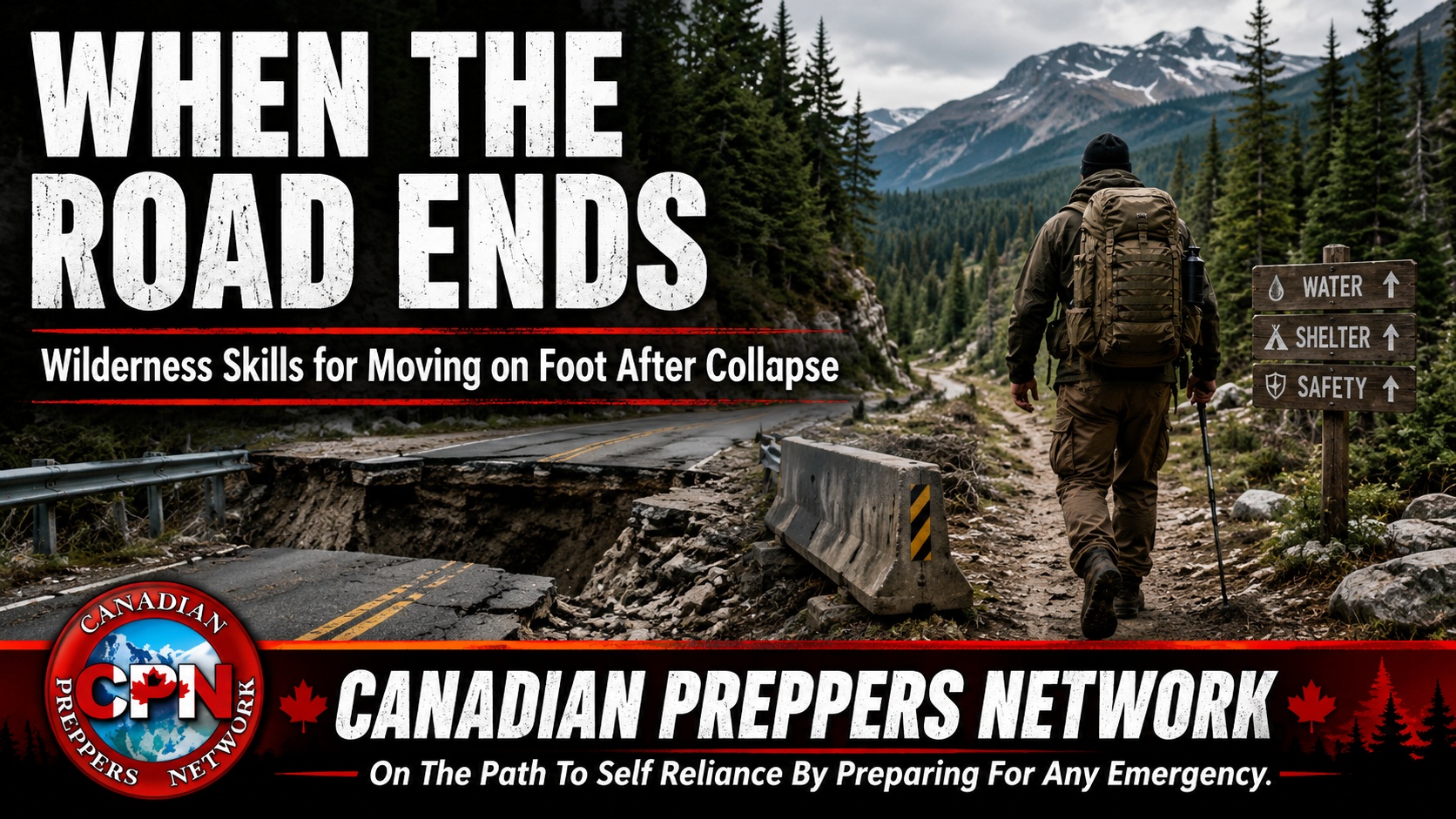
Wilderness Skills for Moving on Foot After Collapse
A lot of preparedness planning quietly assumes that vehicles will still be part of the solution. The truck gets you to the bugout location. The ATV gets you down the trail. The fuel cache buys you time. The backroad stays passable. The bridge is still there.
That may be true in a short emergency.
It is a dangerous assumption in a long one.
In a serious grid-down collapse, wildfire evacuation, regional unrest, fuel shortage, cyberattack, or infrastructure failure, the road system can stop being reliable very quickly. Highways clog. Rural roads wash out. Bridges get closed. Snow, fallen trees, police checkpoints, abandoned vehicles, and simple fuel exhaustion can turn a planned drive into an unplanned walk.
That is where wilderness skill stops being a hobby and becomes a survival skill.
This is not about playing mountain man for the weekend. It is about being able to move yourself, your family, or a small group across rough ground when pavement, fuel, and cell coverage are no longer dependable. The person who can travel on foot, read terrain, manage heat loss, find water, avoid injury, and make good decisions under fatigue has options. The person who can only follow a GPS arrow from inside a heated vehicle does not.
The First Rule: Do Not Leave Too Late
The hardest wilderness skill is not fire lighting, shelter building, or navigation. It is judgement.
Most people wait too long. They watch the situation get worse, hoping it will settle down. They assume roads will remain open. They tell themselves they can leave in the morning. By the time they accept that movement is necessary, everyone else has reached the same conclusion.
That is when a controlled departure turns into a desperate one.
For preppers, the better question is not “Can I survive in the bush?” The better question is “At what point do I stop trusting the road system?”
That decision should be made before the crisis. You should already know your trigger points. A mandatory evacuation. A spreading wildfire. A regional fuel disruption. A confirmed long-term power outage. A security situation moving toward your area. A storm system that will close roads behind you.
Once you are forced to move on foot, every hour matters. Daylight matters. Weather matters. Physical condition matters. How much weight you carry matters. The route matters.
Leaving early does not mean panicking. It means refusing to become trapped by hesitation.
Map and Compass Still Matter
GPS is useful until it is not. Phones die. Batteries freeze. Screens break. Apps fail without downloaded maps. Satellites may still function, but your ability to access them may not.
Paper maps and a compass are not old-fashioned. They are independent.
A serious prepper should have topographic maps for the area around home, the area around a bugout location, and the corridor between the two. Road maps are not enough. You need to understand elevation, water crossings, cut lines, trails, powerline corridors, swamp, ridges, and choke points.
The best route on a map is not always the shortest route. In a collapse situation, the safest route may avoid towns, obvious roads, bridges, and places where desperate people collect. It may follow ridgelines, old logging roads, hydro lines, abandoned rail beds, or a series of water sources.
But every alternate route has a cost. Swamp slows you down. Thick bush burns energy. Steep terrain increases injury risk. River crossings can become deadly. In winter, open ground can expose you to wind. In summer, dense cover can hide hazards and increase fatigue.
Navigation is not just knowing where north is. It is understanding what the land is trying to do to you.
Your Route Should Be Walked Before It Is Needed
A bugout route that only exists on paper is a theory.
If possible, sections of your route should be scouted before an emergency. You do not need to advertise what you are doing. Treat it like hiking, hunting, fishing, mapping, or seasonal land familiarization. Learn where the road shoulders disappear. Learn which trails are maintained and which are fantasy lines on a map. Learn where water is seasonal. Learn which bridges look weak. Learn where snow piles deep. Learn where private land, locked gates, and posted areas complicate movement.
In Canada, seasonal changes are not minor details. A route that is easy in September can be brutal in February. A stream crossing that is ankle deep in August can become dangerous during spring melt. A cut line that looks open on satellite imagery can be choked with blowdown and alder growth on the ground.
Walk pieces of the route with the gear you expect to carry. You may discover that your “reasonable” pack weight is not reasonable after eight kilometres. You may discover that your boots cause blisters. You may discover that one member of your group cannot keep the pace you imagined.
Better to learn that on a Saturday than during a collapse.
Weight Kills Speed
Most bugout bags are built like fantasy kits. They are loaded with gear for every scenario, every season, and every imagined problem. On paper, that feels reassuring. On foot, it becomes punishment.
A heavy pack slows movement, increases sweating, raises injury risk, and breaks morale. The longer the movement, the more every extra pound matters.
The goal is not to carry everything you own. The goal is to carry what keeps you alive while moving.
That usually means water, water treatment, layered clothing, shelter from wind and rain, fire-starting tools, navigation tools, basic first aid, calories, light, communication, and a cutting tool suitable for ordinary camp tasks. It also means dry socks, blister care, and a way to keep critical items dry.
A good pack is not the one that looks impressive in a photo. It is the one you can actually carry when tired, cold, wet, hungry, and under pressure.
For family movement, the load must be realistic for every person. Children, older adults, and anyone with medical limitations cannot be treated like pack animals. Group gear should be distributed intelligently, but the plan must account for the weakest walker, not the strongest.
Water Decides the Route
On foot, water quickly becomes one of the biggest planning factors.
You can carry some, but water is heavy. A litre weighs roughly a kilogram. Carrying enough for a long movement becomes unrealistic fast, especially in heat or while climbing.
That means your route should be planned around water sources. Lakes, rivers, streams, springs, and reliable wells all matter. So does the ability to treat water quickly and repeatedly.
In a long emergency, assume surface water may be contaminated. Agricultural runoff, dead animals, human waste, fuel spills, and poor sanitation can turn a clear stream into a problem. A good wilderness movement kit should include a proven filter, a backup purification method, and a way to collect dirty water without contaminating clean containers.
Do not make water an afterthought. Many people can push through hunger for a while. Dehydration, heat stress, and bad water can end a movement fast.
Shelter Is About Staying Functional
A shelter does not have to be comfortable. It has to keep you functional.
The biggest threats are exposure, wind, wet clothing, and the loss of body heat. In Canadian conditions, this can become serious quickly, especially when a tired person stops moving.
A tarp, bivy, poncho, emergency blanket, or lightweight tent can make the difference between miserable and dangerous. The key is speed. If weather turns, you need to be able to get out of wind and rain quickly without building a fantasy shelter from scratch.
Natural shelter skills still matter. Knowing how to use tree cover, terrain, snow banks, wind breaks, and ground insulation can save energy and time. But the idea that you will casually build a perfect debris hut after walking all day is not a plan. It is entertainment.
Carry shelter. Practise setting it up. Know how to pitch it in wind. Know how to keep sleeping gear dry. Know when to stop early rather than push into darkness and weather.
Fire Is Useful, But Not Always Smart
Fire is one of the most emotionally reassuring survival tools. It gives heat, light, morale, and a way to boil water. It can dry clothing and keep people from mentally falling apart.
It can also reveal your location, waste time, consume energy, and create risk.
In some situations, a fire is worth it. In others, staying dark, dry, and quiet is wiser. This is where judgement matters again. If the issue is hypothermia, fire may be necessary. If the issue is keeping a low profile near a road, settlement, or unstable area, flame and smoke may be a bad idea.
Every kit should include multiple fire-starting methods: lighters, ferro rods, waterproof matches, and dry tinder. But skills matter more than gear. Practise lighting fire in wind, rain, snow, and cold hands. Practise with local materials. Learn what actually burns in your region.
Do not confuse owning fire gear with being able to make fire when conditions are against you.
Movement Discipline Is Not Military Fantasy
Moving on foot after collapse is not about pretending to be special forces. It is about not being stupid.
Avoid obvious trouble. Do not walk straight into crowds, roadblocks, unstable gatherings, or places where desperate people are likely to gather. Do not exhaust yourself trying to move too fast. Do not make unnecessary noise at night. Do not wander into private yards, farms, or camps assuming people will be friendly just because you are in trouble.
At the same time, do not turn caution into paranoia. In many disasters, cooperation matters. A farmer with a working well, a local who knows which bridge washed out, or another family moving away from the same hazard may be more valuable than another piece of gear.
The skill is reading the situation. Who is calm? Who is desperate? Who is organized? Who is dangerous? When do you talk? When do you keep moving? When do you detour?
The wilderness does not remove human problems. It just spreads them out.
Feet, Socks, and Small Injuries Matter
In movies, people walk for days without consequence. In real life, feet fail.
Blisters, wet socks, poor boots, twisted ankles, knee pain, and fatigue can cripple a group. A person who cannot walk becomes a group problem. That may mean stopping early, slowing down, abandoning gear, or changing the entire route.
Foot care is not glamorous, but it matters. Break in boots before they are needed. Carry spare socks. Dry feet when possible. Treat hot spots before they become blisters. Carry basic blister supplies and learn how to use them. Keep toenails trimmed. Avoid brand-new footwear in an emergency.
The same goes for minor injuries. A small cut can become infected. A sprain can become a full stop. A headache, stomach issue, or medication problem can wreck the day. Your first aid kit should reflect movement injuries, not just dramatic trauma.
The boring problems are often the ones that stop you.
The Group Moves at the Speed of Reality
Every bugout plan should be tested against the actual people involved.
Can they walk ten kilometres with gear? Can they do it in rain? Can they do it in cold? Can they do it after poor sleep? Can they do it without constant complaining, arguing, or panic?
A strong plan accounts for pace, rest stops, water points, daylight, and morale. It also assigns responsibilities. Someone navigates. Someone watches time. Someone tracks water. Someone checks weaker members. Someone monitors weather. Someone keeps the group from making emotional decisions.
In a family group, leadership must be calm and clear. People under stress need direction, not speeches. Children need reassurance and simple tasks. Adults need to control their own fear before it spreads.
Mental resilience is a wilderness skill. Panic burns energy. Anger breaks cooperation. Denial wastes daylight.
Training Beats Gear
The prepper market loves selling objects. Wilderness movement requires ability.
Take a navigation course. Practise map and compass work. Hike with your actual pack. Learn basic wilderness first aid. Camp in bad weather. Test water filters. Build a small fire in poor conditions. Walk in winter. Walk in summer heat. Learn what your body can do and what it cannot.
If you are in Ontario or within reach of Preppers Meet, wilderness training, navigation, first aid, and hands-on outdoor skill sessions are exactly the kind of thing serious preppers should be looking for. Reading about movement is useful. Doing it is better.
A person with moderate gear and real experience is often ahead of someone with expensive gear and no field time.
Wilderness Movement Gear Box
Disclosure: As an Amazon Associate, Canadian Preppers Network may earn from qualifying purchases. The point is not to buy everything. The point is to identify weak spots in your current kit and fix them before the road ends.
Map and compass supplies
A real compass, waterproof map case, notebooks, pencils, and local topographic maps should be part of any serious movement plan.
Map, Compass, and Waterproof Map Case Supplies
Water filtration and purification
A lightweight filter, backup purification tablets, and clean/dirty water separation are more important than another gadget in the pack.
Water Filters and Purification Tablets
Tarps, bivy bags, and emergency shelter
Fast shelter matters when weather turns or when a tired group has to stop earlier than planned.
Survival Tarps, Bivy Bags, and Emergency Shelter
Fire-starting kit
Carry more than one method. Lighters, ferro rods, waterproof matches, and dry tinder all have a place.
Ferro Rods, Waterproof Matches, and Tinder
Dry bags and pack liners
Wet gear is heavy, miserable, and dangerous in cold weather. Keep clothing, socks, fire-starting tools, and sleeping gear dry.
Dry Bags and Pack Liners
Blister and foot care supplies
Your feet are transportation. Treat them that way.
Blister Care, Moleskin, and Hiking Socks
Headlamps and rechargeable lighting
Hands-free light matters for camp tasks, first aid, navigation checks, and emergencies after dark.
Rechargeable Headlamps
The bottom line: build the kit around movement, water, shelter, fire, navigation, and injury prevention. Then train with it.
Final Thought
When the road ends, the fantasy ends with it.
There is no heated cab, no unlimited fuel, no easy resupply, and no guarantee that the route you planned will still exist. You are left with your body, your group, your judgement, your gear, and the land in front of you.
That is why wilderness skills matter to preppers.
Not because everyone plans to live in the bush forever. Not because walking to a bugout location is the ideal plan. It is not. A controlled move by vehicle, done early, is almost always better.
But serious preparedness means having options when the preferred plan fails.
If you cannot move on foot, your evacuation plan depends on roads, fuel, weather, traffic, and other people behaving predictably. That is a lot of faith to place in a collapsing situation.
Train now. Scout now. Walk the route now. Light the fire in bad weather now. Carry the pack now. Learn where the water is now.
Because when the road ends, there will be no time left to become capable.

One Comment