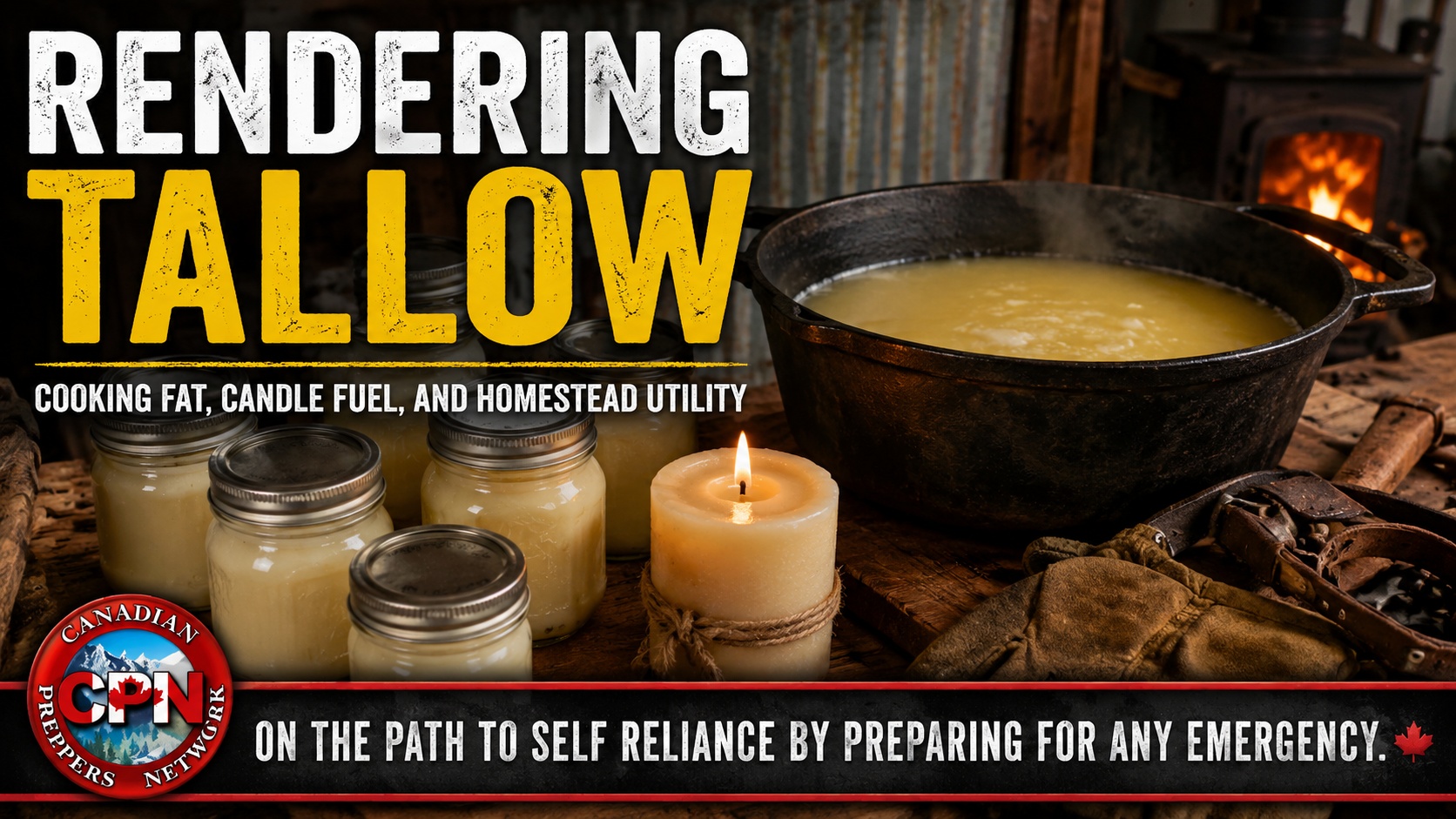
How to render tallow safely for cooking, candles, leather care and long-term homestead utility
Fat is one of the first things modern households waste and one of the last things old homesteads would have thrown away.
That tells you something.
In a long emergency, calories matter. Heat matters. Light matters. Repair materials matter. Cooking fat matters. A household that throws away usable fat is still thinking like a grocery-store consumer. A household that knows how to render it is thinking like a producer.
Tallow is simply rendered hard animal fat, most commonly from beef or sheep. Done properly, it becomes a stable, useful homestead product that can support cooking, preservation, candles, leather care, tool maintenance, and soap-making knowledge. It is not glamorous, but neither is splitting firewood, hauling water, cleaning a chimney, or pressure canning meat. These are the dull skills that keep a household functioning when convenience disappears.
For Canadian preppers, this belongs beside canning, dehydrating, freeze drying, root cellaring, firewood processing, and animal husbandry. It is not a novelty skill. It is part of the old pattern of using the whole animal, reducing waste, and turning seasonal abundance into stored utility.
Related CPN Reading
Home Canning Meat — A Smart Prepper’s Guide
Food Storage Supplies Buying Guide
Why Tallow Matters After The Easy Systems Fail
Modern preparedness tends to focus on packaged goods. Buckets, cans, freeze-dried meals, filters, batteries, and fuel cylinders all have their place. But long-term resilience eventually comes back to raw inputs and repeatable skills.
Animal fat is one of those inputs.
On a working homestead, hunting camp, retreat property, or small livestock system, fat should not be treated as waste. Once rendered, it becomes a shelf-stable cooking fat when freezers are unreliable. It can be used to grease pans, fry food, enrich lean meals, protect certain tools from rust, condition leather, and make simple emergency candles. With proper knowledge and caution, it also becomes part of traditional soap making.
That matters because a long emergency does not just consume your supplies. It also exposes what you cannot replace.
If every useful household material has to come from a store, you are still dependent. If you can turn scrap wood into charcoal, hides into leather, bones into broth, ashes into useful amendments, and fat into tallow, you are moving back toward a production mindset.
What Fat To Use
The best tallow comes from clean, firm beef fat. Kidney fat and other hard internal fats are often prized because they render into a clean, hard finished product. Trim fat from roasts, brisket, suet, or butcher scraps can also be used.
The cleaner the starting fat, the better the finished tallow.
Avoid fat that smells sour, rancid, rotten, or badly contaminated. Rendering improves and separates fat, but it does not magically make spoiled material safe or pleasant. In a normal situation, start with fresh fat, chilled or partially frozen, and process it promptly.
For homestead use, fat can come from several sources: local butcher trimmings, home-raised beef or sheep, saved beef fat from cooking, freezer cleanout fat before it gets old, and some wild-game situations where additional domestic fat may be needed.
Wild game is often much leaner than domestic livestock, which is why fat becomes even more valuable in a self-reliant food system. A freezer full of lean meat is useful, but a household still needs cooking fat, calories, and flavour.
Basic Equipment
You do not need a specialized machine to render tallow. You need controlled heat, patience, and a way to strain and store the finished product.
Useful equipment includes a heavy pot, stockpot, slow cooker, roaster, sharp knife, cutting board, fine mesh strainer, cheesecloth or clean cotton cloth, wide-mouth jars, food-safe containers, ladle, labels, and a marker.
The main requirement is low, steady heat. Too much heat scorches the fat, darkens the tallow, and gives it a stronger smell. This is a slow process, not a race.
Dry Rendering Vs. Wet Rendering
There are two common approaches: dry rendering and wet rendering.
Dry rendering uses fat alone. The trimmed fat is chopped small and heated gently until the liquid fat separates from the remaining bits. It is simple, traditional, and produces good tallow when done carefully.
Wet rendering uses a small amount of water at the start. The water helps prevent early scorching while the fat begins to melt. As the process continues, the water cooks off or separates from the fat. Some people prefer wet rendering for cleaner-tasting tallow, especially when the fat is less carefully trimmed.
For a beginner, wet rendering is often more forgiving. For someone experienced, dry rendering is simple and efficient.
Either way, the rule is the same: low heat, clean fat, careful straining, and no rushing.
Step-By-Step: Rendering Tallow
Start by chilling the fat. Cold fat is easier to cut. Partially frozen fat is even easier to chop or grind.
Trim away obvious meat, blood spots, glands, and dirty sections. A little meat left behind is not the end of the world, but cleaner fat gives cleaner tallow and stores better.
Cut the fat into small pieces. The smaller the pieces, the faster and more evenly the fat will render. A coarse grind works very well if you have access to a grinder, but a knife is enough.
Place the fat in a heavy pot or slow cooker. Use the lowest practical heat. If using the wet method, add a small splash of water to the bottom of the pot to reduce the chance of early scorching.
Heat slowly.
As the fat warms, liquid tallow will begin to pool. Stir occasionally and keep the heat low. You do not want smoke, aggressive frying, or burnt bits sticking to the bottom. If the fat begins to smell scorched, the heat is too high.
Over time, the solid pieces will shrink and turn into browned cracklings. When the bubbling slows and the remaining pieces look cooked down, most of the usable fat has rendered out.
Carefully strain the liquid through a fine mesh strainer lined with cheesecloth or clean cotton cloth. Do this into a heat-safe container. Work slowly and safely. Hot fat can burn badly, and spilled grease near an open flame is a serious hazard.
Let the strained tallow cool. Properly rendered tallow will turn pale and firm as it sets.
For a cleaner product, it can be melted and strained a second time. This is especially useful if you want tallow for candles, skin use, leather care, or longer storage.
Storage Matters
Tallow keeps best when it is clean, dry, and protected from air, heat, and light.
Moisture is the enemy. Bits of meat, water, or food residue left in the fat can shorten storage life. That is why careful trimming, slow rendering, and proper straining matter.
Store finished tallow in clean jars or containers. Label it with the date and source. Keep it cool and dark. For longest storage, refrigeration or freezing is best when available. In a grid-down situation, the coolest stable area of the home, pantry, cellar, or outbuilding becomes important.
Do not assume every jar of homemade tallow is automatically good forever. Check it before use. If it smells sour, rancid, mouldy, or otherwise wrong, do not use it for food.
A prepper pantry should be built on rotation, not fantasy. Tallow should be used, replaced, and monitored like any other stored food or homestead material.
Uses For Rendered Tallow
The most obvious use is cooking. Tallow is excellent for frying, roasting, greasing cast iron, and adding calories to lean meals. In a cold Canadian winter, fat is not a luxury. It is energy.
Tallow can also be used for simple emergency candles. A jar, wick, and properly prepared tallow can produce useful light. It will not replace a modern lantern, but it gives you another option when batteries, fuel, and grid power are limited.
It can help condition some leather goods, especially rough working items. Boots, straps, sheaths, and tool rolls all suffer when neglected. Tallow has a long history in leather care, though it should be tested carefully because it can darken leather and may not suit modern finished goods.
It can be used lightly on some tools to discourage rust, especially hand tools kept in sheds, barns, and damp spaces. This is not a replacement for proper maintenance, but it is one more low-tech option.
Tallow is also a traditional soap-making fat. That said, soap making involves caustic alkali and proper calculations. It is a skill worth learning deliberately, not guessing at during a crisis. Store the knowledge, acquire the equipment, and practise safely before you need it.
Common Mistakes
The first mistake is using bad fat. Rendering is not a rescue plan for rotten material.
The second mistake is using too much heat. Scorched fat makes strong-smelling, darker tallow and can create a fire hazard.
The third mistake is poor straining. Meat particles and moisture shorten storage life.
The fourth mistake is storing it carelessly. A jar left warm, dirty, and exposed to air will not behave like a clean jar kept cool and dark.
The fifth mistake is treating tallow like a single-purpose product. It is not just cooking grease. It is stored energy, maintenance material, candle fuel, and a building block for other homestead skills.
Tallow Belongs In A Larger System
The value of tallow is not just the jar on the shelf. The real value is the mindset behind it.
A serious homestead system does not waste useful byproducts. Wood becomes heat, charcoal, ash, and eventually soil input. Bones become broth. Scraps feed animals or compost. Fat becomes tallow. Hides become leather. Manure becomes fertility. Old jars, tins, cloth, and wire all find second lives.
That is the line between stocking up and becoming productive.
A stocked pantry helps you survive the first stage of disruption. A productive household helps you keep going after the pantry starts shrinking.
Rendering tallow is not difficult, but it changes how you look at food. It forces you to stop seeing meat as a grocery package and start seeing the whole animal as a set of resources. That is exactly the kind of thinking that matters in a long emergency.
Buying Box: Tallow Rendering Supplies
Disclosure: Some of the links below are Amazon.ca affiliate links. As an Amazon Associate, Canadian Preppers Network may earn from qualifying purchases.
You can render tallow with basic kitchen gear, but the right equipment makes the process cleaner, safer, and easier to repeat.
Heavy stockpot or Dutch oven
Heavy Stockpot Or Dutch Oven
Slow cooker for low-temperature rendering
Large Slow Cooker
Fine mesh strainers
Fine Mesh Strainers
Cheesecloth for straining tallow
Food Grade Cheesecloth
Wide-mouth mason jars
Wide-Mouth Mason Jars
Canning funnels for cleaner jar filling
Wide-Mouth Canning Funnel
Kitchen labels and markers
Food Storage Labels
Candle wicks for emergency tallow candles
Candle Wicks
Bottom line: Start with the pot, strainer, cheesecloth, and jars. Everything else improves the system, but those basics are enough to begin practising.
Final Thought
Tallow is not a trendy homestead project. It is older and more useful than that.
It is a reminder that preparedness is not only about what you buy before the crisis. It is about what you can still make when buying is no longer an option.
The old homestead survived by wasting very little. Fat became food, light, soap, protection, and stored energy. In a long emergency, that kind of knowledge becomes more valuable than another plastic bin of supplies no one knows how to replace.