Turning Motivation Into Practical Preparedness
There is a certain kind of energy that comes from spending several days around other preparedness-minded people. Whether it is a formal event, a camping weekend, a course, a workshop, or just time spent talking with people who understand the lifestyle, it can be both encouraging and overwhelming.
You come home with ideas. You come home with notes. You come home with conversations still bouncing around in your head. Maybe you saw a piece of gear you had not considered before. Maybe someone explained a skill in a way that finally made it click. Maybe you realized that one area of your preparedness is stronger than you thought, while another needs serious attention.
That is the value of getting out from behind the screen and spending time with real people doing real things. Preparedness is not just theory. It is not just reading articles, watching videos, buying gear, or making lists. At some point, it has to be practised, tested, discussed, challenged, and improved.
But there is also a trap after a big preparedness event.
The trap is trying to do everything at once.
After a weekend of learning, networking, camping, travelling, and comparing notes with others, it is easy to come home feeling like your entire preparedness plan needs to be rebuilt from scratch. Suddenly the food storage system looks inadequate. The communications plan feels incomplete. The bug out gear seems poorly organized. The medical kit could use upgrades. The vehicle setup needs work. The garden should be expanded. The radio programming needs attention. The freezer inventory is out of date. The water plan needs another look.
Before long, motivation turns into pressure.
That is when many people stall.
The better approach is to treat the days after a preparedness event as a reset period, not a panic period. You do not need to fix everything in one weekend. You do not need to buy every item someone recommended. You do not need to copy another person’s entire setup. You need to slow down, sort through what you learned, and decide what actually applies to your household, your location, your budget, and your realistic risks.
The first step is simple: unpack properly.
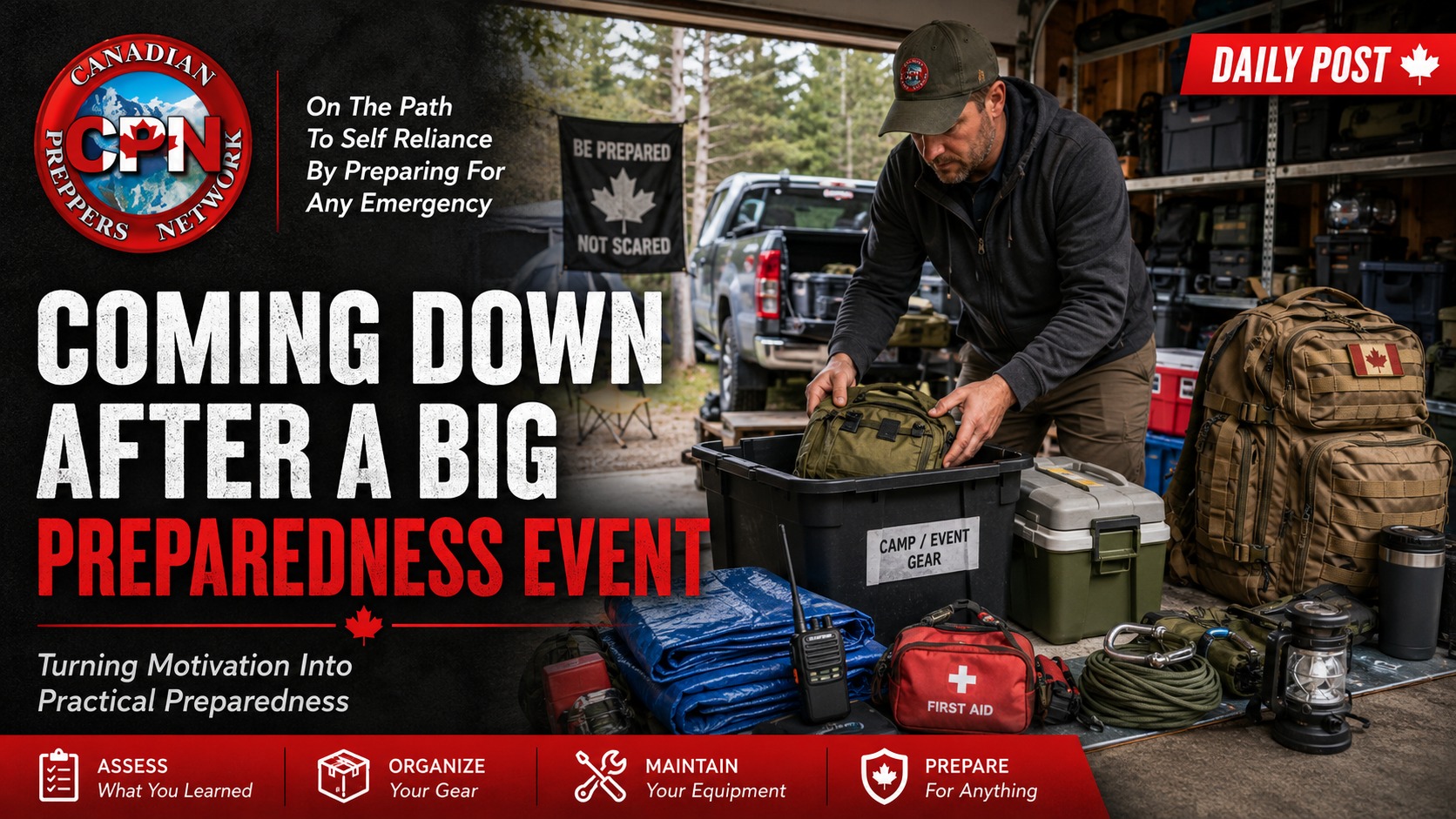
That sounds basic, but it matters. Camping gear, totes, coolers, radios, batteries, first aid supplies, cooking gear, water containers, clothing, tools, and tarps should not sit half-open in the garage for two weeks. Once you are home, give yourself time to put things away with intention.
This is when the real lessons show up.
What did you use constantly? What did you pack and never touch? What broke? What leaked? What was hard to find? What did you forget? What item saved you time, effort, or frustration? What did you borrow from someone else because you did not have your own?
Those answers are more useful than any gear review.
Preparedness is personal. A piece of equipment that looks impressive on a table may not earn its place in your kit after a weekend of actual use. On the other hand, something small and boring — a better headlamp, a labelled tote, extra cordage, a folding table, a power bank, a simple wash basin, or a proper rain shell — may turn out to be far more valuable than expected.
As you unpack, make three piles mentally.
The first pile is what worked. These are the items, systems, and habits that proved themselves. Keep them. Improve them if needed, but recognize that they have value.
The second pile is what failed. These are the items that broke, disappointed, caused frustration, or did not perform the way you expected. Some may need to be repaired. Some may need to be replaced. Some may need to be removed from your setup entirely.
The third pile is what was missing. This is where most people need discipline. A missing item does not automatically mean an immediate purchase. Sometimes the answer is buying something. Sometimes it is reorganizing what you already have. Sometimes it is learning a skill. Sometimes it is changing a procedure.
This is especially true with skills. A preparedness event can expose gaps very quickly. Maybe you realized that you are not as confident with knots as you thought. Maybe your fire-starting ability depends too much on ideal conditions. Maybe your radio knowledge is weak. Maybe your first aid kit is decent, but your ability to use it under stress needs improvement. Maybe your food plan works at home but becomes awkward when you are living outdoors for a few days.
That kind of discovery should not be discouraging. It is exactly the point.
It is far better to learn those lessons at a campground, workshop, or community event than during an actual emergency. Every inconvenience, mistake, forgotten item, and awkward setup is useful information. The goal is not to be embarrassed by it. The goal is to capture the lesson before it fades.
That is why the next step should be a short written review.
It does not need to be fancy. A notebook, spreadsheet, phone note, or printed checklist is enough. Write down what you learned while it is still fresh. Break it into categories if that helps: shelter, food, water, cooking, lighting, power, communications, medical, clothing, tools, transportation, security, hygiene, and comfort.
Then mark each item with one of three actions: fix, practise, or purchase.
Fixes should usually come first. Repair the damaged tote. Replace the missing tent peg. Repack the first aid kit. Recharge the batteries. Clean the stove. Dry the tarp. Wash the sleeping bag. Refill the propane. Re-label the food bins. These small tasks restore readiness quickly and prevent your gear from slowly degrading between uses.
Practice comes next. This is where many preppers skip ahead too quickly. Buying gear is easier than becoming competent. If you came home realizing that a skill needs work, schedule the practice. Set up the tarp again in the backyard. Program the radio again before you forget how. Cook a meal outdoors without using the kitchen. Run the generator safely. Try the water filter. Review the first aid procedure. Pack the vehicle again in a better order.
Purchases should come last, after the lessons have been sorted. That does not mean you should avoid buying useful gear. It means you should avoid emotional buying while the event excitement is still fresh. Give yourself a little distance. Decide what actually solves a problem and what simply looked appealing in the moment.
Another important part of coming down after a big preparedness event is reconnecting with your normal routine.
Preparedness is supposed to support your life, not consume it. After several intense days of travel, camping, talking, learning, organizing, volunteering, or attending workshops, most people need rest. That is not weakness. It is maintenance.
Rest matters because tired people make poor decisions. They overspend. They overcommit. They misjudge priorities. They start too many projects at once and finish none of them. A clear head is part of preparedness too.
Take a day or two to recover if you can. Get proper sleep. Eat real food. Rehydrate. Catch up on household basics. Spend time with family. Let the dust settle before making major changes to your preparedness plan.
Then choose one project.
Not ten.
One.
That project might be reorganizing your bug out totes. It might be improving your camp kitchen. It might be updating your communications plan. It might be building a better vehicle kit. It might be taking a first aid course. It might be practising food preservation. It might be reaching out to someone you met and continuing the conversation.
The point is to turn event energy into one completed improvement.
A single finished project is better than twenty half-started ideas.
There is also a community side to this. Events remind us that preparedness is not meant to be entirely solitary. Yes, every household should build its own resilience. Yes, personal responsibility matters. But no one knows everything, owns everything, or can do everything alone.
The conversations often matter as much as the presentations. The person beside you may have solved a problem you are still struggling with. Someone else may know a local supplier, a course, a radio club, a seed source, a canning group, or a practical workaround that never appears in online discussions. These relationships are part of preparedness.
After an event, follow up while the connection is still fresh. Send the message. Share the link. Ask the question. Thank the person who helped you. Keep the door open. Community does not build itself automatically. It is built through repeated contact, mutual usefulness, and trust over time.
That does not mean every person you meet becomes part of your inner circle. Preparedness relationships should still be built carefully. But dismissing community entirely is a mistake. Strong networks do not appear at the moment of crisis. They are built beforehand, slowly and deliberately.
A good preparedness event should leave you encouraged, not overwhelmed. It should remind you that there is always more to learn, but also that you are probably further along than you think. Every skill you practise, every piece of gear you test, every conversation you have, and every mistake you correct moves you forward.
The key is to come home and do something with it.
Unpack the gear. Capture the lessons. Fix what failed. Practise what was weak. Buy only what fills a real gap. Follow up with useful people. Choose one project and finish it.
That is how a weekend of inspiration becomes long-term preparedness.
Not by trying to change everything overnight.
By taking the energy, sorting it into priorities, and turning it into steady, practical action.