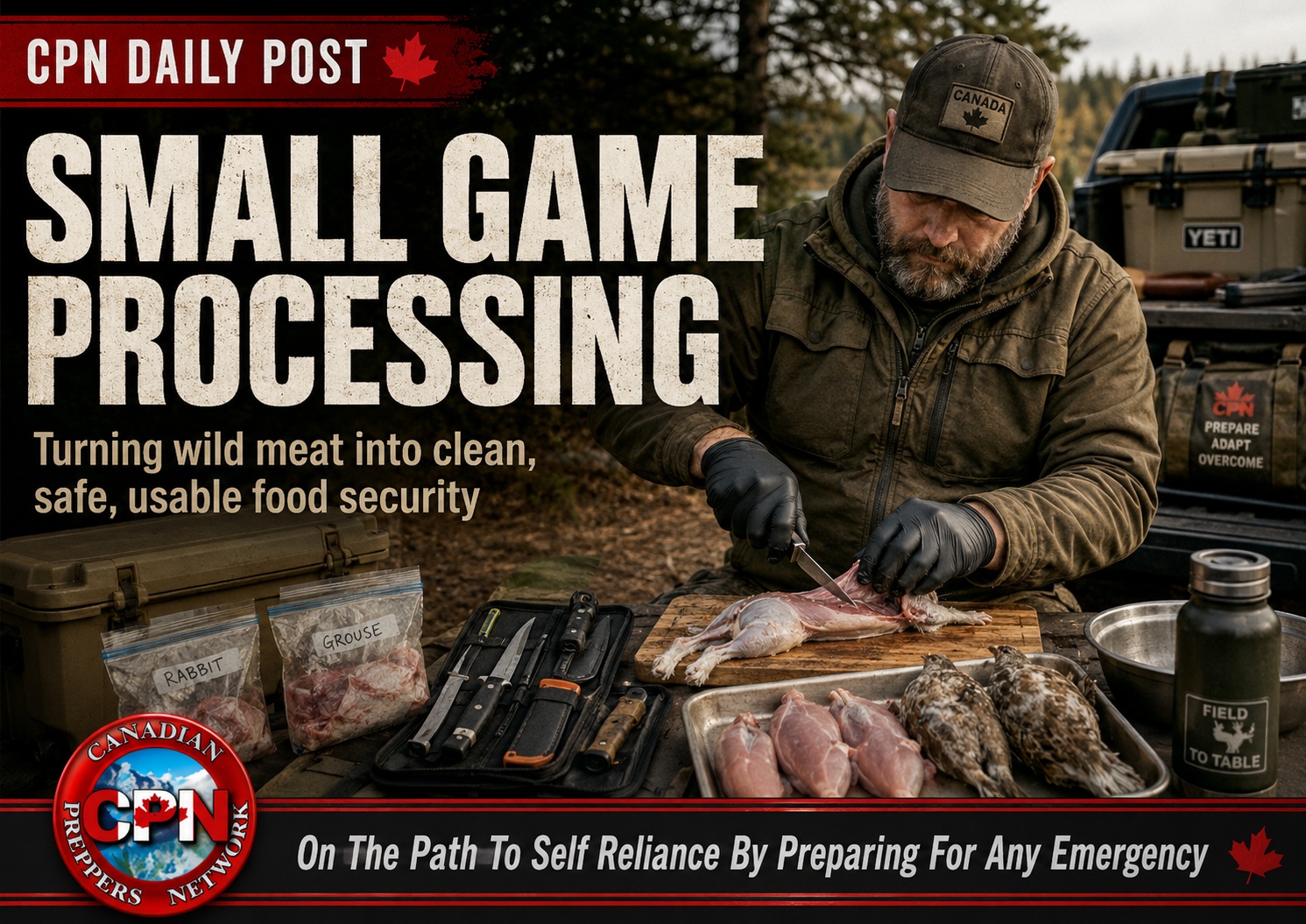
Turning wild meat into clean, safe, usable food security
Small game often gets treated like a backup plan in preparedness circles. People talk about rabbits, squirrels, grouse, ducks, and other small animals as though they are simply “there” when food runs short. But any experienced hunter, trapper, or homesteader knows better. Small game is only useful if you can handle it properly after it is harvested.
That is where many preparedness plans fall apart.
It is one thing to own gear, read about wild foods, or imagine putting meat in the pot after a long-term disruption. It is another thing entirely to take a legally harvested animal and turn it into safe, clean, usable food before heat, dirt, insects, poor storage, or bad handling ruin it. In a real emergency, that knowledge matters just as much as the harvest itself.
For Canadian preppers, small game processing is not about romantic survival fantasy. It is about food security. It is about reducing waste. It is about respecting the animal. And it is about understanding that meat does not become food until it has been properly handled, cooled, cleaned, cooked, preserved, or stored.
Free Canadian Grid-Down Starter Kit
A dependable food plan is only one part of household preparedness. Download the free Canadian Grid-Down Starter Kit to review the essentials of emergency food, water, heat, lighting, communications, sanitation, and backup power.
The first rule is simple: know the law before you ever need the skill. Hunting seasons, licences, bag limits, firearm rules, trapping rules, discharge bylaws, public land access, and species restrictions vary by province and sometimes by municipality. Preparedness does not exempt anyone from those rules. Training now, during legal seasons and under normal conditions, builds the skill without turning an emergency plan into a legal problem.
The second rule is even simpler: only healthy-looking animals should become food. Small game that appears sick, unusually thin, sluggish, wounded in an unexplained way, heavily infested, or behaving strangely should be left alone. That is not paranoia. That is basic food safety. In normal times, there are other food options. In hard times, getting sick from questionable meat can be worse than going without meat for one more meal.
Once an animal has been legally harvested, time becomes important. Warm meat spoils quickly, especially in summer or during early fall. Small game has an advantage over large game because it can often be cooled and processed more quickly, but that advantage disappears if it is carried around all day in a plastic bag, tossed into the sun, or left in a warm vehicle.
The goal is to keep it clean and cool from the beginning. Dirt, leaves, hair, feathers, intestinal contents, insects, and dirty water are all enemies of good meat. A clean work surface, disposable gloves, paper towels, breathable bags, and a cooler with ice packs can make the difference between a useful meal and a wasted animal.
This is where preparedness practice matters. Processing small game at home under calm conditions teaches you what you actually need. It teaches you how much room you need, how much time it takes, how many clean towels or gloves you go through, how quickly flies become a problem, and how much finished meat you actually get. A person who has only read about small game may imagine a full cooler. A person who has processed it understands yield, labour, and storage.
Small game should be dealt with in an orderly way. Inspect it first. Keep the edible meat away from dirt and waste. Remove what is not being used. Cool the meat promptly. Rinse only with clean, potable water when appropriate, and do not rely on pond, creek, ditch, or lake water to clean meat. If water quality is questionable, wiping with clean paper towels is often safer than introducing contamination.
The exact method depends on the animal. Rabbits and hares are not handled the same way as ducks. Grouse are not the same as squirrels. Some small game is skinned. Some is plucked. Some is best broken down into pieces. Some is better cooked whole. That is why this is a skill worth learning hands-on from an experienced hunter, trapper, butcher, or outdoor instructor rather than trying to figure it out for the first time when the power is out and the family is hungry.
The prepper lesson is not “go get small game someday.” The prepper lesson is “learn the complete food chain now.” Harvesting is one step. Processing is another. Cooking is another. Preserving is another. Storing is another. If any link fails, the food is lost.
Cooking small game also requires discipline. Wild meat should not be treated casually just because it is natural. Use a proper food thermometer. Cook small game thoroughly. Avoid cross-contamination between raw meat and cooked food. Keep separate cutting surfaces when possible. Wash hands, tools, and surfaces properly. In a grid-down situation, that may mean using stored water, a wash basin, camp soap, and a planned sanitation setup rather than relying on the kitchen sink.
This connects directly to broader food preparedness. If you already have a pressure canner, dehydrator, vacuum sealer, freeze dryer, or reliable freezer backup, small game becomes more useful. A few animals can be cooked and eaten fresh. A larger amount needs a plan. Meat can be portioned, frozen, canned, dried into appropriate recipes, or cooked into meals for short-term storage depending on your equipment and conditions.
That is why food storage supplies matter. The same jars, lids, pressure canner, vacuum sealer bags, freezer containers, Mylar bags, oxygen absorbers, and shelving used for store-bought food can also support legally harvested food. Food security is not just about buying calories. It is about having the equipment and knowledge to protect whatever food comes into your household. Our Food Storage Supplies Buying Guide covers the equipment used to package, protect, and organize those supplies.
Pressure canning deserves special mention. Meat is low-acid food, and low-acid food requires pressure canning, not water-bath canning. That is not a preference or an old-timer argument. It is a safety issue. If small game is going to become shelf-stable pantry food, it must be processed using tested pressure-canning methods and proper equipment. Those building this skill should review Mastering Pressure Canning and practise with normal grocery-store meat before relying on wild meat during a disruption.
Dehydration and freeze drying also have a place, but they need to be understood properly. Drying cooked meat for short-term trail meals is not the same as making shelf-stable food for years. Freeze drying can produce excellent long-term storage food when done correctly, but it still requires clean handling, proper packaging, oxygen control, and dry storage. Our article on food procurement and storage equipment explains how these systems fit into a layered preparedness pantry.
The biggest mistake is assuming small game is easy food. It can be reliable, but it is not effortless. You need legal access. You need skill. You need safe handling. You need fuel to cook it. You need storage options. You need sanitation. You need a realistic idea of yield. One rabbit is not a month of food. A few grouse are not a winter pantry. Small game is a supplement, not a magic solution.
That said, as a supplement, it can be extremely valuable. Small game can add protein and fat to stored staples like rice, beans, pasta, potatoes, bannock, soups, and stews. A little meat can improve morale and nutrition when most meals are built from dry goods. Bones and trimmings can help make broth. Tougher pieces can be slow cooked. Smaller portions can stretch a meal when combined with pantry basics.
This is where old-fashioned cooking knowledge matters. A prepper pantry full of staples becomes much more useful when you know how to turn small amounts of meat into soups, gravies, stews, pot pies, hash, fried rice, or pressure-canned meal starters. The goal is not to sit down to a giant plate of meat every night. The goal is to use available protein intelligently.
There is also a community angle. In a trusted group, not everyone needs to be good at the same thing. One person may hunt. Another may be better at processing. Someone else may understand pressure canning. Another may manage sanitation and water. Another may track inventory. That kind of division of labour turns random effort into a food system. It also prevents waste.
Practising now can be as simple as making small game part of your normal seasonal routine. Take a hunter education course. Learn from someone experienced. Process legally harvested game in normal conditions. Cook it in different ways. Try canning or freezing small portions. Keep notes on yield, time, flavour, and storage results. Figure out what equipment you wish you had before you need it.
For those who do not hunt, the lesson still applies. You can practise the same food-handling chain with store-bought whole poultry, rabbits from a butcher, farm-raised meat, or bulk meat purchased on sale. The skills overlap: cleanliness, temperature control, portioning, cooking, preserving, labelling, and inventory. You do not need to wait for an emergency to become competent.
Small game processing is not glamorous. It is work. It is messy at times. It requires patience, cleanliness, and attention to detail. But that is exactly why it belongs in a serious preparedness plan. The people who will eat best in hard times are not the ones with the most dramatic theories. They are the ones who can turn available resources into safe meals without wasting them.
If your food plan includes wild game, then your food plan must also include processing, cooking, preserving, and sanitation. Otherwise, it is not a food plan. It is just wishful thinking.
The time to learn is now, while mistakes are cheap, water still runs from the tap, replacement supplies are easy to get, and experienced people are still available to teach. Small game can be a real part of Canadian food preparedness — but only when the skill goes all the way from field to table.
Amazon Buying Box: Small Game Processing Gear
The best processing setup is not necessarily the biggest or most expensive. Look for washable handles, protective storage, practical blade shapes, and tools that can be cleaned easily between animals.
Small Game Processing Knife Sets — compact kits intended for rabbits, birds, and other small animals.
Complete Game Processing Knife Sets — larger kits containing several processing tools and a protective storage case.
Field-Dressing Knife Kits — portable sets that can be kept with normal hunting and processing equipment.
Boning Knife Sets — useful for separating usable meat and preparing portions for cooking or storage.
Knife Sharpeners — help keep processing tools working efficiently and under control.
Heavy-Duty Nitrile Gloves — help keep hands clean and simplify sanitation during processing.
Food-Safe Cutting Boards — choose a board that can be dedicated to raw meat and thoroughly washed after use.
Cooler Thermometers — confirm that meat is being held at a safe temperature rather than simply sitting near melting ice.
Reusable Cooler Ice Packs — provide cooling without surrounding the meat with questionable meltwater.
Breathable Game Bags — protect meat from dirt and insects while still permitting airflow.
Vacuum Sealer Bags — useful for portioning meat and reducing freezer damage during longer storage.
Freezer Tape and Labels — clearly mark the species, cut, and processing date before packages disappear into the freezer.
Digital Food Thermometers — confirm safe internal cooking temperatures instead of relying on appearance alone.