
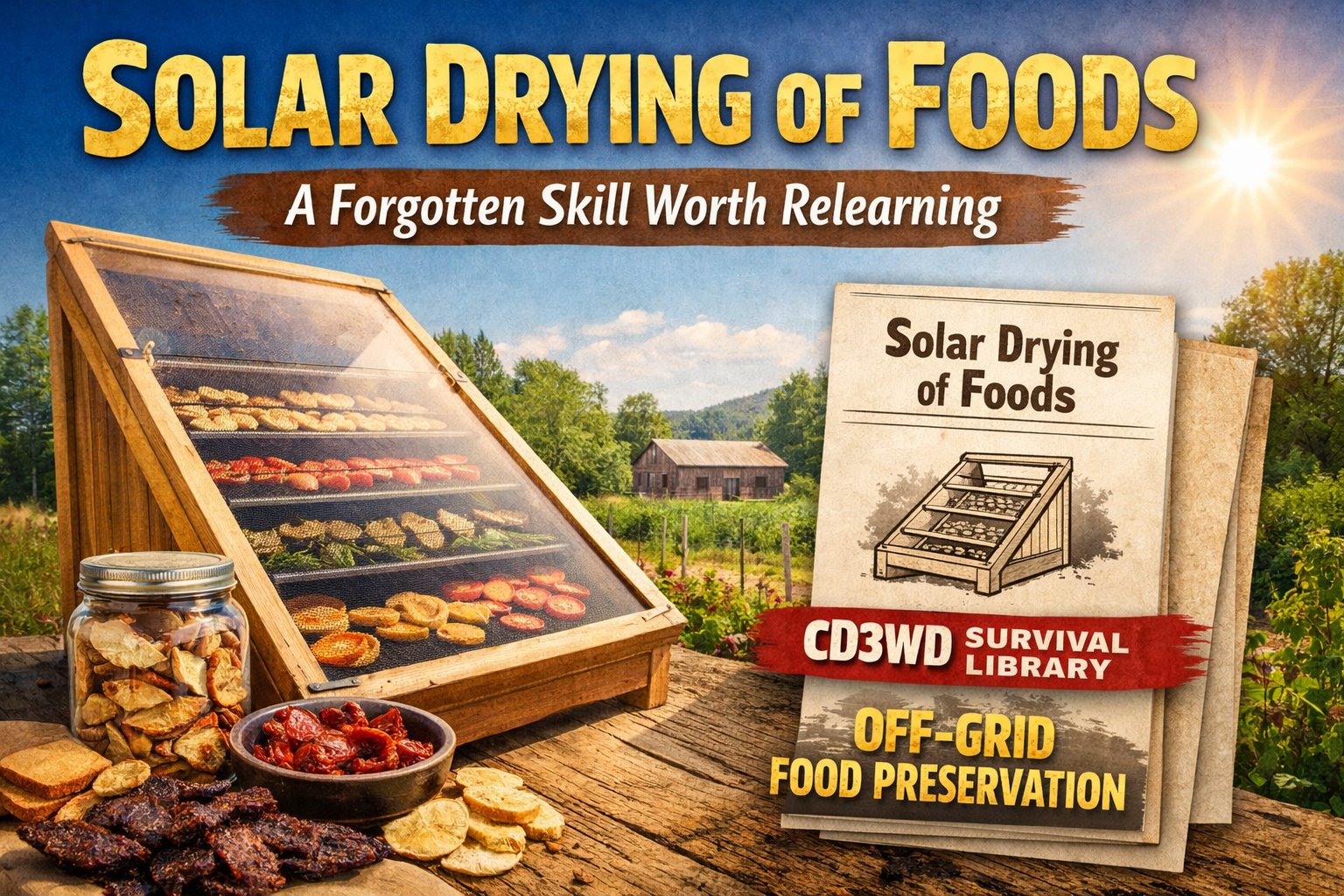
If you were choosing a single manual from the CD3WD archive that quietly solves several preparedness problems at once, Solar Drying of Foods would be near the top of the list. It sits at the intersection of food preservation, energy independence, and simple engineering—three things that matter enormously once modern conveniences stop working.
Most Canadians today think of food preservation in terms of freezers or pressure canners. Both are excellent tools, but they rely on either electricity or significant fuel inputs. Solar drying, by contrast, requires nothing more than sunlight, airflow, and patience. It is one of the oldest food preservation methods humanity has ever used, yet it remains remarkably effective.
The CD3WD manual explains this method in a very practical way. Instead of vague advice, it walks through how dehydration actually works. When moisture is removed from food, the microorganisms that cause spoilage cannot grow. That means fruits, vegetables, meat, and herbs can last for months or even years if properly dried and stored.
What makes the manual particularly valuable is that it focuses on building simple solar dryers, not just laying food out on trays and hoping for the best. Traditional open-air drying exposes food to insects, dust, and uneven temperatures. The designs in the manual solve those problems with surprisingly simple materials.
Most solar dryers share the same basic components:
• A dark heat-absorbing surface that captures solar energy
• An enclosed drying chamber with racks for food
• Ventilation openings that allow moist air to escape
• A clear cover (often glass or plastic) to trap heat
The result is essentially a small solar oven that runs at low temperatures—usually between 45 °C and 65 °C—which is ideal for slowly removing moisture without cooking the food.
For Canadian preppers, the obvious question is whether solar drying actually works in northern climates. The answer is yes, particularly during late summer and early fall when gardens produce the most food. Even moderate sunlight can drive effective dehydration when the dryer is properly designed to concentrate heat and airflow.
This is where the engineering details in the CD3WD manual become useful. It explains how to orient a dryer toward the sun, how to create natural convection airflow, and how to prevent condensation from forming inside the chamber. These small design choices can make the difference between a system that works well and one that produces moldy food.
The manual also covers which foods dry best. Fruits like apples, berries, and peaches dehydrate extremely well. Vegetables such as tomatoes, onions, carrots, and peppers are also excellent candidates. Herbs can be preserved with almost no effort. Even meat can be dried into jerky when properly prepared and protected from contamination.
From a preparedness perspective, solar drying solves several problems at once. It allows excess garden production to be preserved without electricity. It reduces food weight and storage space. It creates lightweight foods that are ideal for long-term storage or evacuation kits.
Perhaps most importantly, it turns the sun into a preservation tool. In a prolonged disruption where power grids are unreliable, that matters.
For readers who prefer a commercial solution rather than building a dryer from scratch, a simple solar dehydrator such as the All Season Solar Cooker Camper or similar designs available on Amazon Canada can provide the same function with minimal setup. Many preppers also combine solar drying with electric dehydrators like the Nesco Snackmaster Pro Food Dehydrator for times when grid power is available.
But the deeper lesson from the CD3WD manual is not about buying equipment. It is about rediscovering a skill that once allowed communities to store food without any modern infrastructure at all.
The Solar Drying of Foods manual is just one example of the kind of practical knowledge hidden inside the CD3WD archive. Thousands of similar manuals cover everything from rural water systems to small-scale farming and traditional toolmaking. Much of this knowledge was written for communities that had to operate with limited resources—exactly the conditions preppers prepare for.
That is why the Canadian Preppers Network Gold Membership includes access to the full CD3WD library. For about the price of a cup of coffee each year, members gain access to a massive offline technical archive that can be downloaded, stored locally, and used whenever it is needed.
Gear matters. Supplies matter. But knowledge—the kind preserved in manuals like Solar Drying of Foods—is what allows people to keep functioning when systems fail.
And once you have that knowledge stored on your own drive, it never disappears when the internet does.