Designing a Resilient Protein System That Doesn’t Depend on the Freezer
Most Canadian prepper pantries look impressive — stacked rice, flour, oats, sugar. Calorie-dense, visually reassuring.
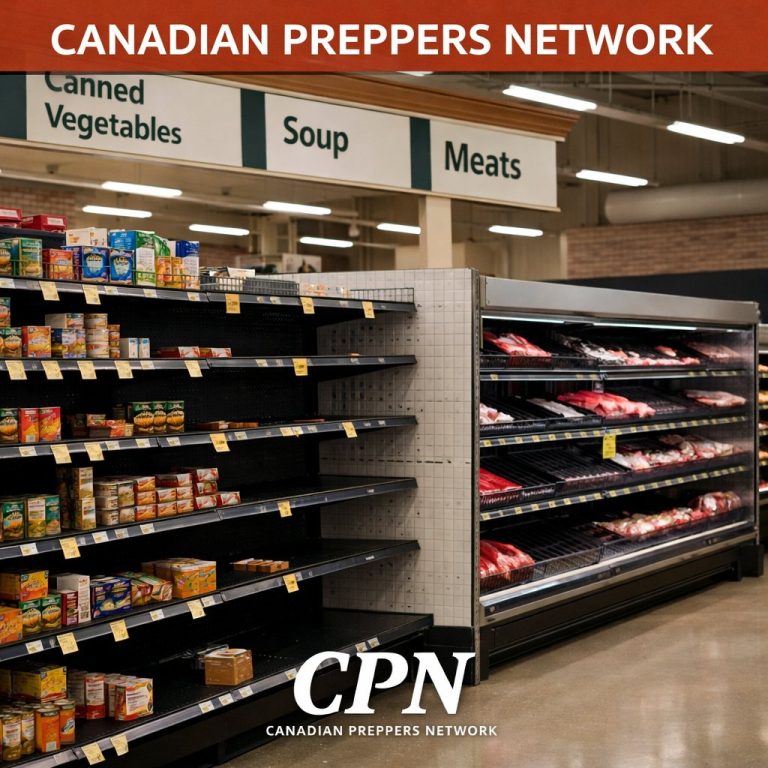
But when you strip away refrigeration and regular grocery access, protein becomes the structural weak point. In a prolonged disruption — whether economic, logistical, or grid-related — carbohydrates will remain available longer than meat. The shelves empty in a predictable order. Protein disappears first.
In a Central Ontario climate, or anywhere in Canada where winter limits fresh production for months, protein storage must be deliberate, mathematical, and layered.
This is not about collecting random cans. It’s about designing a protein architecture.
The Annual Protein Reality
Before discussing storage types, we need honest numbers.
A moderately active adult requires approximately 60 grams of protein per day. Cold weather labour, wood processing, livestock chores, or extended stress conditions increase that requirement.
For a household of four:
| Metric | Amount |
|---|---|
| Daily Requirement | 240 g |
| Monthly Requirement | 7,200 g |
| Annual Requirement | 87,600 g |
That is nearly 88 kilograms of pure protein per year.
Now convert that into actual food weight.
Dry Legumes: The Foundation Layer
Beans and lentils remain the most cost-efficient long-term protein accessible to Canadians.
Protein Density Comparison (Dry Weight)
| Food | Protein / 100g | Food Required for 87,600g Protein | Approximate Weight Needed |
|---|---|---|---|
| Pinto Beans | 21 g | 417 kg | 920+ lbs |
| Red Lentils | 25 g | 350 kg | 770+ lbs |
| Chickpeas | 19 g | 461 kg | 1,015+ lbs |
Even at higher protein lentil levels, a family of four would require hundreds of kilograms annually if relying solely on legumes.
Stored properly in mylar with oxygen absorbers inside sealed buckets, shelf life can exceed 25 years. Canadian storage kits are widely available, such as complete 5-gallon bucket systems:
https://www.amazon.ca/dp/B08T1FJ5Y7?tag=canadianpreppersnetwork-20
But legumes have operational costs. They require water and prolonged cooking — typically 60–90 minutes boiling. In a winter outage scenario, that translates directly into wood, propane, or alcohol fuel consumption.
A pressure canner like the All American 921 reduces cooking time significantly:
https://www.amazon.ca/dp/B00004S88Z?tag=canadianpreppersnetwork-20
Legumes are the structural base. They are not the whole plan.
Canned Meat: The Operational Layer
Canned meat eliminates the fuel variable. It provides immediate protein without soaking or extended boiling.
Common Canadian grocery options include products from Kirkland Signature and Clover Leaf.
Protein Density & Shelf Stability
| Product | Protein / 100g | Practical Shelf Life |
|---|---|---|
| Canned Chicken | 21–23 g | 7–10 years (cool storage) |
| Canned Salmon | 20–22 g | 6–10 years |
| Canned Ham | 18–20 g | 5–8 years |
While official labeling may suggest 3–5 years, properly stored canned meats routinely exceed those timelines.
Cost per gram of protein is higher than legumes, but operational flexibility increases dramatically. In early-stage disruptions — when fuel uncertainty is highest — canned meats stabilize nutrition.
Freeze-Dried Protein: The Strategic Reserve
Freeze-dried protein provides depth.
Brands such as Mountain House and Augason Farms offer 20–25 year shelf stability.
Comparative Storage Efficiency
| Category | Shelf Life | Storage Weight | Water Required | Cost per Gram Protein |
|---|---|---|---|---|
| Dry Beans | 20–30 yrs | High | High | Very Low |
| Canned Meat | 7–10 yrs | High | None | Moderate |
| Freeze-Dried | 20–25 yrs | Very Low | Moderate | High |
Freeze-dried products dramatically reduce storage weight and space, but they require water for rehydration and carry higher upfront cost.
Powdered whole eggs — critical for baking and morale — remain one of the most versatile protein stores available:
https://www.amazon.ca/dp/B00FTE6L90?tag=canadianpreppersnetwork-20
Freeze-dried is insurance, not daily use.
The Fuel Equation Most Preppers Ignore
Protein storage is inseparable from cooking energy.
If a family relies heavily on dry legumes, fuel consumption increases significantly. In a Canadian winter, where daylight is limited and wood processing is labour-intensive, this becomes a compounding burden.
Consider the approximate fuel requirement comparison:
| Protein Source | Cooking Time | Fuel Demand |
|---|---|---|
| Dry Beans (boiled) | 60–90 min | High |
| Dry Beans (pressure) | 20–30 min | Moderate |
| Canned Meat | 0 min | None |
| Freeze-Dried | 5–10 min heat water | Low |
Fuel-efficient protein planning reduces overall strain on energy reserves.
A Balanced 6-Month Canadian Protein Model
For a realistic six-month buffer (43,800 g protein requirement):
| Storage Layer | Approximate Contribution |
|---|---|
| 90 kg Lentils | ~22,500 g protein |
| 60 Cans Mixed Meat | ~12,000 g protein |
| Freeze-Dried Reserve Bucket | ~8,000–10,000 g protein |
This blended approach reduces fuel load, balances cost, and creates depth.
Cold Climate Storage Considerations
In Central Ontario and similar regions, winter temperatures reduce insect risk but increase condensation risk.
Canned goods must not freeze repeatedly — expansion can compromise seals. Garages and sheds require insulation or rotation.
Dry goods must remain below 15% humidity to prevent spoilage.
Root cellars can stabilize temperature but must remain dry and rodent-proof.
Protein stores are dense, heavy, and moisture-sensitive. Storage planning must reflect that reality.
Final Perspective
Food security is not about filling shelves. It is about macronutrient sufficiency over time.
A pantry dominated by carbohydrates may feel full, but without structured protein planning, it leads toward long-term weakness.
In a Canadian preparedness model — especially one oriented toward retreat development or extended winter resilience — protein must be:
- Layered
- Fuel-aware
- Cost-calculated
- Cold-climate compatible
Calories keep you alive.
Protein keeps you functional.