Micron Ratings, Virus Protection, and What Canadian Families Actually Need
In Canada, boil-water advisories, ice storms, wildfire evacuations, and aging infrastructure are not theoretical risks. They happen yearly. Stored water buys you time. Filtration gives you sustainability.
Today we’re drilling down into micron ratings, pathogen size, virus capability, and realistic daily output for a Canadian family of four — and we’re linking directly to actual Amazon.ca options you can source immediately.
If you missed our broader municipal planning piece, review it here:
https://canadianpreppersnetwork.com/urban-water-disruption-preparedness/
Micron Size: The Numbers That Matter
A micron (µm) equals one-millionth of a metre.
For preparedness planning:
- Sediment: 5–25 microns
- Protozoa (Giardia, Crypto): 1–15 microns
- Bacteria (E. coli): ~0.2–2 microns
- Viruses: 0.004–0.1 microns
Key takeaway:
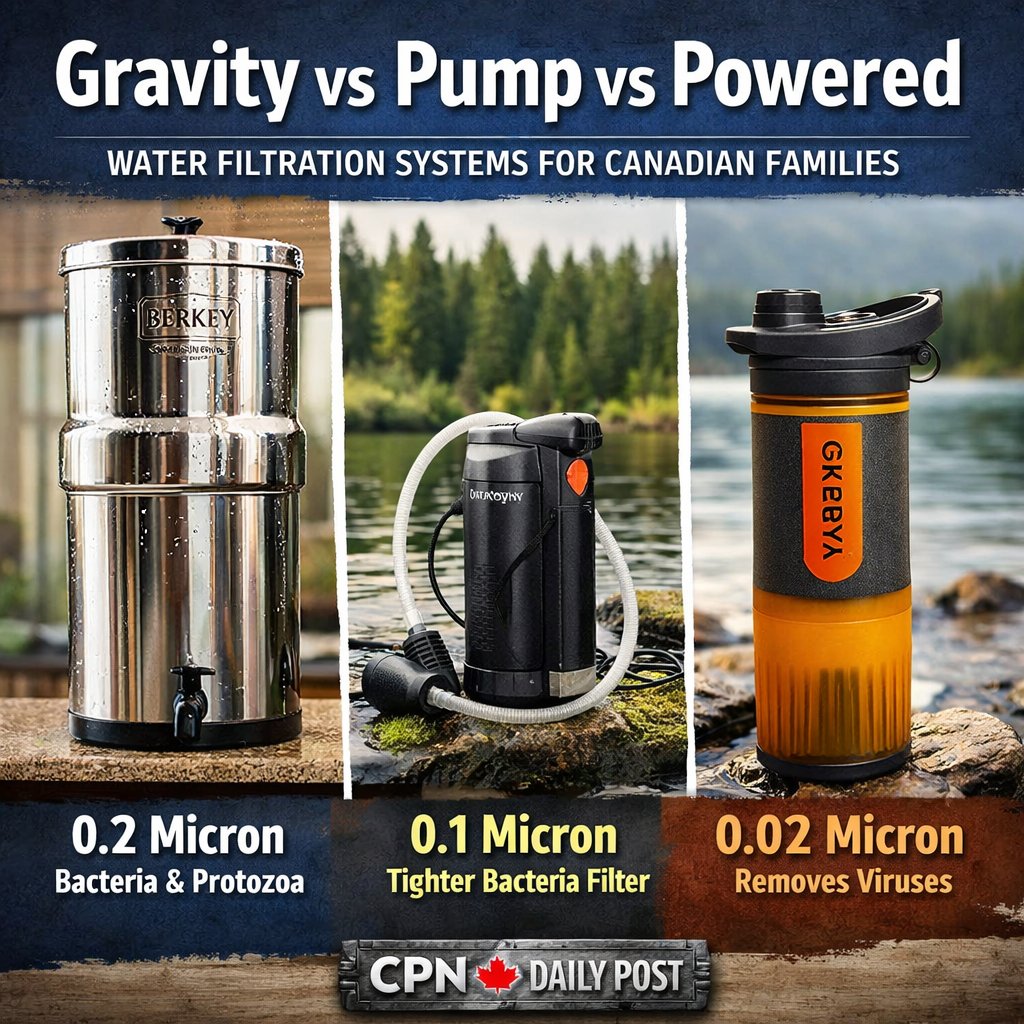
- 0.2 micron filter → removes bacteria & protozoa
- 0.1 micron absolute → stronger bacterial removal
- 0.02 micron → virus-level filtration
Anything larger than 0.1 micron does not reliably remove viruses.
1️⃣ Gravity Filtration Systems (0.2–0.5 Micron Typical)
Common Canadian household systems include:
- Berkey stainless systems
- Alexapure Pro
- ProOne gravity units
Typical Micron Rating
Most gravity carbon block elements are rated:
- 0.2–0.5 micron (nominal)
Nominal means ~85% particle removal at that size. Absolute means 99.9%+. Many gravity filters use nominal ratings.
What They Remove
✔ Sediment
✔ Protozoa
✔ Bacteria
✔ Chlorine & heavy taste
✖ Viruses (unless paired with chemical treatment)
Amazon.ca Example
A stainless steel gravity system like this is ideal for long-term household use:
Berkey Travel Gravity-Fed Water Filter
https://www.amazon.ca/dp/B00CYW3EVO?tag=canadianpreppersnetwork-20
These units can produce 15–25 litres per day passively — perfect for a family.
2️⃣ Manual Pump Filters (0.1–0.2 Micron Absolute)
Well-known field options:
- Katadyn Hiker Pro
- MSR MiniWorks
- LifeStraw Mission
Micron Rating
Most pump filters are:
- 0.1–0.2 micron absolute
This reliably removes:
✔ Bacteria
✔ Protozoa
✔ Sediment
✖ Viruses (unless labeled purifier)
Amazon.ca Example
Katadyn Hiker Pro Hand Pump Filter:
https://www.amazon.ca/dp/B000KUVVY4?tag=canadianpreppersnetwork-20
Realistically, expect 10–20 litres per hour with sustained pumping.
Manual pumps are best for:
- Evacuations
- Cabin use
- Secondary backup
- Vehicle kits
They are not ideal for full-time family production.
3️⃣ Virus-Rated Purifiers (0.02 Micron or UV)
This is where the capability changes.
Examples:
- Grayl GeoPress (mechanical virus removal)
- Steripen UV systems
Micron Rating
Mechanical virus purifiers use membranes around:
- 0.02 microns
This level removes:
✔ Protozoa
✔ Bacteria
✔ Viruses
UV purifiers do not rely on micron size — they neutralize microbes using ultraviolet light. However, water must be clear and batteries are required.
Amazon.ca Example
Grayl GeoPress Purifier Bottle:
https://www.amazon.ca/dp/B07QRSZ1Q9?tag=canadianpreppersnetwork-20
This provides true virus-level protection for high-risk environments, though daily family volume production would be slow.
Stored Water: The Foundation
Before filtration even begins, every Canadian household should maintain at minimum:
- 4 litres per person per day
- 7–14 days stored
For a family of four, that’s 112–224 litres minimum.
Reliable storage option:
20L Stackable BPA-Free Water Container
https://www.amazon.ca/dp/B07GZV9Y35?tag=canadianpreppersnetwork-20
Stackable containers allow you to rotate and manage volume efficiently.
Daily Family Output Reality
Family of four:
- Drinking & cooking: ~16–20 litres/day
- Hygiene minimal use: additional volume
Your system must sustain that output without exhausting you.
Gravity = sustainable
Pump = labour
Virus purifier = precision tool
The smart Canadian prepper layers all three.
For further reading, see our breakdown of municipal water failure scenarios:
https://canadianpreppersnetwork.com/municipal-water-failure-scenarios/
Final Assessment
Micron size determines capability — not marketing.
- 0.5 micron → sediment reduction
- 0.2 micron → bacteria/protozoa
- 0.1 micron absolute → stronger bacterial control
- 0.02 micron → virus removal
A properly built Canadian water system includes:
- Stored water
- Gravity filtration
- Manual backup
- Virus-capable purifier
Water security isn’t gear collecting. It’s layered engineering.