Water storage is often treated as a solved problem: fill, seal, store.
That assumption is incorrect.
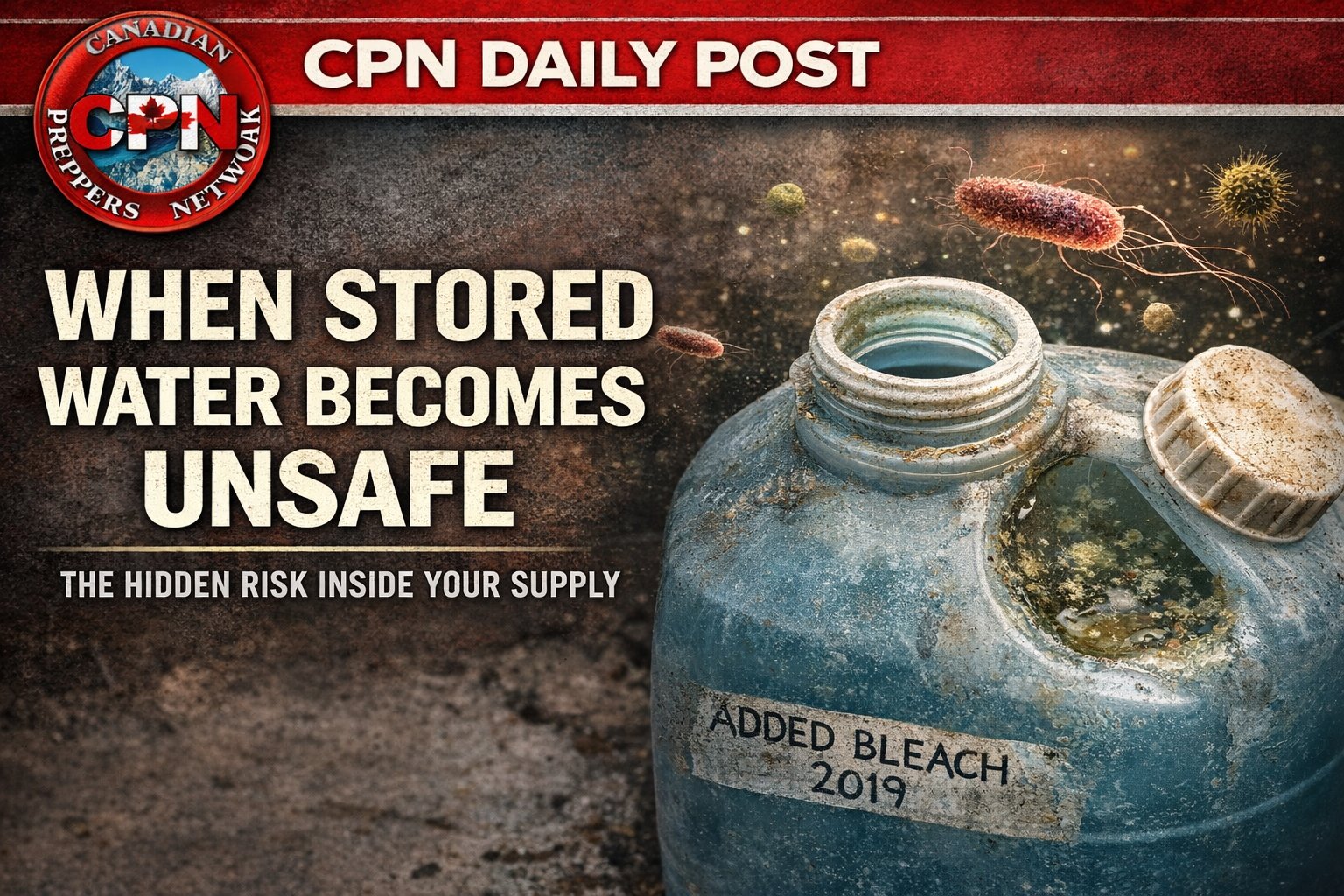
Stored water is a controlled biological and chemical environment, and without proper handling, it will degrade in ways that are not always visible, detectable, or reversible. In a failure scenario, that degradation becomes a direct health risk.
This is not theoretical. It is predictable.
Microbiological Growth: The Primary Failure Mechanism
Even properly treated water is not sterile. It is biologically suppressed, not eliminated.
Over time, several factors contribute to microbial resurgence:
- Residual disinfectant dissipates
- Trace organic material supports growth
- Temperature fluctuations accelerate reproduction
The most common issue is biofilm formation.
Biofilms are structured microbial communities that adhere to container surfaces and produce a protective matrix. This matrix shields bacteria from chlorine and continuously re-contaminates stored water.
Once established, biofilm cannot be removed through rinsing alone.
You need mechanical cleaning tools, not just chemicals.
A proper long-handle cleaning brush makes the difference between surface rinsing and actually breaking biofilm adhesion:
https://www.amazon.ca/s?k=long+handle+water+container+cleaning+brush&tag=canadianprep-20
Chlorine Decay and Loss of Residual Protection
Municipal chlorine does not last in storage.
Within weeks to months:
- Free chlorine dissipates
- UV exposure accelerates breakdown
- Warmer temperatures increase loss
That leaves water unprotected.
You must treat water at storage time using unscented sodium hypochlorite (plain household bleach):
https://www.amazon.ca/s?k=unscented+household+bleach&tag=canadianprep-20
For accuracy and repeatability, a measured dropper bottle or dosing syringe is worth having:
https://www.amazon.ca/s?k=liquid+dropper+bottle+ml&tag=canadianprep-20
Guesswork is how people either under-treat—or poison their own supply.
Material Science: Container Failure and Chemical Risk
Not all containers are suitable for long-term storage.
You want food-grade HDPE, thick-walled, and designed for static storage—not disposable transport.
Reliable options include:
- Stackable, purpose-built containers:
https://www.amazon.ca/s?k=waterbrick+stackable+water+container&tag=canadianprep-20 - Large-volume 55-gallon drum systems:
https://www.amazon.ca/s?k=food+grade+water+storage+drum+55+gallon&tag=canadianprep-20
Cheap containers fail under:
- UV exposure
- Freeze expansion
- Long-term stress
When they fail, they don’t warn you.
Environmental Stressors: Canadian Conditions Matter
Water storage advice that ignores climate is incomplete.
In Canada, your system must survive:
Freeze Expansion
Water expands ~9% when frozen.
Without headspace:
- Containers crack
- Seals fail
- Structural integrity is lost
Temperature Cycling
Repeated expansion/contraction accelerates material fatigue.
Light Exposure
Promotes algae growth and degrades residual disinfectant.
Opaque, UV-resistant containers are not optional—they are required.
Controlled Dispensing: Preventing Secondary Contamination
One of the most common failure points isn’t storage—it’s access.
Every time you open a container:
- You introduce contaminants
- You break the internal environment
A sealed system with a spigot reduces risk significantly:
https://www.amazon.ca/s?k=water+storage+container+spigot&tag=canadianprep-20
Better yet, use a manual water pump for large containers:
https://www.amazon.ca/s?k=manual+water+pump+for+5+gallon+jug&tag=canadianprep-20
This prevents hands, cups, and debris from entering the system.
Detection Limits: Why You Need Redundancy
You cannot rely on your senses.
Clear water can still contain:
- Bacteria
- Protozoa
- Chemical contaminants
This is why stored water should always have a secondary treatment pathway before consumption.
A gravity-fed system provides a reliable final barrier:
https://www.amazon.ca/s?k=berkey+water+filter+system&tag=canadianprep-20
For mobility and redundancy, a field filter is essential:
https://www.amazon.ca/s?k=sawyer+mini+water+filter&tag=canadianprep-20
Filters are not optional. They are your safety net when storage fails.
System Failure Is Predictable—If You Ignore Maintenance
A technically sound system requires:
- Verified container integrity
- Proper initial disinfection
- Controlled storage environment
- Scheduled rotation
- Clean dispensing methods
- Redundant filtration
Miss one, and the system begins to degrade.
Miss several, and it becomes unsafe.
Final Assessment
Water storage is not a passive asset.
It is a managed system with biological, chemical, and physical failure points.
If you treat it like a one-time task, it will eventually fail you.
If you treat it like a system—maintained, monitored, and verified—it becomes one of the most reliable assets you have.
And when everything else starts to break down, that reliability is what keeps you in control.