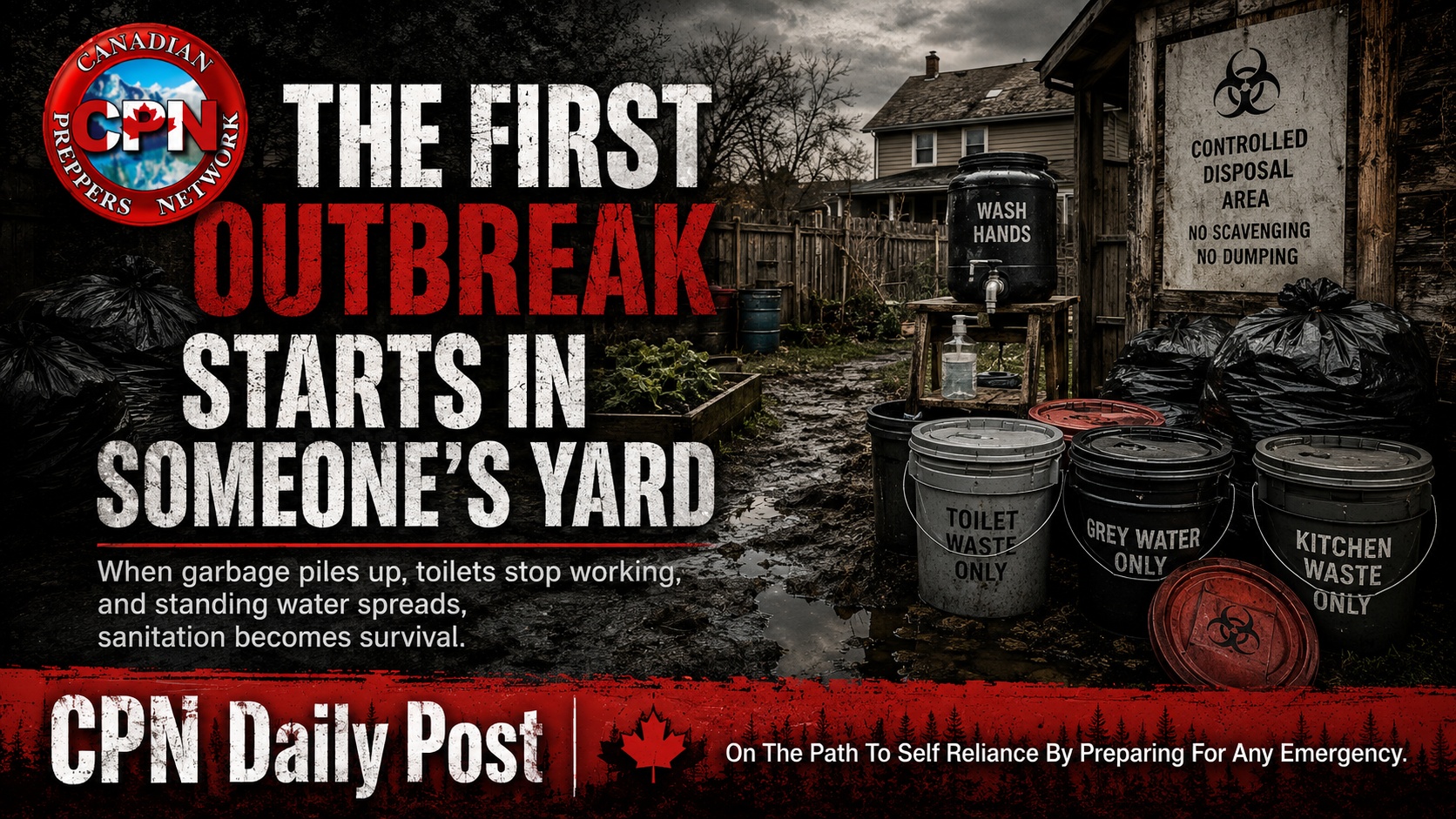
When garbage piles up, toilets stop working, and standing water spreads, sanitation becomes survival.
Most people imagine collapse as a food problem, a power problem, or a security problem.
They picture empty shelves, dark streets, dead phones, dry taps, and maybe a few desperate neighbours knocking on doors.
What they do not picture is the yard.
Bags of garbage split open by animals. Buckets of waste sitting too close to the house. Dishwater dumped wherever it is convenient. Pets dragging filth back onto the porch. Rainwater flowing through the wrong part of the property and carrying the problem with it.
That is where the first local outbreak starts.
Not in a hospital. Not in some dramatic movie scene. In somebody’s yard, because nobody had a sanitation plan once normal collection, flushing, drainage, and municipal treatment stopped working.
Food keeps you fed. Water keeps you alive. Sanitation keeps the household from poisoning itself.
If you are preparing for a long grid-down emergency, sanitation cannot be treated as an afterthought. It has to be planned before the stink, panic, pests, and sickness begin.
The Collapse Nobody Wants To Talk About
Modern homes are built around invisible services.
You flush, and the problem disappears. You bag garbage, and someone takes it away. You rinse a cutting board, and the water vanishes down the drain. You wash your hands, turn off the tap, and never think about where the clean water came from or where the dirty water went.
That convenience is fragile.
In a long emergency, garbage collection may stop. Sewer lift stations may fail. Septic systems may become overloaded. Municipal water pressure may drop or become unreliable. Sump pumps may quit. Toilets may become unusable. Refrigerated food may spoil. Animals and insects will find every weak point.
The danger is not just filth.
The danger is filth moving into the wrong places.
Waste near water. Dirty hands near food. Wash water near drinking water. Garbage near sleeping areas. Pets near contaminated zones. Standing water near the house. Tools used for waste and then carelessly used somewhere else.
That is how a strong household gets weak fast.
Preparedness is not just about having a filter, a barrel, and a few cases of bottled water. It is about keeping clean systems clean and dirty systems contained.
For a deeper water planning framework, start with the CPN water hub here:
Water Collection & Purification in Canada
The Yard Becomes The Front Line
Once normal services fail, the yard becomes part of the household survival system.
That means it needs zones.
There should be a clean zone, where drinking water, food preparation, medical care, bedding, and clean storage remain protected.
There should be a grey zone, where washing, laundry, tool cleaning, boot cleaning, and controlled greywater handling happen.
There should be a dirty zone, where garbage, toilet waste, contaminated materials, spoiled food, animal waste, and anything questionable are kept away from living areas, water storage, gardens, and normal foot traffic.
If those zones blur, the household starts losing control.
In a normal week, that might mean a bad smell. In a collapse, it can mean stomach illness, infected cuts, contaminated drinking containers, or a house full of flies and rodents.
The household that survives longest will not necessarily be the one with the biggest pantry. It may be the one with the cleanest boundaries.
The Real Garbage Plan: Reduce, Strip, Sort, Bury
Here is the hard truth: if garbage collection stops for weeks or months, there is no magic trick that makes household waste disappear.
You cannot store it all forever. You cannot burn everything safely. You cannot compost everything. You cannot just pile it behind the shed and hope animals, insects, rain, and stink leave it alone.
A real post-collapse garbage plan has to do four things.
First, stop creating as much garbage.
Second, strip useful material out of the waste stream.
Third, compost or feed safe organic waste where appropriate.
Fourth, place the remaining non-hazardous garbage into a controlled disposal cell away from the house, water, gardens, animals, and foot traffic.
That last part matters.
In a long emergency, every serious homestead or bug-in location needs a place where true waste can be contained. Not a random dump pile. Not a burn pit full of plastic and batteries. Not garbage bags stacked beside the garage.
A controlled disposal cell.
Think of it as an emergency dry landfill for your own household.
This is not for normal times. In normal times, use municipal garbage, recycling, hazardous-waste depots, and legal disposal options. But in a true long-term breakdown where collection has stopped and waste is becoming a health threat, the household needs a fallback.
The first rule is location.
The disposal cell should be far from wells, springs, creeks, ponds, drainage ditches, garden beds, animal pens, food storage, and living areas. It should not be placed where rainwater will run through it and carry contamination downhill. It should not be near the house just because that is convenient. Convenience is how the yard turns into a disease problem.
Choose high ground if possible. Avoid wet areas. Avoid places where water collects. Avoid areas where digging exposes standing water. Keep it out of the normal path used by people, pets, livestock, and daily chores.
The second rule is separation.
Not everything goes into the disposal cell.
Food scraps do not belong there if they can be composted, fed safely to animals, or otherwise managed without attracting pests. Clean cardboard and paper should be saved for fire starting, compost balance, animal bedding, insulation, or controlled clean burning where safe and legal. Glass jars, metal tins, buckets, bottles, containers, feed bags, and useful packaging should be cleaned and stored for reuse.
Hazardous waste never goes into the household disposal cell.
Batteries, fuel containers, oil, solvents, cleaners, pesticides, paint, aerosol cans, electronics, propane cylinders, medical sharps, and chemical containers must be isolated separately. Those are not “garbage.” They are future poison, fire risk, injury risk, or contamination risk.
The disposal cell is for the ugly leftovers: non-reusable, non-compostable, non-hazardous household waste that cannot be safely burned or repurposed.
That may include damaged packaging, broken non-sharp household items, contaminated but non-hazardous materials, worn-out fabric scraps, ruined plastic items, and general dry refuse that would otherwise pile up and attract pests.
The third rule is volume reduction.
Before anything goes into the cell, reduce it.
Crush cans if they are not being reused. Flatten packaging. Cut large ruined plastic items down if safe to do so. Remove air space. Keep the waste as dry as possible. Wet garbage stinks, leaks, freezes into disgusting blocks in winter, and becomes a far bigger problem in warm weather.
A household that reduces volume daily can stretch a disposal area much longer than a household that throws bulky waste around carelessly.
The fourth rule is cover.
A disposal cell should not remain open like a dump.
Waste should be added in layers and covered with soil, ash from clean wood fires, dry leaves, sawdust, old bedding material, or other dry cover material. The purpose is to reduce smell, limit flies, discourage animals, and keep loose material from blowing around.
The cover layer is not decoration. It is pest control.
If animals can dig it up easily, the system is not good enough. If rainwater is running through it, the location is wrong. If the smell reaches the house, the cell is too close, too wet, too open, or being used for the wrong kind of waste.
The fifth rule is marking.
A disposal cell should be marked and remembered.
Do not create mystery pits all over the property. Do not bury waste where someone may later garden, dig a post hole, set up a tent, build a shelter, or place an animal pen. Mark the area clearly. Map it if necessary. Keep it out of future food-production zones.
A garbage cell is a controlled sacrifice area. It solves one problem by assigning waste to one place instead of letting it spread everywhere.
That is the point.
The Daily Garbage Routine
Every day, the household should sort waste before it becomes a pile.
Useful containers are cleaned and stored.
Clean paper and cardboard are dried and saved.
Safe plant scraps go to compost or animal use.
Food waste that cannot be used is sealed and dealt with quickly.
Hazardous waste is isolated.
True leftover garbage is dried, compacted, and moved to the dirty-zone staging container.
When enough has accumulated, it goes to the disposal cell and is covered.
This routine keeps garbage from building up inside the house. It keeps animals from tearing through bags. It keeps dirty waste away from water and food. It gives the household one controlled place to manage the problem instead of allowing dozens of small contamination points to spread across the property.
The Worst Garbage Mistakes
The worst mistake is burning everything.
Burning clean paper, plain cardboard, and untreated wood may be useful where conditions allow. Burning plastic, foam, treated wood, batteries, chemical containers, synthetic fabric, aerosol cans, and mystery garbage is a different matter. That creates toxic smoke and residue. In a collapse, breathing your own garbage smoke is not a survival strategy.
The second worst mistake is dumping garbage in the bush.
That attracts animals, spreads contamination, creates injury hazards, and turns your property into a scavenger site. It may feel like the problem has moved away from the house, but it has not disappeared. It has only become harder to control.
The third mistake is mixing food waste with dry garbage.
Food waste is what brings flies, raccoons, rats, dogs, bears, and stink. Keep it separate and deal with it fast.
The fourth mistake is putting hazardous waste into the general pile.
One leaking battery, one punctured fuel container, one chemical bottle, or one sharp object in the wrong place can turn garbage management into a medical or contamination problem.
The fifth mistake is waiting too long.
Garbage discipline has to start while the house is still clean. If the system begins only after the bags are already leaking and animals are already interested, the household is reacting instead of controlling.
Hazardous Waste In A Permanent Breakdown
In normal times, hazardous waste goes to municipal depots, pharmacies, recycling centres, specialty collection days, or approved disposal sites.
That is the proper answer while the system still exists.
But a serious preparedness plan has to consider the harder question: what if those systems do not come back for years, or ever?
In that case, “wait for safe disposal” is not enough.
Hazardous waste needs a long-term strategy.
The goal is not to casually get rid of it. The goal is to reduce it, use what can be safely used for its intended purpose, recover useful materials where practical, stabilize what remains, and permanently isolate what cannot be made safe.
That means hazardous waste needs its own plan, separate from garbage, compost, human waste, greywater, and ordinary household refuse.
The first rule is prevention.
Stop buying products that will become a disposal nightmare if the system fails. Avoid mystery chemicals, unnecessary pesticides, aerosol products, cheap disposable electronics, single-use batteries, and half-used jugs of cleaners that will sit for years. In a permanent disruption, today’s convenience product becomes tomorrow’s poison problem.
Buy simpler supplies. Use products fully. Keep fewer chemical categories. Store what you understand. Label everything. Do not create a shed full of half-empty containers that nobody can identify five years later.
The second rule is useful depletion.
Some hazardous materials are only waste because they are sitting unused.
Fuel should be rotated and used in proper engines or heaters while it is still usable. Lubricants should be saved for tools, hinges, chains, firearms maintenance where appropriate, hand pumps, and machinery. Paint should be used for maintenance before it ruins. Solvents and cleaners should be used only for their intended purposes and stretched carefully. Batteries should be used, recharged where possible, salvaged from dead devices where safe, or stored for future repair work.
A permanent collapse household cannot afford to throw away usefulness.
But useful depletion is not the same as reckless dumping. Used oil does not go into a ditch. Old fuel does not get poured onto the ground. Solvents do not get dumped behind the shed. Batteries do not get cracked open by amateurs looking for parts. Pesticides do not get sprayed casually just to empty the bottle.
If it can still serve a controlled purpose, use it carefully. If it cannot, isolate it.
The third rule is material recovery.
Some hazardous items contain useful parts.
Electronics may provide wire, switches, screws, small motors, magnets, cases, heat sinks, connectors, fuses, LEDs, and circuit boards. Broken appliances may contain repair parts. Dead battery-powered tools may still provide housings, chargers, switches, screws, or motors. Empty metal containers may become scrap. Plastic cases may be useful for storage or repair.
Before declaring something waste, strip useful non-dangerous parts from it.
But do not cross the line into unsafe salvage. Do not open sealed batteries. Do not cut into unknown pressurized containers. Do not dismantle capacitors, fluorescent bulbs, mercury devices, chemical containers, or anything you do not understand. Do not turn salvage into exposure.
The rule is simple: recover what can be removed safely with ordinary tools and ordinary caution. Isolate the rest.
The fourth rule is permanent segregation.
Hazardous waste needs its own dead zone.
Not a garbage pit. Not the burn barrel. Not the compost. Not the general disposal cell.
A serious retreat or bug-in property should have a dedicated hazardous storage area. Call it the poison locker, the dead shed, or the hazardous cache. The name does not matter. The discipline does.
It should be away from the house, wells, springs, creeks, drainage routes, gardens, livestock, animal feed, firewood, children’s areas, and normal foot traffic. It should be dry, shaded, ventilated where appropriate, protected from direct weather, protected from freezing damage where possible, and secure against animals and careless people.
Inside that area, hazards should still be separated.
Batteries in one place.
Used oil and fuel-related waste in another.
Chemical cleaners and solvents in another.
Pesticides and poisons in another.
Aerosol cans and pressurized containers away from heat.
Medical sharps in puncture-resistant containers.
Electronics in a salvage pile with batteries removed where safe.
Unknown substances isolated and clearly marked as unknown.
Do not mix categories. Do not combine liquids. Do not pour small amounts together to save space. Do not transfer chemicals into food containers. Do not trust memory. Label everything.
The fifth rule is secondary containment.
Every hazardous container should sit inside something else that can catch a leak.
A tote. A bucket. A tray. A metal pan. A heavy plastic bin. A lidded pail. Anything that prevents a failed bottle from leaking straight into soil or floorboards.
If a container fails, the spill should still be inside another container.
That one habit can prevent a long-term poison problem.
The sixth rule is stabilization.
Some waste cannot be made harmless, but it can be made less mobile.
Dry materials are easier to control than leaking materials. Sealed sharps are safer than loose sharps. Solidified residue is safer than sloshing liquid. Labelled containers are safer than mystery containers. Upright fuel cans in secondary containment are safer than leaking cans in a corner.
For small leaks, absorbent material such as dry soil, sand, clay-based litter, sawdust, or ash from clean wood fires may help contain the mess until it can be isolated. The contaminated absorbent then becomes hazardous waste too. It does not go into the compost. It does not go into the clean burn pile. It gets contained and marked.
The point is to stop movement.
Hazardous waste becomes far more dangerous when it spreads into soil, water, smoke, dust, or food-production areas.
The seventh rule is controlled sacrifice.
If the collapse is permanent, some parts of the property may have to be assigned as sacrifice zones.
That sounds harsh, but it is better than spreading contamination everywhere.
A controlled sacrifice zone is an area that will never be used for gardening, animal pens, wells, cooking, camping, food storage, or regular activity. It is marked, mapped, avoided, and treated as contaminated ground.
Ordinary non-hazardous garbage may have its disposal cell.
Hazardous material needs something more conservative: above-ground containment first, hardened storage if possible, and only last-resort burial of stabilized, sealed, clearly marked material when above-ground storage is becoming a greater risk.
Even then, burial is not magic. Buried hazards can leak. Floodwater can move them. Frost can shift containers. Future digging can expose them. Someone may forget what was placed there.
That is why the best long-term answer is not “bury the chemicals.”
The best answer is: reduce what enters the property, use what still has safe value, recover parts carefully, contain the dangerous remains, and keep them isolated in a known dead zone.
The eighth rule is community consolidation.
In a permanent disruption, every household storing its own random poisons is dangerous.
A functioning retreat group, hamlet, or survival community should eventually designate a controlled hazardous-waste point. One secure area is easier to monitor than twenty backyard poison piles.
That does not mean dragging unknown chemicals all over the countryside in the middle of a crisis. It means that once the immediate emergency stabilizes, the community should identify who has batteries, oils, fuels, chemicals, pesticides, medical sharps, electronics, and pressurized containers, then create rules for storage, access, salvage, reuse, and isolation.
Someone should keep records. Someone should know what is stored. Someone should understand basic handling. Fire should be kept away. Water sources should be protected. Scavengers should not be allowed to turn the site into a mess.
Civilization is partly garbage collection.
If civilization fails, the serious people will have to rebuild that function locally.
The Bottom Line On Hazardous Waste
In a permanent breakdown, hazardous waste is not something you throw away.
There is no away.
There is only useful, recoverable, contained, isolated, or uncontrolled.
Use what can still be used safely.
Salvage what can be recovered without exposure.
Keep dangerous materials separated.
Stabilize leaks and residues.
Store them in secondary containment.
Create a marked hazardous dead zone.
Never burn mystery waste.
Never dump chemicals into soil or water.
Never bury hazards casually just because they are inconvenient.
A long-term preparedness property should not become a scattered junkyard of poison.
It should have one controlled place for hazardous material, clear rules for what goes there, and a household that understands the difference between garbage and contamination.
Human Waste Is The Line You Cannot Cross
There are many uncomfortable parts of preparedness. This is one of the most important.
If flushing stops, human waste has to be handled with strict discipline.
A bucket toilet, portable toilet, outhouse arrangement, or emergency dry toilet system must be set up before people start improvising. The system needs privacy, supplies, handwashing, absorbent material if used, sealed handling, clear rules, and a designated dirty area away from the household’s clean zone.
The worst possible system is no system.
That is when people use the bathroom in unsafe places, dump waste too close to the house, contaminate tools, track filth back indoors, or assume they will “deal with it later.”
Later is when the problem has already spread.
Your sanitation setup does not need to be fancy. It needs to be consistent. Everyone in the household needs to understand where to go, what to touch, what not to touch, where to wash, where supplies are stored, and who is responsible for checking the system.
At minimum, a household should have a backup toilet seat or bucket toilet, heavy bags or approved containers, dry cover material, gloves, toilet paper alternatives, soap, a handwashing station, and a designated containment area. If using a composting or humanure-style system, it must be planned properly and kept well away from wells, surface water, and food handling areas.
Off-grid sanitation is not glamorous, but it is one of the things that separates a livable bug-in from a contaminated shelter.
Related CPN reading:
Off Grid Sanitation: The Humanure System
Bad Water Habits Can Break A Household
Water contamination is often caused by bad habits, not bad luck.
A household may do the hard work of collecting and filtering water, then ruin it with dirty containers, shared cups, unwashed hands, or careless storage.
The danger is not always obvious. Water can look clean and still be unsafe. A bucket can look harmless and still be contaminated. A ladle can move germs from one container to another. A dirty cup can contaminate the clean water supply. An adult in a hurry can make the same mistake.
In a collapse, every water container needs a job.
Drinking water containers should be marked and protected. Untreated water containers should be separate. Wash water should not be confused with drinking water. Greywater should not be casually dumped where people walk, where pets roam, or where runoff can reach a well, creek, spring, or garden bed.
A good rule is simple: clean water never shares tools with dirty water.
Separate buckets. Separate funnels. Separate cloths. Separate storage areas. Separate hands, if possible, with gloves or strict washing routines between dirty and clean tasks.
This sounds fussy until one stomach illness runs through a household already short on sleep, clean clothes, and working plumbing.
For more on household water storage and treatment planning, see:
Canadian Water Storage For Preppers
Greywater Needs A Destination
Greywater is the used water from washing hands, dishes, clothing, tools, and bodies. It is not as dangerous as toilet waste, but it is not clean either.
In a long emergency, greywater becomes a daily volume problem.
Even careful households will produce dirty wash water. If that water is dumped randomly, it creates mud, odour, insects, slippery ground, contaminated pathways, and possible runoff toward wells, creeks, gardens, or living areas.
Greywater needs a destination.
That may be a gravel drainage area, a mulch basin, a designated soakaway, or a controlled dumping point away from clean zones and water sources. The exact setup depends on your property, soil, slope, season, and local conditions. The principle is the same: dirty wash water should not be dumped where people walk, where animals drink, where people gather, or where it can flow into your drinking water source.
Food-heavy dishwater is worse than simple handwashing water. Grease, food particles, and soap residue attract pests and create stink. Scrape dishes before washing. Keep food solids out of greywater when possible. Strain dishwater if needed. Dispose of solids separately with food waste, not in the greywater area.
Laundry water should also be controlled. Washing heavily soiled clothing, animal bedding, or contaminated rags is not the same as washing a shirt. The dirtier the job, the farther it should stay from the clean zone.
Greywater is not harmless just because it came from a sink.
Treat it as a controlled waste stream.
Standing Water Is A Warning Sign
Standing water is easy to ignore at first.
A puddle by the shed. A half-filled bucket behind the garage. A tarp sagging with rainwater. A clogged ditch. A low spot near the compost pile.
In normal times, these are annoyances. In a long emergency, they become part of the sanitation picture.
Standing water attracts insects, spreads muck, hides sharp debris, softens ground around waste areas, and can carry contamination where you do not want it. If the yard has poor drainage, every rainstorm can move dirty material closer to the house, the garden, the well, the animal pen, or the outdoor cooking area.
Drainage is sanitation.
That means paying attention to slope, runoff, ditching, barrels, tarps, gutters, and where dirty water travels after a storm.
A bug-in household should inspect the property after rain, not just during sunshine. Look for where water collects. Look for what it touches. Look for where it flows. Then change the layout before the problem becomes permanent.
Move garbage higher. Keep waste away from runoff paths. Cover supplies properly. Secure lids. Clear obvious drainage paths. Keep boots for dirty zones outside the living space.
Mud can carry the household’s mistakes back through the door.
Handwashing Is Not Optional
In a long emergency, handwashing becomes one of the most important survival habits in the house.
Not bathing. Not laundry. Not comfort.
Hands.
Hands touch waste, pets, tools, door handles, food, water containers, radios, medical supplies, people, and every surface that matters.
A simple handwashing station near the dirty zone is not a luxury. It is a defensive position.
You need water, soap, a catch basin or drainage plan, towels or drying method, and a rule that nobody moves from dirty work to clean work without washing. If water is limited, even a controlled trickle system is better than nothing. If soap is limited, protect it like food.
Hand sanitizer can help in some situations, but it does not replace actual washing when hands are visibly dirty. The household should not build its hygiene plan around one bottle of gel sitting by the door.
The goal is not comfort. The goal is breaking the chain between waste and mouth, waste and food, waste and wound, waste and drinking water.
Once that chain is broken, the household becomes much harder to take down.
Pets And Livestock Complicate Everything
Animals are useful. They are also carriers of dirt, waste, pests, and confusion if they are not managed.
Dogs walk through contaminated areas and then come back inside. Cats use hidden corners. Chickens scratch through anything loose. Livestock produce waste daily whether the grid is up or down. Feed spills attract rodents. Water bowls become dirty. Bedding piles up.
In normal times, this is work. In collapse conditions, it becomes sanitation pressure.
Animals need their own zone. Their waste should not drift into household waste. Their water should not be confused with human drinking water. Their bedding and feed areas should be checked often. Their movement should be controlled so they are not walking through garbage or human waste areas.
A good dog may warn you about strangers. That same dog can drag contamination through the door if nobody is paying attention.
Preparedness means respecting both sides of that reality.
The Neighbour Problem
Your sanitation plan can be solid and still be affected by people around you.
If neighbours dump waste near a ditch, it may move downstream. If garbage piles attract animals, those animals do not respect property lines. If people contaminate a shared creek, everyone downstream pays the price. If a nearby household mishandles spoiled food, pests spread. If someone uses an unsafe outdoor toilet area, rain and runoff may move the problem farther than they expect.
This is one reason community preparedness matters.
Not everyone needs to know everything about your supplies. But basic sanitation expectations can be discussed before an emergency. Where will garbage go if pickup stops? How will shared water sources be protected? Who has tools? Who has a pump? Who understands wells, septic systems, drainage, animal control, and first aid?
After a collapse, you may not be able to control what every neighbour does.
But you can reduce your exposure by knowing your property, understanding runoff, protecting your water, and building useful relationships before the situation turns ugly.
Related CPN reading:
Canadian Grid Down Starter Kit
Build The System Before You Need It
Sanitation planning should be boring before it becomes necessary.
That means walking your property now.
Where would garbage go if pickup stopped for a month? Where would a temporary toilet system be set up? Where would handwashing happen? Where would greywater go? Where does rainwater flow? Where are the clean zones? Where are the dirty zones? What supplies are missing? Who in the household knows the plan?
This is not paranoia. It is household management without the safety net.
A strong sanitation plan includes water storage, water treatment, garbage control, toilet backup, handwashing stations, gloves, buckets, lids, bags, soap, disinfecting supplies, drainage awareness, pest control, and clear rules.
It also includes leadership.
Someone has to be willing to say no. No, the dirty bucket does not go near the kitchen. No, that water is not for drinking. No, garbage does not sit by the door. No, pets do not run through the dirty zone and then jump on the couch.
Soft habits create hard consequences.
Post-collapse sanitation is not about being delicate. It is about staying functional when the systems around you fail.
Preparedness Buying Box: Sanitation And Water Discipline
Disclosure: As an Amazon Associate, Canadian Preppers Network may earn from qualifying purchases.
The point of sanitation gear is not comfort. It is separation. Keep clean things clean, dirty things contained, and water systems clearly marked.
Heavy-Duty Contractor Bags
Useful for garbage control, damaged supplies, contaminated materials, and general household cleanup.
Lidded Buckets
Useful for separating wash water, greywater, emergency sanitation supplies, and dirty-zone tools.
Portable Toilet / Emergency Toilet Supplies
A backup toilet system should be planned before plumbing fails.
Nitrile Gloves
Useful for cleanup, waste handling, first aid, and dirty-zone work.
Handwashing Station Supplies
Look for camp sinks, water jugs with spigots, soap, and catch-basin options.
Water Storage Containers
Keep drinking water separate from wash water and untreated water. Mark containers clearly.
Final Thought
The first outbreak in a collapse will not need a dramatic cause.
It will need only a few careless households, failed toilets, dirty hands, unsecured garbage, standing water, and people who thought sanitation could wait.
It cannot wait.
The real solution is not one product, one filter, one toilet seat, or one burn barrel.
It is a system.
Reduce what comes in. Reuse what still has value. Compost what can safely return to soil. Burn only clean burnable material where safe. Isolate hazardous waste. Dry and compact the rest. Bury only the non-hazardous leftovers in a controlled disposal cell away from water, food, animals, and living areas.
There is no “away” after collapse.
There is only controlled or uncontrolled.
The household that controls its garbage controls its yard. The household that controls its yard protects its water. The household that protects its water protects its health.
In a long emergency, sanitation is not housekeeping.
It is defence.