Why food storage, cooking discipline, and visible abundance become security issues in a long emergency
Most preppers think about food storage as a private matter. Shelves in the basement. Buckets in the pantry. Jars in the cold room. A freezer full of meat. Maybe a garden out back and a few quiet plans for canning season.
That works fine when society is running.
In a long emergency, food is not just food. Food becomes a signal.
The smell of cooking meat, fresh bread, frying onions, wood smoke, generator noise, repeated trips to a shed, garden harvests carried in plain view, livestock noise, and full garbage bags when everyone else is stretching scraps all tell a story. They tell people you have something they do not.
That does not mean you should live in fear of your neighbours. It does mean you should stop pretending food preparedness has no social footprint.
A full pantry may keep your family fed. A careless food routine may tell everyone around you exactly where that pantry is.
Start with the broader food plan first. The Canadian Preppers Network Food Procurement & Storage Hub is where this kind of thinking belongs, because food security is not just about what you own. It is about how you live when others start noticing what you still have.
The first rule is simple: do not wait until things are desperate to think about how your household looks from the outside.
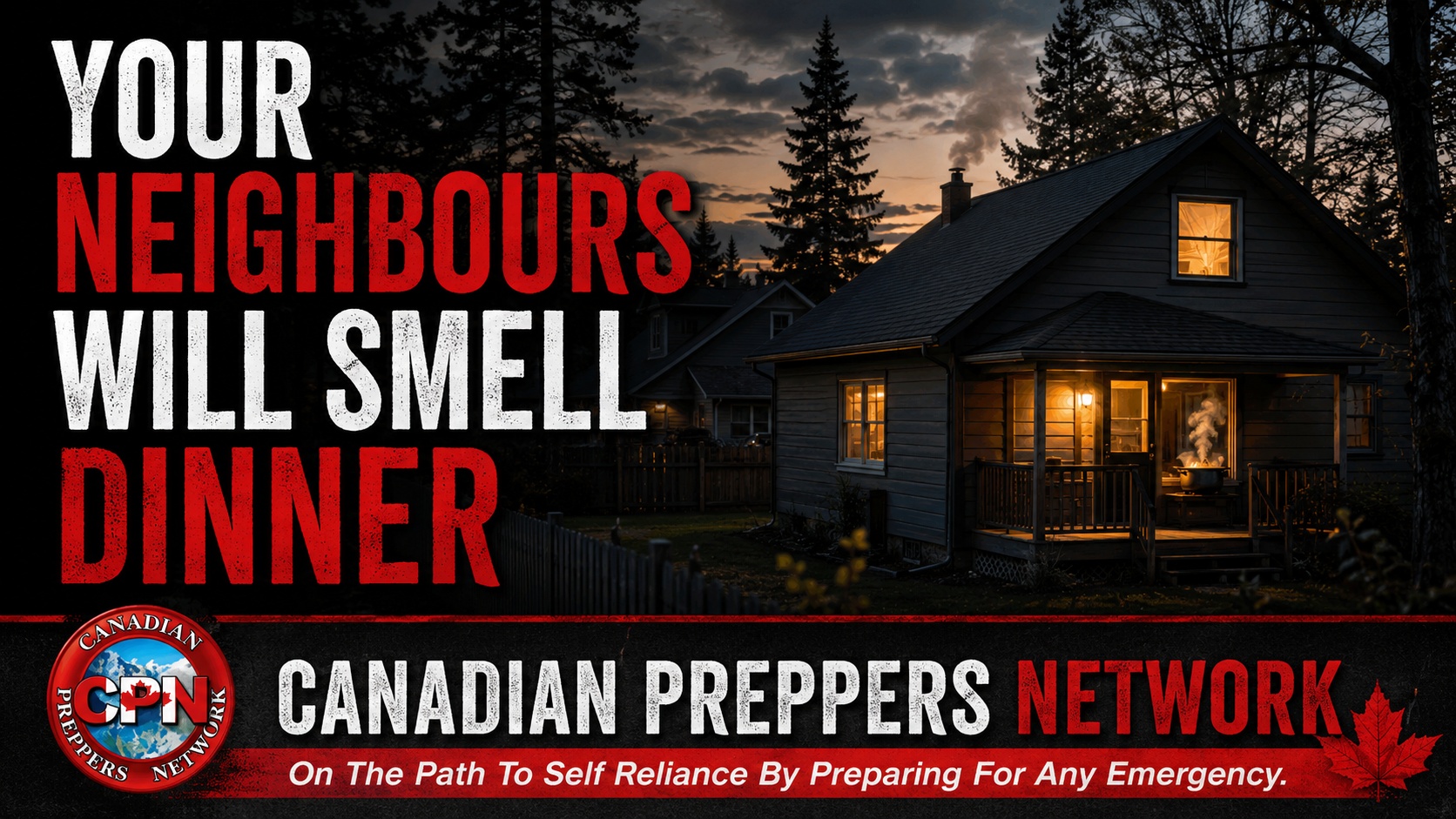
A normal dinner in normal times disappears into the background. A normal dinner during scarcity does not. When other people are eating cold food, skipping meals, or stretching a bag of rice across several days, the smell of roasted meat drifting across the fence line is not background noise. It is information.
That information may not cause trouble on day one. In fact, early in a crisis, people may still be polite. They may still believe help is coming. They may still assume the power will be back, the roads will open, or the stores will restock.
The real pressure comes later.
It comes when routines break. It comes when fuel is low. It comes when people realize the easy answers are gone. That is when visible abundance becomes harder to hide and harder for others to ignore.
This is where many preppers make a dangerous mistake. They prepare the food but not the routine around the food.
They store rice, beans, canned meat, flour, pasta, powdered milk, freeze-dried meals, sugar, salt, spices, oil, and garden seed. Good. But then they imagine using all of it the same way they cook today. Big meals. Strong smells. Visible smoke. Repeated outdoor cooking. Obvious garbage. Loud generators. Bright lights in the kitchen when the whole street is dark.
That is not a food plan. That is a beacon.
Food security needs to be treated as part of household discipline. Not paranoia. Discipline.
The goal is not to hide from everyone forever. The goal is to avoid becoming the obvious house. The house that always smells like dinner. The house with lights when others are dark. The house with fuel noise at predictable hours. The house with full garbage bags. The house with a garden that screams abundance while everyone else is quietly watching.
Cooking Smells Travel Further Than You Think
In a short outage, cooking normally may not matter much. In a longer event, strong smells travel. Meat, fish, bacon, frying fat, fresh bread, coffee, onions, garlic, and wood smoke all carry farther than people think. In cold Canadian air, smells can hang low and move through a neighbourhood in ways that surprise you.
This does not mean you never cook real food. It means you think about when, where, and how you cook.
Meals that require less cooking, shorter cooking times, or lower odour should be part of the pantry. That means canned meals, pressure-canned meat, soups, stews, oats, rice dishes, dehydrated meals, and foods that can be heated quickly instead of cooked from scratch every time.
It also means fuel efficiency matters. A meal that simmers for two hours uses more fuel and advertises itself longer than a meal that is already cooked and only needs heating. This is one reason pressure canning deserves serious attention. Properly canned food is not just shelf-stable food. It is fast food in a blackout.
If pressure canning is not already part of the household skill set, start with Mastering Pressure Canning. In a long emergency, food that only needs reheating is more than convenient. It is quieter, faster, and less wasteful of fuel.
Your Garden Is Not Invisible
A prepper garden can be a blessing, but it is not invisible. Raised beds, trellises, greenhouses, potato patches, bean poles, and fruit trees all tell a story. In stable times, that story is charming. In hard times, it may become a map.
The answer is not to avoid gardening. The answer is to design food production with awareness.
A front-yard show garden is different from a tucked-away production area. A few edible landscaping choices are different from an obvious high-output survival garden. A greenhouse visible from the road says something different than a low-profile backyard system. Food production should not be hidden so well that it becomes useless, but it should not advertise more than necessary either.
This is especially true in rural and semi-rural Canada, where people notice patterns. They notice who has livestock. They notice who has feed deliveries. They notice who is harvesting. They notice who has a smokehouse, a generator, a deep pantry, a freezer, or a truck that keeps returning loaded.
That does not make neighbours enemies. It makes them observers.
And in a long emergency, observers remember.
Garbage Gives You Away
Garbage gives away more than people realize. Empty cans, food packaging, freeze-dried meal pouches, oxygen absorber packets, mylar scraps, coffee tins, meat trays, pet food bags, and garden waste can all reveal what a household has been eating and how well supplied it is.
In normal times, nobody cares. In scarcity, garbage becomes intelligence.
This is why serious food preparedness includes waste discipline. Packaging should be reduced before a crisis where possible. Bulk storage should be organized before it is needed. Repackaging should happen during normal times, not under pressure. Compost should be managed properly. Food waste should be minimized. Strong-smelling scraps should not become a neighbourhood announcement.
This is not glamorous preparedness. It is boring. That is why it matters.
Noise Is Part Of The Food Signature
Food often requires systems. Freezers require power. Pressure canners require heat. Grain mills make noise. Generators make more noise. Livestock makes noise. Water pumps make noise. Outdoor cooking makes noise. Repeated movement between house, shed, garage, garden, and storage area creates patterns.
A generator running at the same time every day is a dinner bell with an engine.
Again, the answer is not to avoid tools. The answer is to plan for quieter, lower-profile alternatives. Hand tools, thermal cooking, insulated cooking methods, stored cooked meals, manual grain options, rocket stoves used carefully where appropriate, and non-electric kitchen tools all reduce dependence on loud systems.
A food plan that only works with a freezer and a generator is not a collapse food plan. It is a short-term inconvenience plan.
Protein Is Valuable, And Everyone Knows It
Protein is especially important in a long emergency. Most households can store carbohydrates easily. Rice, flour, oats, pasta, beans, and sugar are straightforward. Protein is more complicated. Meat in the freezer is vulnerable. Canned meat is useful. Pressure-canned meat is better. Dehydrated and freeze-dried options have a role. Hunting, fishing, small livestock, eggs, legumes, and stored fats all have to be thought through as a system.
For a deeper look at this side of the pantry, see Long-Term Protein Storage for Canadians.
But protein also advertises itself.
Cooking meat smells different than boiling rice. Frying fish smells different than heating soup. Bacon, sausage, stews, and roasted meat carry. If your long-term food plan depends heavily on cooking obvious high-value foods outdoors or during quiet hours, you need to rethink the routine.
This is where stored meals matter.
A pantry built around ingredients is useful. A pantry built around actual meals is better. If your household can open, heat, and eat familiar meals quickly with limited smell and limited fuel, you are in a stronger position than someone staring at buckets and wondering what to do next.
That is why a 30-day food supply should not just be a pile of products. It should be a working menu system. Once that system works for 30 days, it can be expanded, rotated, preserved, and tied into garden production. The article How to Build a 30-Day Food Supply in Canada is a good place to start tightening that system before stretching it into longer-term storage.
Generosity Needs Boundaries
This is the hardest part.
Preppers often talk about community, and rightly so. A household that isolates completely can become brittle. Neighbours can share labour, information, security awareness, childcare, tools, medical knowledge, repairs, and local intelligence. Community matters.
But charity without boundaries can destroy a household food plan.
If you give away too much too early, you may not be able to feed your own family later. If you give in a way that reveals the depth of your supplies, you may create expectations. If you become known as the house with food, you may attract more requests than you can handle.
The better approach is to build community before the crisis.
Encourage neighbours to prepare now. Share general preparedness information now. Talk about food storage in normal terms now. Promote gardening, canning, water storage, backup cooking, and practical household resilience before people are desperate. The more prepared the area is, the less pressure lands on the one prepared household.
This is not selfish. It is realistic.
In a long emergency, you cannot become the grocery store for the road.
Food planning also overlaps with personal and household security. The Security & Defense in Canada Hub is worth reviewing because a food plan that ignores visibility, routines, and social pressure is not complete.
Food Smells Like Morale
There is also a morale side to this.
Food smells are powerful because food is emotional. A hungry person does not just smell calories. They smell comfort, normalcy, family, warmth, and relief. That is why the house cooking well during a crisis stands out. It represents something others have lost.
This is why low-profile food planning is not about shame. It is about control.
You control what you cook. You control when you cook. You control how visible your storage is. You control whether your garden screams abundance or blends into ordinary property use. You control how much packaging leaves the house. You control whether power systems are obvious. You control whether your routines become predictable.
A serious food plan should answer these questions:
- Can we prepare meals with minimal smell?
- Can we cook without drawing attention?
- Can we eat well without running a generator constantly?
- Can we reduce visible packaging and garbage?
- Can we preserve food before the crisis instead of processing everything during it?
- Can we keep some food production low-profile?
- Can we help trusted people without exposing the entire household supply?
- Can we rotate stored food into normal life so the pantry does not become a strange emergency-only system?
If the answer is no, the problem is not your storage. The problem is your routine.
Most food storage advice stops at calories. That is not enough.
Calories matter. So do protein, fat, fibre, vitamins, minerals, comfort foods, cooking fuel, water, preservation, pest control, and rotation. But in a long emergency, social visibility matters too.
The pantry is only one layer.
The real goal is a household food system that feeds your people without advertising weakness or abundance. Stored food buys time. Preserved food reduces fuel demand. Gardens create renewal. Small livestock may add production. Hunting and fishing may supplement where legal and realistic. Skills turn ingredients into meals. Community reduces pressure. Discipline keeps the whole system from becoming obvious.
That is food security.
Not just shelves full of supplies.
Not just buckets in the basement.
Not just a freezer full of meat.
Food security is the ability to keep eating while staying calm, quiet, organized, and less visible than the household that panics in public.
Because in a real long emergency, the question is not only, “Do you have food?”
The question is, “Who knows?”
Practical Gear For Lower-Profile Food Preparedness
Disclosure: As an Amazon Associate, Canadian Preppers Network may earn from qualifying purchases.
A quieter food plan starts with storage, preservation, low-fuel cooking, and manual tools. These are not exciting purchases, but they reduce waste, reduce dependence on loud systems, and help keep meals simple when the pressure is on.
Food storage buckets and gamma lids
Food storage buckets and gamma lids
Mylar bags and oxygen absorbers
Mylar bags and oxygen absorbers
Manual grain mill
Manual grain mill
Thermal cooker or retained-heat cooker
Thermal cooker or retained-heat cooker
Pressure canning supplies
Pressure canning supplies
Heavy-duty manual can opener
Heavy-duty manual can opener
Bottom line: The more food you can store, preserve, open, heat, and prepare without noise, waste, or attention, the stronger your household food plan becomes.
Final Thought
Food storage is not just about surviving hunger. It is about buying time, reducing panic, and keeping your household functional when the outside world gets unstable.
But food is never completely silent.
It smells. It creates waste. It requires fuel. It creates routines. It draws attention when everyone else is doing without.
So build the pantry, but build the discipline around it too.
The best food plan is not the one that looks impressive on a shelf.
It is the one that keeps feeding your family without turning your home into the most interesting house on the road.