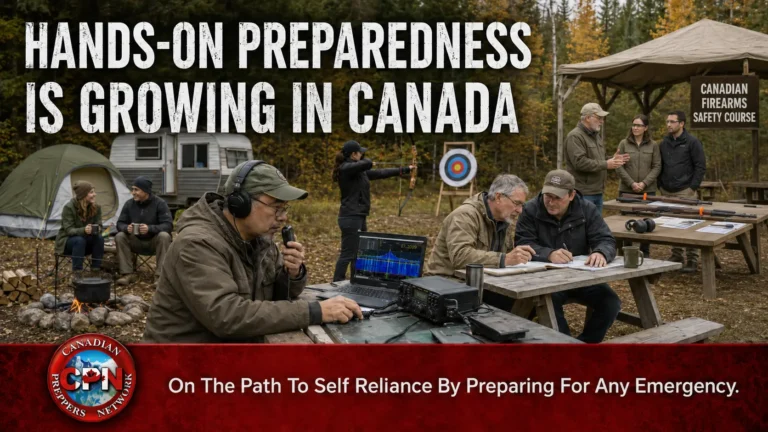
The ability to communicate with others post SHTF in paramount. Radio has the advantage of being independent of infrastructure and therefor a viable option for grid down communications. For local communications, there are few options for handheld comms. For the majority of us, we have the option of FRS/GMRS radios available at big box stores or amateur radio which has hundreds of handheld options. Let’s take a look at the advantages and disadvantages of each.
FRS/GMRS is a public radio service available without license in Canada, much the same way CB is. Amateur radio on the other hand requires you to pass a test and obtain a license to use legally. Each has advantages and disadvantages though. Here is a brief comparison.
Availability & Cost –
FRS/GMRS handsets can be found at almost any outdoor supply or big box store. USually sold in sets of two, they can be found for as little as $35.00 per set and most often cap off around $100.00 per set. To be perfectly honest, the quality difference between price points is nominal at best and is usually more of a factor of features most will never need.
Amateur radios are most often found sold individually. Prices range from the lower end Baofeng units at around $50.00 per unit and go almost as high as you can afford to pay. Many higher end radios sell for hundreds of dollars each. Quality between price points is the subject of much debate, but for the most part, it depends highly on features that can be useful such as digital communications for sending emails and images as well as gps position reporting.
Power Output –
While not as important as many assume, power output is a factor to some degree. FRS/GMRS sets are limited to 1/2 watt or 2 watts depending on the channel selected (more about channels below).
Amateur radios have a much higher output limit. Depending on the license you obtain, you can operate up to 1000 watts. Most handheld radios output a maximum of 10 watts, depending on the make & model chosen.
Customization –
For FRS/GMRS radios, customization is all but nonexistent. You may be lucky to get a headset for your radios, but that’s about it. Antennas, which have more to do with range than power output are fixed and cannot be swapped out for a more performing antenna.
Amateur radios on the other hand are extremely customizable. Almost any accessory can be had or even hand built. The possibilities are almost endless. The first upgrade many amateur radio owners buy is a more performant antenna.
Channels & Frequencies –
Channels are simply preset frequencies. FRS/GMRS radios have a limited number of channels available (only 22 between the two services).
Amateur radios can be programed to use any frequency within the range set out by Industry Canada. This offers much more flexibility in selecting what frequency you want to use.
Which to Choose? –
This depends greatly on your personal requirements. Both FRS/GMRS and handheld amateur radios are for local communications only as range is limited to line of sight. Amateur radios often get better range with fairly inexpensive upgrades to antennas and choosing a model with a higher output power.
FRS/GMRS radios are a great option for remote homesteads (or prepper retreats) or for convoy travel. They are license free, so you can legally use them right out of the box.
Amateur Radio can give you longer range (but not much). They do require you to have a license, for which you must pass a test. Contrary to popular belief, it is actually illegal to own an amateur radio without your license. As mentioned earlier, amateur radios can offer more than just voice communications.
Interested in buying an amateur radio? Visit Prepper Radios Canada.