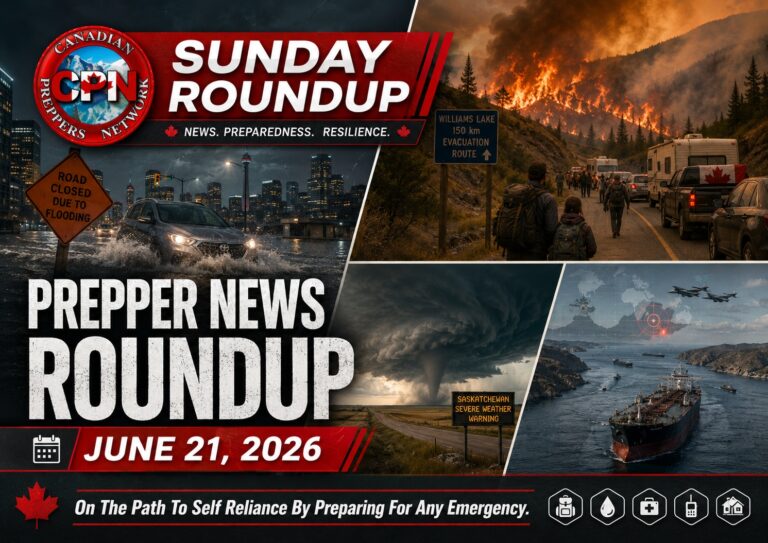
Welcome back to your weekly Sunday news roundup — the place where preppers stay informed on developments that actually matter for readiness and resilience. From infrastructure stress to supply vulnerabilities, here’s what stood out this week.
🔥 1. Preparedness Industry Under Scrutiny as Demand Surges
Recent reporting has highlighted how major preparedness suppliers are experiencing rapid growth as households respond to increasing instability, infrastructure failures, and international uncertainty. While this has helped normalize preparedness, it has also created a crowded market filled with mixed-quality gear.
Why it matters for preppers:
Rising demand means higher prices, backorders, and marketing hype. Choosing equipment that solves real problems — power, water, calories, light, communications — is more important than ever.
Solid, proven options:
- Portable solar generator (backup power for outages)
👉 https://www.amazon.ca/dp/B0B9R6S2GZ?tag=canadpreppn01a-20 - Rechargeable LED lanterns (safe indoor lighting)
👉 https://www.amazon.ca/dp/B09Y2K9M1R?tag=canadpreppn01a-20
🧯 2. Emergency Services Emphasize Household Readiness
Emergency planners internationally continue to stress that households should be capable of operating independently for at least 72 hours during major incidents. This guidance reflects a reality many Canadians have already experienced: help may be delayed, and systems may not recover quickly.
Prepper takeaway:
Prepared households reduce strain on emergency services and avoid panic-driven decisions.
Key readiness tools:
- Hand-crank emergency weather radio (no batteries required)
👉 https://www.amazon.ca/dp/B0B7XJ6M3T?tag=canadpreppn01a-20 - Tactical rechargeable flashlight (long runtime, compact)
👉 https://www.amazon.ca/dp/B08T1B8N5R?tag=canadpreppn01a-20
🍽️ 3. Survival Food Kits Gain Attention Again
Consumer analysis continues to focus on long-shelf-life emergency food kits as more households recognize how quickly grocery access can be disrupted. These kits are increasingly viewed not as “doomsday food,” but as time insurance.
Action step:
Review your food storage for calories, variety, and preparation requirements, not just shelf life.
Practical food storage options:
- 72-hour emergency food supply (starter level)
👉 https://www.amazon.ca/dp/B07J5QFJ1Z?tag=canadpreppn01a-20 - Long-term food storage buckets (extended outages)
👉 https://www.amazon.ca/dp/B09M8Q2L8J?tag=canadpreppn01a-20
🌍 Global Preparedness Context (No Theory — Just Policy)
Governments across Europe and elsewhere continue to publicly recommend short-term household self-sufficiency. This shift reflects recognition that centralized systems can be overwhelmed quickly during large-scale events.
Preparedness takeaway:
Self-reliance is no longer fringe — it’s becoming official policy in many regions.
📌 Prepper Insight of the Week
The Real Risk in 2026
The most likely disruptions ahead are not dramatic collapses, but overlapping system failures:
- Extended power outages
- Communications interruptions
- Supply chain delays affecting food, fuel, and medicine
These events don’t make headlines for long — but they create the most hardship for unprepared households.
Resilience essentials:
- High-capacity power banks (phones, radios, lights)
👉 https://www.amazon.ca/dp/B08L8KR8T3?tag=canadpreppn01a-20 - Gravity-fed water filtration system (no power required)
👉 https://www.amazon.ca/dp/B07F9N2X8K?tag=canadpreppn01a-20
🛠️ Final Thought
Preparedness isn’t about fear or prediction — it’s about removing fragility from your household. When systems strain, prepared families stay calm, informed, and capable.
Weekdays return to skill-focused topics tomorrow. Sundays remain about watching the signals and acting early.