
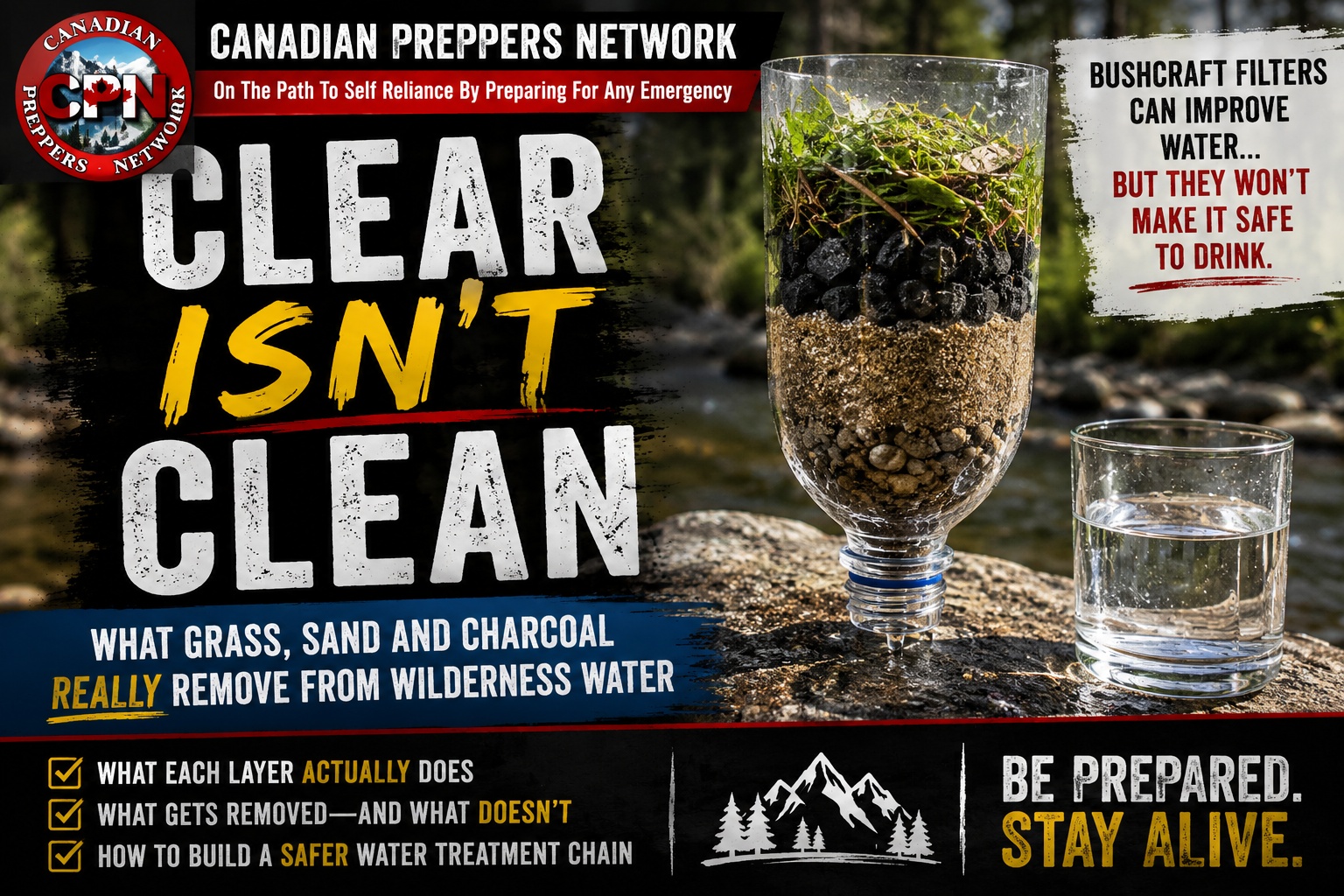
What grass, sand and charcoal really remove from wilderness water
Few bushcraft demonstrations are as convincing as the improvised water filter.
A bottle, bark funnel or hollow container is packed with grass, crushed charcoal and layers of sand. Muddy water goes into the top, and noticeably clearer water drips from the bottom. The change can be dramatic enough to make the finished water look ready to drink.
That appearance can create dangerous confidence.
A layered bushcraft filter can catch debris, reduce suspended sediment and sometimes improve colour, taste or odour. What it cannot do is provide predictable, measurable treatment. The materials have not been selected to a specification, the flow has not been controlled, and the finished filter has not been tested against bacteria, parasites, viruses or dissolved contamination.
The result may be clearer water. That is not the same thing as safe water.
The distinction becomes obvious when an improvised wilderness filter is compared with a properly constructed biosand filter. CAWST, a Canadian charity and licensed engineering firm specializing in household water treatment, emphasizes that filtration sand must meet specific requirements. When the sand is unsuitable, the filter will not work properly.
Free Canadian Grid-Down Starter Kit
Water treatment is only one part of household preparedness. The free Canadian Grid-Down Starter Kit helps you review the essentials of emergency water, food, heat, lighting, communications, sanitation and backup power.
Why the Demonstration Looks So Impressive
The typical bushcraft filter is judged by sight.
Brown water goes in. Clearer water comes out. The filter appears to have worked.
What the demonstration actually proves is that the device removed at least some material large enough to become trapped between the layers. Mud, fragments of vegetation and other suspended particles are easier to see than microorganisms or dissolved chemicals, so visual improvement tells us very little about the hazards remaining in the water.
Even professionally built household filters do not all perform equally under every condition. McGill University field research comparing household water-treatment methods found that biosand-filter performance could be lower than expected and that drinking water could become contaminated again after collection or treatment.
A quickly assembled bottle filter has far less control than the systems evaluated in that research.
What the Grass Layer Really Does
Grass, moss, leaves, cloth or fibrous bark can serve as a coarse first layer.
Its job is mostly mechanical. It catches larger material before that material reaches the finer layers below. Depending on how tightly it is packed, it may intercept leaves, insects, algae, small twigs and clumps of soil.
That is useful, but limited.
The spaces between stems and fibres are irregular. Water follows the easiest route and may simply channel around much of the material. Grass has no known pore rating, no consistent density and no verified ability to remove microorganisms.
Fresh-looking vegetation is not sterile either. Material pulled from the shoreline or forest floor may carry soil, animal droppings and microorganisms into the filter.
The grass layer should therefore be considered a debris screen. It may protect the sand from clogging quickly, but it should not be counted as a purification stage.
What the Sand Layer Really Does
Sand is the component most capable of producing a noticeable change in cloudy water.
As water passes between the grains, suspended particles may become trapped. Finer sand generally catches smaller particles than coarse gravel, while gravel is commonly used to support the sand and prevent the outlet from becoming blocked.
That basic idea is real. The problem comes when a handful of campsite sand is treated as though it were equivalent to an engineered biosand filter.
CAWST’s biosand-filter construction resources describe systems built around specially selected and prepared filtration sand, proper construction, controlled operation and ongoing maintenance. The sand is the most important part of the filter, and unsuitable sand can prevent the system from functioning properly.
A mature biosand filter also develops biological activity near the top of the sand bed. That layer contributes to treatment over time. It is not created instantly when water is poured through a newly filled bottle.
GROSCHE, an Ontario-based company involved in biosand-filter projects, explains that the biological layer requires time to develop. A new filter therefore behaves differently from one that has been correctly operated and allowed to mature.
McGill researchers have also studied the differences between continuously and intermittently operated slow-sand systems, demonstrating that operating conditions matter. Biosand filtration is a treatment technology, not simply the presence of sand in a container.
An improvised sand layer may reduce visible sediment. Its removal of pathogens is unknown and should never be assumed.
What the Charcoal Layer Really Does
Charcoal is the most misunderstood part of the bushcraft filter.
In many demonstrations, ordinary campfire charcoal is credited with removing microorganisms, chemicals, bad tastes and unpleasant smells. This usually confuses common wood charcoal with activated carbon.
Activated carbon is manufactured or treated to create a highly developed internal surface. In engineered water-treatment systems, certain contaminants can attach to that surface through adsorption. Research from the University of British Columbia describes powdered activated carbon as a treatment used to reduce taste, odour, colour and selected contaminants.
A lump of wood pulled from a firepit is not the same product.
The performance of ordinary charcoal depends on the wood, how completely it burned, particle size, ash content, water chemistry, depth of the layer and the length of time the water remains in contact with it. None of these factors is normally controlled in a wilderness filter.
Charcoal may make water smell or taste better. That improvement can be useful for acceptability, but it should not be confused with dependable pathogen removal.
McGill research into adding hardwood biochar to a laboratory biosand system is particularly relevant. The filters were matured before testing, yet the study found no significant improvement in E. coli removal between the biochar layer and the sand-only control under the conditions tested.
If carefully prepared biochar did not automatically improve bacterial removal in a controlled experiment, crushed campfire charcoal should not be treated as a reliable disinfectant.
Grass, Sand and Charcoal Together
Combining the three materials gives each layer a different general role.
Grass or fibrous material catches larger debris.
Sand traps some smaller suspended particles and reduces cloudiness.
Charcoal may reduce some colour, taste or odour.
This can make an improvised filter useful as a prefilter.
It can turn heavily sedimented water into water that is easier to process using a proven treatment method. It may reduce the amount of mud entering a portable filter, make water more practical to boil and improve the finished taste.
The layered filter has done its job when it has reduced debris and turbidity.
It has not finished treating the water.
Why a Real Biosand Filter Is Different
A properly designed biosand filter is a complete system with carefully chosen materials and operating requirements.
It uses prepared sand and gravel rather than random shoreline material. The depth and arrangement of the media matter. The water level and flow matter. The filter requires correct use, maintenance and time for its biological processes to become established.
CAWST publishes separate operation and maintenance guidance because all of these factors influence performance. A biosand filter is not expected to work properly simply because a container contains sand.
The difference is similar to the difference between a pile of fabric and a manufactured respirator. Both may block something, but only one has been designed around a defined performance standard.
That does not make improvised filtration worthless. It makes the limitations important.
A Better Wilderness Treatment Chain
A safer approach separates water treatment into several stages.
Choose the Best Source Available
Avoid water with obvious pollution, unusual smells, heavy surface scum or nearby contamination. An improvised filter should not be expected to rescue every source.
Allow Heavy Sediment to Settle
Let muddy water stand so larger particles fall to the bottom. Transfer the clearer upper portion without disturbing the settled material.
Prefilter the Water
Use clean cloth, a coffee filter or an improvised grass, sand and charcoal arrangement to reduce debris and suspended sediment.
Apply a Proven Treatment Method
Boil the prefiltered water using an established procedure, use a properly rated portable filter within its stated limits, or apply a recognized drinking-water disinfectant exactly according to its directions. CAWST provides separate technical guidance for boiling water because boiling is a treatment stage of its own, not something performed by the improvised filter.
Protect the Finished Water
Treated water can become contaminated again through dirty hands, cups, lids or containers. CAWST treats safe storage and handling as a separate part of household water treatment because producing clean water is only useful when it remains clean.
This layered process is less exciting than pouring muddy water through a bottle and drinking the result, but it is far more defensible.
What About Chemical Contamination?
Grass, sand and charcoal should not be trusted to make chemically contaminated water safe.
An improvised charcoal layer has no measured capacity and no indication of when it has become saturated. Some contaminants may pass through unchanged. Others may be reduced only slightly. Improved taste or smell is not proof that the underlying hazard has been removed.
Even activated carbon is a selective treatment rather than a universal solution. UBC water-treatment research discusses activated carbon in relation to particular organic contaminants, taste, odour and colour—not as a method that automatically removes everything present in water.
Avoid sources near fuel spills, mines, industrial sites, heavily treated agricultural land, sewage discharge or suspicious containers. Boiling may address microorganisms, but it does not make every dissolved substance disappear.
Source selection remains the first and most important treatment stage.
Channeling: The Hidden Problem
Water does not necessarily pass evenly through an improvised filter.
If the materials are packed unevenly, gaps can form against the container wall or between layers. Water follows these low-resistance paths and may bypass much of the filtering media.
A fast flow may look productive, but reduced contact time can make filtration less effective. A clogged filter may force water through a crack or channel rather than through the intended media.
This is another reason that visual results are unreliable. Two filters assembled with apparently identical layers may perform very differently.
The person using the filter has no simple way to know what percentage of the water passed properly through the sand and what percentage slipped through a channel.
The Risk of Recontamination
The treatment process does not end when water leaves the filter.
McGill field research identified post-collection microbiological contamination as a significant issue in household drinking water. Water that was improved at the treatment stage could become contaminated again during storage and handling.
In the field, untreated and treated water containers should remain clearly separated. Avoid dipping dirty cups or hands into finished water. Use a clean container with a narrow opening or controlled pour spout when possible.
Do not pour treated water back into the same dirty bottle used to collect it from the source.
The final container is part of the treatment system.
Bushcraft Skill Versus Preparedness
Improvised filtration is a useful skill because equipment can be lost, broken or exhausted.
But preparedness is supposed to reduce reliance on improvised solutions.
A prepared traveller should have more than one way to treat water. A portable filter may serve as the primary method. A metal container provides a boiling option. Water-treatment tablets or drops provide a compact backup. Clean cloth or coffee filters can remove sediment before it reaches more expensive equipment.
The grass, sand and charcoal filter belongs near the bottom of that list. It is a resourceful method for improving poor-quality source water before proper treatment—not a reason to leave dependable equipment at home.
The real lesson is not that nature provides a complete water purifier.
The lesson is that different materials perform different jobs, and that no single stage should be credited with more than it can accomplish.
The Verdict
Does a grass, sand and charcoal bushcraft filter work?
Yes, as a crude sediment and appearance filter.
It can catch larger debris, reduce some cloudiness and potentially improve taste or odour.
Does it reliably make wilderness water safe to drink?
No.
Its materials are inconsistent, its flow is uncontrolled, its pathogen removal is unknown, and ordinary charcoal is not equivalent to engineered activated carbon. Even proper biosand filters depend on selected media, correct construction, maturation, operation and maintenance.
Use the improvised filter to prepare water for the treatment method that follows.
Never use clarity as proof of safety.
Amazon Buying Box: Wilderness Water Treatment Gear
A dependable wilderness water kit should include several layers of protection rather than relying on one filter.
Portable Squeeze Water Filters — compact primary filters that fit easily into day packs, emergency kits and bug-out bags.
Portable Pump Water Filters — allow water to be drawn from shallow or awkward sources without placing the clean container directly into the water.
Gravity Water Filters — process larger quantities at camp with less hands-on pumping or squeezing.
Single-Wall Stainless-Steel Bottles — provide a durable water container that can also support boiling when the product is designed for direct heating.
Stainless-Steel Camp Kettles — offer a dedicated way to heat and boil larger quantities of water.
Water-Treatment Tablets — provide a compact backup treatment method when used exactly according to the directions.
Collapsible Water Containers — help keep untreated source water separate from finished drinking water.
Reusable Prefilter Cloths — remove coarse sediment before water reaches the main filter or boiling container.
Replacement Filter Elements — prevent a damaged, clogged or exhausted filter from becoming a single point of failure.



One Comment