
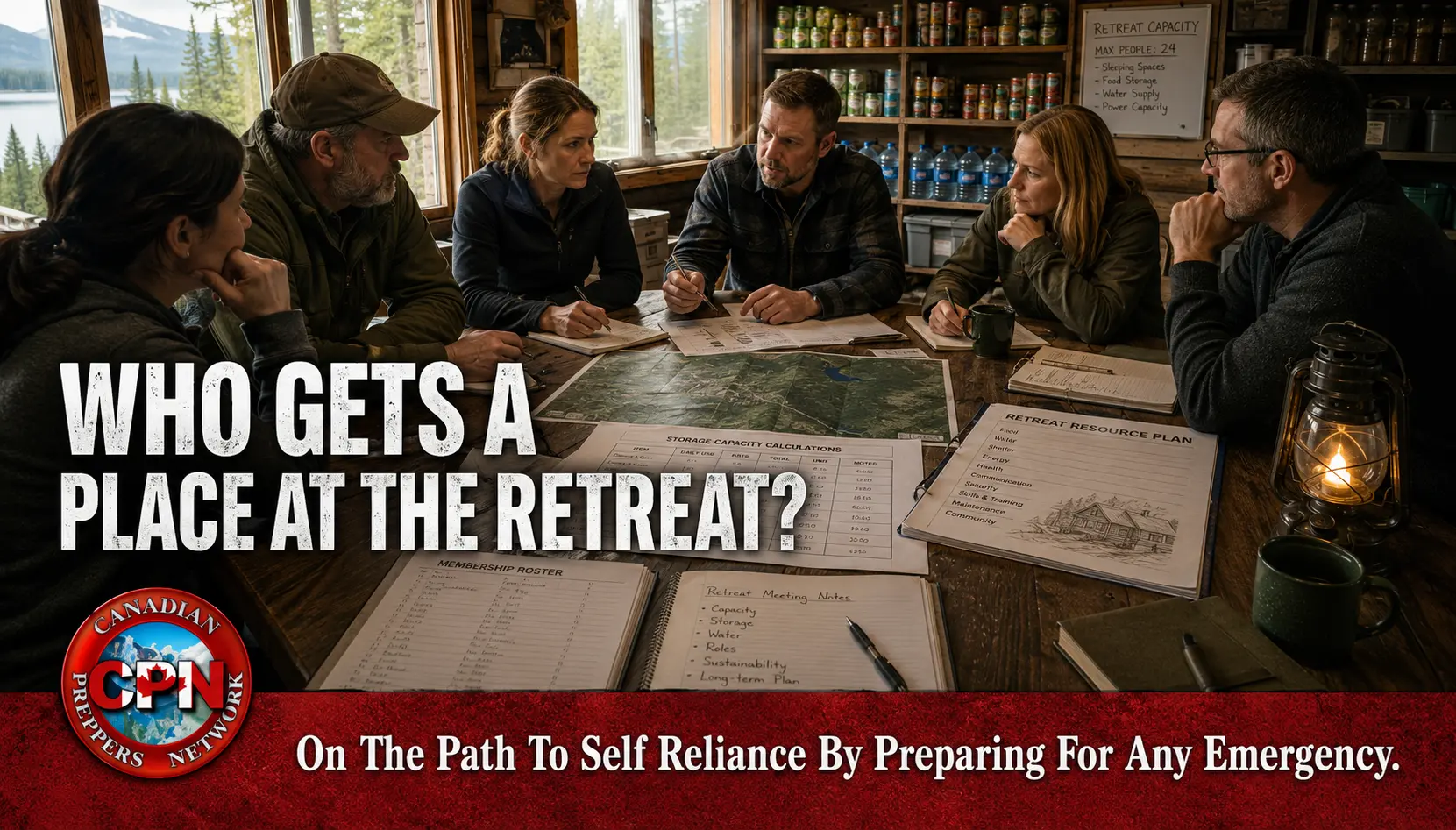
A long-term survival group cannot be built on vague promises and last-minute arrivals.
In a short emergency, opening the door to relatives, neighbours, and friends may be manageable. In a prolonged collapse, every additional person changes the mathematics of survival.
They consume food, water, fuel, medicine, sleeping space, and human attention. They also bring labour, knowledge, tools, supplies, and connections—if expectations were established before the crisis.
The question is not simply who you care about. It is who the group can realistically support, what each person is expected to contribute, and whether everyone understands the conditions attached to membership.
A Retreat Is Not an Unlimited Refuge
Many preparedness plans contain a dangerous contradiction. Supplies are calculated for a small household, but the retreat is quietly promised to a much larger circle.
A property stocked for six people cannot suddenly sustain eighteen because the newcomers are family. Compassion does not multiply stored calories or increase the output of a well.
Make an honest capacity assessment covering:
- Sleeping space
- Potable water
- Sanitation
- Food reserves and production
- Heating fuel
- Medical supplies
- Tools and protective equipment
- Daily labour requirements
- Long-term food production
Capacity should be based on the weakest essential system. A retreat that can sleep twenty people but produce food for eight has a practical capacity of eight.
Decide Before the Emergency
The worst time to debate membership is when exhausted people are standing at the gate.
Create a written list of confirmed members, conditional members, and people the retreat cannot support. This may feel cold while life is normal, but avoiding the decision merely guarantees that it will be made under greater pressure later.
Every confirmed member should know:
- Whether a place is actually reserved
- Who else is included with them
- What supplies they must bring
- When they are expected to arrive
- What route or alternate route they should use
- What responsibilities they will assume
- What conduct could cost them their place
A casual invitation such as “come here if things get bad” is not a preparedness plan. It is an unresolved obligation.
Supplies Are Part of the Admission Price
People expecting refuge should contribute before the emergency—not arrive empty-handed after consuming their own supplies.
Contributions need not be identical. One household might provide stored food, while another supplies equipment, fuel, seed, livestock, medical materials, or construction supplies. The contribution should reflect both the person’s means and the retreat’s actual requirements.
Set minimum standards and record what has been delivered. Supplies stored at someone else’s home may never reach the retreat.
A person who cannot contribute much materially may still be valuable, but that decision should be deliberate. It should not result from an unexpected arrival and an emotional confrontation.
Skills Matter, but So Does Dependability
Groups frequently overvalue impressive skills and undervalue ordinary reliability.
A talented mechanic who refuses routine chores can become less useful than an inexperienced person who learns quickly, follows procedures, and consistently completes necessary work.
Useful capabilities include:
- Food production and preservation
- Water-system operation
- Repair and construction
- Medical care and sanitation
- Cooking
- Communications
- Child and dependant care
- Recordkeeping
- Animal care
- Conflict resolution
- Firewood processing and heating
- Sewing and equipment repair
No adult should be exempt from ordinary communal labour simply because they possess a specialized skill. Specialists still eat, create laundry, use sanitation systems, and benefit from everyone else’s work.
Dependants Must Be Counted Honestly
Children, elderly relatives, and people with disabilities or chronic medical needs are not disposable liabilities. They are, however, members whose requirements must be included in planning.
A household cannot say it is bringing two adults while quietly assuming space will also be found for four dependants.
The group needs to know about:
- Mobility requirements
- Essential medications
- Dietary restrictions
- Supervision needs
- Medical equipment
- Hygiene supplies
- Suitable sleeping arrangements
- The labour time required for continuing care
The purpose is not to exclude people automatically. It is to prevent needs from being concealed until the group has no practical way to meet them.
Free Canadian Grid-Down Starter Kit
Build the household foundation before making commitments to a larger group. Download the free Canadian Grid-Down Starter Kit and use it to identify gaps in food, water, lighting, heat, sanitation, communications, and emergency planning.
Conduct Can Be More Important Than Capability
A well-supplied person with valuable skills can still destroy a group through intimidation, theft, reckless behaviour, constant conflict, or refusal to accept common rules.
Membership standards should address conduct before technical qualifications.
Every member should agree to basic expectations concerning:
- Treatment of other members
- Personal property
- Food and supply allocation
- Sanitation
- Work assignments
- Privacy
- Substance use
- Conflict resolution
- Leadership during emergencies
- Consequences for violating group rules
Rules must apply to founders, relatives, and specialists as well as everyone else. A discipline system loses legitimacy the moment important people become exempt from it.
Use a Probationary Category
Not every possible member needs an immediate permanent place.
A probationary category allows the group to evaluate a person’s reliability before granting full access to supplies, records, storage areas, or decision-making.
During normal times, prospective members can participate in work weekends, training sessions, food-production projects, equipment maintenance, and realistic exercises.
Watch what people actually do.
Do they arrive when promised? Do they bring the agreed equipment? Do they finish unpleasant work? Can they accept correction? Do they create unnecessary arguments? Do they disappear when effort is required?
A weekend of difficult shared work reveals more than months of casual conversation.
Plan for People Who Arrive Unexpectedly
Even with clear rules, unplanned arrivals are likely.
The retreat should establish in advance who can authorize entry, where newcomers wait, what immediate assistance may be provided, and how the final decision is made.
Emergency compassion and permanent membership are different decisions. A group might provide water, a meal, basic first aid, directions, or temporary shelter without promising indefinite support.
Consistency matters. If one person is admitted because someone applies enough emotional pressure, every previous capacity calculation becomes negotiable.
Put the Agreement in Writing
Memory changes when resources become scarce.
A simple retreat membership agreement should identify:
- Included household members
- Required contributions
- Stored supplies and ownership
- Expected work
- Arrival procedures
- Decision-making authority
- Rules of conduct
- Reasons membership may be reviewed
- Procedures for voluntarily leaving
- Treatment of personal property
The document does not need to resemble a complicated legal contract. Its purpose is to remove ambiguity and force difficult conversations while there is still time to solve problems.
Retreat Planning and Recordkeeping
Written plans are easier to review, update, and apply consistently. These basic supplies can help a group document membership, track stored resources, post work assignments, and protect important records.
- Lockable document box
- Waterproof notebooks
- Laminator for permanent procedures and duty charts
- Magnetic dry-erase planning board
- Lockable metal storage clipboard
As an Amazon Associate, Canadian Preppers Network earns from qualifying purchases.
The Hardest Answer Is Sometimes No
No retreat can support everyone connected to its members.
Promising space that does not exist is not generosity. It transfers the consequences to everyone who stored food, built systems, performed the work, and relied upon the original plan.
A fair membership system is transparent, consistent, and established in advance. It considers supplies and skills, but also character, dependants, medical realities, behaviour, and the group’s actual carrying capacity.
A resilient community begins by deciding who belongs, what belonging requires, and whether the group can keep every promise it makes.



One Comment