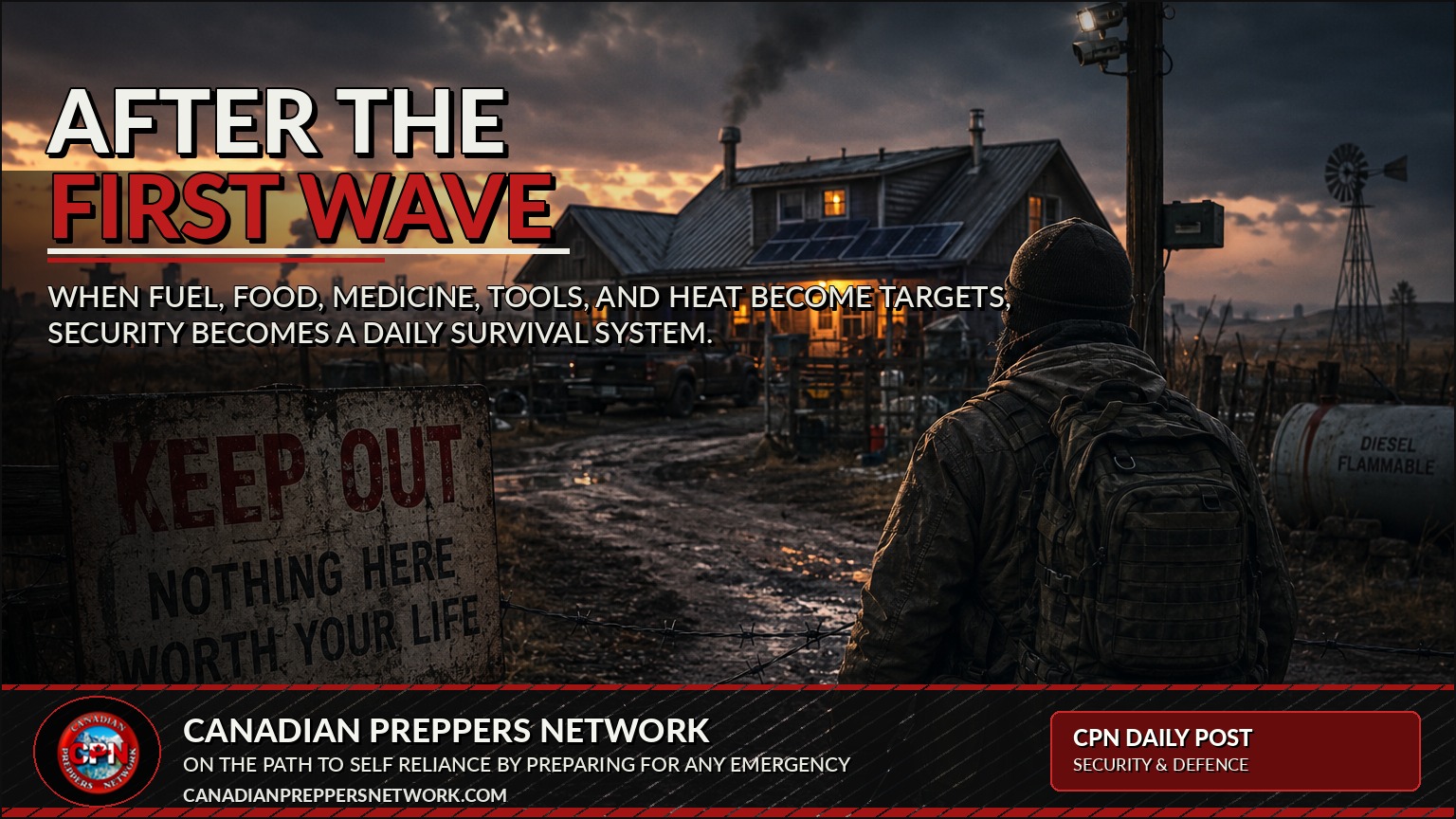
The first shock gets everyone’s attention. The real test begins when the power is still out, the shelves are still empty, and people realize normal life is not coming back tomorrow.
The first wave of a disaster gets all the attention. The storm hits. The power goes out. The roads close. The first panic-buying rush empties the shelves. Emergency alerts go out. Everyone reacts.
But the first wave is not usually what breaks people.
The real danger often comes after the first shock, when the easy supplies are gone, tempers are shorter, systems are still down, and people begin to understand that help may not be coming quickly. That is when preparedness stops being about a few bins in the basement and starts becoming a test of systems, discipline, and endurance.
After the first wave, the emergency changes character. It is no longer about getting through the first night. It is about managing food, water, heat, sanitation, security, information, medical needs, and morale over time. This is where weak plans fall apart.
The First Wave Is Reaction. The Second Wave Is Management.
During the first hours of an emergency, most people focus on immediate problems. They check family members, find flashlights, start generators, bring pets inside, charge phones, and try to figure out what happened. That phase matters, but it is also the phase most preppers already think about.
The second phase is different. It begins when the situation does not quickly return to normal.
Food starts being counted instead of casually eaten. Batteries stop being treated as unlimited. Fuel use becomes a decision. Water storage becomes a daily calculation. Waste disposal becomes a real issue. People who laughed at preparedness begin looking for someone else’s supplies.
This is where the prepared household needs to shift from emergency reaction to household operations. The question is no longer, “Do we have supplies?” The question becomes, “Can we run this household under stress for days or weeks without outside help?”
Inventory Becomes More Important Than Optimism
After the first wave, guessing is dangerous. A family needs to know what it actually has, not what it assumes it has.
That means checking food, water, fuel, batteries, medications, hygiene supplies, animal feed, backup lighting, heating options, cooking fuel, tools, and first aid supplies. It also means identifying what is already being used too quickly.
A pantry that looks large on day one can look very different after a week of careless meals. A fuel supply that seems adequate can vanish quickly if a generator is run without a schedule. A case of bottled water can disappear faster than expected when it is used for drinking, cooking, washing, pets, and cleanup.
This is the point where rationing should not be emotional. It should be practical. Stretching supplies early is far easier than trying to recover from waste later.
Every prepared household should be able to answer simple questions by the end of the first day:
- How many days of drinking water are available?
- How much food can be prepared without grid power?
- How much fuel is on hand, and what is it needed for?
- Which supplies are being consumed fastest?
- What must be protected, conserved, or replaced first?
The household that measures early has options. The household that guesses usually discovers the problem too late.
Water And Sanitation Move To The Front
Many people think first about food, but water and sanitation can become more urgent. If municipal water stops, if wells lose power, if septic systems are strained, or if toilets stop functioning properly, the household can become unhealthy quickly.
After the first wave, every preparedness plan should answer three questions: where does clean water come from, how is it treated, and where does waste go?
Stored water helps, but it is only the beginning. A serious household needs a way to collect, move, filter, boil, disinfect, and conserve water. This could include stored water, rain collection, a hand pump, gravity filters, chemical treatment, boiling capacity, and containers that can be carried without spilling half the supply on the ground.
Sanitation deserves the same attention. If toilets stop working or water pressure is gone, people need a backup system before the house becomes a health problem. Heavy-duty bags, buckets, sawdust, handwashing stations, disinfectants, gloves, and a clear disposal plan can matter as much as food storage.
A family can tolerate plain meals. It cannot tolerate contaminated water and failed sanitation for long.
Heat Becomes A Daily Calculation
In much of Canada, heat is not a comfort item. It is a survival system.
After the first wave, the household needs to stop thinking in terms of heating the entire home and start thinking in terms of controlled living zones. Which room can be kept warm? Which doors should be closed? Which windows need covering? Where will people sleep? How will pipes be protected? What fuel is available, and how quickly is it being burned?
Backup heat must be used safely. Fuel-burning equipment brings carbon monoxide risk, fire risk, and ventilation concerns. Improvised indoor heating is where many people get into trouble. A serious plan uses safe, properly installed equipment, working carbon monoxide alarms, fire extinguishers, and conservative fuel management.
The second wave punishes households that waste heat. Insulation, blankets, layered clothing, warm drinks, draft control, and shared living space can stretch fuel and reduce stress. The goal is not luxury. The goal is keeping people alive, functional, and able to make good decisions.
Food Planning Changes After The First Few Meals
Emergency food planning often focuses on what is stored. After the first wave, the focus shifts to how it is used.
Meals should become simpler, more predictable, and less wasteful. This is not the time to open random items just because they are available. It is time to plan meals around calories, nutrition, cooking fuel, water use, cleanup, and shelf life.
Use perishable food first if refrigeration is failing. Protect long-term staples. Avoid meals that require excessive water or long cooking times unless fuel and water are secure. Keep some comfort foods in reserve for morale, but do not let boredom drive waste.
If animals are part of the household, their feed must be counted too. Chickens, rabbits, dogs, cats, goats, and livestock all become part of the second-phase supply picture. A preparedness plan that feeds the people but forgets the animals is incomplete.
Security Changes When People Realize The Situation Is Not Temporary
The first wave may bring confusion. The second wave can bring desperation. Most people remain decent, but stress changes behaviour. Empty shelves, cold houses, fuel shortages, rumours, and fear can make communities unpredictable.
This does not mean turning every home into a fortress. It means paying attention.
After the first wave, households should reduce unnecessary visibility, control information, keep exterior areas organized, check doors and outbuildings, avoid broadcasting supply levels, and stay aware of what is happening locally. Security is not only about defence. It is also about not making yourself an obvious target.
Light discipline, noise discipline, and privacy become more important during prolonged disruption. A generator running all night tells people something. Piles of supplies visible through a garage door tell people something. Social media posts about how well stocked you are tell people something.
The best security measure is often being calm, boring, organized, and harder to read than everyone else.
Information Discipline Matters
Rumours spread fast during prolonged emergencies. Social media, scanner chatter, neighbour talk, and half-heard reports can create panic or bad decisions.
A prepared household should separate confirmed information from noise. Who actually knows the road is closed? Who confirmed the power restoration estimate? Is the boil-water advisory official, or did someone just repeat it from a friend?
After the first wave, bad information can waste fuel, expose people to risk, or cause unnecessary conflict. A simple household communications plan helps keep decisions grounded.
That plan does not need to be complicated. Keep a battery radio available. Know where official municipal, provincial, and utility updates are posted when networks are still working. Have a method to contact nearby family or group members. Keep written notes of important updates instead of relying on memory.
When stress is high, memory gets sloppy. Written information keeps the household from making the same decisions over and over again.
Medical Needs Become Harder To Ignore
The first wave can hide medical problems because everyone is busy reacting. After that, small issues start to matter.
Missed medication, minor cuts, dehydration, poor sleep, stress, cold exposure, stomach problems, and poor hygiene can all grow into larger concerns. A prepared household should check on vulnerable members daily, including seniors, children, people with chronic conditions, and anyone already under strain.
Medical preparedness is not only about trauma kits. It is also about routine care when clinics are closed, roads are bad, pharmacies are delayed, and people are tired. Prescription planning, basic first aid, sanitation, clean water, and warmth all become part of the same system.
Morale Is A Survival Resource
People can handle a difficult night. They can usually handle a difficult weekend. The problem starts when discomfort becomes routine.
Cold rooms, poor sleep, repetitive food, limited privacy, bored children, worried adults, and constant uncertainty wear people down. After the first wave, morale must be managed deliberately.
That means routines, useful work, warm drinks, simple meals, check-ins, rest periods, and honest communication. A household that stays calm and organized will make better decisions than one running on panic and resentment.
Morale does not mean pretending everything is fine. It means giving people structure. Who cooks? Who checks water? Who charges batteries? Who watches the weather? Who checks on neighbours? Who rests next?
In a long emergency, idle panic is dangerous. Useful work keeps people grounded.
The Prepared Household Has A Second-Phase Plan
A strong preparedness plan does not end when the emergency kit is opened. It begins there.
The second-phase plan should include food rationing, water production, backup heat, sanitation, communications, security routines, medical checks, livestock or pet care, and a daily household meeting. None of this has to be complicated, but it does need to exist before people are tired, cold, and stressed.
The first wave tests supplies. The second wave tests systems.
That is the difference between owning preparedness gear and living prepared. Gear helps, but systems keep a household functioning when the disruption stretches longer than expected.
Related CPN Resources
Water Collection & Purification In Canada
https://canadianpreppersnetwork.com/canadian-preppers-network-preparedness-hubs/water-collection-purification-in-canada/
Shelter & Heat In Canada
https://canadianpreppersnetwork.com/canadian-preppers-network-preparedness-hubs/shelter-heat-in-canada/
Food Procurement & Storage In Canada
https://canadianpreppersnetwork.com/canadian-preppers-network-preparedness-hubs/food-procurement-storage-in-canada/
Communications In Canada
https://canadianpreppersnetwork.com/canadian-preppers-network-preparedness-hubs/communications-in-canada/
Medical & First Aid In Canada
https://canadianpreppersnetwork.com/canadian-preppers-network-preparedness-hubs/medical-first-aid-in-canada/
Mental Resilience & Community Building In Canada
https://canadianpreppersnetwork.com/canadian-preppers-network-preparedness-hubs/mental-resilience-community-building-in-canada/
Preparedness Buying Box: Second-Wave Emergency Supplies
Water Storage Containers
https://www.amazon.ca/s?k=water+storage+container&tag=canadianprep-20
Gravity Water Filters
https://www.amazon.ca/s?k=gravity+water+filter&tag=canadianprep-20
Portable Camping Toilet
https://www.amazon.ca/s?k=portable+camping+toilet&tag=canadianprep-20
Heavy-Duty Contractor Garbage Bags
https://www.amazon.ca/s?k=heavy+duty+contractor+garbage+bags&tag=canadianprep-20
Carbon Monoxide Alarms
https://www.amazon.ca/s?k=carbon+monoxide+alarm&tag=canadianprep-20
ABC Fire Extinguishers
https://www.amazon.ca/s?k=abc+fire+extinguisher&tag=canadianprep-20
Rechargeable LED Lanterns
https://www.amazon.ca/s?k=rechargeable+led+lantern&tag=canadianprep-20
Rechargeable AA And AAA Batteries
https://www.amazon.ca/s?k=rechargeable+aa+aaa+batteries&tag=canadianprep-20
Emergency Weather Radio
https://www.amazon.ca/s?k=emergency+weather+radio&tag=canadianprep-20
First Aid Kit Refill Supplies
https://www.amazon.ca/s?k=first+aid+kit+refill+supplies&tag=canadianprep-20
Final Thought
Do not build your preparedness plan only around the first night. Build it around the week after, the month after, and the point where outside systems are still unstable.
Review your food, water, heat, sanitation, communications, medical, and security plans now, while there is still time to correct weak spots. The first wave may be unavoidable. Being unprepared for what comes after it is not.