Floods, Fire Risk, Civil Defence, and Supply Pressure
Canada has just finished Emergency Preparedness Week, but the real lesson did not come from a brochure, a government slogan, or a social media graphic. It came from the headlines.
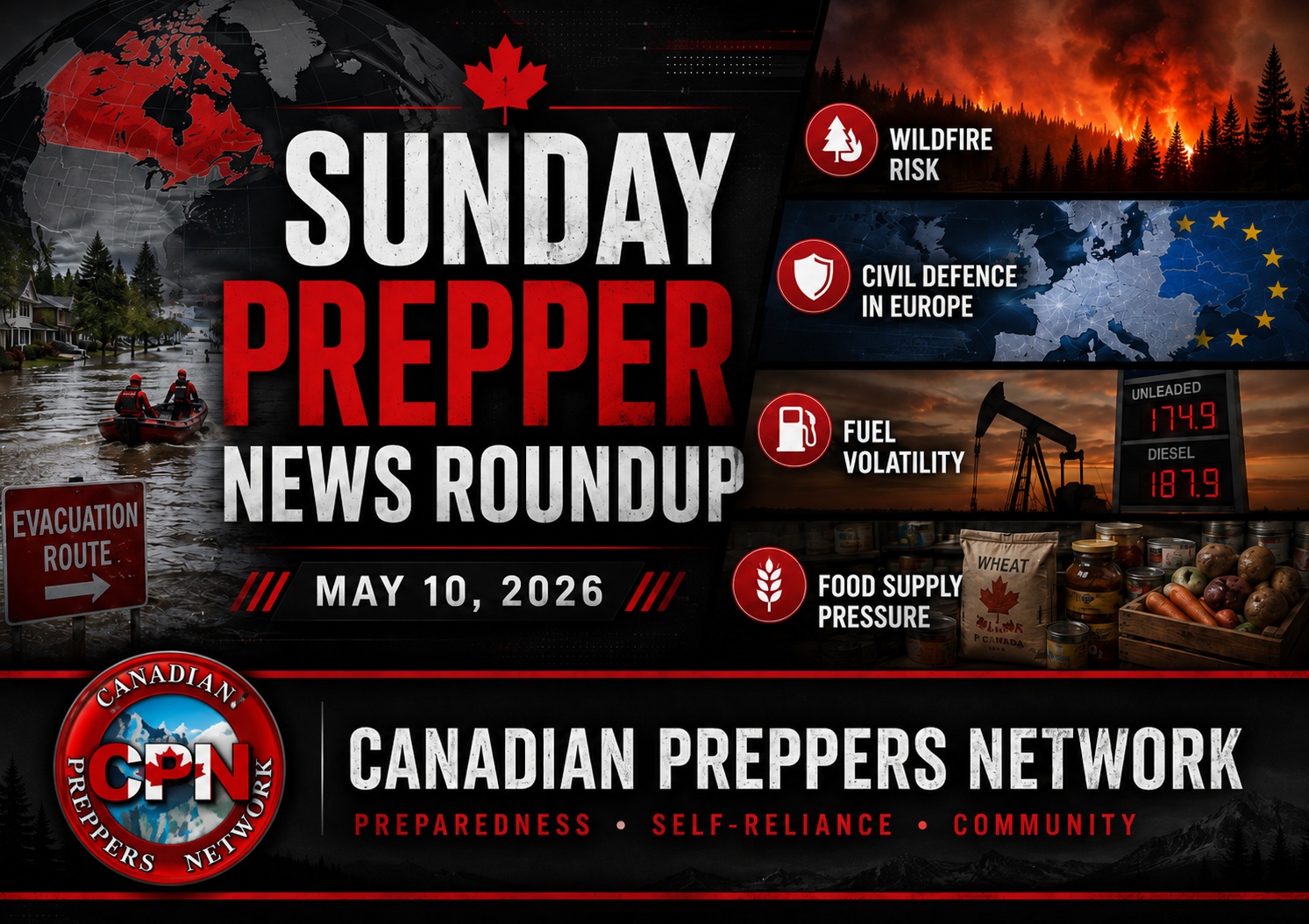
Flooding in Saskatchewan has forced evacuations and left roads underwater. Alberta is already watching wildfire danger rise in parts of the province. A landslide evacuation order remains in place in northern British Columbia. Europe is quietly rebuilding civil-defence systems. Food prices are still under pressure. Fuel markets remain vulnerable to geopolitical shocks.
None of these stories mean the sky is falling. They do mean that preparedness is no longer a fringe conversation. It is becoming a household, community, and national-security issue again.
Saskatchewan Flooding Shows How Fast the Evacuation Clock Runs Out
The strongest Canadian preparedness story this week comes from Saskatchewan, where spring flooding has created a serious emergency across multiple communities. Reports from May 5 and 6 described 15 local states of emergency active across the province, with residents in some areas using boats and personal watercraft to move people through flooded roads. The Saskatchewan Association of Rural Municipalities warned that peak floodwaters were still expected in some river systems within four to six days, while washed-out roads had already cut off dozens of communities.
That is the part every household should pay attention to. Flood evacuation is not a neat, orderly process where everyone has plenty of time to pack, plan, fuel up, and make calm decisions. Once the road is underwater, your options shrink fast. A family that could have left by truck in the morning may need a boat by evening. A route that looked passable yesterday may be gone today.
For Canadian preppers, this is a reminder that evacuation planning has to be more than a bag sitting in the closet. It means knowing your local flood risk, knowing more than one route out, keeping vehicles fuelled during high-risk periods, protecting key documents, and deciding ahead of time what would make you leave before officials are forced to order it.
Related CPN reading:
When Your Home Stops Being Safe: Floodproofing and Emergency Shelter Decisions in Canada
Alberta Wildfire Risk Is Already Worth Watching
Western Canada is also moving back into wildfire season. Alberta’s May 8 wildfire update for the High Level Forest Area warned of high wildfire danger, with drying vegetation and warmer conditions increasing risk. Even where danger levels are not yet extreme, this is the time of year when the situation can change quickly.
Wildfire preparedness does not begin when the evacuation alert appears on your phone. By then, everyone else in the area is also fuelling vehicles, buying last-minute supplies, calling relatives, looking for pet carriers, and trying to remember where important papers are stored.
The better time to prepare is before the smoke column is visible. That means fuel, medications, identification, insurance papers, pet supplies, spare clothing, masks, battery banks, local alert systems, and a clear family plan. It also means having a realistic trigger point. Waiting until the last possible moment may feel brave, but it often creates more danger for the household and for emergency crews.
Related CPN reading:
Building a Wildfire Emergency Kit for Canadians
B.C. Landslide Evacuation Is a Reminder That Not Every Evacuation Is a Fire
British Columbia also has an active evacuation story that does not fit the usual wildfire pattern. EmergencyInfoBC lists an evacuation order for the Old Fort area, issued by the Peace River Regional District, with a nearby evacuation alert also in effect because of landslide danger. The Peace River Regional District said the order was issued due to immediate danger to life safety from active and increasing ground movement.
That matters because many Canadians still think of evacuation mainly in terms of wildfire. In reality, a household may be forced out by flooding, landslides, road washouts, chemical spills, long power failures, or unstable ground. The exact cause changes, but the household problem is often the same: you may need to leave quickly, with limited access to normal services, and without knowing when you can return.
A real evacuation plan should not depend on one hazard. It should answer the basics: where will you go, what will you take, how will you communicate, who needs help, what happens to pets and livestock, and what is your backup plan if the main road is closed?
Related CPN reading:
When the Road Ends: When a Bug-Out Turns Into a Wilderness Survival Situation
Emergency Preparedness Week Ended, But the Work Did Not
Canada’s Emergency Preparedness Week ran from May 3 to May 9, 2026, with the theme focused on knowing local risks and taking practical steps before emergencies happen. Public Safety Canada used the week to point Canadians toward household planning, emergency kits, local risk awareness, and provincial or territorial emergency management resources.
That message is useful, but it is only a starting point. A 72-hour kit is better than nothing, but three days of supplies will not solve a flooded road, a damaged well, a week-long outage, a family medical issue, or a regional evacuation where stores and fuel stations are overwhelmed.
Preparedness Week should not be treated as an annual checkbox. It should be treated as a reminder to review the systems that actually keep a household functioning: water, food, heat, power, sanitation, communications, transportation, first aid, and community support.
Related CPN reading:
Canadian Preppers Network Preparedness Hubs
Europe Is Quietly Rebuilding Civil Defence
This week’s international preparedness signal comes from Europe, but it should not be overstated. The point is not that nuclear war is imminent. The point is that civil defence is becoming a serious public-policy issue again.
The European Union has been moving toward a broader Preparedness Union model, encouraging citizens to maintain at least 72 hours of essential supplies and calling for better crisis coordination, civil-military cooperation, stockpiling, and preparedness planning. EU civil protection material also refers to stockpiles and response capacity for chemical, biological, radiological, and nuclear emergencies.
Several European countries are going even further. Sweden’s official crisis-and-war guidance says the security situation is the most serious since the Second World War and that an armed attack against Sweden cannot be ruled out. Finland maintains about 50,500 civil-defence shelters with space for roughly 4.8 million people. Poland’s Crisis and War Guide covers alarm signals, evacuation preparation, power outages, contaminated areas, disinformation, and first aid. Norway has declared 2026 a “Total Defence Year,” focused on improving the ability of civilian and military systems to work together during serious crises.
For Canadian preppers, the lesson is not to panic over Europe. The lesson is to notice the direction of travel. Serious governments are once again talking about shelters, public instructions, household supplies, infrastructure protection, communications, and national resilience.
That is a major shift. Civil defence is coming back into the mainstream.
Related CPN reading:
Communications in Canada
Water Security Remains a Canadian Weak Point
Water should always be near the top of a Canadian preparedness roundup, because safe water is not guaranteed simply because we live in a wealthy country. Indigenous Services Canada reported that, as of May 6, 2026, there were 39 active long-term drinking water advisories on public systems on reserve in 37 communities, affecting approximately 5,497 homes and 346 community buildings. The same federal tracking also notes recent progress, including Mishkeegogamang First Nation lifting one long-term advisory on May 5 after water treatment upgrades.
That combination matters. Progress is real, but so is the remaining vulnerability.
For households, water preparedness needs to cover more than a case of bottled water. Stored water, filtration, gravity systems, manual pumping options, backup containers, rain collection where legal and practical, and sanitation planning all matter. In a short outage, stored water may be enough. In a longer disruption, the question becomes whether you can collect, move, filter, and safely use water without depending entirely on municipal systems or store shelves.
Related CPN reading:
Gravity vs Pump vs Powered Water Filtration
Food Prices and Fertilizer Pressure Keep Moving Upstream
Food pressure is another story that should not be ignored. Reports this week noted that global food prices rose again in April, with the FAO Food Price Index climbing for a third consecutive month. Vegetable oil prices were a major contributor, but the larger issue is that food costs remain exposed to energy prices, shipping disruption, fertilizer costs, conflict, weather, and currency swings.
For preppers, this is not just about whether groceries cost more next week. It is about the long chain behind every pantry item. Fertilizer, fuel, transport, processing, packaging, labour, and retail all sit upstream of the food on the shelf. When those systems become more expensive or less reliable, households feel it later.
This is where pantry depth becomes practical, not paranoid. A deep pantry lets a household buy more when prices are favourable, ride out short shortages, reduce panic buying, and avoid being completely exposed to every price spike. It also gives families more time to adjust when food inflation hits the items they use most.
Related CPN reading:
Food Procurement & Storage Hub
How to Build a 30-Day Food Supply in Canada Without Overspending
Fuel Volatility Makes Preparedness More Expensive
Fuel remains one of the biggest weak points in modern preparedness. Oil markets have been reacting to renewed U.S.-Iran fighting, with prices jumping before paring gains. Analysts have also warned that oil supplies could remain tight in the coming weeks even if conflict eased, because disrupted shipments and depleted inventories take time to normalise.
That is the preparedness angle. Fuel shocks are not limited to what drivers pay at the pump. Fuel affects generators, farm equipment, trucking, heating, food distribution, construction, emergency response, and the cost of almost everything that has to move.
A household that depends on fuel for every backup plan is vulnerable. Gasoline generators, vehicle evacuation, fuel-powered pumps, chainsaws, propane appliances, kerosene heaters, and diesel equipment all have a place, but they also require storage, rotation, maintenance, and realistic expectations.
The goal is not to abandon fuel. The goal is to stop pretending that fuel will always be cheap, available, and easy to replace during a crisis.
Related CPN reading:
Fuel Storage in Canada: Propane vs Gasoline vs Diesel vs Kerosene
The Pattern Is the Story
Taken one by one, these stories may look unrelated. Flooding in Saskatchewan. Wildfire risk in Alberta. A landslide evacuation in British Columbia. European civil-defence planning. Long-term drinking water advisories. Food price pressure. Oil volatility.
But preparedness is about pattern recognition.
The pattern is that modern life depends on systems most households do not control. Roads, power, fuel, grocery supply, water treatment, communications, emergency response, and public infrastructure all work well until they do not. When they fail, they rarely fail at a convenient time.
That does not mean every household needs to live in fear. It means every household should build more margin.
More stored water.
More food at home.
More than one way to cook.
More than one way to stay warm.
More than one way to communicate.
More than one evacuation route.
More printed information.
More community connection.
More ability to function when normal systems pause.
The lesson from this week is simple: emergencies are not theoretical. They are local, regional, national, and global all at once. The household that prepares before the warning is always in a better position than the household that starts after the road is closed, the shelf is empty, or the power is already out.