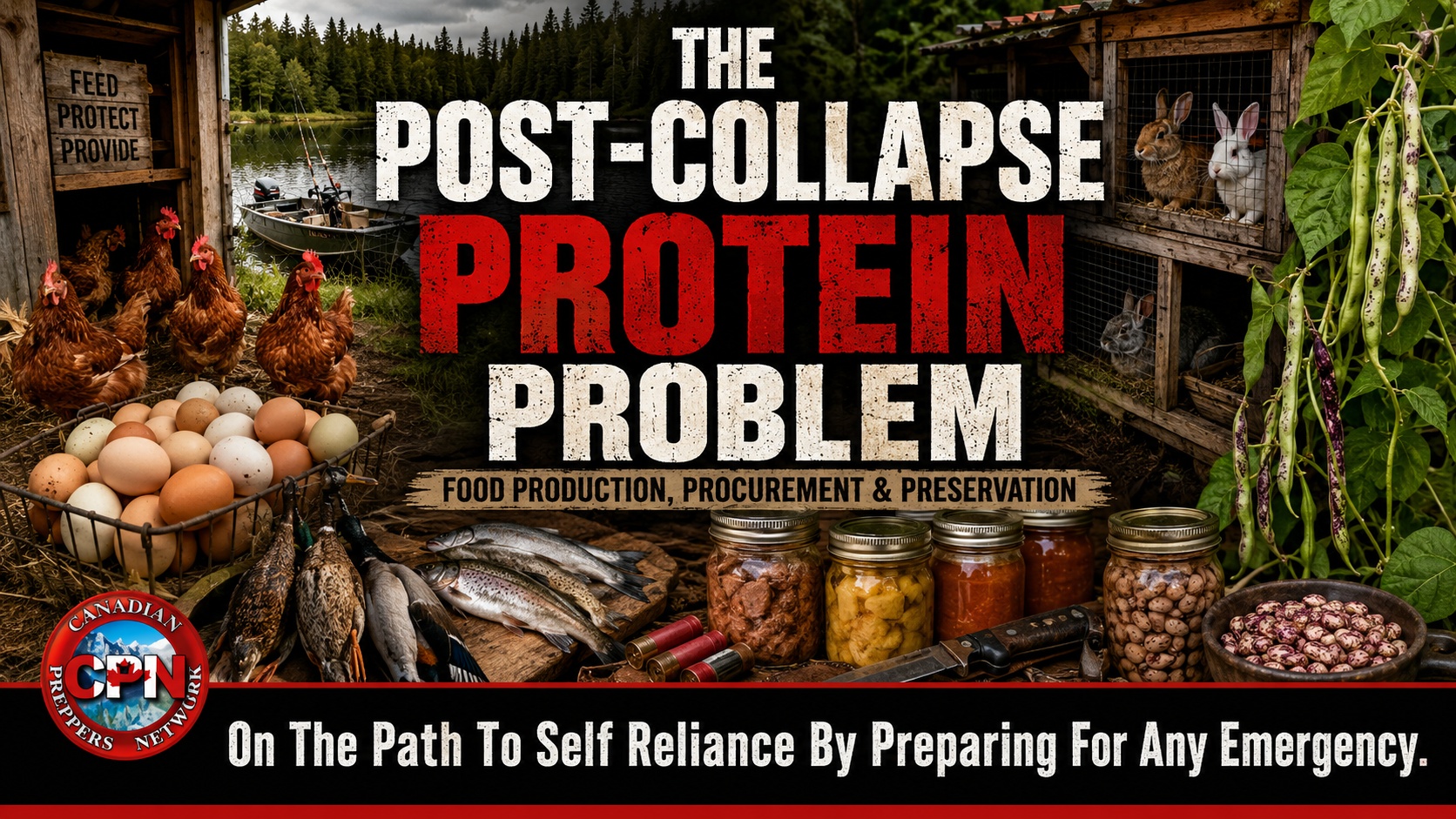
Why rice, beans, and buckets are not enough when hard work, winter, and long emergencies start burning through the body
Most preparedness food plans are heavy on starch. Rice, oats, pasta, flour, potatoes, and dry beans all have their place, and no serious pantry should ignore them. They are affordable, shelf-stable, and calorie dense. But calories alone are not the whole problem.
In a long emergency, especially in Canada, the real food challenge becomes protein and fat.
That is where many prepper food plans start to fall apart.
A person can survive for a time on stored carbohydrates, but a working household, retreat group, or rural homestead needs more than belly filler. People chopping wood, hauling water, repairing fences, gardening by hand, tending animals, repairing equipment, and living without normal conveniences are burning energy and breaking down muscle every day. Children are still growing. Older adults need strength. Sick or injured people need nutrients to recover. Morale drops fast when every meal feels thin.
The question is not just, “Do we have food?”
The better question is, “Where will steady protein come from after the freezer is empty, the cans are gone, and the stores are not refilling?”
For Canadian preppers, that answer has to be built before it is needed.
Stored protein buys time. Production keeps the table alive.
Canned meat, tuna, salmon, sardines, peanut butter, powdered eggs, freeze-dried meat, lentils, split peas, beans, TVP, protein powders, and dehydrated meals all have a role in a serious pantry. These are useful because they bridge the gap between normal shopping and working production.
But stored protein has limits. It costs more than bulk starch. It takes up space. It can be expensive to rotate. Some options rely on heavy packaging, imported supply chains, or specialty suppliers. Freezers are excellent while the grid works, but they become a liability when power and fuel become uncertain.
That does not mean freezers are useless. They are one of the best short- and medium-term food tools available. The mistake is treating frozen meat as a permanent survival plan without a way to preserve it or replace it.
A better approach is layered.
Store protein now. Preserve more while conditions are normal. Learn production methods before failure matters. Build relationships with local producers before everyone else is desperate.
The backyard egg system is often the first realistic step.
For many households, chickens are the most obvious protein producer. Eggs are compact, useful, familiar, and easy to cook. A few laying hens can turn kitchen scraps, garden waste, insects, weeds, and feed into steady food. In a long emergency, eggs also provide fat, protein, and cooking flexibility.
But chickens are not magic. They need protection from predators, dry housing, winter water, bedding, space, and feed. In much of Canada, winter changes everything. Frozen water, short daylight, deep snow, and feed storage all matter. A person who has only watched homestead videos may underestimate how much planning goes into keeping birds alive and productive through February.
That is why poultry should be practised now, not imagined later.
Ducks may suit some properties better than chickens, especially where there is damp ground, slugs, or access to water. They can be hardy and productive, but they are messy, and their water needs can become a chore. Quail can work in smaller spaces and produce eggs quickly, though they are more fragile and less familiar to many people.
The key is not choosing the trendiest animal. The key is choosing a system that your property, climate, bylaws, time, and feed sources can actually support.
Rabbits solve a different problem.
Where legal and practical, rabbits are one of the most efficient small-livestock options for meat production. They are quiet, compact, and can fit into spaces where larger livestock cannot. They also reproduce quickly compared with chickens, goats, sheep, or cattle.
But rabbits require discipline. Housing must be clean and secure. Breeding must be managed. Feed must be reliable. Heat, cold, predators, disease, and poor handling can all ruin the system. Rabbit meat is also very lean, which means it should not be viewed as the only animal protein in a long-term diet. A survival food plan still needs fat.
That point matters.
Protein gets the attention, but fat is often the hidden shortage. Fat carries calories. It helps with satiety. It makes plain food more tolerable. It is important for cooking and nutrition. A pantry full of rice and lean meat will keep people busy chewing, but it may not keep them strong.
This is why eggs, nuts, seeds, stored cooking oils, rendered fats, peanut butter, sunflower seeds, flax, and oil-rich crops deserve a place in the plan. It is also why livestock systems should be connected to the larger food plan, not treated as separate hobbies.
Legumes are the overlooked workhorses.
Not every protein source has to walk, swim, or lay eggs. Dry beans, peas, lentils, chickpeas, and soybeans can all contribute to household protein, and many store extremely well. In Canadian gardens, dry beans can be a serious survival crop if you choose varieties suited to your growing season.
The mistake is growing only fresh-eating garden crops.
Lettuce, radishes, cucumbers, and tomatoes are welcome, but they are not a serious protein plan. A survival garden needs dry beans, storage peas, potatoes, squash, corn where suitable, cabbage, carrots, beets, onions, garlic, and other crops that become actual meals. Beans and grains together can support a diet far better than starch alone.
Growing dry beans also teaches reality. You quickly learn how much land, labour, drying space, and processing time it takes to produce meaningful quantities of food. That lesson is valuable. It turns fantasy into numbers.
Fish can be part of the plan, but not a fantasy plan.
Fishing is often mentioned as a food source after collapse, but it is not reliable if everyone has the same idea. Local lakes, rivers, and streams can be pressured quickly. Regulations still matter in normal times, and skill matters in all times. Weather, access, seasons, gear, preservation, and local fish populations all affect the result.
For rural properties with the right conditions, ponds or aquaculture may be possible, but they are not simple. Fish need oxygen, water quality, feed, temperature control, and protection from predators. A pond is not automatically a protein machine.
The more realistic approach is to treat fishing as one layer, not the foundation. Learn the local waters legally now. Understand the species. Know the seasons. Practise preservation. But do not assume that a rod and tackle box will feed a family through a Canadian winter.
Hunting belongs in the plan, but it cannot be the whole plan.
Hunting should be part of the food-procurement discussion, especially in Canada, where many rural and northern households already understand wild meat as part of the food system. Deer, moose, bear, small game, waterfowl, and upland birds can provide meaningful protein where hunting is legal, properly licensed, and practised responsibly.
But hunting is not a magic answer to the post-collapse protein problem.
Game populations are not unlimited. Access to land matters. Seasons, tags, provincial regulations, firearms laws, transport rules, and safe storage requirements all matter in normal times. Skill matters even more. A person who has not hunted before should not assume that owning gear means they can feed a family when pressure is high, weather is poor, and everyone else has the same idea.
There is also a preservation problem. A large animal is only useful if the meat can be processed, shared, canned, frozen while power remains available, dried, smoked by proper methods, or otherwise preserved safely. Without that plan, a successful hunt can become a waste problem instead of a food-security solution.
For serious preppers, hunting should be treated as one layer in a wider protein system. Learn legally now. Build relationships with ethical hunters, landowners, butchers, trappers where lawful, and rural families who already understand wild-food handling. Know the rules. Know the seasons. Know how wild meat fits into the pantry. But do not build a household food plan on the assumption that the woods will feed everyone after the shelves go bare.
Fishing and hunting can both support a food plan, but neither should be treated as the foundation. The more people depend on wild food at the same time, the faster that layer becomes uncertain. Production, preservation, stored protein, local relationships, and legal procurement skills all have to work together.
Procurement depends on relationships.
In a prolonged emergency, food will not come only from what you personally grow. It will come from neighbours, local farms, hunters, gardeners, livestock owners, beekeepers, market gardeners, seed savers, and small processors.
Those relationships cannot be built honestly in the middle of panic.
A serious prepper should know where local eggs come from, who raises meat birds, who sells beef or pork by the side, who grows storage crops, who has extra hay, who saves seed, who presses cider, who keeps bees, and who has canning or freeze-drying capacity. That does not mean broadcasting your pantry or begging for favours. It means becoming part of a practical local food network before need becomes urgent.
Barter is not just a pile of silver coins and spare batteries. Barter is skill, trust, reliability, labour, tools, transport, repairs, firewood, storage space, and the ability to help preserve a harvest before it spoils.
Protein production needs feed production.
This is the part many people skip.
Animals do not create food from nothing. Chickens, rabbits, ducks, goats, pigs, and larger livestock all need feed. If your livestock system depends entirely on store-bought feed, then it is still tied to the supply chain. That may be acceptable in normal times, but it is a weak point in a long emergency.
A better plan looks for partial feed independence.
Garden waste, comfrey, weeds, fallen fruit, squash, pumpkins, mangels, sunflower heads, sprouted grains, insect-rich compost systems, hay, pasture, and crop residues can all play a role depending on the animal and the property. None of this removes the need for knowledge. Some plants are unsafe for certain animals. Poor feed can reduce production or cause health problems. Winter feed is especially important in Canada because snow can erase most casual forage.
This is why food production should be designed as a system.
The garden feeds the people. The garden scraps help feed the animals. The animals provide eggs, meat, manure, and sometimes pest control. Compost feeds the soil. Stored seed starts the cycle again. Preserving equipment captures seasonal abundance. The pantry bridges seasonal gaps.
That is very different from simply buying a few hens and hoping.
Preservation turns protein into security.
Producing protein is only half the job. Preserving it safely is the other half.
Eggs, meat, fish, beans, and dairy all require different handling. Some can be frozen while the grid works. Some can be pressure canned. Some can be dehydrated or freeze-dried. Some can be fermented, cured, smoked, or salted only when proper methods, temperatures, and food-safety rules are understood.
This is not an area for guesswork. Bad preservation can waste food or make people sick. A pressure canner, proper jars, tested recipes, clean handling, and careful storage are not optional details when dealing with low-acid foods like meat and beans.
The harder the emergency, the less room there is for sloppy food handling.
Related Internal Content
This article fits into the larger CPN food-security system. Protein is only one part of the problem. Readers should also think about food storage depth, preservation equipment, food-production skills, and how agriculture, hunting, fishing, foraging, and stockpiling support each other.
Food Procurement & Storage In Canada
Start here for the broader CPN food-security hub, including storage, preservation, production, and procurement planning.
Food Storage Supplies Buying Guide
A practical guide to the basic storage equipment that helps keep dry goods, pantry staples, and preserved foods usable over time.
You Don’t Own Food Security Until You Can Produce It
A useful companion article for readers who need to move beyond stored food and start thinking in terms of production.
The Three Pillars of Survival: Agriculture, Hunting & Foraging, and Stockpiling
A broader look at how different food sources work together instead of relying on one fragile supply chain.
Homestead Skills In Canada
A hub for the practical skills that support long-term food security, livestock systems, soil building, and household resilience.
Homestead Skills Buying Guide
A useful gear guide for readers building the practical tool base needed for gardening, preservation, and small-scale homestead work.
Popular Dry Goods For Long Term Food Storage
A good follow-up for readers who need shelf-stable calories and protein support while they build more productive food systems.
Start small before you scale.
The best protein plan is not the most impressive one on paper. It is the one you can actually manage.
A household that has never kept livestock should not assume it can run chickens, rabbits, ducks, goats, bees, and a large garden all at once after the system fails. That is how animals suffer, crops fail, and people burn out.
Start with one layer. Add skill. Track costs. Learn winter problems. Learn predators. Learn preservation. Learn what your family will actually eat. Then add the next layer.
For one household, that may mean dry beans, eggs, and stored canned fish. For another, it may mean rabbits, laying hens, and a serious garden. For a retreat group, it may mean dividing responsibilities between poultry, root crops, dry beans, fishing, hunting where legal, preservation, and feed production.
The goal is not self-sufficiency as a slogan. The goal is fewer single points of failure.
Food Production & Preservation Gear Worth Having Before You Need It
Disclosure: As an Amazon Associate, Canadian Preppers Network may earn from qualifying purchases.
A serious protein plan does not start with one big purchase. It starts with the basic equipment that lets a household produce, protect, preserve, and rotate food before an emergency makes learning expensive. The goal is not to buy a homestead overnight. The goal is to remove weak points one layer at a time.
Pressure Canners
Useful for preserving low-acid foods such as meat, poultry, fish, beans, soups, and stews when tested methods are followed.
Canning Jars and Lids
The backbone of home preservation. Keep extra lids on hand, because jars can be reused but lids are consumable.
Food Dehydrators
Useful for herbs, vegetables, fruit, lightweight trail foods, and some short-term meal components.
Vacuum Sealers
Helpful for protecting dry goods, freezer food, dehydrated foods, and portioned ingredients.
Mylar Bags and Oxygen Absorbers
Best suited for dry staples such as rice, oats, beans, lentils, pasta, flour alternatives, and dry animal-feed backup where appropriate.
Food-Grade Buckets and Gamma Lids
Useful for bulk dry storage, feed protection, pantry organization, and keeping rodents and moisture away from staples.
Seed Starting Trays
A low-cost way to begin food production earlier in short Canadian growing seasons.
Grow Lights for Seedlings
Helpful for starting tomatoes, peppers, herbs, brassicas, and other plants indoors before outdoor planting is safe.
Garden Hand Tools
Basic tools matter more than gadgets: trowels, hoes, weeders, pruning shears, garden forks, and watering cans.
Chicken Feeders and Waterers
For households legally and practically able to keep poultry, reliable feeders and winter-aware water planning are part of the system.
Feed Storage Bins
Animal feed, grains, and bulk dry goods need protection from rodents, moisture, and waste.
Compost Thermometers and Compost Tools
Soil fertility is food security. Composting turns garden waste, bedding, leaves, and organic matter into long-term production capacity.
Bottom line: stored protein matters, but tools that help produce and preserve food matter even more. The pantry buys time. Production, preservation, and local skill keep the table supplied after the easy food is gone.
Final thought: protein is where fantasy food plans meet reality.
A basement full of buckets may buy time, but it does not solve the long emergency. Eventually the shelf-stable food gets thinner. The freezer empties. The easy meals disappear. Labour increases. Winter arrives. People still need strength.
That is when the prepper who built food production before the crisis has an advantage.
Not because they have one perfect system.
Because they have layers.
Stored protein. Eggs. Dry beans. Small livestock where practical. Local producers. Legal fishing and hunting skills. Preservation equipment. Feed planning. Seed saving. Soil building. Relationships.
The post-collapse protein problem is not solved by one product, one animal, one garden, one hunting season, or one good fishing spot. It is solved by building a food system that keeps producing when buying food is no longer the answer.