
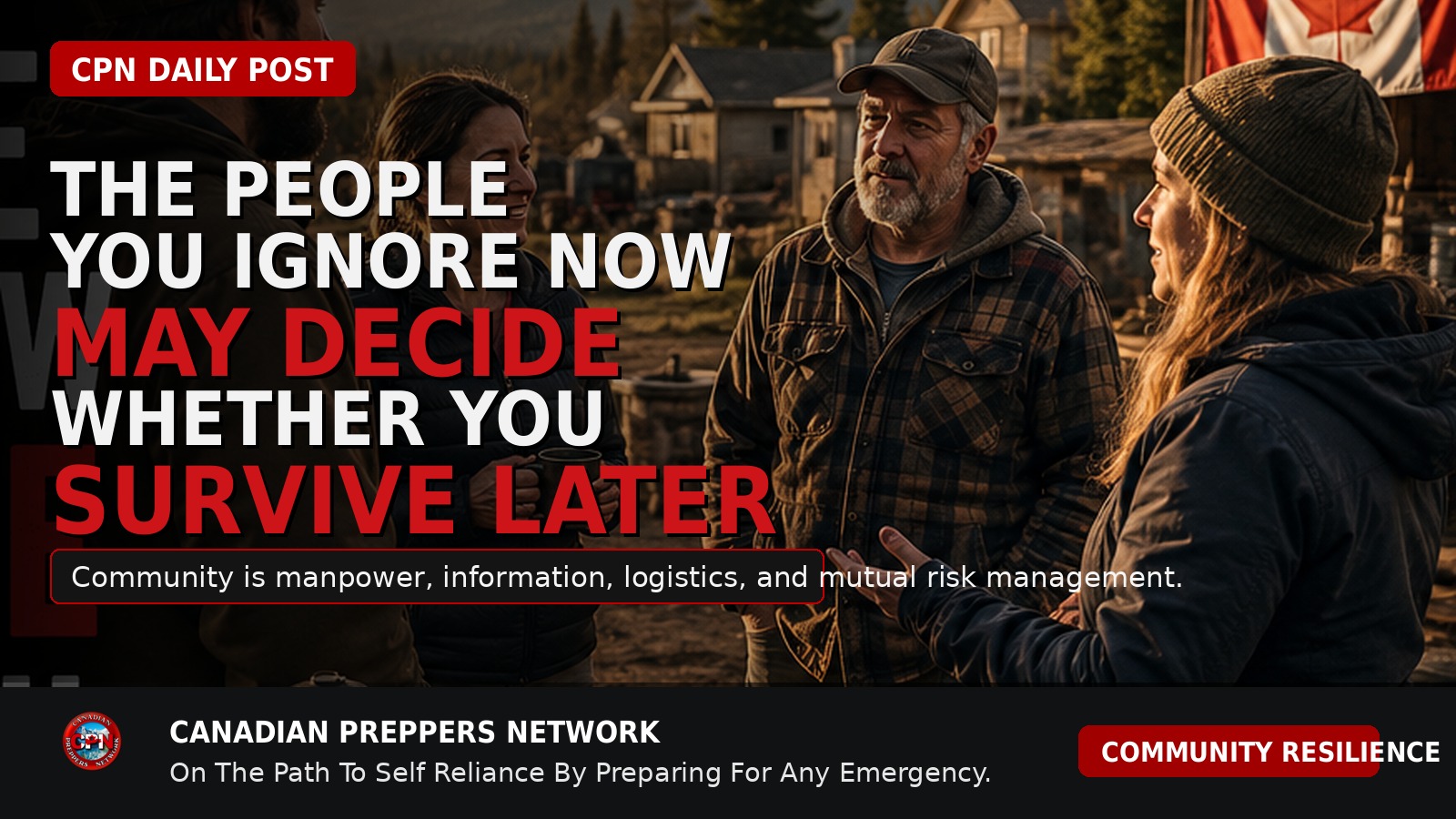
Community building is not soft preparedness. It is manpower, information, logistics, and mutual risk management.
Preparedness attracts independent people. That is one of its strengths. The man who can fix a pump, split firewood, repair a generator, pressure can a year’s worth of food, run a radio, and make decisions under pressure is not helpless. Neither is the woman who can manage a household, tend animals, preserve food, care for children, patch clothing, organize supplies, and keep others calm when things begin to break.
But independence has a limit.
In a short emergency, a well-prepared household can do a lot on its own. During a winter outage, flood, wildfire evacuation, supply interruption, or extended storm, stored food, backup heat, water filtration, fuel, lighting, and communications can carry a family through the first stretch. That is why we prepare.
In a long emergency, the lone household becomes fragile.
Not because the family is weak. Not because the preps are useless. Not because the plan was foolish. It becomes fragile because no household can do everything forever.
Someone has to stay awake. Someone has to sleep. Someone has to cook. Someone has to haul water. Someone has to check on animals. Someone has to repair equipment. Someone has to care for the sick. Someone has to listen for news. Someone has to watch the road, clear snow, split wood, tend a garden, calm a child, handle sanitation, manage supplies, and make decisions when everyone is tired.
That is where community stops being a pleasant idea and becomes a survival system.
A serious prepper does not build community because it sounds nice. He builds it because manpower matters. Information matters. Local knowledge matters. Trust matters. Skills matter. A single household can store supplies. A network can keep functioning when one person gets sick, one generator fails, one road washes out, or one family gets overwhelmed.
The people you ignore now may be the same people who know which road is flooded, which neighbour has a tractor, which bridge is out, which family needs help, which farm still has eggs, which well still produces water, and which local rumour is nonsense.
That is not charity. That is situational awareness.
Most Canadians already live inside loose networks whether they realize it or not. The neighbour with the snowblower. The farmer who knows every back road. The nurse down the street. The mechanic with spare parts. The amateur radio operator. The retired carpenter. The church group. The volunteer firefighter. The hunter. The beekeeper. The gardener. The family with a woodlot. The person who always knows what is happening in town before anyone else.
In normal times, those people are background noise.
In hard times, they are infrastructure.
The mistake many preppers make is assuming that community has to mean opening the doors to everyone, sharing everything, and trusting people blindly. That is not community. That is weakness dressed up as kindness.
Real preparedness community has boundaries.
It starts small. It starts with people you already know, people you can observe over time, and people who prove useful before a crisis. A good network does not need to know everything you have. They do not need a tour of your pantry. They do not need to know your fuel supply, your full plan, your storage locations, or every member of your group.
They need to know that you are reliable.
That is the part many people miss. Building community does not begin by asking what others can do for you. It begins by becoming the kind of person others would want beside them when things go bad.
Can you keep your mouth shut? Can you show up when you say you will? Can you bring something useful to the table? Can you solve problems without creating drama? Can you take direction when someone else knows more than you? Can you admit when you are wrong? Can you work without needing praise? Can you help without turning every favour into leverage?
Those traits matter more than another plastic tote of gear.
A group of unstable, selfish, loud, unreliable people with expensive equipment is not a survival group. It is a future argument waiting for stress to light the fuse. A handful of steady people with practical skills, clear boundaries, and trust built over time may be far more valuable.
This is why local relationships should be built before the emergency.
Once the power is out, the roads are closed, the shelves are empty, and people are scared, every new relationship is distorted by need. People become more suspicious. They ask harder questions. They wonder what you want. You wonder what they want. Help offered too late can look like manipulation. Requests made too late can look like desperation.
Trust formed under pressure is possible, but it is slower, riskier, and easier to misread.
Trust formed before pressure is different.
You know who shows up. You know who talks too much. You know who panics. You know who stays calm. You know who exaggerates. You know who has useful hands. You know who borrows tools and returns them. You know who disappears whenever work appears. You know who treats small responsibilities seriously.
That is intelligence gathering at the human level.
For Canadian preppers, this matters even more because our emergencies are often local, seasonal, and infrastructure-driven. Winter storms, rural outages, spring flooding, wildfire evacuations, road closures, supply disruptions, and communications failures do not affect everyone equally. The official alert may be late. The cell network may be overloaded. The highway report may not tell you what is happening on the concession road five minutes away.
Local people will.
A trusted neighbour may know that the creek is rising before the municipality posts anything. A farmer may know which back road remains passable. A radio operator may hear regional traffic before the news catches up. A volunteer firefighter may understand where trouble is spreading. A retired tradesman may know how to keep a heating system limping along until proper repairs are possible.
That kind of information does not come from an app. It comes from relationships.
This does not mean every prepper should become public about preparedness. Quite the opposite. The goal is not to advertise. The goal is to connect carefully.
Talk about ordinary resilience. Talk about winter readiness. Talk about backup heat. Talk about gardening, tools, local food, first aid, power outages, storm cleanup, and communications. Those are normal subjects. They do not require revealing deep stores or private plans.
You can build useful relationships through everyday activities: helping a neighbour clear a driveway, attending local events, joining a radio club, volunteering, buying from local farms, taking first aid training, visiting community markets, supporting church or service groups, or simply being known as someone who can be counted on.
The best networks are often built sideways, not formally.
One person knows a mechanic. Another knows a nurse. Another has a tractor. Another has a good well. Another has radio experience. Another grows food. Another understands local roads. Another can repair small engines. Another can organize people without causing friction.
No single person needs to be everything.
That is the point.
A serious preparedness network is not a fantasy commune. It is not a public invitation. It is not a list of people entitled to your supplies. It is a layered structure of trust.
The outer layer is general community awareness. These are people you know casually: neighbours, local business owners, farmers, volunteers, tradespeople, and community members. You do not tell them everything. You simply know who they are and whether they seem steady.
The middle layer is practical cooperation. These are people you might share information with, trade skills with, check on during storms, or coordinate with during local disruptions.
The inner layer is trusted preparedness alignment. These are the few people who understand your seriousness, respect privacy, contribute value, and can be included in more deliberate planning.
Confusing those layers is dangerous.
Not everyone belongs close. Not everyone needs details. Not everyone who is friendly is trustworthy. Not everyone who is useful is stable. Not everyone who talks about preparedness is someone you want near your family under stress.
Community building is not blind inclusion. It is sorting.
That sorting takes time.
Start with low-risk cooperation. Share garden surplus. Trade labour. Compare storm notes. Discuss road conditions. Help with a repair. Invite someone to a skill-building day. Talk about radios without discussing retreat plans. Talk about food preservation without discussing inventory. Talk about emergency contact trees without discussing where everything is stored.
Let people reveal themselves through ordinary pressure.
Do they gossip? Do they respect privacy? Do they show gratitude? Do they return borrowed items? Do they handle disagreement well? Do they contribute, or do they only take? Do they stay calm when plans change? Do they understand boundaries?
A crisis will magnify whatever is already there.
The person who is unreliable now will not become reliable because the grid went down. The person who cannot keep a small confidence now will not protect important information later. The person who causes drama in good times will not become a calming presence in bad times.
Choose accordingly.
This is also where mental resilience connects directly to community. Isolation wears people down. Fear gets louder when nobody can compare notes. Rumours spread faster when information channels are weak. Fatigue becomes more dangerous when there is no relief. Families under pressure can start turning on each other when there are no outside supports, no shared labour, and no trusted voices to help steady the situation.
A household with a strong pantry but no human network is still vulnerable.
A household with stored food, backup water, heat, communications, skills, and trusted local relationships is much harder to break.
That does not mean depending on others instead of preparing. It means preparing in a way that recognizes reality. Mutual support works best when everyone brings something. The strongest community ties are not built around dependency. They are built around contribution.
Bring something useful.
Learn a skill. Build a pantry. Get first aid training. Understand radios. Grow food. Store extra water. Keep tools maintained. Learn basic repairs. Know your local roads. Have printed maps. Build routines. Keep your family organized. Become steady under pressure.
Then connect with others who are doing the same.
Preparedness is not just about surviving the first few days. It is about remaining functional after the easy part is over. When systems fail, people become the system. Some will be liabilities. Some will be threats. Some will be overwhelmed. Some will become essential.
Your job is to know the difference before the crisis makes the decision for you.
Related CPN Reading
Mental Resilience & Community Building in Canada
Establishing Relationships With Other Survival Groups
Communications When the Grid Goes Silent
Emergency Communications Buying Guide
Mental Resilience & Community Building Buying Guide
Preparedness Buying Box
As an Amazon Associate, Canadian Preppers Network may earn from qualifying purchases.
Community preparedness is not about buying your way into trust. It is about having the basic tools that help a household communicate, organize, document, and cooperate when normal systems are strained.
Waterproof Notebooks
Useful for contact lists, radio logs, local observations, barter notes, supply tracking, neighbourhood checks, and written instructions when phones are dead or disorganized.
Laminated Map Cases
Printed maps are still useful when GPS, data service, or online routing fails. A local map marked with flood-prone roads, alternate routes, water sources, neighbours, and meeting points can become a serious planning tool.
Whiteboard and Dry Erase Supplies
A simple household or group status board can track tasks, water use, fuel, medical needs, weather notes, radio schedules, and who is responsible for what.
Battery-Powered AM/FM Radios
Not every information source needs to be complex. A basic radio gives households access to public broadcasts during outages and can reduce dependence on cell networks.
Two-Way Family Radios
Short-range radios can help with property coordination, neighbourhood checks, vehicle convoys, and local tasks. Know the rules, limitations, and realistic range before depending on them.
First Aid Manuals
A trusted paper reference is useful when stress is high, internet access is gone, or the person with the most experience is not available.
The bottom line: gear does not create community, but the right basic tools help reliable people coordinate under pressure.
Final Thought
The lone wolf image sells well because it flatters the ego. It tells people they can out-store, out-plan, and outlast everyone else without needing to deal with the messy reality of other human beings.
But long emergencies punish fantasy.
The real survivor is not always the person with the deepest basement pantry. Often, it is the person who knows who can be trusted, who can fix what, who has information, who has skills, who needs help, and who will stand steady when everyone else is reacting.
The people you ignore now may decide whether you survive later.
Choose carefully. Build quietly. Contribute first. Trust slowly.


2 Comments