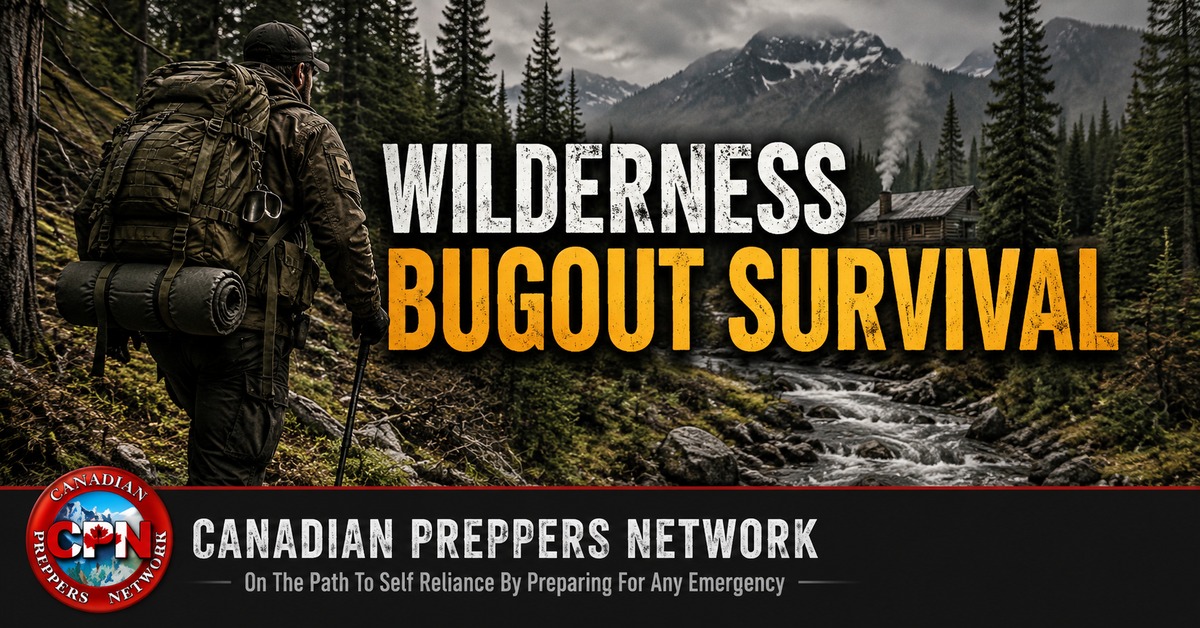
Getting to your BOL when roads, fuel, crowds, and weather are no longer on your side
The wilderness is not the destination.
That is the first thing every serious prepper needs to understand before building a bugout plan. In a real long-term emergency, the goal is not to “live in the woods.” The goal is to survive the movement from where you are to where you should have already prepared to be.
That place may be a rural property, a family farm, a hunt camp, a group retreat, a cabin, a trusted friend’s acreage, or a properly stocked bugout location. Whatever form it takes, your BOL should offer something the wilderness cannot: stored food, shelter, heat, tools, water options, security, sanitation, and the possibility of long-term stability.
The bush is the corridor.
The BOL is the objective.
That distinction matters because a lot of preparedness thinking gets this backwards. People imagine fleeing into the trees as though the forest itself is the plan. It is not. The Canadian wilderness can help you move, hide, rest, and survive temporarily while you are in transit. It can give you water, fuel, cover, and alternate routes when roads become blocked, unsafe, or watched. But it can also punish bad planning through exposure, injury, exhaustion, bad navigation, dehydration, and poor decisions.
Wilderness bugout survival is not camping.
It is movement under stress.
Your Bugout Route Is More Important Than Your Bugout Bag
Most people spend far too much time obsessing over what goes into the bag and not enough time studying the route.
A good bag matters, but the bag is only one part of the system. The route determines what you will face. Roads determine choke points. Bridges determine bottlenecks. Rivers determine crossings. Suburbs determine crowds. Logging roads determine access. Terrain determines speed. Weather determines whether your plan is realistic or foolish.
A serious bugout route to your BOL should not be one line on a map. It should be a layered route system.
You need a primary route, an alternate route, and at least one ugly route that avoids the obvious roads entirely. You need to know which roads are likely to jam, which bridges matter, where fuel may become unavailable, where cell service disappears, where official checkpoints or road closures could exist during normal emergency conditions, and where desperate people may naturally gather.
In Canada, this gets complicated quickly. Lakes, rivers, swamps, Crown land, private property, farms, rail lines, bush roads, snowmobile trails, hydro corridors, and seasonal roads can all affect movement. A route that works in July may be useless in March thaw. A gravel road that looks good on a map may be gated, washed out, or buried in snow.
Your plan should not begin with “grab the bag.”
It should begin with “which route is still open?”
The First Goal Is Distance From Immediate Danger
During the first stage of a bugout, speed may matter more than comfort.
If your home area has become unsafe because of fire, flood, civil disorder, chemical spill, extended blackout, supply collapse, or organized criminal activity, your first priority is to break contact with the immediate danger zone. This may mean using a vehicle as far as possible, then switching to foot movement only when roads fail or become too risky.
This is where many people make a mistake. They assume the entire bugout has to be done one way. It does not.
A realistic bugout may involve vehicle movement, foot movement, short-term concealment, waiting out danger, then moving again. It may involve abandoning the obvious route and circling wide. It may involve stopping earlier than planned because weather or fatigue makes further movement dangerous.
Flexibility matters more than pride.
The person who insists on pushing through exhaustion because “the BOL is only twenty more kilometres” may never reach it. The person who knows when to stop, get dry, drink water, check feet, adjust the route, and move again at first light has a much better chance.
The Wilderness Is A Transit Zone, Not A Home
Once you leave roads and enter bush, you trade speed for concealment and risk reduction.
That tradeoff can be worth it, but only if you understand the cost. Travel becomes slower. Navigation becomes harder. Injuries become more serious. Water becomes both an opportunity and a hazard. Fire becomes useful but risky because it can reveal your location. Food becomes limited to what you carried unless you already have staged supplies or lawful, practical means of resupply.
This is why the wilderness should be treated as a transit zone. You are passing through it to reach a better place. You are not settling in permanently beside a random creek and hoping the land provides.
A good wilderness transit plan is built around short stages. Move. Rest. Hydrate. Check the map. Reassess. Avoid unnecessary exposure. Avoid unnecessary contact. Avoid wasting calories. Avoid making noise, smoke, or light when it is not needed.
The goal is not to prove you can suffer.
The goal is to arrive.
Cache Points Can Make Or Break The Route
A properly planned BOL route should include cache points if you have the legal ability and secure locations to establish them.
This does not mean dumping random buckets in the woods and hoping they are still there years later. A useful cache is deliberate. It supports a specific route. It contains supplies that solve likely problems. It is protected from water, animals, freezing, theft, and accidental discovery. It is checked and rotated when possible.
For a long movement to a BOL, a cache might include food, water treatment supplies, socks, fire-starting materials, basic medical items, batteries, a paper map copy, cordage, a small tarp, gloves, or seasonal clothing. The point is not to replace your main supplies. The point is to reduce the consequences of loss, delay, injury, or weather.
One of the worst bugout assumptions is that everything you need will stay on your back.
If you lose your pack crossing water, take a fall, get separated from supplies, or burn through more food than expected, a planned cache can turn a disaster into a delay.
Water Is The Route Problem You Cannot Ignore
Water planning has to be built into the route from the beginning.
You cannot carry enough water for a long wilderness movement unless the route is short. Water is heavy, and the harder you move, the more you need. At the same time, drinking untreated water can create serious problems when you are already under stress.
Every serious BOL route should identify water points in advance. Rivers, streams, lakes, springs, public access points, campgrounds, rural cemeteries, boat launches, and seasonal creeks can all matter. But water on a map is not always usable water on the ground. Some sources dry up. Some freeze. Some are contaminated by agriculture, industry, flooding, dead animals, or human waste.
Carry more than one way to make water safer. A filter is good. Chemical treatment is good. Boiling is useful when time, fuel, and concealment allow. Redundancy matters because frozen filters, cracked containers, clogged elements, and lost gear are not theoretical problems.
Water is also a navigation feature. Rivers and lakes can guide movement, block movement, expose movement, or funnel people into predictable crossing points. A bridge may be convenient, but it may also be watched, blocked, washed out, or crowded.
A serious prepper studies water before the emergency, not while thirsty.
Exposure Will Beat You Before Hunger Does
People worry about food first because hunger is easy to imagine. Exposure is usually the faster threat.
Cold rain, wet clothing, wind, and poor sleep can destroy your ability to think clearly. In Canada, this is not just a winter problem. Spring and fall can be brutal. Even summer nights can become dangerous if you are soaked, exhausted, and unable to dry out.
Your transit kit should be built around staying dry, staying warm, and protecting sleep. A tarp, ground insulation, dry socks, gloves, head covering, rain protection, and a reliable fire-starting method matter because they protect function.
Function is survival.
Once you are cold, wet, sleep-deprived, and calorie-depleted, everything gets harder. Navigation gets sloppy. Foot placement gets careless. Temper gets short. Risk tolerance goes up. A bad decision that you would normally avoid suddenly seems acceptable because you just want the situation to end.
That is when people get hurt.
A wilderness bugout plan should assume miserable weather, not ideal weather. If your route only works on a dry weekend in June, it is not a real route.
Movement Discipline Matters
When you are moving toward a BOL during a serious emergency, you should assume that not every person you encounter is harmless.
That does not mean paranoia should run the plan. It means visibility matters. Sound matters. Light matters. Smoke matters. Cooking smells matter. Tracks matter. Camp location matters.
Obvious campsites are obvious to everyone. Shorelines, road edges, trail junctions, open ridges, abandoned buildings, scenic clearings, and easy access points may attract attention. The better choice is often less comfortable but less visible.
A low-profile camp should be chosen before darkness if possible. It should offer cover from wind, some concealment from likely travel routes, access to water without camping directly on top of it, and enough distance from roads and trails to reduce accidental contact.
At night, light discipline matters. A bright headlamp can be seen from far away. Fire may be necessary in cold conditions, but it should not be used casually. Noise should be controlled. Camp routines should be simple and quiet.
The goal is not to sneak around like a movie character.
The goal is to avoid becoming an easy problem for someone else to notice.
Foot Care Is A Survival Skill
A bugout route lives or dies on your feet.
Blisters, wet socks, poor boots, overloaded packs, and unrealistic distances can cripple a person long before food or water runs out. This is especially true for people who have good gear but have not walked real distances with real weight.
Foot care is not glamorous, but it is one of the most important wilderness transit skills you can build. Break in footwear before it matters. Carry spare socks. Stop early when hot spots begin. Keep feet dry when possible. Air them out during longer rests. Reduce pack weight before it damages you.
A person who can move steadily for several days has options.
A person who destroys their feet on day one becomes dependent on luck, rescue, or other people.
Navigation Must Not Depend On A Phone
Phones are useful until they are not.
Battery failure, broken screens, poor signal, water damage, dead networks, and simple loss can all happen. GPS is convenient, but your bugout route to a BOL should be navigable without it.
That means paper maps. It means a real compass. It means knowing how to orient the map, identify terrain, follow handrails like rivers or ridges, estimate distance, and recognize when you are drifting off route.
You should also understand pace. Ten kilometres on pavement is not the same as ten kilometres through bush, snow, mud, hills, blowdown, or swamp. A route that looks short on a screen may consume an entire day when conditions turn bad.
Navigation is not just about knowing where you are.
It is about knowing whether the plan is still realistic.
The BOL Must Be Ready Before You Need It
This is the part many people avoid.
A bugout location that is not stocked, secured, maintained, and reachable is not a BOL. It is a hope.
If you are moving through wilderness to reach a BOL, that location should already contain supplies. Food, water storage, cooking ability, heat, bedding, tools, first aid, sanitation, lighting, communications options, and repair materials should be considered before the crisis. If other people are expected to gather there, the group plan should be worked out in advance.
Who is allowed in? Who has keys? Who brings what? What happens if someone arrives injured? What happens if someone arrives with extra people? What if the primary route is blocked? What if the first group to arrive finds damage, theft, or occupation?
These are uncomfortable questions, which is why they need to be answered before stress, fear, and hunger get involved.
A wilderness route is only useful if it leads somewhere better.
Otherwise, you are just leaving one problem to enter another.
Practise The Route In Pieces
You do not need to run a full collapse simulation to test your plan.
Start by driving the route. Then drive the alternate route. Identify fuel points, bridges, dead zones, choke points, road closures, seasonal hazards, and possible rest points. Then walk sections of the route with your actual pack. Test the terrain. Test water access. Test how long things really take.
Do this in different seasons. A route that is easy in September may be miserable in blackfly season, dangerous during spring flooding, or impossible after heavy snow. A trail that looks clear on a satellite image may be overgrown, gated, posted, washed out, or filled with deadfall.
The point of testing is not to confirm your fantasy.
The point is to find out where your plan fails while failure is still cheap.
When Not To Move
Sometimes the best bugout decision is to stay put longer.
Moving too early can throw you into danger before you need to be there. Moving too late can trap you. The skill is knowing the difference.
A useful bugout trigger should be specific. Not vague fear. Not headlines. Not internet panic. Specific indicators. Fire moving toward your area. Flood evacuation warnings. Long-term grid failure with no restoration timeline. Local violence spreading. Fuel becoming unavailable. Bridges closing. Medical needs you cannot meet at home. Supply conditions deteriorating beyond your household’s ability to manage.
If home is still safer than the route, stay and prepare.
If the route is becoming safer than home, move before everyone else reaches the same conclusion.
That timing decision may matter more than any single item in your pack.
Related Reading On Canadian Preppers Network
Water Collection & Purification In Canada
Wilderness Bugout Transit Gear Worth Testing
A bugout bag is not a magic backpack. It is a short-term movement kit designed to keep you functional while getting to a better location. The gear below should be tested before it is trusted. Do not leave this equipment in a package and assume it will work when the route is cold, wet, dark, and stressful.
Navigation
Water
Shelter & Exposure Protection
Fire & Camp Utility
Medical & Foot Care
The rule is simple: if it is part of your route plan, it needs to be tested before the emergency. Gear that has never been used is not part of your plan. It is just an assumption with a price tag.
Final Thought
The wilderness can help you reach your BOL.
It can provide concealment when roads are unsafe. It can offer water, fuel, and temporary shelter. It can give you alternate movement options when the obvious routes fail. It can buy you time.
But it is not a replacement for a prepared destination.
The serious prepper does not bug out into nowhere. He moves with purpose, by planned routes, toward a stocked and realistic location. He understands that the bush is not a fantasy refuge. It is a hard, unforgiving transit zone that rewards preparation and punishes arrogance.
Your BOL is the plan.
The wilderness is just the dangerous ground you may have to cross to get there.