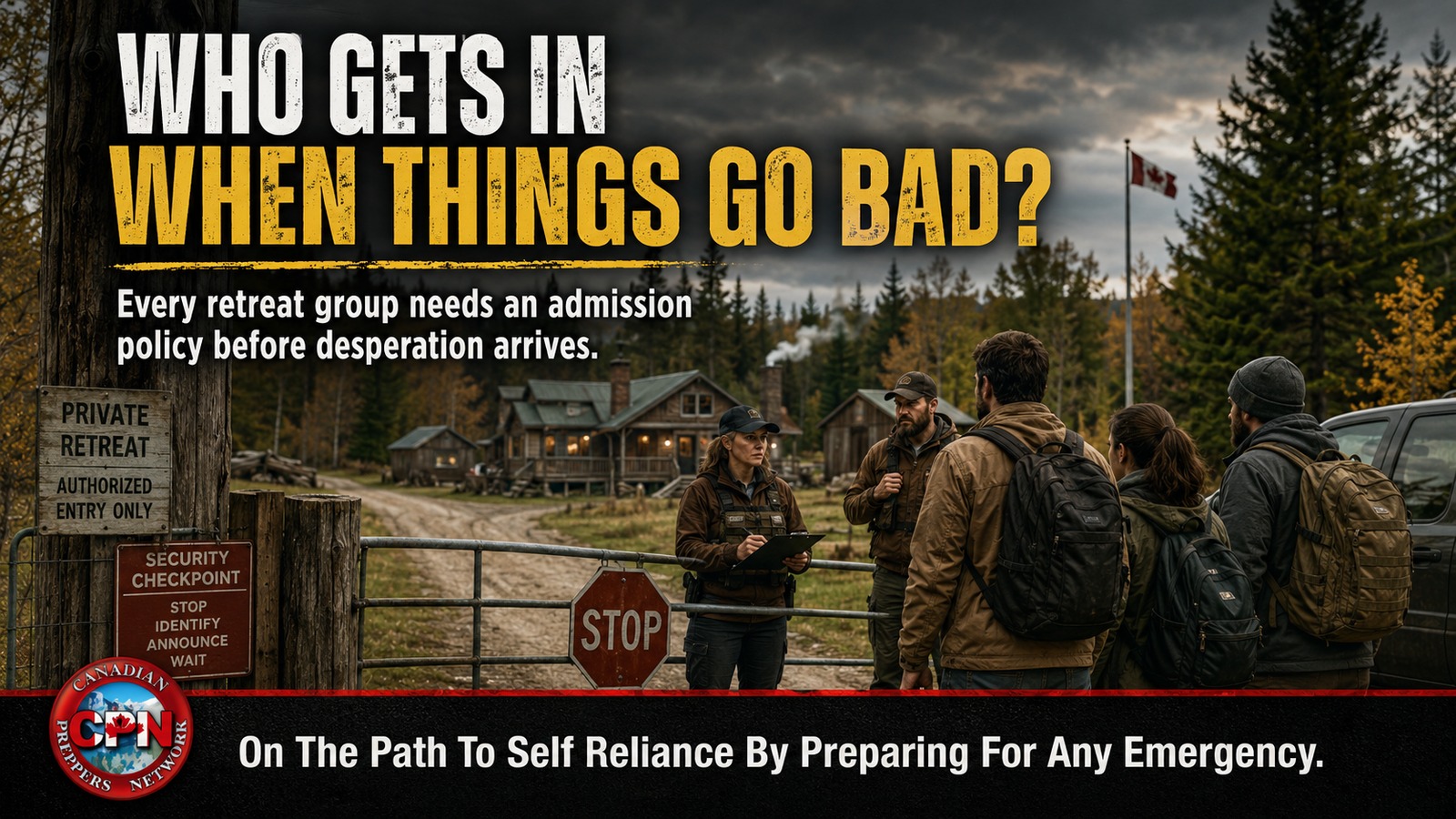
Every retreat group needs an admission policy before desperation arrives.
There is one retreat question nobody likes answering honestly.
Who gets in?
Not in theory. Not in a calm conversation over coffee. Not when everyone is comfortable, polite, and still imagining disaster as something distant. The real question is this: who gets through the gate when the power has been out for days, the roads are uncertain, the grocery stores are stripped, and people who never contributed to the retreat suddenly remember that you were “into preparedness”?
That is when vague plans fail.
A multi-family retreat, MAG, rural fallback property, or survival group cannot rely on good intentions alone. If the group has not decided in advance who belongs, who may be invited, who is not allowed, and what the process is for handling unexpected arrivals, then the decision will be made under pressure. That is the worst possible time to make it.
A retreat is not just land. It is food, labour, shelter, trust, discipline, medical capacity, sanitation, heat, water, and social stability. Every person added to that system affects all of it.
The Comfortable Lie: “We’ll Figure It Out”
Many retreat groups avoid this conversation because it feels harsh. Nobody wants to sound cold. Nobody wants to admit that stored food is limited, sleeping space is limited, and trust is limited. So the plan becomes vague.
“We’ll help who we can.”
“We’ll take care of family.”
“We’ll make decisions when the time comes.”
Those statements sound decent, but they are not policies. They are emotional placeholders.
The problem is that emergencies do not bring people to your door in neat categories. They bring your cousin who mocked prepping but now has three kids and no food. They bring the neighbour who helped you once but never prepared. They bring a friend of a friend. They bring someone useful with no supplies. They bring someone vulnerable who needs help. They bring someone with conflict attached to them. They bring people who may be honest, desperate, angry, ashamed, manipulative, or all of the above.
A group that has not prepared for that moment will fracture.
Some members will want to let everyone in. Others will see every outsider as a threat. Some will secretly promise space to relatives. Others will hide supplies. Resentment will build fast. The retreat may survive the storm, blackout, or collapse — and still be destroyed by disagreement.
Membership Has to Mean Something
If a retreat group has members, then membership must carry expectations.
That does not mean creating some fantasy bunker club with titles and uniforms. It means being clear about who has earned a place in the plan. A real member should be someone who has contributed before the emergency, shown up for work weekends, accepted group rules, built trust over time, and brought useful value to the table.
That value may be food, tools, skills, land access, medical knowledge, mechanical ability, communications experience, gardening labour, security awareness, childcare support, cooking ability, logistics, or steady character. Not everyone contributes in the same way. But everyone must contribute in some way.
The hard truth is that a person who only appears after disaster strikes is not in the same category as someone who helped build the system before it was needed.
Preparedness is not a reservation system for people who never took it seriously.
Family Is the Hardest Category
Most retreat groups can discuss strangers easily. Family is where things get uncomfortable.
A person may be part of the retreat group, but their adult children, parents, siblings, in-laws, or close friends may not be. That creates enormous pressure. In a real emergency, people will not think in terms of group capacity. They will think in terms of love, guilt, loyalty, and panic.
This is why every serious retreat plan needs a family policy.
Not because family should be abandoned. Not because compassion has no place. But because “my family can come” is not a plan if every member quietly means something different by it.
Does “family” mean spouse and dependent children only? Does it include adult children? Elderly parents? Siblings? In-laws? Ex-spouses? Grandchildren? Close friends who are “basically family”? What happens if one member arrives with four extra people and another arrives alone after contributing twice as much?
These questions feel ugly now because conditions are normal. They will feel much uglier later if nobody has answered them.
The group should define household membership clearly. It should list who is included in each member’s immediate retreat plan. It should also define whether additional relatives are automatic members, conditional guests, temporary evacuees, or outside the plan entirely.
That may sound formal, but clarity now prevents betrayal later.
Guests Are Not Members
One of the most useful distinctions a retreat group can make is between members, approved guests, and emergency arrivals.
A member has a defined role, responsibility, and place in the retreat plan. They are part of decision-making and group capacity planning.
An approved guest is someone the group has discussed in advance. They may be allowed under certain conditions, but they are not automatically equal to a full contributing member.
An emergency arrival is someone who shows up during a crisis without prior approval.
Those three categories should not be treated the same.
A guest might be allowed shelter for a night, medical help, a meal, or transport assistance without being absorbed into the retreat. An approved relative might be welcomed if they arrive with supplies, accept group rules, and do not overload capacity. An unknown arrival might be handled at a distance, assessed carefully, and assisted only in limited ways.
Without categories, every arrival becomes a moral crisis.
With categories, the group has a process.
Capacity Is Not Cruelty
One of the most dangerous myths in preparedness is the belief that saying “we do not have capacity” is the same as saying “we do not care.”
Capacity is real.
A retreat with food for twelve people does not magically support twenty. A septic system, outhouse, well, woodpile, sleeping area, medical kit, and winter heating plan all have limits. So does emotional stability. So does leadership. So does labour coordination.
Adding people may help if they bring skills, discipline, and resources. It may also destroy the system if they consume more than they contribute, create conflict, ignore rules, or panic under stress.
Every retreat group should calculate realistic capacity in advance. Not fantasy capacity. Not “we could squeeze people in” capacity. Real capacity based on calories, water, heat, sanitation, bedding, medicine, cooking, security of supplies, and workload.
Then the group must decide what happens when that capacity is reached.
That decision should not be made at the door.
The Written Admission Policy
A retreat group does not need a 40-page legal document, but it does need written expectations. A simple admission policy should answer a few core questions.
Who are the current members?
Who is included in each member’s household?
Are extended family members automatically included, conditionally included, or excluded unless approved?
Can any one member invite someone without group agreement?
What supplies, tools, skills, or labour are expected from new members?
What behaviour results in refusal or removal?
Who has authority to make decisions during an emergency?
How are unexpected arrivals handled?
Is there a temporary aid policy for people who cannot be admitted?
How are disputes settled?
This does not have to be cold. In fact, a written policy can make the group more humane because it prevents panic-based decisions. It lets members say, “This is what we all agreed to,” instead of fighting in the middle of a crisis.
The Neighbour Problem
In rural Canada, neighbours matter. Ignoring everyone around a retreat property is foolish. The nearest farmer, mechanic, nurse, chainsaw owner, snowplow operator, hunter, or ham radio operator may matter more than someone on your official membership list.
But neighbour relationships are not the same as retreat membership.
A retreat group should develop local relationships long before trouble arrives. Help with storms. Trade skills. Share labour. Attend community events. Learn who is reliable. Learn who talks too much. Learn who helps when there is no reward.
Over time, some neighbours may become trusted allies. Others may remain friendly but outside the core plan. That distinction matters.
In a serious emergency, the best answer may not be “everyone joins the retreat.” It may be a loose network of nearby households that can share information, labour, tools, and mutual aid while still maintaining separate stores and separate living arrangements.
That is often more realistic than absorbing people into one location.
Mercy Without Surrendering the Retreat
A hard admission policy does not mean refusing all help.
A group can decide in advance what limited aid looks like. Maybe that means providing directions, water refills, basic first aid, a warm meal, local information, or help contacting family. Maybe it means maintaining a small charity reserve separate from core retreat supplies. Maybe it means helping known neighbours in specific ways without opening the entire retreat.
The key is separation.
Core survival supplies must remain protected for the people they were planned for. Charity, trade, and temporary aid should come from a clearly defined margin, not from the group’s essential reserves.
That may sound severe, but it is the difference between helping responsibly and collapsing under emotional pressure.
Screen People Before They Need You
The best time to decide who belongs is long before the emergency.
Invite potential members to work weekends. Watch how they behave when they are tired, cold, bored, or asked to do unglamorous jobs. See who brings tools, who brings excuses, who listens, who complains, who learns, who disappears, and who quietly does the work.
Talk openly about food storage, communications, sanitation, first aid, gardening, fuel, winter access, conflict, privacy, alcohol, pets, children, guests, and finances. The goal is not to find perfect people. Perfect people do not exist. The goal is to find steady people who can function inside a group under stress.
A person who cannot respect rules now will not magically become reliable later.
A person who treats the retreat like a free insurance policy is not a member. They are a future burden.
The Final Question
Every retreat group eventually has to answer this:
Are we building a plan, or are we building a wish?
A wish says everyone we love will somehow fit. A wish says food will stretch. A wish says conflict will settle itself. A wish says good people will make good decisions under unbearable pressure.
A plan is harder. A plan names people. A plan counts supplies. A plan defines authority. A plan admits limits. A plan protects the group from emotional collapse.
“Who gets in?” is not a cruel question.
It is one of the most responsible questions a retreat group can ask.
Because when things go bad, the gate is not just a gate. It is the boundary between preparation and chaos.