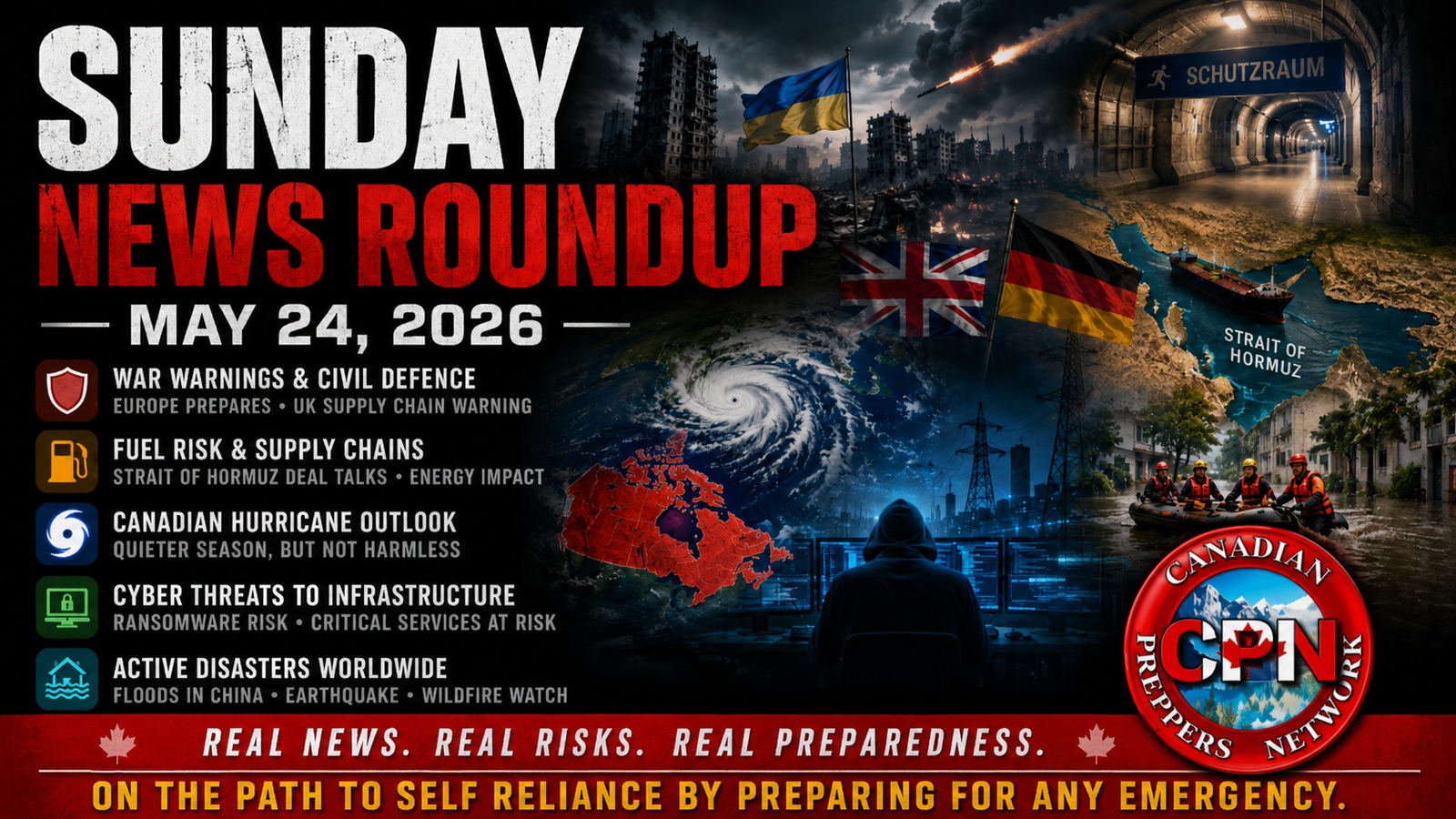
War Warnings, Civil Defence, Fuel Risk, Canadian Hurricane Outlook, Cyber Threats, and Active Disasters
This week’s preparedness stories are not about distant headlines. They are about systems under strain: war hitting civilian infrastructure, European governments rebuilding civil defence, supply chains being questioned, fuel routes becoming geopolitical bargaining chips, Canada entering hurricane season, cyber threats moving into critical infrastructure, and active disasters forcing evacuations overseas.
For Canadian preppers, the point is not to panic over every international event. The point is to notice the pattern. Modern life depends on long chains: fuel, food, medicine, power, banking, communications, roads, ports, cloud systems, emergency services, and public trust. When those chains are stressed, the household with margin is in a very different position than the household waiting for normal to return.
Europe Is Preparing for War-Level Disruption
Germany is putting civil defence back on the table in a serious way. Reuters reporting says Germany has approved a Civil Defense Plan that shifts away from relying only on old Cold War bunkers and looks at ordinary public spaces such as underground parking garages, tunnels, and subway stations as potential shelters. The plan includes a €10 billion civil defence investment, including shelters, vehicles, protective gear, medical capacity, and mass-alert systems.
Source: Reuters via Internazionale
That matters because Europe is no longer treating civil defence as nostalgia. It is being discussed as present-day national resilience. Germany is not simply buying military equipment; it is also looking at civilian protection, warning systems, emergency vehicles, and medical capacity. That is the part Canadian households should pay attention to.
Preparedness is not only about remote cabins and stored food. It is also about how ordinary people survive disruption in cities, suburbs, small towns, and rural communities when the systems around them are overloaded.
A second warning came from the United Kingdom, where The Guardian reported on a National Preparedness Commission warning that Britain’s supply chains are underprepared for major shocks such as war, pandemics, and climate-related crises. The report points to weak stockpiling of food and essential medicines compared with countries such as Norway and Sweden.
Source: The Guardian
That should sound familiar. Canada is also a country that assumes trucks will keep moving, pharmacies will keep filling prescriptions, stores will restock, payment systems will work, and emergency services will remain available. Those assumptions may hold most of the time. Preparedness is what you do for the times they do not.
The Canadian household takeaway is straightforward: keep depth in the pantry, keep essential medications organized, maintain paper records, build local supply relationships, and do not assume government or retail systems have unlimited reserves.
Ukraine Shows What Civil Defence Really Means
Russia launched one of its largest attacks on Kyiv since the war began, according to Reuters, firing hundreds of drones and 90 missiles, including the Oreshnik hypersonic missile. Reuters reported deaths, more than 80 injuries, and damage to residential buildings, schools, and water facilities.
Source: Reuters
This is the brutal reality behind the phrase “civil defence.” It is not abstract policy language. It is people trying to sleep, cook, communicate, get water, reach medical care, and protect their families while infrastructure is being damaged around them.
For Canadian preppers, Ukraine is not a direct comparison. Canada is not Ukraine. But the lessons are still useful. Civilian life depends on power, water, shelter, communications, transportation, and reliable information. When those are hit, even strong people can become vulnerable quickly.
That is why a household plan should not stop at “we have some food.” It should include stored water, backup light, backup heat where safe and legal, battery charging, a radio, paper contact lists, a family communication plan, basic first aid, cash, fuel discipline, and a way to function when internet-based services are unreliable.
Fuel and Supply Chains Are Back in the Danger Zone
The Strait of Hormuz remains one of the week’s most important global risk stories. Reuters reported that U.S. President Donald Trump said a U.S.-Iran memorandum of understanding had been “largely negotiated” and could lead to a peace deal and reopening of the Strait of Hormuz. The same report describes the strait as a crucial global oil shipping route.
Source: Reuters
A possible deal is good news, but it does not erase the lesson. Fuel routes are not guaranteed. Shipping routes are not guaranteed. Energy prices are not isolated from war, diplomacy, ports, insurance, sanctions, or military risk.
For Canadian households, fuel is not just about driving. Fuel affects grocery prices, farm costs, home heating, delivery trucks, construction, snow clearing, emergency response, generator use, and the price of nearly everything that moves.
This is why fuel preparedness should be boring and disciplined. Keep vehicles from sitting near empty. Store fuel only in safe, legal, appropriate containers. Rotate what you store. Maintain generators before an outage, not during one. Think about how far you really need to drive during a crisis. Build more resilience at home so every emergency does not require a last-minute trip.
A fragile fuel market punishes the unprepared quickly.
Canada’s Hurricane Outlook Is Quieter, But Not Harmless
Environment and Climate Change Canada says the 2026 North Atlantic hurricane season is expected to be below average, with 8 to 14 named storms, 3 to 6 hurricanes, and 1 to 3 major hurricanes. ECCC says the expected development and strengthening of El Niño is a major reason for the lower forecast, even though Atlantic water temperatures remain a factor.
Source: Environment and Climate Change Canada
That sounds like good news, and in some ways it is. But a quieter season does not mean Atlantic Canada, coastal Quebec, ferry routes, ports, offshore workers, rural roads, and shoreline communities can relax. ECCC warns that even one storm can have significant impacts, and the agency says Canada averages three or four tropical cyclone events each hurricane season, with one or two affecting Canadian soil and others threatening offshore waters.
The prepper mistake is confusing a seasonal forecast with a household plan.
A below-average hurricane season can still produce the storm that knocks out power, blocks roads, damages roofs, floods basements, interrupts ferry service, delays fuel deliveries, and forces people to leave home quickly. Hurricane Fiona remains the obvious Canadian reminder: one storm at the wrong angle can do historic damage.
For households in Atlantic Canada and exposed coastal regions, the work should happen before the first storm is tracking north. Test generators. Rotate stored fuel safely. Inspect sump pumps. Secure tarps and roof-repair supplies. Keep chainsaws maintained. Back up documents. Keep cash available. Have water stored. Know evacuation routes. Plan for pets, livestock, elderly relatives, and anyone who cannot move quickly.
A quiet forecast is not permission to ignore hurricane season.
It is an opportunity to prepare before everyone else remembers they should have.
Cyberattacks Are Infrastructure Threats, Not Just Computer Problems
Canada’s Cyber Centre launched the Critical Infrastructure Resilience and Escalated Threat Navigation initiative, known as CIREN, in April to help critical infrastructure organizations prepare for severe cyber incidents. The Cyber Centre says CIREN is meant to help essential-service organizations prepare for worst-case scenarios, including widespread and prolonged cyber disruptions, and it specifically names sectors such as energy, telecommunications, transportation, and water.
Source: Canadian Centre for Cyber Security
That should land hard with preppers. A cyberattack does not have to target your house to affect your life. It can hit the water utility, the hospital network, a fuel distributor, a municipality, a pharmacy system, a payment processor, a telecom provider, or a transportation hub.
The Cyber Centre’s National Cyber Threat Assessment says ransomware is the top cybercrime threat facing Canada’s critical infrastructure because it can disrupt the delivery of critical services. The same assessment warns that state-sponsored cyber actors are very likely targeting critical infrastructure networks in Canada and allied countries to prepare for possible future disruptive or destructive operations.
Source: National Cyber Threat Assessment 2025–2026
For households, the answer is not becoming an IT department. The answer is offline redundancy. Keep printed copies of key documents. Keep a written medication list. Keep emergency contacts on paper. Keep some cash. Keep maps that do not require cell service. Back up important files. Know how to reach family if phones, apps, banking, or cloud services are unreliable.
A cyber crisis may not look like Hollywood. It may look like debit machines failing, appointments being cancelled, websites going down, records being unavailable, fuel logistics slowing, or municipal services becoming confused and delayed.
That is still a preparedness problem.
Active Disasters: Floods and Earthquakes Are Still Moving People
China saw severe flooding this week across central and southern regions. Reuters reported that heavy rain and flooding killed people in Guangxi, Guizhou, Hunan, and Hubei, with some people still missing. Reuters also reported that flooding in Chongqing left three people dead and 17 missing after extreme rainfall hit Yongchuan district.
Source: Reuters
This is not included because China is Canada. It is included because disasters repeat the same basic patterns everywhere: water rises, roads disappear, power and transport fail, people get stranded, and rescue resources are stretched.
Flooding also reminds preppers that evacuation is not always theoretical. Keep go-bags realistic. Keep documents ready. Keep fuel in the vehicle. Know more than one route out. Have a communication plan that does not depend on everyone being online. Do not assume a familiar road will remain passable.
A separate Reuters report said a magnitude 5.2 earthquake in China’s Guangxi region killed two people and forced more than 7,000 residents in Liuzhou to evacuate. AP reported that at least 13 buildings collapsed, landslides blocked roads, and train services were disrupted.
Source: Reuters
For Canada, earthquake readiness often gets treated as a West Coast issue, but the broader lesson applies everywhere: buildings fail, roads close, utilities are interrupted, and people may have to leave quickly. Every household should be able to handle darkness, broken glass, water interruption, blocked routes, and a sudden need to leave or shelter in place.
Wildfire Season Still Deserves Canadian Attention
There was not a clean, major Canadian wildfire evacuation story in the first pass of today’s news search, but the official Canadian Wildland Fire Information System remains the better source for current national fire status. Natural Resources Canada’s National Wildland Fire Summary is updated with current conditions, reported fires, and national statistics.
Source: Canadian Wildland Fire Information System
That means wildfire should stay on the radar without forcing it into the lead. For many Canadian households, the practical work is already familiar: clear combustibles near structures, keep evacuation documents ready, prepare for smoke, know local alerts, keep masks and filters available, and have a plan for pets, livestock, elderly relatives, and people with respiratory issues.
Wildfire preparedness is not just a rural issue anymore. Smoke, road closures, evacuations, insurance problems, and supply disruption can reach far beyond the fire line.
The Preparedness Takeaway
This week’s stories point in the same direction.
Europe is rebuilding civil defence. Ukraine is showing what attacks on civilian infrastructure look like. Britain is questioning whether its supply chains are ready for major shocks. The Strait of Hormuz remains a reminder that fuel security can change quickly. Canada’s hurricane outlook is quieter, but not harmless. Canada’s own Cyber Centre is telling critical infrastructure operators to prepare for severe cyber incidents. Floods and earthquakes overseas are moving thousands of people with little warning.
The lesson is not fear.
The lesson is redundancy.
Redundancy in food. Redundancy in water. Redundancy in communications. Redundancy in power. Redundancy in records. Redundancy in transportation. Redundancy in cash. Redundancy in local relationships. Redundancy in practical skills.
Preparedness is not about predicting the exact crisis.
It is about building a household that does not fall apart the moment one system fails.