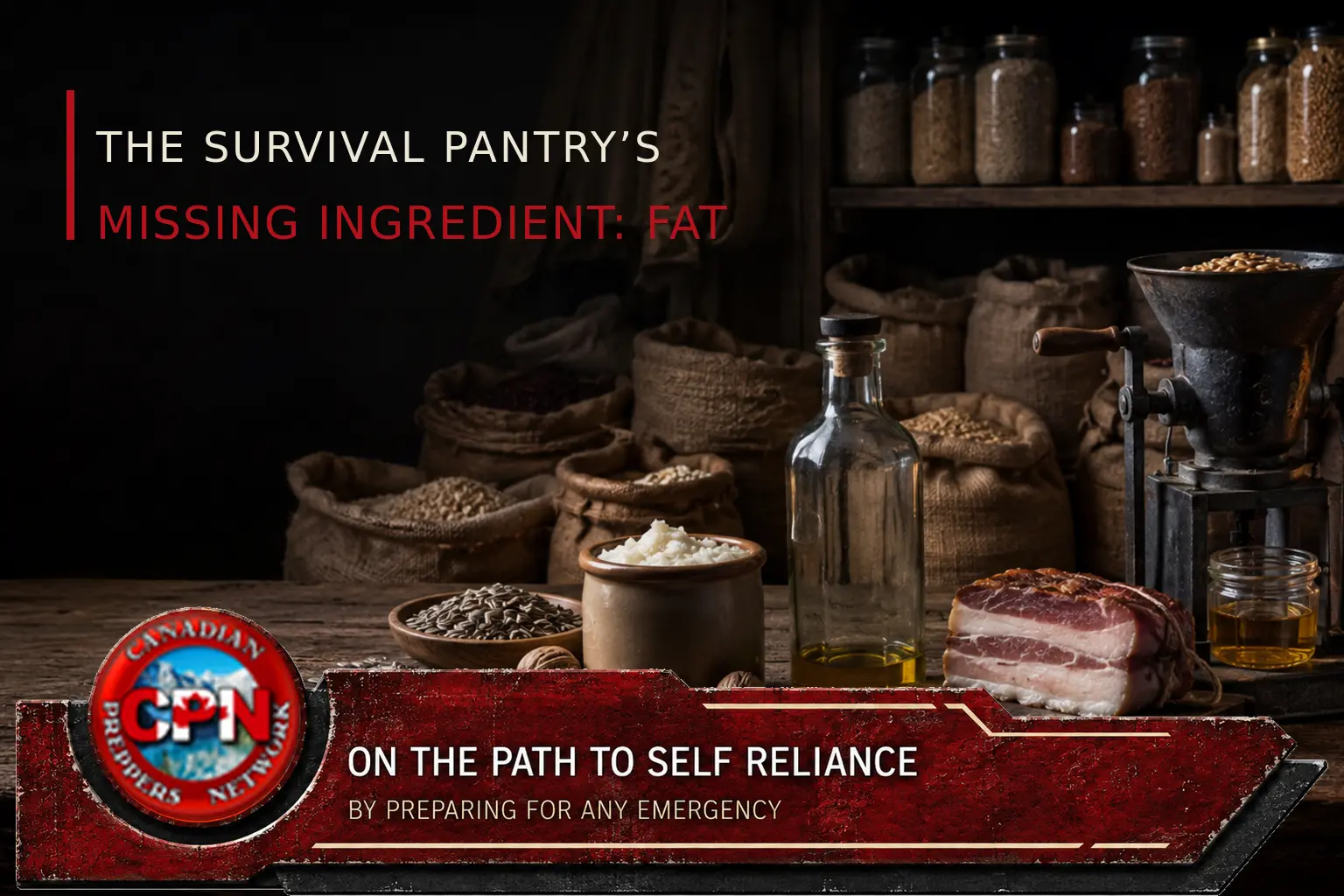
Stored grains may fill the shelves, but fat keeps people working.
Most long-term food plans are built around bulk carbohydrates. Rice, wheat, oats, pasta, flour, beans and dehydrated potatoes are inexpensive, easy to store and capable of supplying an impressive number of calories.
On paper, the pantry looks ready.
The problem becomes apparent when those foods must sustain adults performing hard physical work for months rather than sheltering through a short emergency. Grains and legumes provide energy and protein, but most contain relatively little fat. Once the cooking oil, peanut butter and canned meat are gone, an otherwise substantial food reserve can become painfully lean.
In a prolonged collapse, fat may become one of the hardest nutrients to replace.
Fat Is More Than Extra Calories
Fat supplies approximately nine calories per gram, compared with about four calories per gram from either carbohydrates or protein. That makes it an extremely concentrated way to store and transport food energy.
It also serves purposes that another sack of rice cannot entirely replace. Dietary fat helps the body absorb vitamins A, D, E and K. It supplies essential fatty acids and makes lean foods more satisfying. A small amount can transform dry beans, boiled grain or root vegetables into a meal capable of supporting physical labour.
Health Canada’s dietary reference tables place the normal adult range for fat at roughly 20 to 35 per cent of total energy. That does not mean every retreat must hit a perfect percentage during a crisis, but it does reveal the scale of the problem.
Consider an adult receiving 2,400 calories per day. If 25 per cent comes from fat, that represents about 67 grams of fat daily. For four adults, the requirement approaches 98 kilograms over a full year.
That is far more than a few bottles pushed to the back of the pantry.
CPN Gold Membership includes access to the CD3WD collection and hundreds of practical manuals covering food production, agriculture, water, energy, repairs, health and self-reliance.
Gold members also receive the new Canadian Preparedness Intelligence Briefing by email every month. Each briefing examines emerging risks that may affect Canadian households, including global geopolitics, domestic economic pressures, employment trends, food and energy security, civil-defence developments and other issues worth watching.
Build an offline preparedness library and receive serious monthly intelligence without depending on social-media rumours or endless daily news feeds.
The Pantry Can Hide the Shortfall
A stockpile should be evaluated by nutrients and usable calories, not merely by servings.
Emergency-food manufacturers frequently define a serving as a small portion rather than a complete meal. Similarly, a household may own hundreds of kilograms of dry food without having enough fat to build a balanced working diet.
A basic audit can expose the problem:
- Record the amount of fat shown on each food label.
- Multiply that figure by the number of servings stored.
- Add the fat contained in oils, shortening, nuts, seeds, canned fish, meat and other foods.
- Divide the total by the number of adults and expected days.
- Compare the result with the energy demands of the group.
Do not count every drop of oil as available for eating. Some will be lost through spills, spoilage and cooking. In a working homestead, fat may also be diverted into soap, leather dressing, lamp fuel or equipment maintenance.
The calculation will not produce a perfect nutritional plan, but it will reveal whether the pantry holds a genuine fat reserve or merely the appearance of one. For broader pantry planning, see the CPN guide to food procurement and storage in Canada.
Stored Oil Is the Bridge, Not the Destination
Commercial cooking oil is an easy way to add calories, but it is not an indefinite food.
Heat, light, oxygen and time encourage oils to become rancid. More highly unsaturated oils are generally vulnerable, while solid or more saturated fats often store somewhat better. Packaging, freshness and storage conditions matter enormously, so a printed date should not be mistaken for a universal shelf-life guarantee.
Keep oils in their original sealed containers until needed. Store them in the coolest, darkest practical location and buy sizes that can be consumed reasonably soon after opening. Several smaller containers are generally more useful than one enormous jug that exposes the entire reserve every time it is opened.
A sensible short-term reserve can include several different sources:
- Canola or another everyday cooking oil
- Olive oil for uncooked foods and moderate-heat cooking
- Coconut oil or shortening
- Peanut butter
- Whole nuts and seeds
- Canned oily fish
- Shelf-stable meat
- Powdered whole milk, where appropriate
- Commercially packaged butter or ghee intended for shelf storage
Diversification prevents the loss of one container or one type of fat from crippling the entire plan. Never assume that repackaging oil in a vacuum-sealed bag or pouring it into an untested container makes it shelf-stable. Vacuum packaging does not preserve food by itself.
Spend a full day developing practical outdoor rimfire marksmanship skills with Frugal Gunnie. This is a hands-on private event—not another afternoon spent sitting at a shooting bench.
Saturday, September 12, 2026
8:00 a.m.–5:00 p.m.
Great Ape Empire
267 Highway 6, Wiarton, Ontario
Weekend camping: $20 per person
Space is strictly limited. Adult participants must meet all applicable legal and organizer requirements.
Stop Wasting Animal Fat
In normal times, fatty trimmings are often discarded. Under austere conditions, they become a strategic food resource.
Pork fat can be rendered into lard. Beef, sheep, goat and deer fat can produce various grades of tallow. Poultry fat can also be collected, although it is generally softer and less stable than hard ruminant fat.
Rendering removes water and separates usable fat from tissue:
- Trim away meat, blood, glands and damaged material.
- Cut or grind the clean fat into small pieces.
- Heat it gently in a heavy pot.
- Allow the fat to melt without scorching.
- Strain the liquid through a clean, heat-safe filter.
- Transfer it into clean containers and cool it promptly.
Low heat matters. Burning the tissue damages the flavour and makes the resulting fat less versatile. Moisture and fragments left behind can accelerate spoilage.
Rendered fat is not automatically immortal. Its storage life depends upon cleanliness, moisture, temperature, exposure to air and the animal source. Cool storage remains preferable, and any fat with an objectionable odour, visible mould or other signs of deterioration should be rejected.
Canning Is Not the Answer for Pure Fat
Internet survival advice sometimes recommends home-canning butter, lard or jars of cooking oil. That is not a safe shortcut.
Pure fats interfere with heat transfer, and tested home-canning processes for ordinary jars of butter or rendered fat are not available. Low-acid foods sealed at room temperature can support botulism if they have not been processed using a validated method.
Pressure-canned meat is different. Meat, poultry and fish can be safely canned using tested recipes, correct equipment and the specified pressure and processing time. Even then, excessive fat should be removed because it can climb the jar and interfere with the seal.
The practical distinction:
- Render fat for controlled short-term storage and use.
- Pressure-can meat only according to a tested procedure.
- Do not improvise shelf-stable jars of butter or oil.
- Do not assume a vacuum-sealed lid proves that food is safe.
Grow Fat, Not Just Vegetables
Most Canadian survival gardens are planned around potatoes, beans, squash and common vegetables. These are valuable crops, but they do not necessarily solve the fat problem.
A garden intended to support long-term independence should include crops selected for both local growing conditions and oil content:
- Sunflowers
- Flax
- Soybeans
- Canola or rapeseed varieties suitable for food use
- Pumpkins and squash grown partly for their seeds
- Peanuts in sufficiently warm locations or protected systems
- Hazelnuts, walnuts and other suitable nut trees
The useful yield is not the same as the harvested weight. Seeds must be dried, protected from rodents and either eaten whole or processed. Extracting oil requires considerable pressure, and a small hand-operated press may produce much less oil than expected.
Plant a realistic plot. Weigh the harvested seed. Measure the finished oil. Record the labour involved and determine what happens to the press cake. Depending on the crop and processing method, that remaining material may still have value as food or animal feed.
A photograph of sunflowers is not a fat-production plan. A measured harvest and a proven extraction method are.
When ordinary communications fail, amateur radio can connect a household or retreat with stations well beyond the local area.
PrepperRadio.ca offers an online Canadian Basic Amateur Radio Course built specifically around preparedness, emergency communications and practical station use.
Livestock Must Be Chosen for More Than Protein
Small livestock are often discussed as sources of meat, but lean meat alone does not guarantee adequate dietary fat.
Rabbit is a good example. Rabbits can convert forage into protein efficiently, but the meat is famously lean. A retreat relying heavily upon rabbit, wild game and garden produce could still struggle to obtain sufficient fat.
Pigs are especially valuable because they can provide both meat and renderable fat, although breed, diet and age affect the result. Dairy animals supply butterfat along with milk. Chickens and ducks provide eggs, and surplus birds yield varying amounts of cooking fat. Cold-water fish may add useful fats when a dependable and lawful fishery is available.
The correct combination depends upon land, climate, feed and available labour. Livestock that must consume food suitable for people can become competitors rather than assets. Animals should ideally convert pasture, browse, insects, crop residue and unavoidable food waste into nutrients humans can use.
Nuts and Seeds Deserve Better Protection
Nuts and seeds pack considerable energy into a small space, but their oils make them vulnerable to rancidity. They should be kept cool, dry, dark and protected from oxygen as much as practical.
Storing them whole, rather than ground, generally provides better protection. Shell-on nuts may store better still, although they require more space and labour. Damaged kernels should be removed before storage, and every container must be guarded against insects and rodents.
Planting stock should be kept separate from food reserves. In a hungry winter, it is very easy to eat the seed required for the following year’s crop. Keep clearly marked planting seed in a separate location under the control of designated members of the group.
Ration Fat Before It Becomes Scarce
Waiting until the last bottle is opened is poor ration management.
Fat should be issued according to the food being prepared and the work being performed. People doing heavy outdoor labour may need more total energy than those assigned to less demanding duties. Pregnant or nursing members, older adults and people with medical conditions may also have different requirements that deserve informed attention.
Centralized cooking makes control easier. A measured amount added to a communal stew or porridge is more efficient than allowing everyone to pour oil independently. Fat can also improve the usefulness of other stored foods:
- Add it to beans and whole grains for greater energy density.
- Fry or roast bland root crops when fuel permits.
- Enrich soups with rendered drippings.
- Use nut or seed pastes as concentrated additions.
- Combine fats with herbs, salt and strong flavours to improve monotonous meals.
The goal is not to make every meal rich. It is to prevent an irreplaceable resource from being wasted early or guarded so aggressively that people become underfed while it turns rancid in storage.
Build a Three-Stage Fat Plan
Stage One: Stored Reserves
Commercial oils, shortening, peanut butter, canned fish, nuts, seeds and other familiar foods support the household through the initial disruption.
Stage Two: Recovered and Rendered Fat
Animal processing, cooking drippings and available dairy production begin replacing the stored supply. The household uses skills and equipment acquired before the collapse.
Stage Three: Renewable Production
Oilseed crops, nut trees, dairy animals, pigs, eggs, fish and other locally appropriate systems become the continuing sources.
Each stage should overlap the next. Stored oil buys time to establish production. Livestock and perennial trees should already exist before the pantry begins running low. Seed should be in hand, and the press, grinder, rendering pots and storage containers should have been tested.
The Hard Question for Every Pantry
The most important question is not how many servings are stored.
Where will next year’s fat come from?
If the answer is another trip to the supermarket, the food system remains temporary. Rice, wheat and beans may carry a household through the opening months of a disaster, but they cannot create cooking oil, butterfat or animal fat by themselves.
Store enough fat to bridge the initial emergency. Rotate it while it is still useful. Learn to render what the homestead produces. Grow oil-bearing crops, protect nut trees and select livestock with the entire diet in mind.
A post-collapse pantry needs more than food that lasts. It needs a practical path from stored calories to renewable nutrition.
As an Amazon Associate, Canadian Preppers Network may earn from qualifying purchases. This does not change the price you pay.