Table of Contents
Prepper News Roundup: Winter Readiness and Civilian Resilience
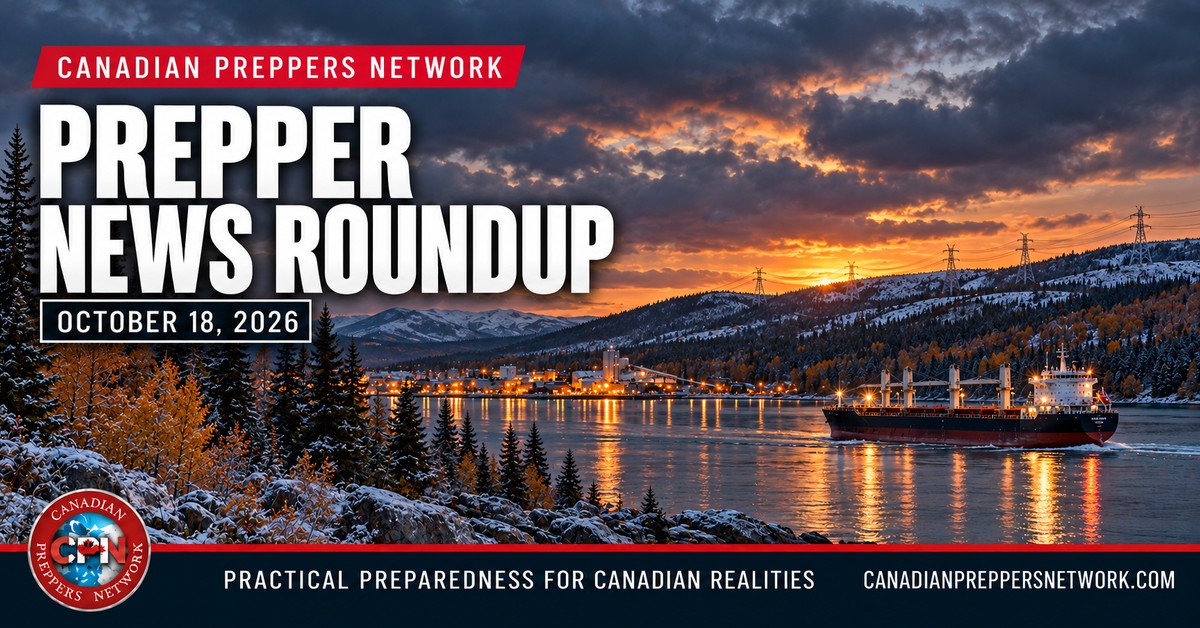
This Prepper News Roundup begins in Canada, where the first −30°C reading of the season brings winter preparations into focus, while earthquake drills in Quebec and British Columbia offer another reminder to practise before an emergency arrives. Overseas, businesses are preparing to support communities through disruption, and continuing conflicts are exposing weaknesses in energy, transport and communications.
This week’s Prepper News Roundup looks at what these developments mean for Canadian households: protecting essential services, preparing for overlapping failures and keeping alternatives available when the usual systems stop working.
This Prepper News Roundup uses reporting available through October 16, 2026. The Denmark feature, published October 9, is included for its practical relevance to community preparedness.
Canada Records Its First −30°C Reading of the Season
Canada recorded its first −30°C temperature of the season at Isachsen, Nunavut, early on October 15, according to The Weather Network. That does not mean the same Arctic air is about to sweep across southern Canada: the report specifically cautioned against that interpretation.
Nevertheless, this is a useful deadline for households still working through their autumn preparations. Heating equipment should be ready to operate, fuel arrangements settled, and exposed water systems protected before local temperatures become a problem.
Consider what happens if your usual heating system stops overnight. Where will everyone sleep? How will you keep that space warm? What happens to plumbing elsewhere in the building?
A cold-weather plan needs to cover the house, its occupants and the supplies stored inside it. Food, water and equipment that survived summer in an unheated shed may need different accommodation through winter.
Preparedness takeaway: Finish the work that becomes harder, more expensive or impossible once freezing weather arrives.
Source: The Weather Network — Canada records first −30°C reading of the season, October 15, 2026.
Quebec and British Columbia Practise Earthquake Preparedness
This week’s Great ShakeOut encouraged earthquake preparedness in both Quebec and British Columbia, with drills scheduled for October 15 at 10:15 a.m. Coverage highlighted participation in Quebec and in communities on Vancouver Island and the Sunshine Coast.
A scheduled drill gives people a reason to rehearse. The household value comes from carrying that exercise beyond its few minutes on the calendar.
Look around the places where you spend the most time. Identify furniture that could fall, objects stored above beds, and exits that clutter could obstruct. Consider whether your emergency supplies would remain accessible after items shifted or cupboards emptied.
Family communications also deserve attention. An emergency during working hours could leave household members in different locations, each trying to establish whether the others are safe. Agreeing on contact arrangements beforehand removes one decision from an already difficult situation.
Preparedness takeaway: Use a drill to find weaknesses in your household arrangements, then correct them.
Sources: CityNews — Quebec earthquake preparedness drill, October 14, 2026; My Powell River Now — Great BC ShakeOut, October 13, 2026.
Denmark Looks to Businesses for Emergency Shelter and Supplies
An October 9 Reuters report described how IKEA stores in Denmark could become emergency shelters or temporary hospitals during a crisis. Existing beds, kitchens, warehouse stock and generators give the buildings resources that could support displaced people.
The report also described Salling Group’s plans for 51 supermarkets designed to operate for up to 48 hours without electricity or internet access. IKEA participates in Denmark’s Corporate Coalition for Crisis Preparedness, which identifies resources businesses could contribute during emergencies. These are potential arrangements, rather than a guarantee that every store will become a shelter.
The useful lesson for Canadian communities is to identify existing capacity before a disaster. A local business may have storage space, transport, cooking facilities or equipment that a volunteer group lacks.
Those arrangements require willing participants and advance discussion. Knowing that a building has a generator tells you little about whether it can accommodate people, provide sanitation or operate for several days.
Community resilience improves when people understand both the resources available and their limits.
Preparedness takeaway: Build local relationships and discuss specific resources before anyone needs to request them during an emergency.
Source: Reuters, via Euronext — IKEA’s Danish stores could become shelters as Europe boosts preparedness, October 9, 2026.
Kyiv’s Winter Preparations Face Scrutiny
Ukrainska Pravda reported on October 13 that President Volodymyr Zelenskyy criticised Kyiv’s progress on resilience preparations, saying the capital lagged behind other Ukrainian regions. He cited electricity and water outages following drone strikes.
Mayor Vitali Klitschko rejected accusations that preparations for the heating season had been mishandled. The publication also reported that residents with friends or relatives outside the capital had been advised to consider temporarily relocating.
The political dispute sits alongside a practical household problem: several essential services can fail together.
A home may remain structurally sound while becoming difficult to occupy because it lacks heat, running water or reliable access. Supplies help, but relocation may still become necessary.
That makes a winter evacuation plan worth developing alongside plans to stay home. Identify somewhere you could realistically go, confirm that you would be welcome, and consider transport, medication, pets and the possibility of leaving during poor weather.
Preparedness takeaway: Establish the conditions that would make you leave, and make arrangements while you still have time and choices.
Source: Ukrainska Pravda — Kyiv’s winter preparations face criticism, October 13, 2026.
Middle East Escalation Threatens Shipping and Energy Infrastructure
AP reported October 16 that 10 attacks on shipping had been reported in the Strait of Hormuz during the preceding week, including one ship sinking. The maritime monitor warned that underreporting made the full extent uncertain.
Separately, Reuters reported President Donald Trump’s statement that the United States might target Iran’s fortified Pickaxe Mountain nuclear-related site. He said he would not use nuclear weapons and was not considering American ground troops. His comments described a possible action, rather than a confirmed strike.
For Canadian households, the practical connection is exposure to disruptions in fuel transport and international trade. These developments do not establish an imminent Canadian shortage.
Review routine fuel requirements, essential journeys and deliveries on which your household depends. Preparedness decisions should follow actual needs and verified developments, without turning every escalation into a reason for panic buying.
Preparedness takeaway: Understand your exposure to supply disruption and make measured preparations based on household requirements.
Sources: Associated Press — Middle East developments and reported Hormuz shipping attacks, October 16, 2026; Reuters — Trump says US may need to strike Iran’s Pickaxe Mountain, October 16, 2026.
Russian Refinery Strikes Deepen Fuel-Security Concerns
Reuters reported that a Ukrainian strike hit Russia’s Ryazan refinery on October 15. Ukraine said it resumed such attacks because Russian strikes against its energy infrastructure continued. Reuters noted that neither side had confirmed the energy ceasefire Trump had announced.
The next day, Brent crude touched US$110 a barrel amid concerns about Middle East escalation and Russian fuel supplies. That is a crude-oil benchmark, rather than a prediction of Canadian pump prices.
For households, fuel planning begins with consumption. Know what essential travel, heating and generator use require. Reducing unnecessary demand can stretch your available supply and budget.
Preparedness takeaway: Calculate essential fuel use so you can make informed decisions when prices or availability change.
Sources: Reuters — Russia acknowledges refinery attack, October 16, 2026; Reuters — Oil touches US$110 a barrel on supply fears, October 16, 2026.
Starlink Disruption Highlights Communications Dependence
Reuters reported October 16 that Ukraine had lost Starlink access in a way that affected military operations. Trump denied that he or Elon Musk was responsible. The report leaves responsibility unresolved.
For household planning, examine what your backup communications actually require. Equipment can still depend on electricity, subscriptions, accounts and distant infrastructure.
Write down important numbers and meeting arrangements. Practise how you would receive information and contact family if your normal internet connection became unavailable.
Preparedness takeaway: Check the dependencies behind each communications option and prepare a workable alternative.
Source: Reuters — Ukraine’s loss of Starlink access, October 16, 2026.
Hackers Disrupt French Supermarket Refrigeration
Reuters reported October 13 that a cyberattack affected refrigeration systems at at least 350 French supermarkets. Temperature settings were overridden, and spoiled meat and frozen goods were discarded.
This is another reason to maintain variety in household food storage. Frozen supplies offer convenience, but shelf-stable foods provide options when refrigeration becomes unreliable.
Consider how much of your reserve requires continuous cooling, cooking or both. A useful pantry gives you meals you can prepare under several different conditions.
Preparedness takeaway: Maintain food options that remain useful when refrigeration or cooking arrangements fail.
Source: Reuters — Investigators hunt French supermarket refrigeration hackers, October 13, 2026.
Hurricanes Disrupt Power, Drinking Water and Travel
Reuters reported October 13 that Hurricane Isaias had left widespread outages across parts of the southeastern United States. Pensacola faced drinking-water problems and airport disruption. Hurricane Simon also brought flooding to western Mexico. These conditions reflect that reporting date.
The household lesson is to plan for overlapping failures. Electricity, water, transport and accommodation may all become difficult to secure during the same emergency.
Keep enough flexibility to change course when your original plan becomes unworkable. That includes supplies for staying home, transport options for leaving and clear arrangements with the people you expect to rely on.
Preparedness takeaway: Test your plans against several services failing at once.
Source: Reuters — Multiple hurricanes hit the United States and Mexico, October 13, 2026.
Put This Prepper News Roundup Into Practice
Turn the concerns in this Prepper News Roundup into practical household checks. Review winter bedding and backup warmth, plan for seven days without running water, and consider how to keep a portable radio station powered.
Choose the gaps that matter most to your household and work through them before disruption makes the job harder. The Prepper News Roundup connects weekly developments with preparations you can put into practice.
Read the Prepper News Roundup each Sunday for Canadian preparedness news and international developments that affect household resilience.