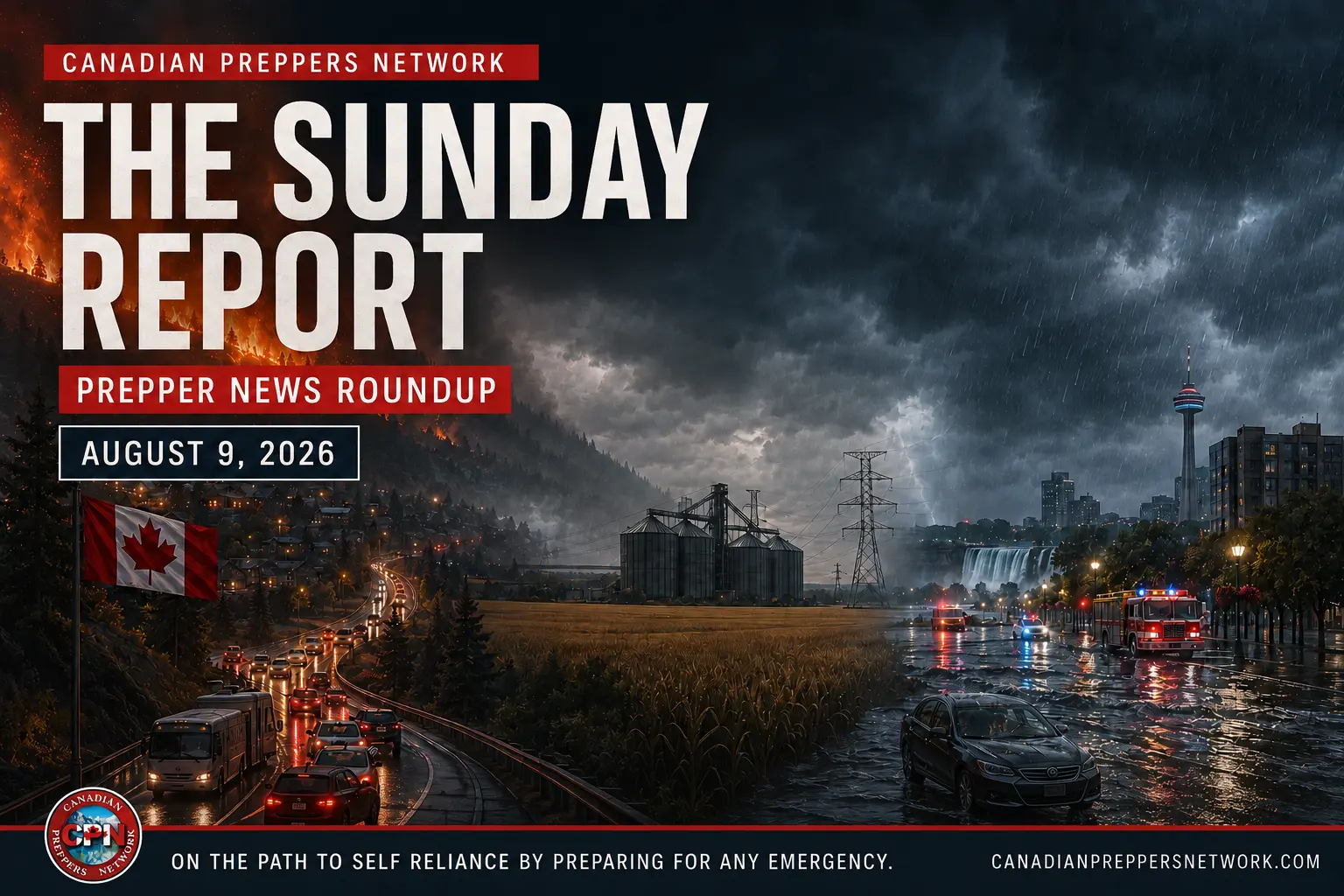
Wildfire evacuations, destructive flooding and growing pressure on global food and energy systems
Wildfires and flooding dominated the Canadian preparedness picture this week. More than 20,000 British Columbians were forced from their homes, thousands of First Nations residents remained displaced across the country, and two Ontario municipalities declared states of emergency following repeated flooding.
Beyond Canada, wildfires devastated communities in Washington State, more than one million people were evacuated ahead of a typhoon in China, and dangerously low river levels began interfering with European electricity production. At the same time, conflict around two of the world’s most important shipping corridors placed additional pressure on food and energy supplies.
British Columbia Declares a Wildfire State of Emergency
British Columbia declared a provincewide state of emergency Saturday as the Bald Range wildfire expanded rapidly around Summerland, Peachland and the western side of Okanagan Lake.
The fire grew to approximately 9,500 hectares in a matter of hours, forcing more than 20,000 people to evacuate. The entire community of Summerland, with roughly 12,000 residents, was ordered out along with thousands more in and around Peachland.
Highway 97 was closed, electrical service was interrupted and Summerland issued a boil-water advisory after the municipal water system was affected. Homes, farms and other structures were destroyed, although the full extent of the damage was not yet known.
More than 100 wildfires were burning across British Columbia, with nearly half classified as out of control. The Bald Range fire produced the province’s largest evacuation of the summer.
For preparedness-minded Canadians, this was another reminder that evacuation time cannot be assumed. Many residents received their orders during the night, while roads were already becoming congested or closing. Fuel, medications, identification, animal carriers and essential documents need to be ready before an evacuation alert becomes an order.
Source: Reuters
Thousands of First Nations Residents Remain Displaced
The situation in British Columbia formed part of a much larger wildfire emergency affecting First Nations across the country.
As of August 7, 14 First Nations remained evacuated because of wildfires: nine in British Columbia, four in Ontario and one in Saskatchewan. A total of 2,931 people were still displaced from their communities.
Since April 1, 81 wildfires have affected 77 First Nations and forced 8,325 residents to evacuate.
Remote communities face particular difficulties during prolonged evacuations. Residents may be transported hundreds of kilometres from home, families can be divided among several host communities, and returning is often delayed by damage to power, water, telecommunications and transportation infrastructure.
These figures also demonstrate the difference between an evacuation lasting several days and widespread seasonal displacement. Emergency planning must account for more than leaving safely. It must also address extended accommodation, prescription replacement, communications, pets, transportation and the possibility that essential services will not be available immediately after residents return.
Source: Indigenous Services Canada
Flooding Emergencies Declared in Niagara
St. Catharines and Lincoln, Ontario, declared states of emergency after repeated storms overwhelmed drainage systems and flooded homes, roads and municipal infrastructure.
During the July 27–28 storm, approximately 138 millimetres of rain fell in Port Dalhousie and 126 millimetres in Port Weller, much of it within only a few hours. Another intense storm on August 2 brought more than 100 millimetres to much of St. Catharines, with higher amounts reported in some areas.
The repeated flooding created sinkholes, erosion, damaged roads and extensive household cleanup requirements. Municipal waste limits were temporarily lifted to help residents dispose of flood-damaged material, while outside volunteers were brought in to assist with recovery.
The important lesson is the cumulative effect of repeated events. A household may make it through the first storm with a wet basement, damaged pump or depleted supplies, only to face another storm before repairs are complete. Saturated ground also leaves subsequent rainfall with fewer places to go.
Flood preparation should therefore include a recovery reserve: spare pump capacity, backup power, additional cleaning supplies, protective equipment and somewhere dry to store items removed from a basement. Insurance coverage should also be checked for the distinction between sewer backup and overland flooding.
Sources: St. Catharines flooding updates | Lincoln flooding updates
Free Canadian Grid-Down Starter Kit
Use this printable first-72-hours checklist to test your household’s water, power, food, sanitation, communications and operating routines before a short outage becomes a long-term grid-down emergency.
Washington Wildfires Destroy Hundreds of Buildings
Wildfires around Spokane, Washington, destroyed at least 700 buildings and placed as many as 64,000 people under evacuation orders at the height of the emergency.
Three major fires spread from wildland into residential and commercial areas, creating what Spokane officials described as the city’s worst natural disaster. Thousands of customers lost electricity after transmission infrastructure was damaged.
Firefighters gained some ground later in the week, but assessments indicated that hundreds of additional buildings may have been damaged or destroyed.
The scale of the evacuation is significant for Canadians because Spokane is relatively close to the British Columbia border and forms part of the same broader Pacific Northwest fire environment. Major emergencies on both sides of the border can compete for aircraft, crews, equipment and temporary accommodations.
It also reinforces an uncomfortable reality: living inside a town or city does not eliminate wildfire risk. Once fire enters developed areas, traffic congestion, electrical failures and falling communications capacity can quickly complicate evacuation.
Source: Reuters
More Than One Million Evacuated Ahead of Typhoon Dolphin
Typhoon Dolphin disrupted southern Japan before moving toward the eastern coast of China with winds approaching 162 kilometres per hour.
More than one million people were evacuated in China. Approximately 900,000 were moved in and around Wenzhou, while additional evacuations took place in Fujian and Shanghai. Authorities cancelled or suspended flights, ferries, port activity, rail service and construction work.
Some regions were forecast to receive as much as 500 millimetres of rain, creating serious flooding and landslide concerns well beyond the storm’s immediate coastal landfall.
For Canadians, the direct danger is limited, but the secondary effects can extend much farther. Eastern China contains major ports, factories and transportation networks. Even temporary closures can delay manufactured goods, replacement parts, electronics and industrial materials moving through international supply chains.
Source: Reuters
Support CPN and Show Where You Stand
Visit the Canadian Preppers Network shop for preparedness books, CPN clothing and merchandise created for Canadians working toward greater self-reliance.
Low Danube Levels Threaten European Electricity Production
Extremely low water levels on the Danube created an energy emergency across parts of southeastern Europe.
Romania had already shut down one of the two reactors at its Cernavoda nuclear station. Authorities conducted controlled blasting to redirect more water toward the remaining reactor’s cooling channel and began constructing a temporary dam.
Hungary’s Paks nuclear plant, which normally supplies approximately half the country’s electricity, was operating at little more than ten per cent of capacity. Falling river levels threatened to force its complete shutdown.
The problem was not confined to nuclear generation. Reduced river levels also affected hydroelectric output, freight transportation and water availability. Governments and large industrial users began reducing electricity consumption to ease pressure on the grid.
This is an important example of how one resource failure can spread through several systems. Low water does not only mean drought. It can reduce electricity generation, interrupt fuel and commodity transportation, restrict industrial output and increase dependence on imported power—all at the same time.
Source: Reuters
Global Food Prices Reach a Three-Year High
The United Nations Food and Agriculture Organization reported that its Food Price Index reached 131.1 points in July, an increase of 0.6 per cent from June and its highest level since January 2023.
Global wheat prices increased by 5.8 per cent during the month, while maize rose 3.6 per cent and sugar increased 5.6 per cent. Vegetable oil prices reached their highest level since June 2022.
Disruption to Black Sea exports, damage to agricultural infrastructure and poor growing conditions in several producing regions contributed to the increases. Meat and dairy prices declined, partly offsetting the overall rise.
The index remains approximately 18 per cent below its March 2022 peak, so this is not yet a repeat of that crisis. The concern is the direction of travel and the number of pressures appearing simultaneously.
Households do not need to panic-buy because of a monthly index change. The practical response is to steadily maintain staple-food reserves and rotate them through normal meals. That provides some protection against both temporary shortages and sudden retail price increases.
Source: FAO Food Price Index
Preserve the Knowledge You May Need Later
Gold Membership includes access to the CD3WD collection and hundreds of practical manuals covering food production, water, energy, repairs, health, agriculture and self-reliance.
For only $5 per year, members can build an offline reference library that remains useful when an internet connection is not available.
Black Sea Attacks Disrupt Grain and Fuel Shipments
Attacks on ports, commercial vessels and export terminals intensified across the Black Sea, interfering with shipments of grain, crude oil and refined fuel.
Russia and Ukraine are both major agricultural exporters, and the Black Sea remains one of the world’s most important commodity routes. The escalating attacks have increased marine-insurance costs, disrupted loading operations and created additional risks for ships entering the region.
Ukraine normally moves most of its agricultural exports through the Odesa area. An additional overnight attack damaged Odesa’s seaport and electrical infrastructure on August 9, highlighting the vulnerability of those export facilities.
This story is directly connected to the increase in global wheat prices. Agricultural production can remain relatively strong while food costs rise because ships cannot load safely, ports lose electricity or insurance becomes prohibitively expensive.
Sources: Black Sea shipping report | Odesa port attack
Conflict Watch: Iran Threatens Gulf Energy Infrastructure
Iran reportedly warned several Gulf states that another American attack on Iranian territory could trigger retaliation against critical energy infrastructure across the region.
Saudi Arabia, Qatar and Oman were among the countries pushing for negotiations intended to prevent renewed escalation. The warning was significant because the Gulf contains oil fields, refineries, export terminals and shipping routes that supply a substantial portion of the global energy market.
This remains a threat rather than a confirmed new round of attacks, but the consequences could extend far beyond the region. Any major interruption could quickly affect crude-oil prices, transportation costs, fertilizer production and eventually food prices in Canada.
The situation deserves continued monitoring, particularly when considered alongside existing disruption in the Strait of Hormuz and the growing risks to Black Sea shipping.
Source: Reuters
The Preparedness Takeaway
This week’s stories are connected by dependence on systems that can fail together.
Wildfires closed roads, interrupted electricity and compromised municipal water. Flooding damaged homes while overwhelming waste removal and drainage infrastructure. Low river levels reduced electricity generation. Conflict disrupted the shipping routes carrying food and fuel.
Preparedness is not about predicting which headline will reach your community. It is about building enough flexibility to function when transportation, water, power, communications or retail supply becomes unreliable.
The immediate Canadian priorities remain wildfire evacuation readiness, flood recovery capacity and sufficient household supplies to endure service interruptions without joining the rush at already strained stores.
Space-weather check: No G3 or stronger geomagnetic storm was recorded during the reporting period, so no geomagnetic event has been included in this week’s roundup.