
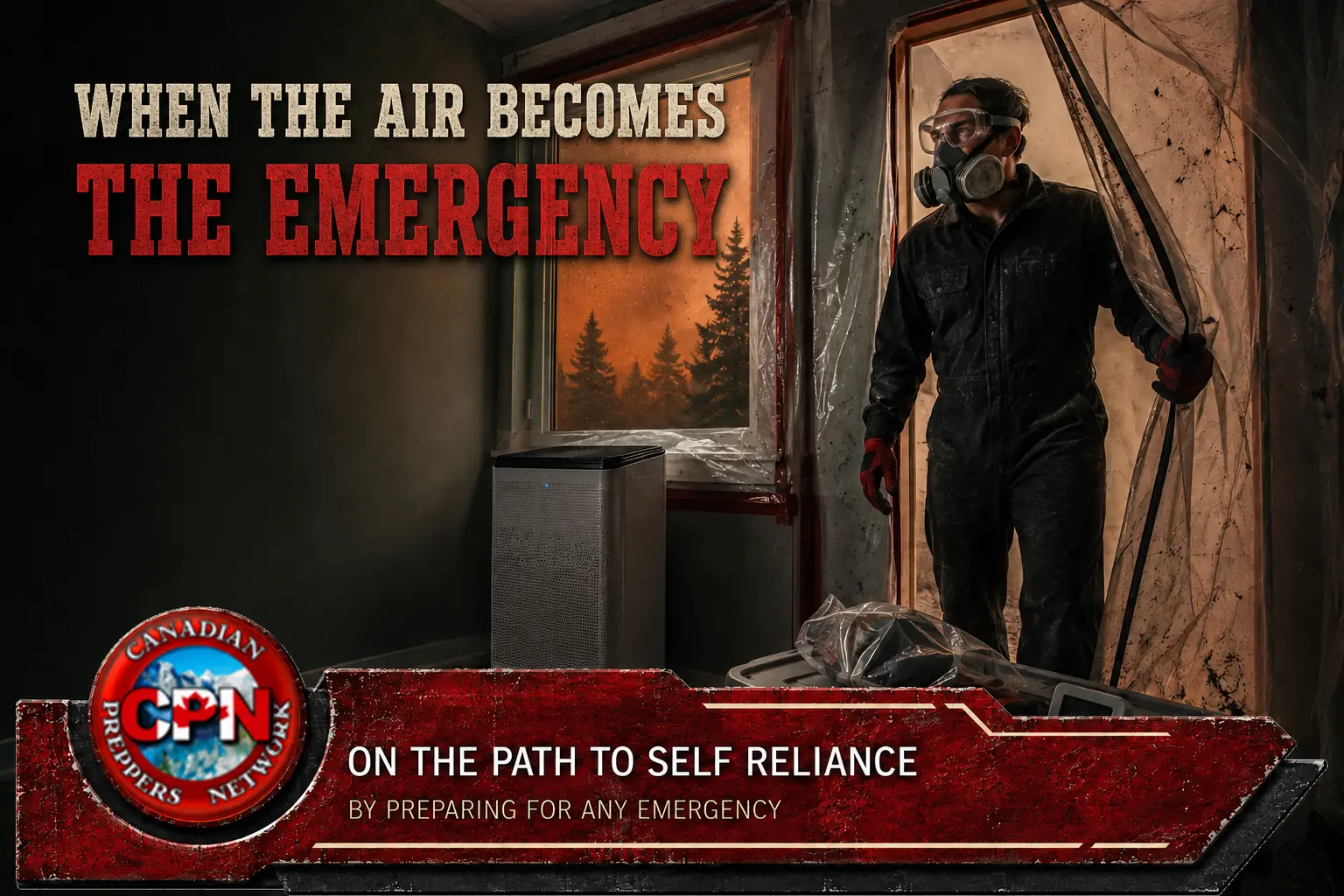
Gear for Smoke, Ash and Toxic Dust
Preparedness usually begins with food, water, heat and power. Air is easier to overlook because it normally requires no storage, treatment or equipment. That changes quickly when wildfire smoke settles over a community, buildings burn, ash begins falling or damaged structures release years of accumulated dust.
In a prolonged collapse, the problem could become much worse. Fire departments may no longer contain every blaze. Garbage may be burned openly. Woodstoves, improvised heaters and poorly maintained engines may fill neighbourhoods with smoke. Demolition, scavenging and rebuilding could disturb insulation, mould, concrete dust and other contaminants.
You cannot store months of clean air in the basement. You can, however, build a layered system that protects your lungs, creates a cleaner room and allows essential work to continue without treating one disposable mask as a complete solution.
First Understand What the Equipment Cannot Do
A particulate respirator filters particles suspended in the air. Smoke particles, ash, dust, pollen and many biological contaminants fall into this category.
It does not supply oxygen.
It also does not automatically protect against carbon monoxide, fuel vapours, chlorine, ammonia or the unknown mixture of gases produced by burning buildings and industrial materials. An N95 or P100 respirator may reduce the particles you inhale while doing necessary outdoor work, but it cannot make an oxygen-deficient room, active fire or chemical release safe.
If the air contains an unknown chemical hazard, visible fire, extreme heat or heavy structural smoke, the correct equipment is distance and evacuation.
Layer One: Disposable N95 Respirators
A properly fitted N95 is the simplest useful starting point. It is compact, relatively inexpensive and easy to distribute among several household kits.
Keep them in:
- Evacuation bags
- Vehicles
- Workshop supplies
- The household clean-room bin
- Each adult’s outdoor work kit
Choose a recognized respirator from an established manufacturer rather than a fashionable cloth “pollution mask.” Individually wrapped masks are preferable because they remain clean and can be divided between different locations.
The mask must seal against the face. Air that escapes around the nose or cheeks bypasses the filter. Facial hair crossing the sealing surface can prevent a reliable fit, while different face shapes may require different models.
N95 respirators are best treated as portable, short-duration protection. Once a mask becomes damaged, heavily soiled, wet or difficult to breathe through, it should be replaced.
Layer Two: A Reusable P100 Respirator
For repeated ash cleanup, dusty repairs or prolonged outdoor work, a reusable half-face respirator fitted with P100 particulate filters is a stronger long-term option.
A reusable system offers several advantages:
- A more substantial face seal
- Replaceable filters
- Better durability during dirty work
- Lower long-term cost when used repeatedly
- Easier inspection before each use
Buy the facepiece and filters as one compatible system. Respirator parts that look similar are not necessarily interchangeable. Record the exact facepiece series, filter number and size, then stock replacements while they remain available.
P100 filters are highly efficient particulate filters, but the “100” does not mean protection from every airborne threat. Some filters advertise nuisance-level odour relief. That wording must not be mistaken for protection against dangerous concentrations of gases or vapours.
A spare respirator should be stored clean, dry and sealed away from fuel, solvents and workshop chemicals. Filters should not be allowed to absorb contamination while sitting uncovered on a shelf.
Support Canadian Preparedness
Shop CPN-branded apparel, caps, preparedness books and more while helping support the continued growth of Canadian Preppers Network.
Your Eyes Need Protection Too
Smoke and blowing ash can make the eyes water, sting and close involuntarily. Ordinary safety glasses leave large gaps around the lenses and offer limited protection from fine airborne debris.
Sealed or closely fitting anti-fog goggles are more useful for:
- Ash cleanup
- Travelling through blowing dust
- Working around damaged buildings
- Cutting or moving dusty materials
- Exterior repairs during smoky conditions
Check that the goggles fit with the chosen respirator. A bulky goggle frame can press against the respirator or interfere with its seal. Anti-fog performance also matters because equipment that blocks vision will eventually be removed.
Full-face respirators combine respiratory and eye protection, but they cost more and require careful sizing, inspection and maintenance. For most households, a quality half-face respirator and compatible goggles provide a practical starting point.
Build One Clean-Air Room
Personal protective equipment helps when someone must go outside. The better household strategy is to reduce the amount of contaminated air everyone must breathe.
Choose one room that can become the clean-air area. A bedroom or other comfortable room with a closable door, few exterior openings and enough space for the household is usually preferable to trying to filter an entire building.
The room kit should include:
- A true HEPA air purifier
- Replacement filters
- Removable weather-stripping
- Painter’s tape
- Plastic sheeting
- Towels for temporary door-gap control
- A PM2.5 air-quality monitor
- A power plan for the purifier
- Drinking water, lighting and basic comfort supplies
Close windows and unnecessary exterior vents. Reduce obvious leaks around the selected room without making unsafe changes to heating, combustion or ventilation systems. Never operate fuel-burning equipment in a sealed space, and keep working carbon-monoxide alarms in any building using combustion appliances.
Free Canadian Grid-Down Starter Kit
Smoke emergencies often arrive with power failures, evacuation warnings and disrupted communications. Use the free first-72-hours checklist to identify the household systems that still need work.
Buy the Purifier for the Room, Not the Marketing Claim
Air-purifier packaging often advertises an enormous maximum floor area. That number may assume the machine gets an hour or more to clean the room once. Smoke control requires repeated air changes.
Choose a purifier with:
- A published clean-air delivery rate
- A genuine replaceable HEPA filter
- Filters that are readily available in Canada
- Manual controls that resume after a power interruption
- Several fan speeds
- Power consumption your backup system can support
Avoid models that depend entirely on a phone application or cloud connection. In a prolonged outage, a physical power button and simple speed controls are more valuable than smart-home integration.
Replacement filters are part of the purchase. A purifier without replacement media becomes a fan in a plastic box. Store at least one complete replacement set in its original sealed packaging.
If only one purifier is available, run it in the clean room with the door closed. Do not place it in an open hallway and expect it to protect an entire house.
Plan for the Blackout
Wildfires, wind damage and overloaded infrastructure can remove electrical power at precisely the time filtration is needed.
Measure the purifier’s actual consumption at each setting with a plug-in power meter. A purifier drawing 40 watts from a 500-watt-hour power station might theoretically run for 12.5 hours, but inverter losses and battery limitations will reduce that figure. Plan around measured performance rather than the number printed on the battery.
A resilient power plan could include:
- Grid power while available.
- A charged portable power station.
- Solar charging or another sustainable charging source.
- A generator used outdoors and safely separated from doors, windows and air intakes.
- Personal respirators for periods when powered filtration is unavailable.
Battery fans can circulate filtered air within the room, but a fan does not remove contamination by itself. Do not use one to draw smoky outdoor air into the building.
Measure What You Cannot See
Air can look clear while fine-particle levels remain elevated. A portable monitor capable of displaying PM2.5 helps answer practical questions:
- Is the clean room improving?
- Is the purifier large enough?
- Did opening the exterior door cause a major spike?
- Is the filter becoming less effective?
- Is outdoor air finally cleaner than indoor air?
The monitor should guide decisions, not create false confidence. Consumer sensors are not laboratory instruments and may respond imperfectly to humidity or different particle types. Their real value is showing trends and comparing one area with another.
Keep the monitor charged, learn its controls before an emergency and record what normal indoor readings look like.
Unlock the CPN Gold Library
For only $5 per year, Gold members receive unlimited access to the CD3WD collection, canning and medical references, ham-radio resources and exclusive CPN preparedness guides.
Establish a Dirty Side and a Clean Side
Contamination carried inside on clothing can defeat the purpose of filtering the room.
Create a transition area near the entrance. Anyone returning from ash cleanup or dusty work should leave heavily contaminated outerwear, footwear, goggles and reusable respirators there. Store dirty equipment in a washable tote rather than dropping it beside the clean-room door.
Useful supplies include:
- Washable coveralls
- Work gloves
- Boot tray
- Heavy garbage bags
- Lidded storage tote
- Damp cleaning cloths
- Disposable wipes
- Soft brush for equipment cleaning
Avoid aggressive dry sweeping inside. It simply launches settled dust back into the air. Damp wiping and suitable filtration are usually better for controlling fine particles.
Ash from burned buildings may contain unknown contaminants. Do not disturb it unnecessarily, and do not treat ordinary respiratory equipment as permission to enter a dangerous structure.
Build a Mobile Air Kit
Smoke rarely stays conveniently outside the home. An evacuation, supply run or trade journey may require hours in a vehicle.
A vehicle air kit should contain:
- Individually wrapped N95 respirators
- Sealed goggles
- Spare cabin-air filters
- Disposable gloves
- Eye rinse
- Drinking water
- Moist wipes
- A sealable bag for contaminated items
- A printed evacuation map
Set the vehicle ventilation to recirculate when travelling through smoke and keep the windows closed. Replace the cabin filter before fire season and keep a spare if the vehicle uses a commonly available size.
Vehicle filtration offers limited protection and depends on the engine, electrical system and cabin seal. It is transportation equipment, not a substitute for getting beyond the affected area.
What Not to Waste Money On
Skip products that rely on vague terms such as “military,” “tactical,” “anti-pollution” or “gas mask” without stating a recognized filtration rating and compatible replacement filter.
Also avoid:
- Uncertified fashion masks
- Used respirators of unknown history
- Obscure filters that cannot be replaced
- Purifiers without published performance information
- Ozone-generating devices
- Tiny wearable “air purifiers”
- Equipment that has never been fitted or tested
- A single mask expected to serve the entire household
Good equipment is identifiable, maintainable and supported by available consumables.
Air-Protection Buying Box
Portable Protection
- 3M Aura 9205+ N95 respirators — Individually packaged disposable protection for evacuation and short-duration exposure.
- 3M 6500-series reusable half-face respirator — Durable reusable facepiece; verify the required size before ordering.
- 3M P100 replacement filters — Confirm compatibility with the selected facepiece.
- DEWALT DPG82 sealed safety goggles — Closely fitting eye protection for smoke, ash and blowing debris.
Clean-Room Equipment
- Levoit Core 300-P HEPA air purifier — A practical size for a designated bedroom or clean-air room.
- Replacement Core 300 filters — Store replacements before they are needed.
- Temtop M10+ air-quality monitor — Tracks PM2.5 and other indoor-air measurements.
- Removable weather-stripping — Helps control obvious air leakage around the selected room.
- Rechargeable battery fan — Useful for circulation inside the clean area, not as a filter.
As an Amazon Associate, Canadian Preppers Network may earn from qualifying purchases. This does not change the price paid.
Related Reading
- Bugging Out Due to Wildfires
- Energy Production and Blackout Power Buying Guide
- Medical and First Aid Buying Guide
- The Mask I Chose
The Final Priority
Build the system in this order: protection for each person, one filtered room, replacement filters, air monitoring and enough backup power to keep the purifier operating.
Respirators are useful tools. They are not magic shields. A clean room is valuable. It is not a bunker against every airborne hazard. The equipment buys time, reduces exposure and preserves options.
When the air itself becomes the emergency, those options may be among the most important preparations in the house.
