
A core CPN reference guide.
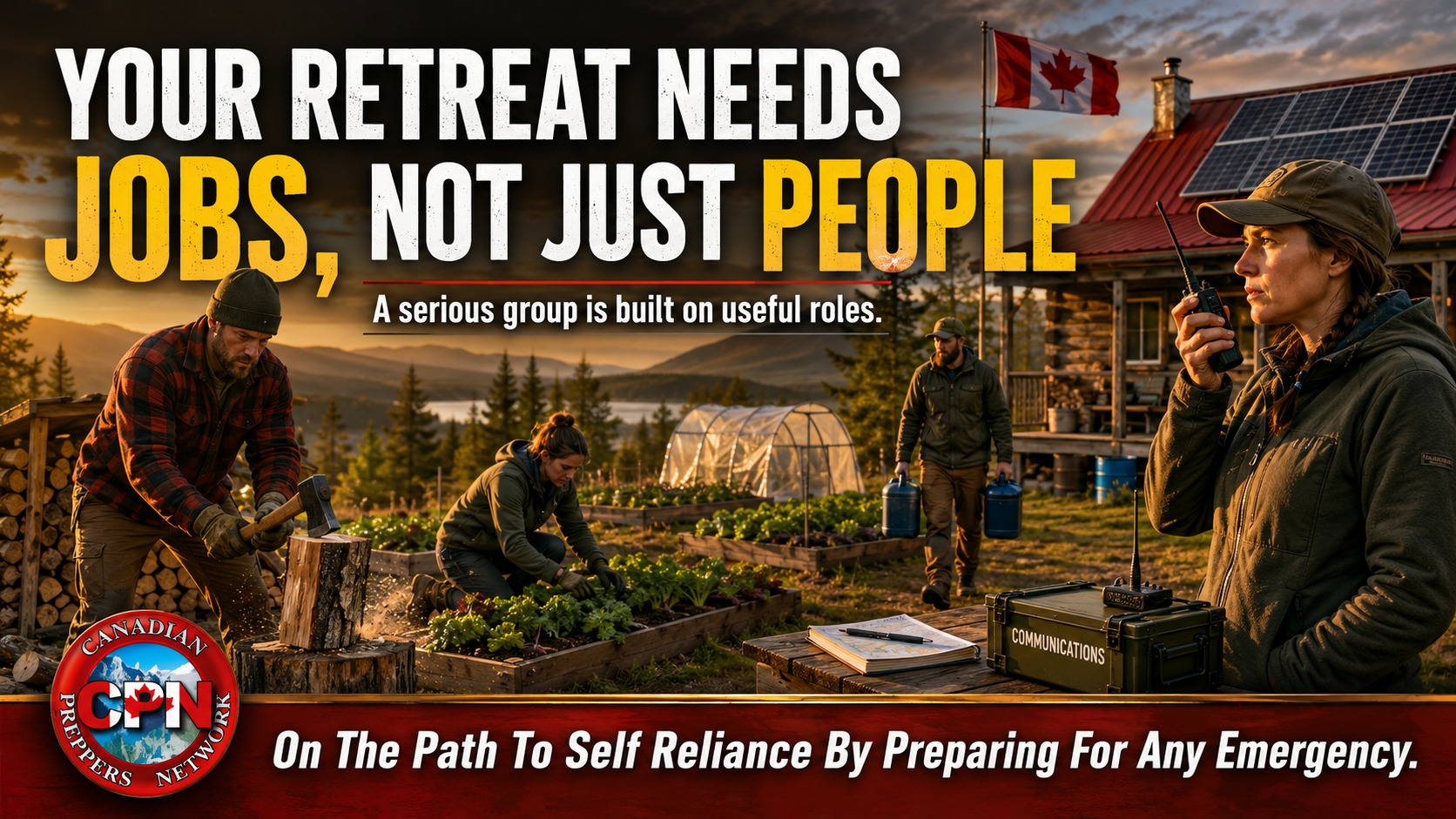
A serious prepper group is built around useful roles before the emergency starts.
A prepper retreat is not saved by headcount alone.
In fact, too many people can become a liability if nobody knows what they are responsible for, who they answer to, or what useful work they are expected to do when the pressure comes on. In normal life, people can drift, argue, avoid responsibility, and still get by. In a long emergency, that same behaviour can drain supplies, create resentment, and turn a retreat into a crowded campsite full of opinions.
The hard truth is simple: a serious retreat does not need “more people.” It needs the right people doing the right jobs.
That is the difference between a group that survives hardship and a group that collapses under its own weight.
Warm Bodies Are Not a Plan
Many preppers imagine a retreat as a place where family, friends, neighbours, and trusted contacts can gather when things go bad. That idea makes sense on the surface. More hands should mean more labour. More adults should mean more skills. More people should mean better security, better morale, and more resilience.
But that only works if those people bring something useful to the table.
A retreat filled with unassigned, untrained, uncommitted people quickly becomes a burden. Someone has to haul water. Someone has to split wood. Someone has to cook. Someone has to maintain sanitation. Someone has to tend gardens, repair equipment, care for children, manage medical problems, monitor communications, and keep records of supplies.
If those jobs are not assigned before the emergency, they will be fought over during the emergency. Or worse, they will be ignored until failure forces the issue.
A retreat cannot run on vague good intentions.
Every Serious Retreat Needs a Labour Map
Before anyone talks about cabins, acreage, garden space, or defensive posture, the group needs to answer a more basic question:
Who does what?
A labour map is not complicated. It is simply a clear picture of the work required to keep the retreat alive, matched against the people expected to be there. It should include daily jobs, seasonal jobs, emergency jobs, and specialist roles.
Food is one category. Water is another. Heat, sanitation, medical care, communications, childcare, repairs, fuel, firewood, livestock, tool maintenance, and decision-making all need to be considered. Even morale matters. A group that is exhausted, cold, hungry, and constantly arguing will not function for long.
This is where many retreat plans fall apart. People love talking about land, gear, and supplies. They are less interested in talking about who cleans the latrine, who gets up in bad weather to check livestock, who cooks when everyone is tired, and who keeps track of what is being used.
Those are the jobs that decide whether a retreat works.
Skills Matter, But Reliability Matters More
It is tempting to build a retreat group around resumes. One person knows first aid. Another can hunt. Another has mechanical skills. Someone else is good with radios. That matters, but it is not enough.
A useful retreat member must also be reliable.
A person with average skills who shows up, follows through, learns quickly, and does the ugly jobs without constant drama may be more valuable than a highly skilled person who disappears when work gets unpleasant. In a real emergency, attitude becomes a survival factor.
Can they take instruction? Can they accept correction? Can they work when cold, hungry, or tired? Can they live under rules? Can they put the group’s survival ahead of their own comfort?
Those questions matter more than people like to admit.
Leadership Cannot Be Improvised Under Stress
A retreat also needs a clear leadership structure before trouble starts. That does not mean creating a dictator or turning the group into a fantasy militia. It means deciding how decisions are made when time, supplies, safety, and lives are on the line.
Who handles day-to-day organization? Who settles disputes? Who decides work assignments? Who has authority during medical issues, fire risk, severe weather, or outside pressure? When does the group vote, and when does someone simply have to make the call?
These questions are uncomfortable, which is why many groups avoid them. But avoiding them does not prevent conflict. It guarantees conflict at the worst possible time.
A serious group talks through leadership early, while everyone is calm.
The Core Jobs of a Working Retreat
Every retreat will be different, but most need the same basic categories covered.
Food production and food storage need people who understand gardening, seed saving, livestock care, preservation, rationing, and cooking from stored staples. This is not glamorous work, but it is the foundation of long-term survival.
Water needs people responsible for collection, filtration, storage, hauling, maintenance, and keeping water sources clean. In a grid-down situation, water failure becomes a crisis very quickly.
Heat and shelter need people who understand firewood, insulation, stove safety, repairs, weatherproofing, and winter preparation. In Canada, this is not optional. A retreat that cannot produce reliable heat is not a retreat. It is a temporary shelter waiting to fail.
Medical care needs calm, organized people who can manage supplies, basic first aid, sanitation, illness prevention, and records. Medical work is not just treating injuries. It is preventing small problems from becoming group-wide problems.
Communications need someone who understands radios, message discipline, power management, charging systems, and information gathering. A retreat cut off from all outside awareness is blind.
Security needs to be handled responsibly, legally, and with discipline. That includes access control, lighting, observation, rules for visitors, conflict avoidance, and protecting vulnerable people. Security is not about ego. It is about reducing risk.
Repairs and maintenance need practical hands. Pumps, stoves, hinges, fencing, tools, generators, carts, plumbing, and buildings will all break eventually. A retreat with no repair capacity becomes weaker every month.
Administration sounds boring, but it matters. Someone has to track supplies, fuel, medicine, tools, seeds, parts, and work schedules. In a long emergency, memory is not enough.
Children, Elders, and Non-Working Members Still Need Planning
Not everyone at a retreat will be able to do heavy labour. Children, elders, injured members, and people with limitations still need to be accounted for honestly.
That does not make them disposable. It means the group must plan around reality.
Children need supervision, structure, warmth, food, hygiene, and emotional stability. Elders may carry knowledge, judgment, and calm that younger members lack. People who cannot split wood may still cook, mend, teach, watch children, sort supplies, tend seedlings, keep records, or monitor radios.
The key is to stop pretending everyone contributes the same way.
A mature retreat plan assigns people according to ability, not fantasy.
The “Guest Problem” Must Be Solved Early
One of the most dangerous weaknesses in many retreat plans is the undefined guest.
Who is allowed to come? Who can bring family? Can members invite friends? What happens when someone arrives with people the group never approved? What if they bring no food, no tools, no skills, and no willingness to work?
These questions must be answered before the emergency.
A retreat that cannot say “no” will eventually be overwhelmed by people it never planned for. Compassion matters, but so does survival math. Supplies are finite. Space is finite. Labour capacity is finite. One person’s emotional promise to an outsider can become everyone else’s burden.
The rules for guests must be written down, understood, and agreed upon in advance.
Training Days Reveal the Truth
The best way to test retreat members is not a conversation. It is a work weekend.
Cut wood. Haul water. Build garden beds. Cook outdoors. Run a radio check. Practise blackout routines. Inventory supplies. Repair something. Spend a weekend without convenience and see who complains, who helps, who disappears, and who quietly gets useful things done.
Training days expose fantasy.
They show who can work beside others. They show who needs constant attention. They show who is careful with tools, who listens, who takes safety seriously, and who treats shared property with respect.
A person who cannot handle a normal work weekend will not magically become dependable during a collapse.
Recommended Reading
Acres of Preparedness: Planning the Last Safe Place
For readers thinking seriously about retreat planning, group survival, land use, and the hard decisions behind building a last safe place, this book fits directly with today’s topic.
Acres of Preparedness: Planning the Last Safe Place
Disclosure: As an Amazon Associate, Canadian Preppers Network may earn from qualifying purchases.
Final Thought
A retreat is not just land. It is not just supplies. It is not just a group chat full of people who say they are “in” when things get bad.
A real retreat is a working system.
That system needs food, water, heat, sanitation, security, communications, medical care, maintenance, leadership, rules, and steady labour. Every person who joins should understand where they fit and what they are expected to contribute.
The time to discover that your retreat has too many mouths and not enough workers is not after the roads are blocked, the power is out, and winter is closing in.
Build the jobs first.
Then decide who belongs.