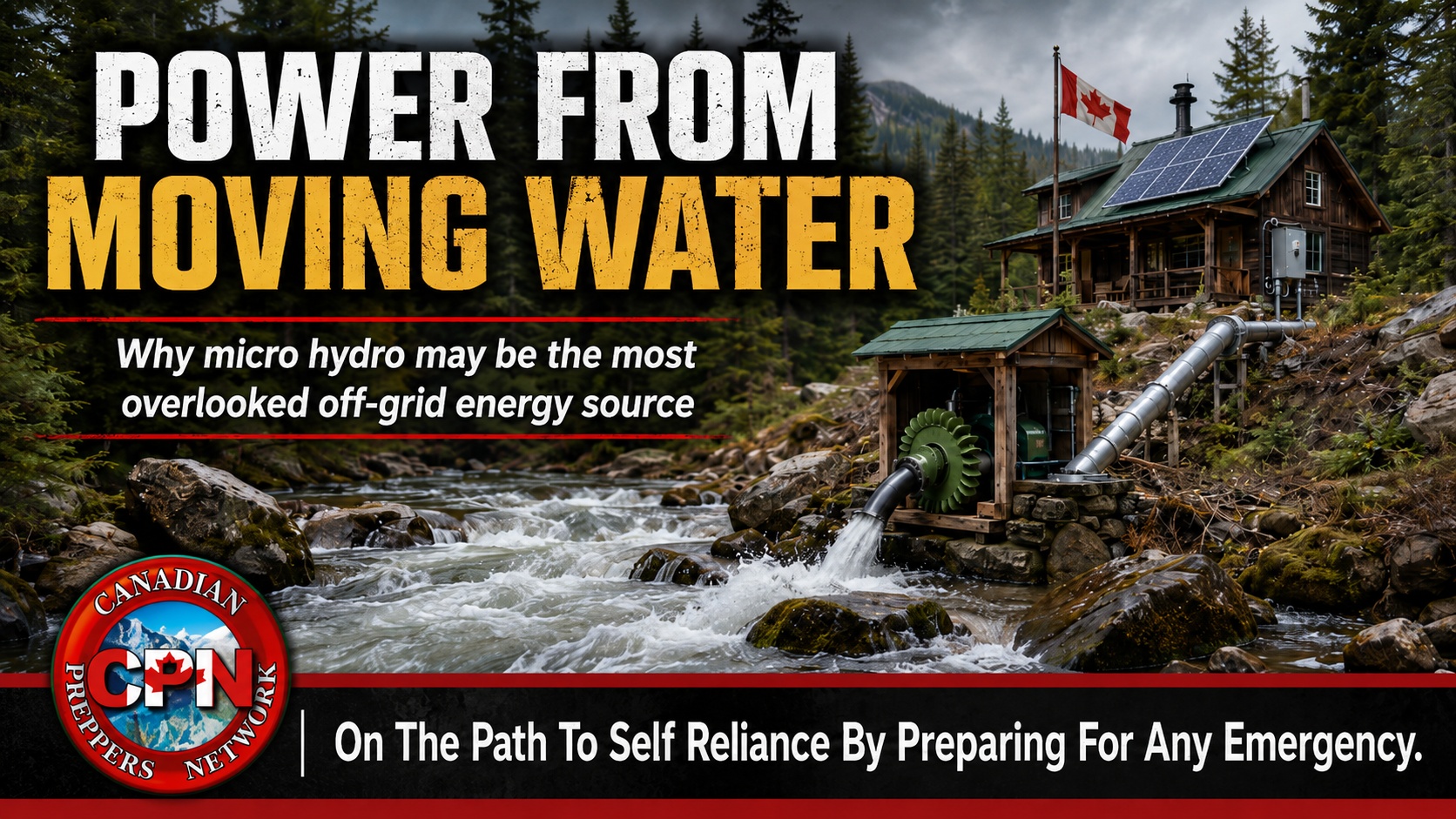
Why Micro Hydro May Be the Most Overlooked Off-Grid Energy Source for Long Emergencies
Most preppers talk about solar because solar is easy to understand, easy to buy, and easy to install in stages. Panels, batteries, charge controllers, portable power stations, and folding solar blankets have become standard preparedness gear.
That does not mean solar is always the best answer.
For a Canadian homestead, rural retreat, hunting camp, or bug-out location with the right water source, micro hydro can be far more interesting. A solar panel only works when light is available. Wind comes and goes. A generator runs only as long as the fuel lasts. Moving water, if the site is right, can produce power day and night with no fuel delivery, no constant engine noise, and no dependency on clear weather.
That is the attraction.
Micro hydro is not magic. It is not as simple as dropping a gadget into a creek and expecting free electricity. It requires the right combination of water flow, elevation drop, intake design, pipe, turbine, wiring, battery storage, and maintenance access. But when those pieces line up, moving water can become one of the most useful long-term power sources a prepared property can have.
For the broader energy planning foundation, see CPN’s Energy Production in Canada hub.
Why Micro Hydro Deserves More Attention
Solar gets the attention because it is visible. You can buy a panel, put it in the sun, and watch a battery charge. That makes it easy to market.
Micro hydro is different. The real asset is not the turbine. The real asset is the site.
A useful water-power site needs two things: flow and head. Flow is the amount of water available. Head is the vertical drop that allows gravity to create pressure. A small amount of water falling a long distance can be useful. A large amount of water falling a short distance can also be useful. A lazy creek with no usable drop may be less useful than it looks.
This is why micro hydro belongs in retreat planning, not just gear shopping. If you are evaluating land, a cabin, a homestead, or a group retreat location, moving water should be treated as infrastructure. A property with reliable year-round flow and usable elevation may offer an energy advantage that cannot easily be duplicated with stored fuel.
In a long emergency, that matters.
A generator may carry you through the first few days. Stored gasoline may carry you through a few weeks if it was managed properly. A solar and battery system may carry critical loads through most conditions if it was sized correctly. But a good hydro site has the potential to quietly recharge batteries every hour of the day.
That does not mean it powers everything. It means it may keep the essentials alive.
Lights. Radios. Battery chargers. Small electronics. Tool batteries. A DC pump. A medical device. Communications equipment. Security lighting. These are not luxuries in a long emergency. They are force multipliers.
The Prepper Mistake: Thinking in Whole-House Terms
One reason people dismiss micro hydro is that they imagine it must run the entire house or it is not worth doing.
That is the wrong way to think.
Preparedness power is not about living normally after the grid fails. It is about identifying what must keep working. The question is not, “Can this replace the utility company?” The question is, “Can this keep my most important systems alive when everything else becomes uncertain?”
A modest hydro system feeding a battery bank can be extremely valuable even if it does not run an electric stove, dryer, heat pump, deep well pump, or full household panel. The real value may be steady production over time.
A 100-watt load running continuously is a different thing from a 100-watt solar panel that only produces well under ideal sunlight. Continuous production adds up. If water is moving at midnight, during rain, during overcast weather, and through short winter days, the system may provide a kind of resilience solar cannot match by itself.
This is where micro hydro can fit into a layered energy plan alongside solar, batteries, generator backup, and manual charging.
For readers building a broader blackout power plan, see CPN’s Energy Production Blackout Power Buying Guide.
Site First, Turbine Second
The biggest mistake is buying a turbine before understanding the water.
A real micro-hydro plan starts with questions like these:
How much vertical drop is available between the intake and the turbine?
How much water flows during the driest part of the year?
Does the stream freeze, flood, clog with leaves, or disappear during summer?
Can an intake be installed without creating legal, environmental, or neighbour problems?
How far is the turbine from the battery bank or point of use?
Can the system survive spring runoff, ice movement, debris, and wildlife?
Can it be maintained quietly and safely in bad weather?
Will the water source still be accessible in winter?
Those questions matter more than the wattage printed on a product listing.
A proper micro-hydro system usually involves an intake, screen, penstock pipe, valves, turbine, generator, wiring, charge controller, battery bank, dump load, overcurrent protection, and inverter if AC power is needed. Each part has to match the site. Too little flow and the turbine underperforms. Too little head and it may barely produce. Too much pressure through the wrong equipment can damage the system or create unsafe conditions.
This is why serious micro hydro is not an impulse buy. It is a site project.
Beware of Toy-Sized “Micro Hydro” Generators
This is where many Amazon listings become a problem.
A quick search for micro hydro generators turns up small plastic inline turbine units that look tempting because they are cheap, compact, and advertised with impressive-sounding wattage claims. Some are marketed as 12V or 50W hydro generators. That sounds useful until you read the fine print.
One example we looked at was a small F50-style inline water turbine listed on Amazon.ca. It was promoted with language that made it sound like a useful micro-hydro generator, but the listing also described maximum output current as 220 mA at 12V. That works out to only a few watts in practical terms, not a serious retreat power system.
That is the point.
A few watts may be enough for a small experiment. It may teach the basic concept of water pressure turning a tiny generator. It may have some value for a hobby bench or a proof-of-concept project. But it should not be confused with dependable off-grid infrastructure.
It will not run a freezer.
It will not charge a meaningful battery bank quickly.
It will not replace a real turbine.
It will not turn a creek into a power plant.
Cheap inline gadgets can give people the false impression that micro hydro is as simple as ordering a plastic fitting and sticking it into moving water. That is not preparedness. That is wishful thinking with a shipping label.
The better lesson is this: if the listing does not clearly explain head requirements, flow requirements, turbine type, voltage behaviour, duty cycle, controller needs, and realistic output, treat it with suspicion.
What To Look For Instead
A more serious micro-hydro product should give you useful technical information before asking for your money.
You want to see required head. You want flow requirements. You want inlet and outlet sizing. You want turbine type. You want voltage options. You want information about controllers, batteries, dump loads, maintenance, bearings, nozzles, debris handling, and expected output at different site conditions.
A serious supplier will talk about the site before promising power.
This is one reason Canadian preppers should look beyond generic Amazon listings when considering actual hydro generation. Energy Systems & Design in New Brunswick sells purpose-built micro-hydro machines such as the Stream Engine, Watter Buddy, and LH1000. Those are the kinds of names readers should study when trying to understand what real micro-hydro equipment looks like.
That does not mean every reader should run out and buy one. It means serious planning starts with serious information.
Amazon may still be useful for support gear, tools, wiring components, meters, conduit, batteries, charge controllers, and general off-grid electrical supplies. But for the turbine itself, readers should be extremely cautious. A mystery turbine with big wattage claims and vague site requirements is not the same thing as a designed system.
Canadian Realities: Ice, Distance, Flooding, and Permits
Micro hydro sounds simple until Canada gets involved.
Ice can damage intakes, block screens, crack fittings, reduce flow, or make maintenance dangerous. Spring runoff can tear out poorly placed components. Leaves, sticks, silt, and gravel can clog intakes or damage turbine parts. A creek that looks powerful in April may be nearly useless in August. A stream that looks harmless in summer may become violent during snowmelt.
Distance is another issue. The best water source may not be near the cabin, battery bank, or retreat building. Long cable runs can create voltage drop and cost more than expected. Long pipe runs require proper sizing, burial, protection, and access. A system that is easy to sketch on paper may become a major project once terrain, frost, rock, and maintenance access are considered.
Then there are legal and environmental concerns. Waterways are not just another backyard feature. Before altering a stream, diverting water, building an intake, or placing equipment in or near a watercourse, landowners need to understand local and provincial rules. In normal times, permits and watercourse regulations matter. In bad times, poor design can still cause washouts, erosion, neighbour conflict, and loss of the system.
The prepper answer is not to ignore those issues. The prepper answer is to design with them in mind before the emergency.
Where Micro Hydro Fits in a Layered Power Plan
Micro hydro should not be treated as the only answer. It should be treated as one layer.
A strong off-grid energy plan may include solar for daytime production, battery storage for quiet power, generator backup for heavy loads, manual charging for radios and small devices, and micro hydro where the property has suitable moving water.
The goal is not to recreate modern comfort. The goal is to keep critical systems alive with the least possible dependence on outside supply chains.
That is where micro hydro becomes especially interesting. If a retreat has the right water source, hydro can reduce generator runtime, stretch stored fuel, support communications, maintain battery banks, and provide quiet ongoing energy while other people are burning through their fuel cans.
For more on small-scale emergency charging, see Very Small Scale Manual Power Generation For Charging Essential Devices.
For broader solar comparison, see How To Run A Home On Solar Power Alone.
What Micro Hydro Can Realistically Power
A properly designed small system may be able to support critical loads. That may include LED lighting, radios, chargers, small DC loads, battery maintenance, security lighting, tool battery charging, or carefully managed refrigeration depending on actual output and storage.
A larger and better-sited system may support more.
But the key word is “properly.”
The stream does not care about marketing claims. The turbine does not care about wishful thinking. If the site cannot provide the necessary head and flow, the system will not produce the power the buyer imagined. If the wiring is undersized, losses eat output. If the intake clogs, production stops. If the system has no dump load or proper control, batteries and components can be damaged. If the installation is unsafe, the energy plan becomes a hazard.
This is where preppers must get out of the consumer mindset.
You are not buying power. You are building a system.
Amazon Buying Box: Useful Support Gear, Not Mystery Turbines
Disclosure: As an Amazon Associate, Canadian Preppers Network may earn from qualifying purchases.
The following Amazon.ca searches are better treated as support categories, not as a recommendation to buy questionable micro-hydro turbines. For the turbine itself, readers should do proper site calculations and consider established micro-hydro suppliers.
Digital Multimeter
A basic requirement for checking voltage, continuity, battery condition, and troubleshooting small power systems.
Shop digital multimeters on Amazon.ca
DC Clamp Meter
Useful for checking current in DC systems without disconnecting wiring. Particularly helpful when working around batteries, charge controllers, and low-voltage power setups.
Shop DC clamp meters on Amazon.ca
MC4 Solar Extension Cables
Often useful in small renewable systems, especially where solar and hydro are part of the same battery-based setup. Always size wiring properly for distance and current.
Shop MC4 extension cables on Amazon.ca
Battery Monitor
A battery bank is only useful if you know its state of charge. A monitor helps prevent guessing, over-discharging, and false confidence.
Shop 12V battery monitors on Amazon.ca
12V Fuse Block
Low-voltage systems still need proper overcurrent protection. A fuse block helps organize small DC circuits for lights, radios, and charging stations.
Shop 12V fuse blocks on Amazon.ca
Solar Charge Controller
Some hydro systems require specialized controllers and dump loads, so do not assume a random solar controller is appropriate for every turbine. Still, understanding charge controllers is part of learning off-grid power.
Shop solar charge controllers on Amazon.ca
Battery Cables and Lugs
Poor connections waste power and create hazards. Proper cable sizing, crimping, strain relief, and protection matter in any battery-based power system.
Shop battery cables and lugs on Amazon.ca
Weatherproof Electrical Enclosure
Outdoor power equipment needs protection from rain, snow, splash, insects, and accidental contact. Use appropriate enclosures and follow electrical safety standards.
Shop weatherproof electrical enclosures on Amazon.ca
Bottom line: buy support gear carefully, but do not buy a “50W” or “1000W” turbine just because the headline sounds good. Micro hydro is site-specific. The wrong turbine in the wrong place is just expensive junk.
The Retreat Advantage
Micro hydro is not for everyone.
An apartment prepper is not installing a turbine. A suburban lot probably does not have the water source. A flat rural property may have plenty of land and still have no useful hydro potential.
But a retreat property is different.
A multi-family retreat with a year-round creek, spring-fed flow, hillside drainage, or a usable water drop should take micro hydro seriously. In a long emergency, the ability to produce even modest continuous power can change how a group functions. It can keep radios running. It can keep lights on after dark. It can reduce fuel dependency. It can support tool charging and small systems that make daily life less fragile.
That is the real value.
Not comfort.
Continuity.
A retreat that can produce some of its own power quietly and consistently has an advantage over a retreat that depends entirely on stored fuel and sunny weather.
Final Thought
Micro hydro is one of the most overlooked preparedness power options because it cannot be solved by shopping alone.
That is also what makes it valuable.
Solar panels can be bought by anyone. Generators can be bought by anyone. Batteries can be bought by anyone. But a good water-power site is a property-level asset. It has to be found, measured, protected, and developed correctly.
For Canadian preppers thinking beyond short outages, that matters.
Do not be fooled by toy turbines and inflated Amazon wattage claims. A plastic inline generator that produces only a few watts is not a retreat energy plan. It is a lesson in reading the fine print.
Real micro hydro begins with water, gravity, and honest numbers.
If your property has those, you may be sitting on one of the strongest long-emergency power sources available.