Hand-crank, pedal, and “just enough” electricity when the grid is unreliable
When people talk energy preparedness, they usually jump straight to solar arrays, fuel generators, and big battery banks. Those systems absolutely have a place — and you’ve covered that broader approach well in Energy Resilience in 2026: Building Redundant Power When the Grid Can’t Be Trusted — but they aren’t the whole story.
There’s a smaller tier of power that matters precisely because it’s boring: manual, human-powered charging for essential devices. It won’t run your home. It’s not meant to. Its purpose is to keep the tools that prevent isolation and confusion alive: radios, lights, phones used for maps/notes, and rechargeable battery packs.
Manual power becomes especially relevant during Canadian winter outages where solar performance can be inconsistent — something you’ve already addressed in How Solar Power Actually Performs in a Canadian Winter and Energy Under Winter Stress: Practical Power Preparedness for Canadian Preppers.
The mindset shift: maintenance charging, not “recharge from zero”
The biggest mistake people make with hand-crank or pedal generation is expecting it to feel like wall power. It won’t. Think “maintenance,” not “restoration.”
A lot of emergency devices don’t actually need huge watt-hours to stay useful. A handheld radio doesn’t need 100% every day. A headlamp is most effective when you keep it topped up. A phone in an outage is rarely used for doom-scrolling — it’s for notes, photos of damage, offline maps, occasional updates, and coordination. Manual generation is the tool that keeps those devices alive enough to do their job.
This pairs naturally with the comms-first mindset in Communications: When the Grid Goes Silent — Staying Connected During Canadian Emergencies.
Hand-crank generators: immediate, compact, and indoor-friendly
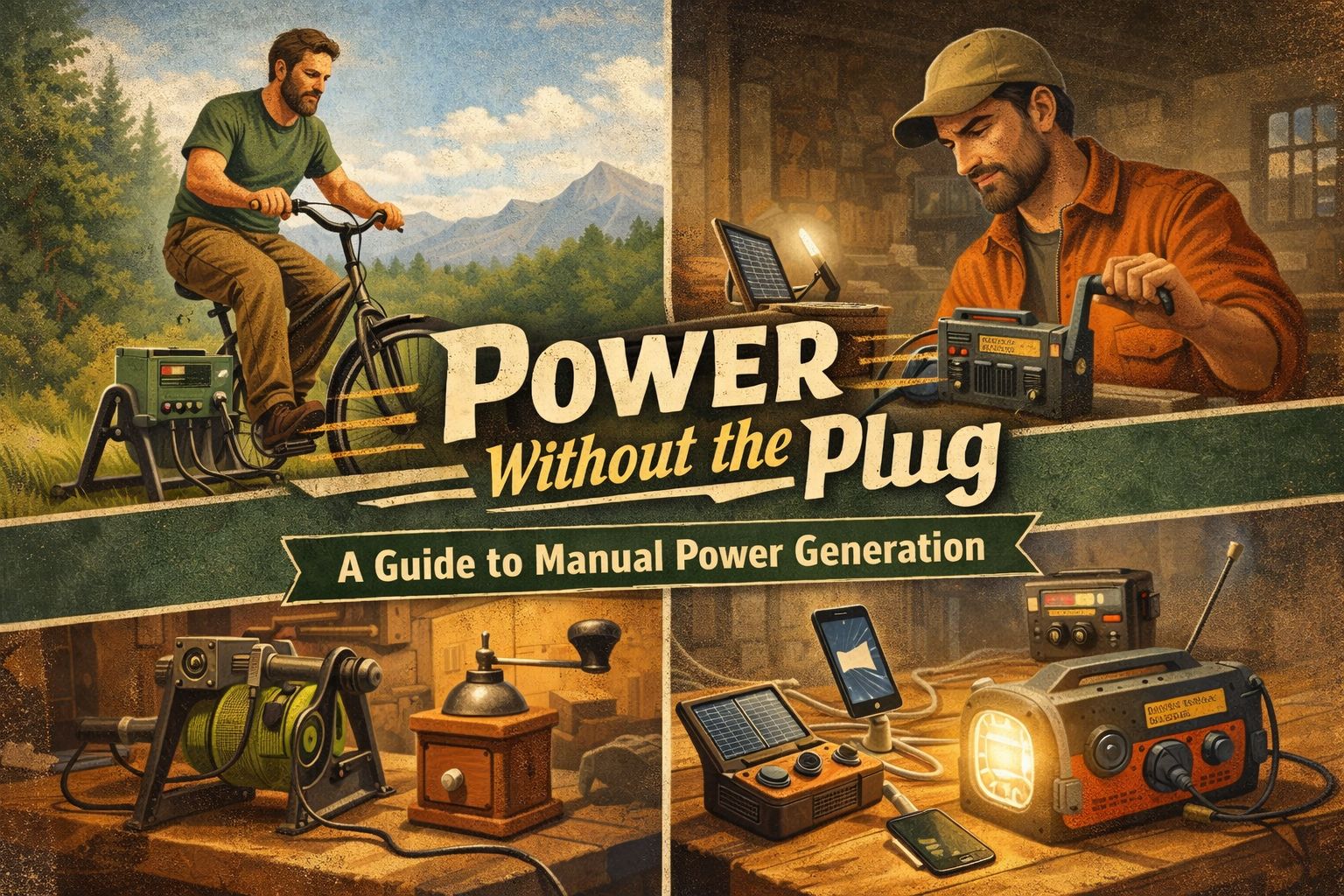
Hand-crank units are common because they’re simple and they work anywhere — even in the dark during a storm. Expect low output, but fast access. Ten minutes of steady cranking isn’t glamorous, but it’s often enough to restore basic function to:
- an emergency radio
- a rechargeable light
- a phone that’s hovering in the danger zone
If you want this tier to actually be useful, buy one quality solution and test it now (under load), rather than owning three cheap ones you’ve never used.
Amazon.ca affiliate picks (search links):
- Hand-crank emergency radios: https://www.amazon.ca/s?k=hand+crank+emergency+radio&tag=canadpreppn01a-20
- Hand-crank USB generators: https://www.amazon.ca/s?k=hand+crank+usb+generator&tag=canadpreppn01a-20
If you’re pairing manual power with radios, your article Amateur Radio Emergency Nets in Canada is the perfect internal handoff because it reinforces why keeping devices charged matters.
Pedal power: the “sustainable effort” option
Pedal systems aren’t magic either, but they’re dramatically more sustainable than hand-cranking because legs can deliver steady output longer. Pedal generation shines when you want to put real energy back into a battery bank over time.
This is the tier that makes sense if you’re planning for longer outages, multi-person households, or you want a human-powered backup that can keep a comms-and-lighting ecosystem alive indefinitely.
Amazon.ca affiliate picks:
- Pedal power generators: https://www.amazon.ca/s?k=pedal+power+generator&tag=canadpreppn01a-20
Pedal power fits especially well as a “third layer” alongside solar and storage — the same redundancy theme you’ve built across How to Run a Home on Solar Power Alone and Harnessing Solar Power: Your Guide to Solar-Powered Generators.
The secret weapon: power banks as buffers
Manual generation becomes far more useful when you stop charging devices directly and start charging a power bank. This solves three problems:
- Stability: devices charge better from a steady source than from fluctuating crank output
- Efficiency: you can generate power in short sessions and store it
- Flexibility: one bank can top up multiple devices as needed
In practice, this means you can crank for a few minutes here and there (indoors, warm, low stress), then charge your headlamp, radio battery, or phone later.
Amazon.ca affiliate picks:
- USB power banks: https://www.amazon.ca/s?k=usb+power+bank&tag=canadpreppn01a-20
- USB rechargeable headlamps: https://www.amazon.ca/s?k=usb+rechargeable+headlamp&tag=canadpreppn01a-20
This same “keep the lights and comms alive” logic also pairs well with Lighting Options for SHTF: Staying Illuminated When the Grid Goes Down.
What devices should you prioritize first?
When power is scarce, priorities matter. A simple order that works well in Canadian conditions is:
1) Light → 2) Comms → 3) Phone → 4) Everything else
Because when it’s cold and dark, lighting prevents injuries and mistakes. Comms prevents isolation. Phones are tools — but they’re easy to waste if you treat them like normal life.
For comms hardware that benefits from this approach, you can funnel readers into HF Wire Antennas for Emergency Communications (because if you’re powering radios, you may as well improve the antenna side too).
The hard limits (so you don’t fool yourself)
Manual generation will not:
- run appliances
- heat your home
- replace a generator
- make solar irrelevant
If you treat it like a tiny “always works” capability layer for device survival, it’s excellent. If you treat it like a replacement for real generation, it’s misery.
That’s the same realism you’ve emphasized across winter outage content like ⚡ The Reality of Winter Power Failures in Canada.
Why this belongs in your plan
Manual charging is one of the few energy options that still works when:
- fuel is scarce
- the sky is grey for a week
- batteries are aging
- the grid is unstable
- you’re stuck indoors during a storm
It’s not sexy. It’s dependable. And in preparedness, dependable wins.
If you want to push this into a tighter “CPN framework,” the natural next internal link from this article is your broader power overview:
Off-Grid Emergency Power Sources During Winter for Preppers
Optional “CPN Gear Sidebar” (short, non-salesy)
If you’re building a basic manual micro-power kit, the simplest, least-fragile combo is:
- Hand-crank emergency radio: https://www.amazon.ca/s?k=hand+crank+emergency+radio&tag=canadpreppn01a-20
- 10,000–20,000 mAh power bank: https://www.amazon.ca/s?k=20000mah+power+bank&tag=canadpreppn01a-20
- USB rechargeable headlamp: https://www.amazon.ca/s?k=usb+rechargeable+headlamp&tag=canadpreppn01a-20
That kit keeps you lit, informed, and able to coordinate — which is the whole point.