
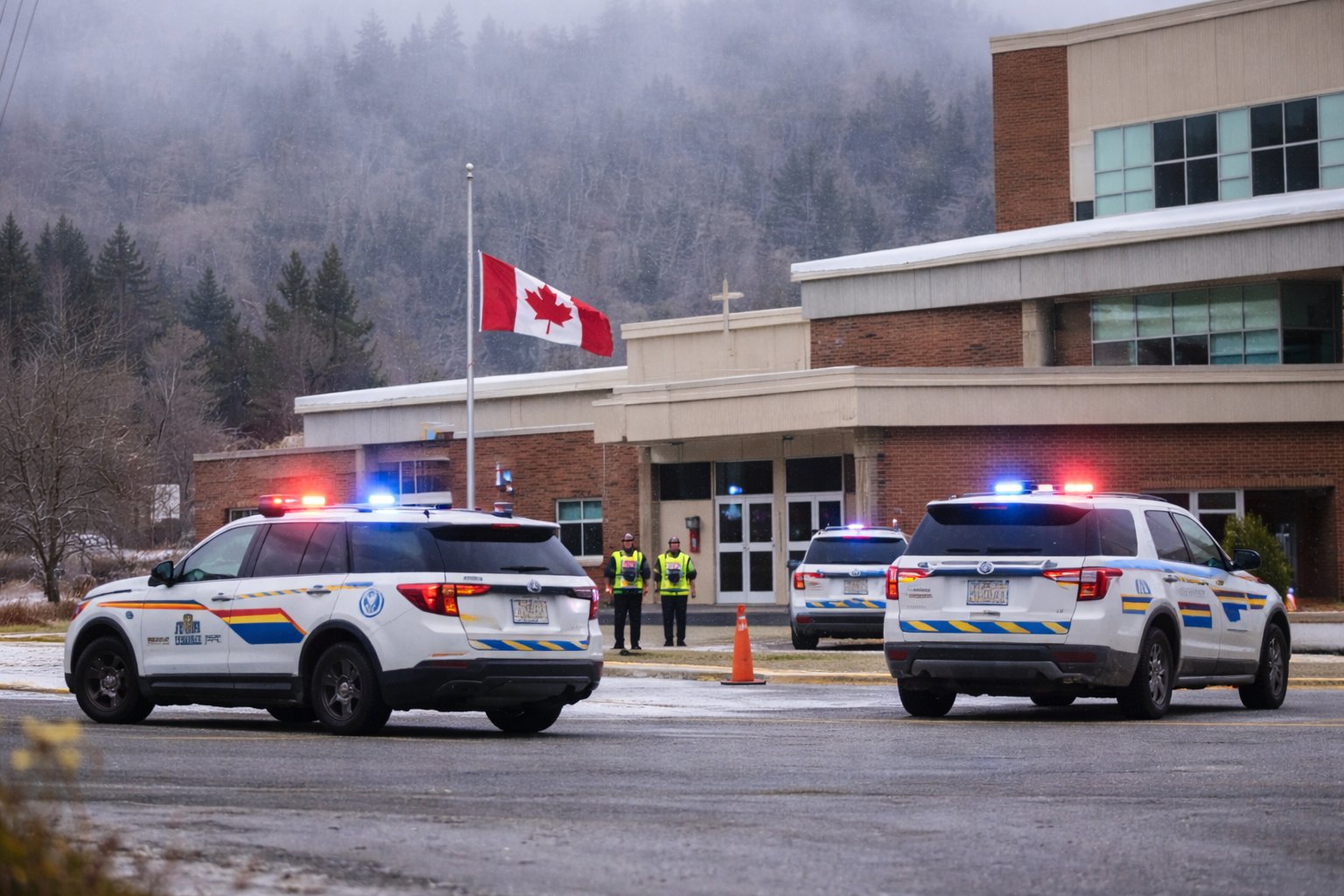
A devastating mass shooting in Tumbler Ridge, British Columbia on February 10, 2026 has left the country shaken.
According to reporting from major outlets including AP News, Reuters, and The Guardian, the attack occurred at Tumbler Ridge Secondary School and a connected residence in the small northeastern BC community of roughly 2,500 residents.
As of current confirmed reporting:
- Ten people are dead, including the suspect.
- Six victims were located inside the school.
- One died while being transported to hospital.
- Two additional victims were found at a residence believed connected to the suspect.
- More than two dozen others were injured.
- The suspect, reported as a female, was found deceased from an apparent self-inflicted injury.
- RCMP responded rapidly after an emergency alert was issued.
This is among the deadliest school shootings in modern Canadian history.
The investigation into motive and weapon access remains ongoing.
The National Conversation That Follows
In Canada, tragedies of this magnitude inevitably lead to scrutiny of firearms policy.
Canada already operates under:
- Mandatory PAL / RPAL licensing
- Continuous eligibility screening
- Background checks
- Required safety training
- Storage and transport regulations
- Magazine capacity limits
- A national handgun freeze
- An expanded prohibited firearms list
The current framework is already among the strictest in the democratic world.
The question that often arises after events like this is not whether something should be done — but whether additional bans or regulatory expansions would meaningfully address the causes behind the violence.
That is a serious policy discussion. It deserves evidence, not momentum.
Key Questions That Matter
As investigators determine details, several factors will shape the policy debate:
- Was the firearm legally owned or illegally obtained?
- Were there prior warning signs?
- Did enforcement or intervention systems fail?
- Were existing laws violated — or insufficient?
These distinctions matter enormously.
If laws were broken, enforcement becomes central.
If warning signs were missed, mental health systems become central.
If regulatory gaps are identified, those gaps should be addressed with precision — not broad expansion.
Preparedness thinking always asks: What is the actual failure point?
Why Preppers Should Be Attentive
The preparedness community should not be reactionary — but it should be attentive.
Historically, significant incidents can influence future regulatory direction, even months later. Discussions may explore:
- Additional model prohibitions
- Enhanced storage enforcement
- Licensing scrutiny
- Expanded transfer limitations
- New classification reviews
Whether or not any of those occur, the principle remains:
Stable preparedness planning requires predictability in lawful tool access.
Frequent classification shifts or layered restrictions introduce uncertainty into long-term resilience planning for licensed owners.
It is reasonable to be aware of that possibility without assuming immediate change.
Firearms in Canadian Preparedness
For many Canadians — especially in rural regions — firearms serve practical, lawful roles:
- Hunting for food security
- Predator control
- Livestock protection
- Remote property defense
- Emergency signaling in wilderness areas
Supporting responsible firearms ownership does not contradict public safety. It acknowledges reality outside major urban centres.
Lawful owners in Canada are:
- Licensed
- Screened
- Trained
- Subject to continuous eligibility checks
Broad restrictions that primarily affect compliant citizens must demonstrate measurable benefit to justify expansion.
That is not extremism. That is policy analysis.
The Risk of Reactive Expansion
Tragedies create understandable public pressure.
However, preparedness — and good governance — both operate best when decisions are deliberate.
Expanding prohibitions without clear linkage to root cause risks:
- Increasing compliance burden on lawful owners
- Reducing trust between rural communities and policymakers
- Producing minimal impact if misuse pathways remain unchanged
The core issue is effectiveness.
If criminal misuse stems from illegal acquisition or untreated mental health crises, then addressing those variables directly may yield greater safety gains than expanding prohibitions on already regulated citizens.
What This Incident Truly Highlights
Beyond firearms classification, this tragedy reinforces several broader preparedness lessons:
1. Emergency Response Speed Matters
RCMP arrival within minutes likely prevented additional loss of life.
2. Community Networks Matter
In small towns, neighbours are often first to respond before official services scale up.
3. Medical Readiness Saves Lives
Bleeding control capability in the first minutes of trauma can dramatically alter outcomes.
4. Prevention Requires Early Intervention
Mental health systems, reporting mechanisms, and early-warning frameworks deserve serious investment.
Preparedness is multi-dimensional.
Firearms are one tool category within a much larger resilience structure.
A Balanced Position
Supporting lawful firearms ownership does not mean rejecting safety measures.
It means:
- Demanding evidence-based policy.
- Maintaining strict compliance and responsible standards.
- Opposing broad prohibitions that lack demonstrated effectiveness.
- Encouraging focused intervention where real risk indicators exist.
The tragedy in BC deserves sober reflection, not political acceleration.
If policy discussions unfold, they should be grounded in investigation results — not assumption.
Preparedness is calm. It is deliberate. It is data-driven.
And it is strongest when it protects both public safety and responsible citizens.

