
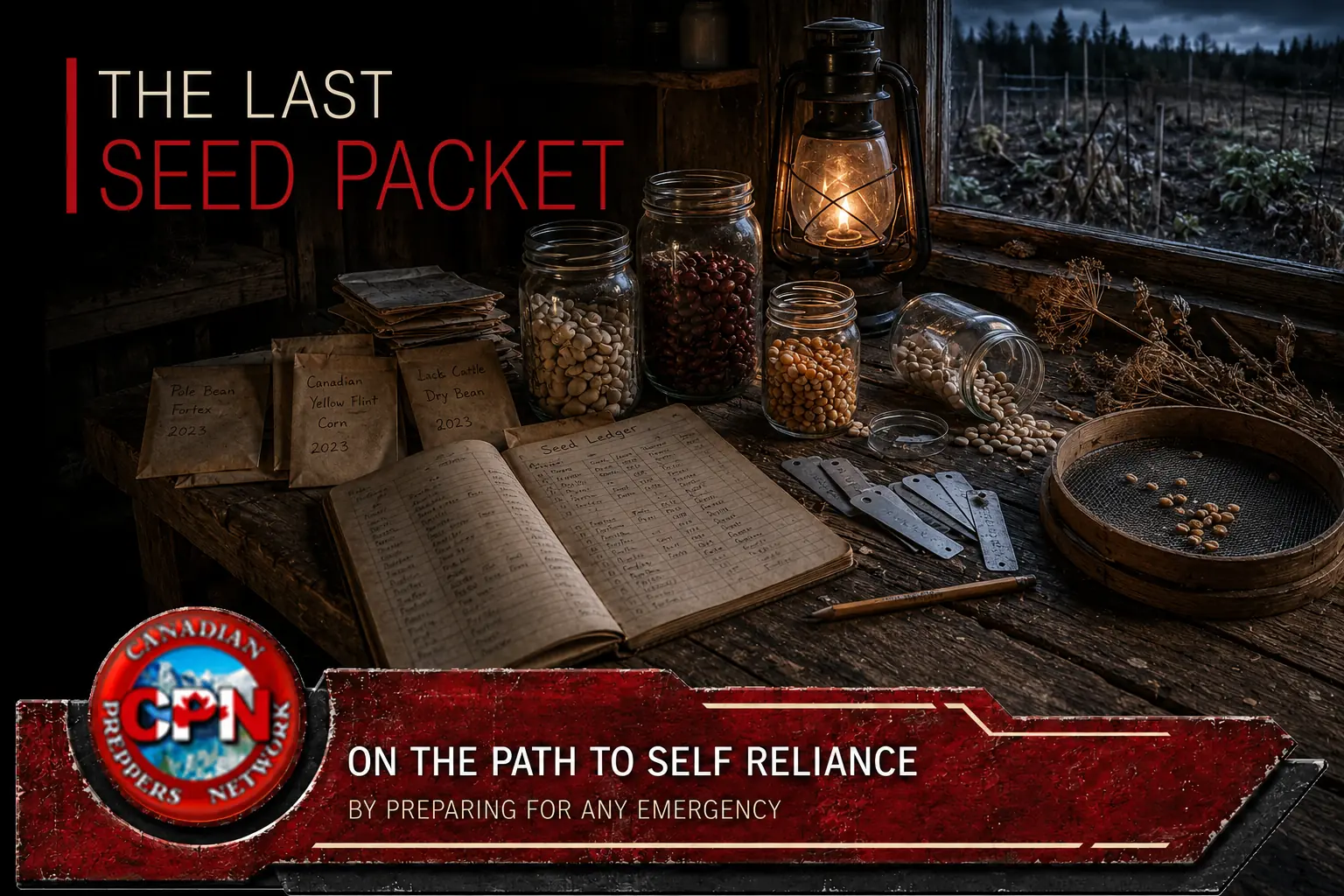
Keeping a crop alive after replacement seed is gone
A cupboard full of seed packets looks reassuring. It is also temporary.
Every packet represents a shrinking reserve. Some seeds will be planted. Some will fail to germinate. Others will be lost to moisture, rodents, poor storage, crop failure or a simple labelling mistake. If commercial seed disappears for several years, the important question will no longer be how many packets were stored before the collapse. It will be whether the household can produce reliable seed every season without outside replacement.
That requires more than collecting a few beans or shaking lettuce seed into an envelope. It means maintaining a living seed line: a population of plants that remains productive, recognisable and suited to the land from one generation to the next.
Stored seed is an inventory. A seed line is a system.
A Variety Is a Population
Gardeners often speak of a variety as though it were a fixed object. In practice, an open-pollinated variety is a population of related plants sharing recognisable traits. There is still variation within it. One plant emerges earlier. Another tolerates dry soil better. A third resists a disease that weakens the rest.
That variation is valuable. It gives the crop room to respond when conditions change.
The danger comes when seed is repeatedly saved from too few plants. A single healthy bean plant may provide enough seed to fill next year’s row, but using it as the sole parent also creates a genetic bottleneck. Repeat that pattern and useful variation can disappear. The seed may still germinate, yet the line can become less dependable over time.
There is no single correct population number for every crop. Tomatoes, beans and lettuce do not behave like corn, squash or cabbage. The serious seed saver needs crop-specific information before planting, not after the harvest is already hanging in the shed. As a general principle, save from several healthy, true-to-type plants and from more plants when working with a crop that readily cross-pollinates.
The goal is not merely enough seed for next spring. It is enough parent plants to keep the line healthy through many springs.
|
|
Begin With Crops You Can Control
A post-collapse seed programme should not begin with the most complicated crops in the garden. Start by mastering varieties that are relatively easy to keep true.
Dry beans and peas are strong foundation crops. They are useful foods, their seed is easy to recognise and handle, and many varieties are primarily self-pollinating. Lettuce and open-pollinated tomatoes are also reasonable training crops. A household can learn selection, labelling, drying, storage and germination testing without trying to manage every pollination problem at once.
Corn, squash, cucumbers, onions, beets and the cabbage family require more planning. Some depend heavily on wind or insects for pollination. Some cross readily with compatible varieties. Several important Canadian garden crops are biennials, meaning they normally produce seed in their second growing season rather than their first.
That does not make them unsuitable. It makes them advanced work.
A household that can reliably maintain one bean, one pea, one tomato and one lettuce variety has a better survival asset than a household with thirty untested packets and no practical experience.
|
Free Canadian Preparedness Download
Canadian Grid-Down Starter Kit
Use this printable first-72-hours checklist to test your household’s water, power, food, sanitation, communications and operating routines before a short outage becomes a long-term grid-down emergency. |
Separate the Food Crop From the Seed Crop
In a hungry year, the seed crop will be under constant pressure.
Every dry bean saved for planting is a bean that cannot go into the cooking pot. Every carrot selected for seed production is a root that may need to survive the winter and be replanted instead of eaten. Lettuce plants reserved for seed remain in the bed long after they would normally have been harvested.
This conflict must be planned before the crop is planted.
Mark seed parents early with durable tags or coloured ties. Choose them while the traits that matter are still visible: strong germination, healthy growth, early maturity, useful yield, disease resistance and performance under the actual conditions of the property. Do not wait until harvest and save seed from whatever happens to be left.
At the same time, avoid selecting only one exceptional plant. Save from a broad group of healthy plants that fit the variety. That keeps useful diversity while gradually favouring the traits the household needs.
For Canadian growers, early and dependable maturity may be more valuable than spectacular size. A squash that reliably ripens before the first hard frost can be a better seed parent than a larger one that needs three extra weeks. A storage onion that remains sound into March may be more valuable than the heaviest bulb in August.
Selection should serve the whole food system, not the garden photograph.
Control Who Pollinates Whom
Open-pollinated does not mean that a crop can be planted anywhere and automatically remain true to type. It means the seed can reproduce the variety when pollination is properly managed.
Unwanted pollen can arrive from another variety in the same garden, a neighbour’s plot, a nearby farm or a compatible wild plant. The required isolation depends on the species and how its pollen travels. Distance is usually the most reliable method, but flowering at different times and carefully managed containment can also help in some situations.
This is where the botanical name becomes practical information. Two vegetables with different common names may still belong to the same species and cross. Two squash varieties may be able to share a garden safely if they belong to different species, while two that look completely different may cross because they belong to the same one.
In a small post-collapse community, the answer may be coordination rather than distance. One household maintains the community’s storage squash. Another maintains cucumbers. A third grows the seed corn well away from other corn. Seed is shared after harvest, but responsibility for keeping each line true remains clear.
Without that coordination, every family can unknowingly contaminate the same seed supply.
Biennials Are the Real Canadian Test
Carrots, beets, onions, cabbage and several other valuable crops usually require two seasons to produce seed. The selected plants must survive winter in the ground where conditions allow, or be lifted, stored correctly and replanted in spring.
This changes the job completely.
The household must select good roots or plants without using them for food, keep them alive through months of cold storage, protect them from rot and rodents, replant enough survivors and then allow them to flower and mature seed. A failure in any stage can erase two years of work.
Biennial seed production should be practised now, while replacement seed is still available. It is one of those skills that appears simple on paper and reveals its problems only when attempted through a full Canadian winter.
Keep the Line Broad, but Select With Purpose
Local adaptation is not magic. Saving seed on the same property does not guarantee that every generation automatically becomes better.
The grower creates the pressure.
If seed is consistently saved from plants that mature within the local season, withstand the property’s ordinary moisture pattern and remain healthy without unavailable inputs, those traits may become more common when they have a heritable basis. But the process takes observation, adequate population size and several generations.
Environmental luck can also mislead. A plant beside the compost pile may outperform the rest because its soil is richer, not because its genetics are better. This is why records and repeated results matter.
Select for a small number of useful traits at a time:
- dependable germination;
- maturity within the local season;
- resistance to recurring disease;
- useful yield under realistic inputs;
- flavour and cooking quality;
- storage life; and
- consistent performance across several years.
Do not narrow the population to one perfect specimen. A resilient line needs both direction and breadth.
| Preserve the Knowledge You May Need Later |
|
CPN Gold Membership
Gold Membership includes access to the CD3WD collection and hundreds of practical manuals covering food production, water, energy, repairs, health, agriculture and self-reliance. Only $5 per year. Build an offline reference library that remains useful when an internet connection is not available. |
Build Records That Survive the Gardener
A seed collection without records eventually becomes a box of unidentified possibilities.
Each seed lot should carry the crop, variety, harvest year and source. The accompanying garden record should note where it was grown, how many plants contributed seed, what other compatible varieties were nearby, how isolation was handled, which traits were selected and whether disease appeared.
The following spring, record germination and field performance. A simple test using a counted sample on damp paper can reveal whether an older lot remains dependable before valuable garden space is committed to it. Use the crop’s normal germination time rather than expecting every seed to sprout on the same schedule.
Keep a paper record. Computers and phones are convenient working copies, but they should not be the only place that the history of an irreplaceable seed line exists.
Write so that another person can continue the line. If the entire system depends on one gardener’s memory, it is not yet resilient.
Never Keep the Only Copy in One Place
A mouse, flood, house fire, mould problem or failed growing season can destroy years of careful work. The answer is the same principle used for other critical supplies: separate the reserve.
Keep a working lot for the next planting and a protected backup lot in another cool, dry location. Where trusted relationships already exist, place a second living copy with another capable grower. Both growers should occasionally grow the variety, compare notes and replenish each other’s reserve.
This is more than a seed swap. It is distributed preservation.
The same principle already supports Canadian seed conservation. Seeds of Diversity maintains thousands of regionally adapted and rare varieties by combining stored samples with growers who reproduce seed to keep it viable. A smaller preparedness community can use the same basic idea: no vital crop should depend on one packet, one garden or one person.
Dry Storage Is Only Half the System
Seed must be fully dry before it is sealed. Trapped moisture encourages mould and can destroy viability. Dry seed in a cool, shaded place with good airflow, using screens, trays, paper or breathable bags as appropriate for the crop. Once properly dry, protect it from heat, light, humidity and pests.
Paper envelopes are useful for organising dry seed lots. Glass jars or metal containers add protection against moisture and rodents when the seed is ready to be sealed. Avoid garages and sheds that swing repeatedly between heat, cold and dampness. A stable, cool and dry location is generally more valuable than an elaborate container in a poor environment.
Storage, however, only delays decline. Seeds are living material, and different crops lose viability at different rates. The collection must be planted, tested and renewed. A freezer full of forgotten seed is not the same thing as a functioning seed supply.
The Five-Season Standard
Before calling a seed line part of the survival plan, prove that the household can maintain it repeatedly.
Can the crop be grown to maturity? Can enough plants be reserved for seed? Can crossing be controlled? Can the seed be harvested, cleaned and dried? Does it germinate the following year? Do the plants remain recognisable and useful after several generations?
One successful season proves that seed can be saved once. Five seasons begin to prove that the system can survive variable weather, mistakes, storage problems and changing labour.
That is the standard that matters after commercial replacement disappears.
The last seed packet should not represent the end of the supply. It should represent the beginning of a line that no longer depends on one.
These simple supplies help with collecting, identifying, drying, protecting and renewing seed from one season to the next.
- Paper seed-saving envelopes
- Fine-mesh drying screens and trays
- Durable plant labels and permanent marking pencils
- Storage-area thermometer and humidity gauge
- Garden and seed-saving record book
- Row cover and crop-appropriate pollination mesh
- Hand pruners and small harvest trays
- Rodent-resistant metal storage containers
Disclosure: This article contains Amazon affiliate links. As an Amazon Associate, Canadian Preppers Network may earn from qualifying purchases.
Related Reading on CPN
- Building a Seed-Saving System Before the Stores Go Quiet
- Best Canadian Heirloom Crops for Seed Saving
- Homestead Skills in Canada
- Homestead Skills Buying Guide

One Comment