Wildfire Recovery, Trade Shock, Civil Defence, and Winter Supply Pressure
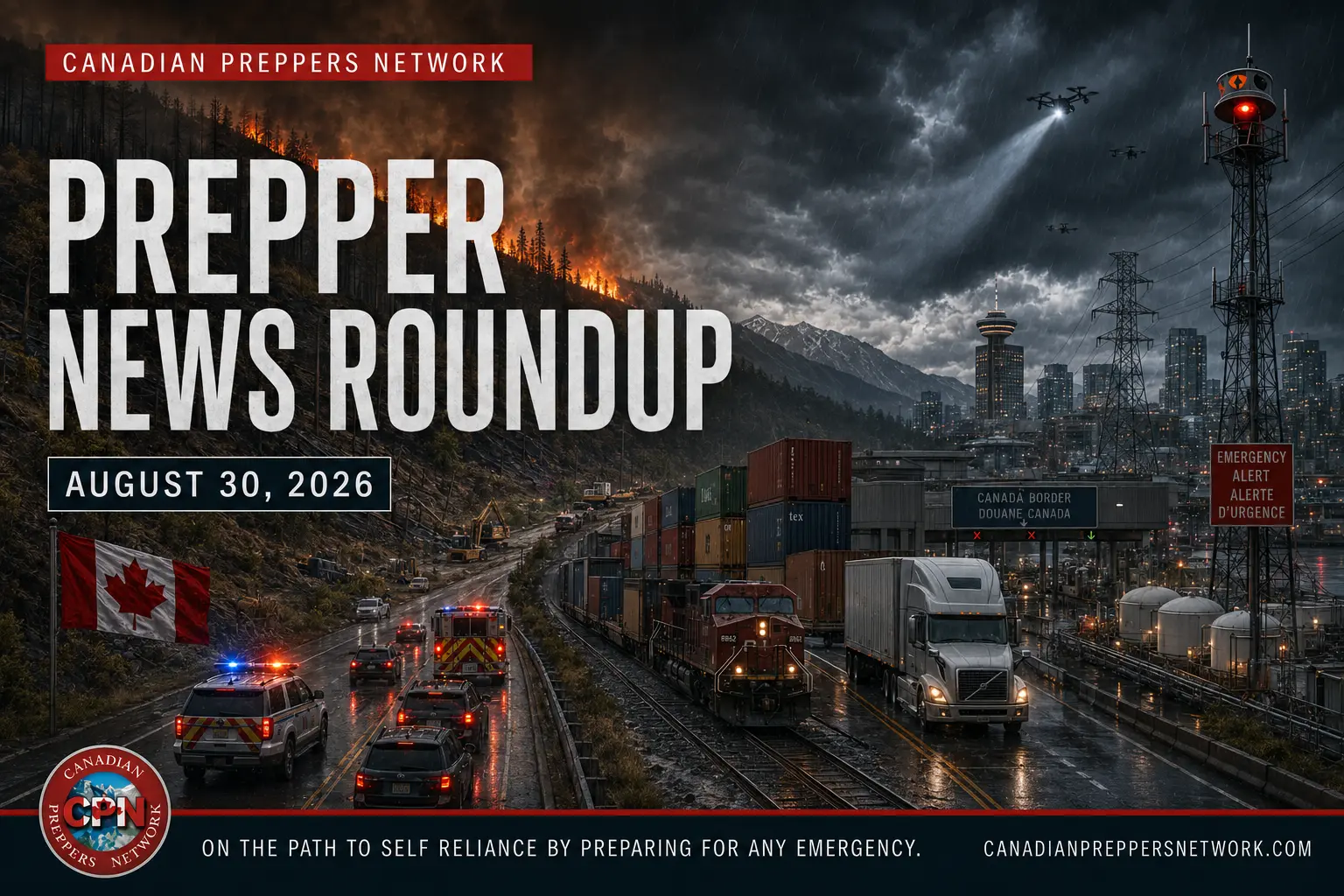
This week’s preparedness news is not dominated by one looming catastrophe. Instead, several pressures are developing at the same time: British Columbia is shifting from wildfire evacuation to recovery, Canada and the United States are entering another round of retaliatory tariffs, European governments are accelerating civil-defence preparations, and attacks on energy and transportation infrastructure are beginning to affect global fuel and food systems.
None of these developments calls for panic. Together, however, they reinforce the value of having supplies, plans and alternatives in place before a disruption becomes personal.
British Columbia Ends Its Provincial Emergency
British Columbia ended its wildfire-related state of provincial emergency on August 27, nearly three weeks after it was declared. That is encouraging news, but it does not mean the wildfire threat has disappeared.
The provincial government emphasized that ending the declaration does not cancel local states of emergency, evacuation orders or evacuation alerts. Warm and dry conditions continue to create elevated fire risk across parts of the province, while affected communities move from evacuation toward re-entry and recovery. Read the B.C. government wildfire update.
In the Okanagan-Similkameen region, officials continued issuing advisories and operational updates throughout the week for the Bald Range wildfire and another fire near Princeton. Some areas were downgraded from evacuation orders to alerts, allowing residents to return while remaining ready to leave again if conditions changed. View the regional emergency updates.
This transition is an overlooked part of disaster preparedness. Returning home is not the same as returning to normal. Roads, electricity, drinking-water systems, communications and local businesses may remain unreliable long after the immediate danger has passed.
People returning to an affected area should keep their evacuation supplies packed, refill fuel tanks, replace used food and water, and confirm that utilities are safe before relying on them. An evacuation alert should be treated as a warning to remain ready—not as an all-clear.
Canada and the United States Escalate Their Trade Dispute
Canada announced retaliatory tariffs covering approximately $20 billion worth of annual imports from the United States after new American tariffs on Canadian goods came into effect.
The Canadian counter-tariffs are scheduled to begin September 8. Rates of 15, 25 and 50 per cent will be applied across roughly 700 product categories. The list includes prepared foods, cheese, appliances, electronics, hand tools, toiletries, clothing, furniture, steel, aluminum and other industrial products.
Ottawa also announced a $7.5-billion support package for affected Canadian businesses and workers. Read the full trade report.
Not every listed product will suddenly become scarce or jump in price on September 8. Existing inventories, exemptions and alternate suppliers will soften the immediate effect. Nevertheless, tariffs frequently produce uneven price increases and temporary gaps while retailers and wholesalers adjust their supply chains.
For preparedness households, the sensible response is not indiscriminate stockpiling. It is identifying imported items that are already due for replacement—filters, batteries, tools, appliance parts, repair materials or necessary consumables—and checking their origin and availability. Buying something that will genuinely be needed is different from emptying shelves because of a headline.
Food prices may also be affected indirectly. Packaging, machinery, transportation equipment and agricultural inputs can all increase production costs even when the finished food itself is not included on a tariff list.
LIMITED-SPACE OUTDOOR EVENT
PLINKIN’ IN THE WOODS
With Frugal Gunnie
Spend a full day developing practical outdoor rimfire marksmanship skills. Work from prone, standing, seated and kneeling positions while learning to use slings, bipods, tripods and shooting bags more effectively.
Saturday, September 12, 2026
8:00 a.m.–5:00 p.m.
Great Ape Empire
267 Highway 6, Wiarton, Ontario
Event admission: $250 CAD
Weekend camping: $20 per person
Space is strictly limited.
Presented in collaboration with Off-Grid School, Preppers Meet, Canadian Preppers Network and Great Ape Empire.
Britain Accelerates Home-Defence Planning
Britain is accelerating work on its Home Defence Programme, an initiative intended to coordinate military, civilian and government preparations for a major crisis affecting the country.
The programme includes updating central crisis protocols traditionally known as the government’s “War Books.” These documents outline how departments would function during conflict or a serious threat against the British mainland. Review the UK Government Resilience Action Plan.
Reports this week also indicated that Britain is preparing a public-awareness campaign encouraging households to keep bottled water, tinned food and other essentials for disruptions caused by severe weather, cyberattacks or international conflict. Read the report on British household preparedness.
This does not mean British officials believe an attack is imminent. It does mean that household preparedness is increasingly being treated as part of national resilience rather than a fringe activity.
The lesson applies equally well in Canada. Governments and emergency services possess resources individual households could never duplicate, but those resources cannot reach everyone simultaneously. A prepared household reduces its immediate dependence on an already overloaded response system.
Drone War Produces Another Deadly Secondary Disaster
At least 37 people were killed after a Russian drone struck an ammunition-storage site near Kyiv on Friday night. The initial strike triggered a much larger detonation, spreading fires into nearby residential buildings and a care facility. Hundreds of people were evacuated.
Ukraine’s president blamed negligent storage practices and ordered an audit of military storage locations. It was the second serious strike-related ammunition explosion in the Kyiv region in two months. Russia also carried out attacks across nine other Ukrainian regions while Kyiv endured nearly continuous drone alerts for a third day. Read the report from Kyiv.
The direct circumstances are far removed from an ordinary Canadian household, but the principle is universal: secondary hazards can cause more damage than the original event.
Fuel, propane, ammunition, batteries, chemicals and other hazardous materials should not be concentrated beside sleeping areas, primary exits or everything else needed for recovery. Dividing important supplies between suitable locations can prevent one fire, flood, theft or structural failure from destroying the entire reserve.
The wider confrontation also showed signs of escalation this week. Russia warned that it could target British military installations in response to the use of British-supplied missiles against Russian territory. Separately, Royal Navy vessels spent three days tracking a Russian naval group through British waters.
These developments are not proof that direct conflict is about to begin, but they show how rapidly a regional war can create risks for countries outside the original battlefield. Read more about the latest escalation.
HANDS-ON OUTDOOR TRAINING
ARCHERY INTENSIVE AT GREAT APE EMPIRE
Presented by Barefoot Bushcraft
Spend a full day improving shooting form, bow control, accuracy and consistency through progressive exercises and individual coaching with Wolf Starchild of Barefoot Bushcraft.
Sunday, September 13, 2026
Great Ape Empire
267 Highway 6, Wiarton, Ontario
Course fee: $120 per person
Registration deposit: $10
Equipment: Provided
A minimum of eight registered participants is required. Class size is limited to preserve the hands-on nature of the instruction.
Presented by Barefoot Bushcraft in partnership with Canadian Preppers Network, Preppers Meet, Great Ape Empire and Off-Grid School.
Fuel and Heating Markets Face New Pressure
Russia extended its ban on diesel exports until September 30 as several refineries remained offline following repeated Ukrainian drone attacks. The restrictions also cover marine fuel and gas oils, while separate limits remain on gasoline and jet-fuel exports.
Russia is normally the world’s second-largest diesel exporter. Removing part of that supply from international markets can influence transportation and industrial fuel costs well beyond the countries directly involved in the war. Read the report on Russia’s diesel-export ban.
Europe is also approaching autumn with natural-gas storage at unusually low levels. European Union storage facilities were approximately 63 per cent full during the final week of August, compared with a recent seasonal average of about 80 per cent. Current projections suggest Europe could begin the winter heating season with reserves roughly one-fifth below the five-year average. Read more about European gas storage.
Canada is not facing the same physical gas-supply problem, and a Canadian shortage should not be inferred from European conditions. Energy markets, however, are interconnected. Competition for fuel can raise shipping, manufacturing and agricultural costs even in energy-producing countries.
Fertilizer Pressure Could Reach Future Food Prices
Farm organizations are warning that disruption around the Strait of Hormuz is limiting access to internationally traded fertilizer, particularly urea and ammonia. Reduced Russian supply and the loss of some domestic European production have added further pressure. Read the fertilizer-supply report.
Fertilizer problems do not normally create empty grocery shelves overnight. Their effects appear later through higher production expenses, reduced planting, smaller yields or increased livestock-feed costs.
Canada’s fertilizer industry provides some protection, particularly through domestic potash production, but Canadian farmers and consumers are not isolated from global prices. Fuel, nitrogen fertilizer, machinery, packaging and transportation all contribute to the final cost of food.
The practical response remains gradual rather than dramatic: maintain a working pantry, rotate what is stored, preserve seasonal produce when possible and avoid becoming dependent on a single store or supplier.
The Preparedness Takeaway
This week’s common theme is transition. British Columbia is transitioning from evacuation to recovery. North American trade is transitioning from negotiation to tariffs. Britain is moving civil-defence planning into public view. War is shifting from attacks on military forces toward pressure on energy, transportation and civilian infrastructure.
For Canadian households, the immediate priorities are straightforward:
- Confirm local emergency-alert sources and evacuation routes.
- Refill supplies used during summer travel, storms or wildfire preparations.
- Review imported tools, parts and consumables that will genuinely be needed in the coming months.
- Test backup heat, lighting, communications and cooking arrangements before autumn.
- Separate hazardous materials so one incident cannot destroy every reserve.
- Continue building food storage through ordinary shopping and seasonal preservation rather than panic buying.
Preparedness works best when it is completed during the quiet period between the warning and the disruption. This week supplied several warnings. What happens with them is up to us.