
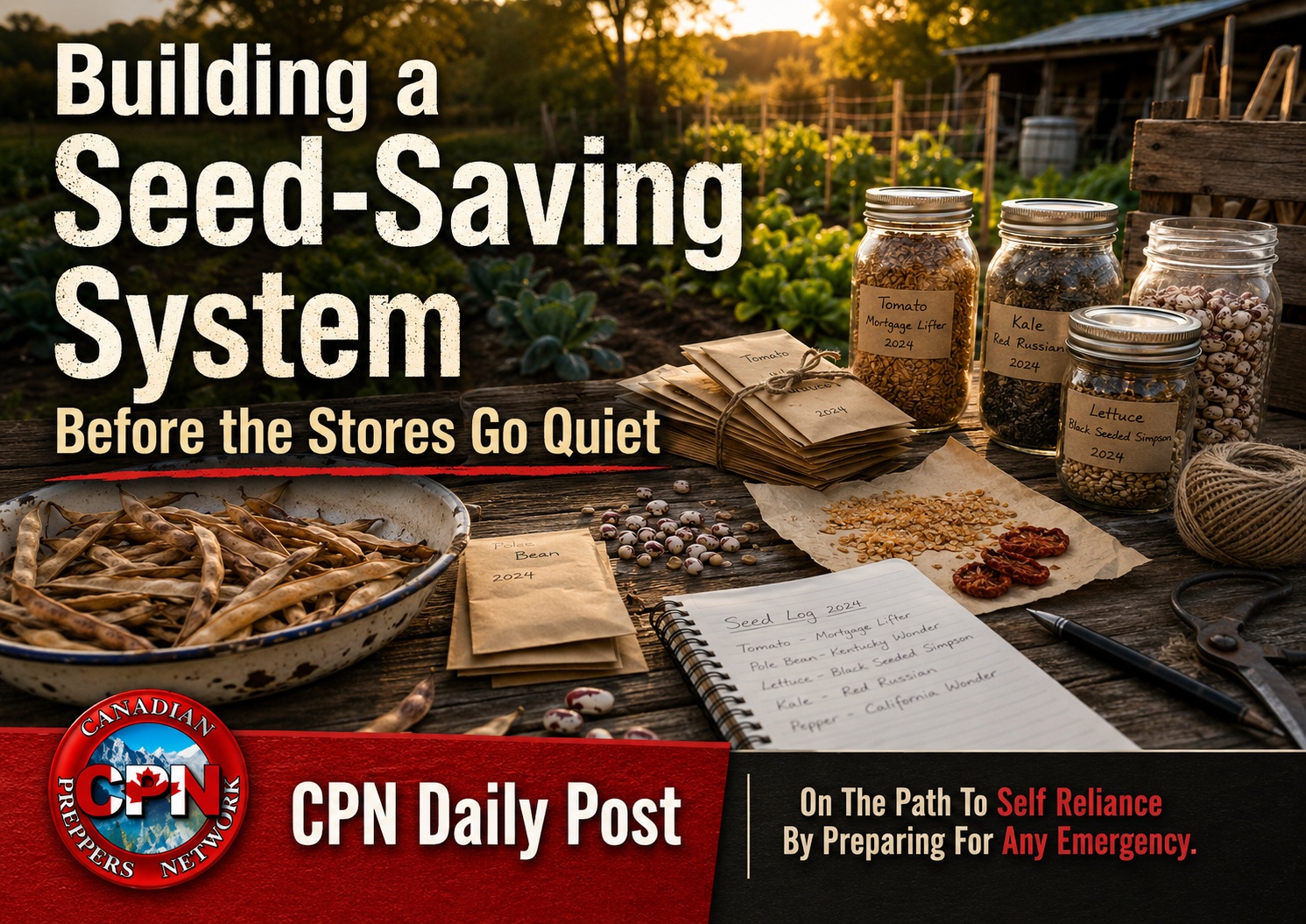
Seeds are not a backup plan unless you can reproduce them year after year.
A packet of seeds is not food security.
It feels like food security. It looks good in a tote or ammo can. It gives the comforting impression that, if things ever get bad enough, the garden can simply be started when needed. But that is not how reliable food production works.
Seeds are living material. They age. They lose germination. They can be mislabelled, poorly stored, or completely wrong for your climate. Some varieties will reproduce predictably. Others will not. Some crops are easy to save seed from. Others need isolation, timing, population size, or deliberate selection. A prepper who owns seeds but has never grown, selected, dried, stored, tested, and replanted them does not own a seed system. They own a hopeful container.
In a short emergency, that may be enough. In a long disruption, it is not.
A real seed-saving system is not built in panic. It is built over seasons. It starts with choosing the right varieties, growing enough plants to observe them properly, saving from the strongest performers, keeping records, and protecting next year’s seed from moisture, heat, rodents, confusion, and human laziness.
That last one matters more than most people admit.
Seed saving is not just gardening. It is memory. It is selection. It is local adaptation. It is the difference between depending on a catalogue and slowly building a food system that belongs to your property, your climate, and your household.
If you are serious about homestead resilience, seed saving belongs beside food storage, pressure canning, root cellaring, livestock planning, and water management. Canadian Preppers Network already has a broader preparedness hub for this kind of work here:
And if your garden planning still needs work, this is the place to connect seed saving to calories instead of hobby gardening:
Garden Planning For Food Security
Start With The Right Kind Of Seeds
The first rule is simple: do not build your long-term seed system around hybrids.
Hybrid seeds can be useful in normal times. They may offer disease resistance, uniformity, early production, or high yields. There is nothing wrong with using them when supply chains work. The problem is dependency. Seeds saved from many hybrid varieties will not reliably produce plants like the parent crop.
For preparedness, the core seed stock should be open-pollinated or heirloom varieties.
That does not mean every heirloom is automatically good. Some are fragile. Some are poor producers. Some were preserved for flavour or history rather than hardiness. What matters is performance on your land. A seed packet description is a sales pitch. Your own records are evidence.
A good seed-saving garden should include crops that do three things: feed people, store well, and reproduce reliably. That means beans, peas, tomatoes, dry corn where climate allows, squash, pumpkins, storage onions, garlic, hardy greens, herbs, and regional staples suited to your growing zone.
Do not waste your best seed-saving effort on novelty crops. Purple carrots and striped tomatoes may be fun, but they should not outrank calories, reliability, and winter storage.
Grow For Seed, Not Just For Food
Most gardeners harvest the best-looking produce first. That makes sense for eating, but it can work against seed saving.
If the biggest, earliest, healthiest plants are always eaten before they mature seed, then the remaining seed comes from the leftovers. Over time, that is backwards selection. You are quietly breeding toward weaker performance.
A seed-saving system requires deliberate choices.
Mark the plants that germinate strongly, survive local weather, resist disease, produce heavily, and mature within your actual season. Those are your seed candidates. Not the prettiest plant. Not the one closest to the path. Not the one you forgot to harvest. The best survivors.
That advice matters even more in a preparedness context. After a collapse-level disruption, you may not have access to sprays, replacement seed, soil amendments, nursery starts, or easy do-overs.
Selection becomes your supply chain.
For some crops, this is easy. Beans and peas can often be left on the plant until pods dry. Tomatoes can be selected from the best fruit on the best plant. Lettuce can be allowed to bolt after you choose the plants that handled your local conditions well.
Other crops are more complicated. Squash, pumpkins, cucumbers, and many brassicas cross-pollinate more easily. Saving seed from them without isolation can give unpredictable results. Sometimes that unpredictability is harmless. Sometimes it produces food that is disappointing, poor storing, or useless.
The point is not to become a professional plant breeder overnight. The point is to know which crops are beginner-friendly and which ones require more planning.
Build The Garden In Layers
A good prepper seed system should have layers, just like a food storage system.
The first layer is your working seed. This is what you plant each year.
The second layer is your reserve seed. This is stored separately and protected against garden failure, mice, moisture, family mistakes, and one bad season.
The third layer is your adaptation line. These are seeds saved from your strongest local performers over multiple seasons. This becomes more valuable every year.
The fourth layer is community redundancy. That means trading seed with people you trust, especially those gardening in similar conditions. In a serious long-term disruption, seed libraries, local growers, neighbours, and mutual aid circles may matter more than distant suppliers.
This is where preparedness and community overlap. You do not want your entire future garden sitting in one box on one shelf in one basement.
Seed sharing should be done carefully. Label everything. Include the crop, variety, year saved, location, basic notes, and whether it may have crossed. Bad seed information spreads problems. Good seed information spreads resilience.
This ties directly into the broader food preparedness system here:
Keep Records Like They Matter
Most people think they will remember what they planted.
They will not.
After a normal summer, labels fade, seed packets disappear, and garden maps get lost. After a hard year involving shortages, family stress, bad weather, illness, or relocation, memory becomes even less reliable.
A seed-saving notebook should be treated as a serious preparedness document.
Record the variety, source, planting date, transplant date if applicable, germination rate, weather problems, pest pressure, disease issues, harvest window, flavour, storage quality, and seed-saving notes. Keep it simple enough that you will actually use it.
A paper notebook is better than relying only on a phone. Digital notes are convenient, but grid-down resilience means the essential information must still be readable without power, cloud access, passwords, or a working device.
At minimum, every saved seed lot should include:
- Crop
- Variety
- Year saved
- Number of parent plants
- Reason for saving
- Any suspected crossing
- Storage location
- Germination test result
That may sound excessive until you are trying to figure out why one batch failed while another performed well.
Preparedness is not only about owning supplies. It is about reducing mystery.
Drying And Storage Are Where Many People Fail
Saving seeds is not finished when seeds are removed from the plant.
Moisture is the enemy. Heat is the enemy. Confusion is the enemy. Rodents are definitely the enemy.
Seeds must be thoroughly dried before storage. Damp seeds can mould, rot, or lose viability. Once dry, they should be stored in clearly labelled envelopes or small packets, then placed inside airtight containers with a desiccant packet. A cool, dark, dry location is ideal.
Do not store your entire seed supply in a hot shed, damp garage, greenhouse, or uninsulated outbuilding. Those places punish seeds. They may be convenient, but convenience is not the same as preservation.
A basement can work if humidity is controlled. A cool closet can work. A refrigerator can work if seeds are sealed against moisture and temperature swings. The key is consistency.
Never assume seed is still good just because it looks fine. Old seed can look perfectly normal and still fail when planted.
That is why germination testing matters.
A simple test can be done by placing a counted number of seeds on a damp paper towel, sealing it in a bag or container, keeping it warm enough for germination, and checking how many sprout. If 10 seeds are tested and 8 sprout, that is roughly 80 percent germination. If only 3 sprout, you either plant heavily or replace that seed line.
In a long emergency, discovering bad seed after planting season is a serious failure.
Focus First On Easy Seed Crops
Do not start by trying to save everything.
Start with crops that give you the highest chance of success.
Beans are one of the best beginner seed crops. They are useful as food, can be dried for storage, and many varieties are relatively straightforward to save. Let pods dry fully on the plant when possible, then finish drying indoors if weather forces harvest.
Peas are similar. They provide food, seed, and soil benefits through nitrogen fixation. In shorter Canadian seasons, choose varieties that mature early enough to produce dry seed before prolonged wet weather.
Tomatoes are worth saving, especially from reliable open-pollinated varieties. They do require cleaning and fermentation for best results, but the process is manageable. Once you have a tomato that performs in your soil and climate, saving seed from it year after year is worthwhile.
Lettuce is useful because it teaches patience. You eat some plants and let the best ones bolt for seed. It is not a calorie crop, but it supports diet variety and early-season greens.
Herbs such as dill, cilantro, parsley, and basil can be valuable because they improve food, support pollinators, and provide seed with little effort. In a collapse scenario, morale matters too. Bland survival food wears people down.
Squash and pumpkins are important, but they require more caution because of cross-pollination. Storage squash is a serious food-security crop, but saving pure seed means understanding isolation or hand-pollination. Learn that skill before you depend on it.
Do Not Confuse A Garden With A Food System
This is where many preppers get uncomfortable.
A garden can produce a lot of vegetables and still fail as a survival food system.
Lettuce, herbs, radishes, and fresh tomatoes are useful, but they do not carry a family through winter. A serious food garden needs calories, storage crops, protein support, preservation methods, cooking fuel, water, compost, pest control, and labour planning.
Seed saving must support that larger system.
There is little value in perfectly saving seed from crops that do not meaningfully feed your household. There is high value in saving seed from beans that dry well, squash that stores into winter, tomatoes that can be canned, onions that keep, and grains or pseudo-grains that fit your land.
Food production and food storage should not be treated as separate subjects. A household that grows without preserving wastes food. A household that stores without producing remains dependent. A household that produces, preserves, and saves seed is moving toward continuity.
For a deeper look at equipment that turns stored food into real resilience, this article fits well:
Food Procurement & Storage Equipment That Turns Food Into Resilience
And for a broader homestead supply framework, use the Homestead Skills Buying Guide:
Think In Seasons, Not Emergencies
Seed saving is slow preparedness.
That is why it is so valuable.
You cannot compress five years of observation into one panicked spring. You cannot instantly create locally adapted seed after the stores go quiet. You cannot discover which crops fail in your soil after failure already matters.
Start now.
Year one is for learning. Grow open-pollinated varieties beside whatever else you already grow. Save a few easy seeds. Test them. Replant them.
Year two is for selection. Track which plants handle your conditions best. Begin separating eating crops from seed crops. Improve labelling and storage.
Year three is for redundancy. Expand reserves. Share with trusted local growers. Keep backup seed off-site if possible. Compare germination rates. Drop varieties that do not perform.
Year four and beyond is when the system starts to become yours.
That timeline may sound slow, but it is realistic. Preparedness rewards people who begin before urgency arrives.
Buying Box: Seed-Saving Supplies Worth Having Before You Need Them
As an Amazon Associate, Canadian Preppers Network may earn from qualifying purchases.
A seed-saving system does not require expensive equipment, but it does require organization. The following supplies help protect seed from moisture, confusion, pests, and careless handling.
Seed saving envelopes
Useful for separating varieties, recording dates, and avoiding mystery seed piles.
Seed saving envelopes
Waterproof garden labels
Mark seed plants in the garden before harvest season gets chaotic.
Waterproof garden labels
Wide-mouth mason jars
Good secondary storage for labelled seed packets when kept cool, dark, and dry.
Wide-mouth mason jars
Silica gel desiccant packets
Helps control moisture inside sealed seed-storage containers.
Silica gel desiccant packets
Seed starting trays with humidity domes
Useful for germination testing and starting saved seed under controlled conditions.
Seed starting trays with humidity domes
Garden notebook or weatherproof field book
A seed system without records eventually turns into guesswork.
Weatherproof field notebook
Final Thought
Seed saving is not romantic. It is not just a heritage hobby. It is not something to learn after the last packet has been opened.
It is one of the quiet skills that separates real resilience from stored inventory.
A pantry buys time. A garden produces food. A seed-saving system gives that garden a future.
When the stores are open, seed packets are cheap and mistakes are manageable. When supply chains fail, the household that already knows how to grow, select, dry, store, test, and replant seed has crossed an important line.
They are no longer just consuming preparedness.
They are reproducing it.


