How Ham Radio Signals Really Behave Around Hills, Trees, Buildings, and Bad Terrain
Radio choice is one of those subjects that looks simple until you actually try to use one in the real world.
A new ham operator buys a dual-band handheld, sees VHF and UHF on the spec sheet, and assumes both bands are basically interchangeable. After all, they both work through the same radio. They both talk through repeaters. They both handle local communication. They both seem to do the same thing.
Then the first real test happens.
One band works better across the farm. The other works better around buildings. One signal disappears behind a ridge. Another bounces strangely through town. A handheld that works from the driveway fails from inside the house. A transmission that was unreadable becomes clear after moving ten feet to the left.
That is not random. That is radio propagation.
For Canadian preppers, understanding the difference between VHF and UHF is not just a technical hobby issue. It affects what radios you buy, where you place antennas, how you plan emergency communication, and whether your gear works when the terrain is no longer convenient.
Most local ham radio preparedness comes down to two common bands:
- 2 metres, usually around 144–148 MHz
- 70 centimetres, usually around 430–450 MHz in Canada
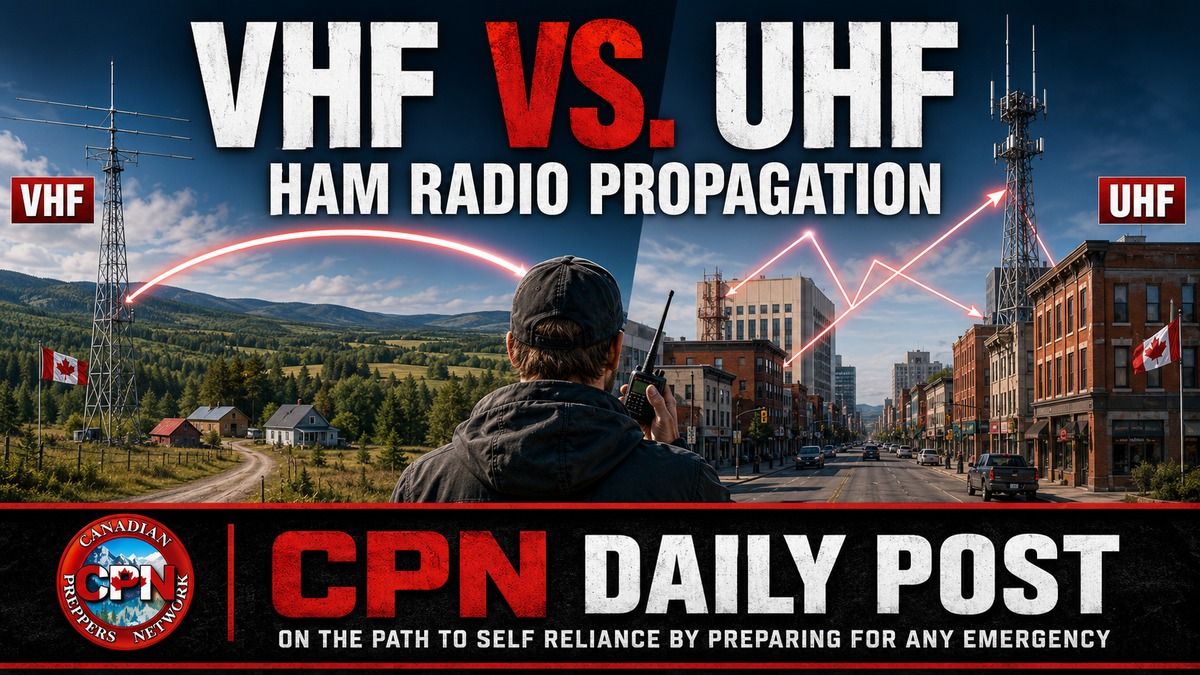
The short version is that VHF usually performs better across rural terrain, open country, rolling land, and longer outdoor paths. UHF often performs better in towns, around buildings, inside structures, and over shorter cluttered paths.
But that shortcut is not enough.
To make smart decisions, you need to understand what radio waves actually do when they meet hills, trees, buildings, vehicles, water, snow, and the ground itself.
VHF and UHF Are Both Mostly Line-of-Sight — But Not Like a Laser
The first thing to understand is that VHF and UHF ham radio signals are mostly line-of-sight.
That means antenna height, terrain, and obstacles matter enormously. If two stations are separated by a ridge, a valley wall, a block of buildings, or dense forest, the signal may be weakened or blocked.
But “line-of-sight” does not mean the signal travels like a pencil-thin laser beam.
Radio waves spread, bend, reflect, scatter, absorb, and sometimes arrive by more than one path at the same time. That is why VHF and UHF can sometimes work when you do not have perfect visual line-of-sight. It is also why they sometimes fail even when the distance seems short.
The main behaviours to understand are:
- Diffraction: the wave bending around edges, ridges, rooftops, hilltops, and treelines.
- Reflection: the wave bouncing off buildings, vehicles, water, rock, metal, and other hard surfaces.
- Absorption: the wave losing energy into trees, wet leaves, walls, soil, people, and building materials.
- Scattering: the wave breaking into weaker, messy paths after striking rough or irregular objects.
- Multipath: several copies of the same signal arriving by different routes and either helping or cancelling each other.
- Fresnel zone blockage: signal loss caused by obstacles near the radio path, even when the antennas appear to “see” each other.
Once you understand those behaviours, VHF and UHF stop feeling mysterious.
The Wavelength Difference: Why 2 Metres and 70 Centimetres Act Differently
The biggest physical difference between VHF and UHF is wavelength.
A 2 metre signal around 146 MHz has a wavelength of roughly two metres. A 70 centimetre signal around 440 MHz has a wavelength of roughly seventy centimetres.
That matters because objects interact with radio waves partly based on their size compared with the wavelength.
Longer VHF waves are generally better at bending around broader natural obstacles. They tend to be more forgiving in rural terrain, light forest, open country, and longer outdoor paths.
Shorter UHF waves interact more with smaller objects and hard surfaces. They reflect more readily off buildings, vehicles, walls, metal surfaces, and urban clutter. That can make UHF surprisingly useful in towns and around structures.
However, UHF also pays a price. At the same distance, all else being equal, UHF suffers more free-space path loss than VHF. In plain English, a 440 MHz signal loses more strength over distance than a 146 MHz signal before you even account for hills, trees, buildings, poor antennas, coax loss, or bad battery condition.
That is one reason VHF often feels stronger outdoors over distance.
UHF can be very useful, but it starts with a tougher link budget.
Hills and Ridges: Why VHF Usually Has the Advantage
Hills are one of the most important obstacles for Canadian emergency radio planning.
When a hill or ridge blocks the direct path between two antennas, the signal does not always stop completely. Some of the wave may bend over the obstruction. This bending is called diffraction.
Longer wavelengths generally diffract better around large obstacles. That gives VHF an advantage over UHF when you are trying to communicate over rolling land, rural terrain, low ridges, and natural obstructions.
This does not mean VHF magically punches through hills. It does not.
If both operators are sitting low in separate valleys, both VHF and UHF may perform poorly. But VHF usually has a better chance of producing a usable signal around or over terrain than UHF does.
A sharp ridge can behave like a knife-edge obstruction. A rounded hill can be worse because the signal must bend over a broader obstacle. Either way, signal strength can drop hard once the terrain cuts into the path.
This is where many preppers make the wrong move. They reach for more power when they should be reaching for more height.
A five-watt handheld at the bottom of a hill may fail. The same handheld carried fifty metres uphill may suddenly work. A modest antenna raised above the roofline may outperform a more powerful radio with a poor antenna at ground level.
The prepper rule is simple:
If terrain blocks the path, changing position often beats adding watts.
Valleys: Radio Shadows and Lopsided Coverage
Valleys create some of the most frustrating VHF/UHF conditions.
A valley can trap an operator below the surrounding terrain. Signals may be blocked in one direction, reflected in another, and partially diffracted over a ridge in a third. Instead of a neat circular coverage area, your radio range becomes lopsided and unpredictable.
This is why “five kilometres of range” means almost nothing without terrain context.
Five kilometres across flat open land is one thing. Five kilometres from one valley bottom to another is something else entirely.
In valley country, the strongest radio locations are usually not the most comfortable ones. A ridge, high road, open field, tower site, hilltop, or elevated clearing may provide far better coverage than the house, cabin, or vehicle location where you actually want to operate.
VHF is usually the better first choice in this terrain, but even VHF has limits. If the terrain blocks the signal badly enough, you need one of four things:
- More antenna height
- A better operating position
- A repeater on high ground
- A different communication plan
This is why emergency communication plans should include known radio checkpoints. If the house is in a poor radio location, identify a nearby hill, open road, or clearing where a handheld or mobile radio performs better.
Do not discover that location during the emergency.
Find it now.
Forests: Trees Do More Than “Get in the Way”
Forests are complicated radio environments.
A tree is not a solid wall, but it is not invisible either. Trunks, branches, leaves, needles, sap, moisture, snow, and ice can all affect signal strength. The deeper and wetter the forest, the worse the problem becomes.
VHF usually handles forest better than UHF because the longer wavelength is less affected by smaller branches, leaves, and vegetation. UHF can still work well at short range, but it often drops off faster in dense bush, especially when the foliage is wet.
A summer hardwood forest in full leaf can behave differently from the same forest in winter. Dense conifer cover can behave differently from open deciduous bush. Wet leaves after rain can absorb and scatter more signal than dry leaves. Snow and ice on branches can change conditions again.
For Canadian preppers, this matters around hunting camps, woodlots, rural retreats, trails, logging roads, sugar bushes, and heavily treed properties.
If your radio fails in the bush, do not immediately assume the band is wrong or the radio is junk. Change the radio environment.
Step out of the thick trees. Move to a clearing. Get onto a trail or road. Raise the antenna above shoulder height. Move to higher ground. Try the edge of a lake, field, or cut line. A small change in position can make a large change in signal quality.
The prepper rule:
In forest, VHF usually gets the first try, but position still matters more than brand name.
Buildings: Why UHF Often Works Better in Town
Buildings affect radio waves differently than hills and trees.
A building can block the direct signal, absorb part of it, reflect part of it, scatter part of it, and create strange dead spots indoors. Urban radio paths are often not one clean path. They are a mess of direct signal, wall reflections, vehicle reflections, window paths, rooftop diffraction, and multipath.
This is where UHF often has an advantage.
Because UHF has a shorter wavelength, it can interact more effectively with smaller openings, streets, corridors, vehicles, windows, and structural gaps. It can reflect around corners and move through built-up areas in ways that sometimes make it more usable than VHF at short range.
That is one reason UHF is commonly favoured for short-range communication around buildings, events, commercial sites, and urban environments.
But do not confuse “better around buildings” with “goes through anything.”
Reinforced concrete, steel siding, metal roofs, foil-backed insulation, elevators, basements, underground parking, shipping containers, and heavy industrial buildings can wreck both VHF and UHF signals.
A basement may be a radio hole. A metal barn may shield the signal. A house with foil-backed insulation or a steel roof may perform far worse than expected. A handheld used from deep inside a building may fail where the same radio works fine beside a window or outdoors.
The prepper rule:
UHF is often better for short-range building clutter, but outside and at distance, VHF may take the lead again.
Urban Streets: Reflections, Corners, and Dead Spots
In a town or city, radio waves can behave strangely.
A signal may bounce off brick, glass, vehicles, street signs, metal roofs, and walls. It may travel down a street like a rough corridor. It may bend over rooftops, reflect off a nearby building, and arrive from a direction you did not expect.
This can help.
A UHF signal may reach around a corner because it bounced off a building across the street. A station that is not in direct view may still be readable because the signal found another path.
But it can also hurt.
The same reflections can create dead spots. Multiple copies of the signal can arrive at the receiving antenna slightly out of phase. When those copies cancel each other, the signal fades or disappears.
That is why moving a few feet can make a dramatic difference.
One spot on the sidewalk may be unreadable. Two steps toward the road may be clear. Standing beside a vehicle may hurt the signal. Moving away from the metal body may help. A second-floor window may work better than the kitchen. A balcony may work better than a basement.
This is multipath in action.
For urban and suburban preparedness, UHF should be taken seriously. It may outperform VHF for short-range neighbourhood coordination, building-to-building communication, parking lots, event grounds, and dense streets.
But it must be tested where you actually plan to use it.
The prepper rule:
In town, UHF may work better than expected — until the wrong building, basement, or corner creates a dead zone.
Vehicles: The Metal Box Problem
Vehicles are both useful and troublesome for radio.
A vehicle can carry power, antennas, gear, maps, and mobile radios. But the metal body of the vehicle can also shield or distort signals from a handheld used inside the cab.
A handheld sitting in a cup holder is a compromised setup. The antenna is low. The body of the vehicle blocks part of the signal. The operator may be surrounded by metal, glass, electronics, and passengers. The signal may escape unevenly through windows or reflect around the cabin before getting out.
This is why an external antenna makes such a large difference.
A modest mobile antenna on the roof can outperform a handheld inside the vehicle by a wide margin. Roof height helps. A better antenna helps. The metal vehicle body can serve as a useful ground plane for many mobile antenna designs. Even a temporary mag-mount antenna can be a serious improvement over a rubber duck antenna inside the cab.
For vehicle convoys, VHF is usually the stronger choice over rural roads, highways, and open country. UHF can still be useful for close vehicle coordination, urban movement, parking areas, event sites, and short-range group use.
The key point is that the antenna matters more than many beginners realize.
The prepper rule:
A basic radio with a good outside antenna may beat an expensive handheld trapped inside a vehicle.
Water, Lakes, Ice, and Wet Ground
Water can reflect radio waves.
That matters in Canada because many people operate near lakes, rivers, wet fields, frozen lakes, snow-covered ground, and icy roads.
A signal travelling over water may arrive at the receiver by more than one path. One part travels directly. Another part reflects off the water surface. Depending on the path length and phase, those signals may strengthen each other or partially cancel each other.
This can produce fading.
You may notice a signal that is strong in one spot and weak a few metres away. You may also find that communication across open water works better than expected because the path is clear and reflective.
Frozen lakes and snow-covered terrain can change the operating environment again. Snow does not usually behave like a simple wall to VHF and UHF, but winter changes many things at once: foliage, ground conditions, surface reflections, antenna placement, operator comfort, and battery performance.
Cold batteries are especially important. A radio path that is technically workable may still fail if the battery voltage drops, the handheld is kept outside in deep cold, or the operator cannot safely stay in the best radio position.
The prepper rule:
Water and ice can help or hurt, but cold batteries will always make the plan worse.
Fresnel Zone: The Invisible Space Around the Signal Path
This is one of the most important radio concepts most beginners never hear about.
Even when two antennas appear to have line-of-sight, the signal does not travel only along a thin visual line. There is an invisible football-shaped volume around the path called the Fresnel zone.
For the strongest signal, much of that zone needs to be clear.
If a hilltop, treeline, roofline, vehicle, ridge, or building cuts into the Fresnel zone, the signal can weaken even though the antennas technically “see” each other.
This explains why antenna height matters so much.
Raising an antenna does not just extend the horizon. It also helps clear the Fresnel zone. A small increase in height can reduce ground obstruction, clear nearby objects, and improve the signal path more than extra power would.
This is especially important over fields, roads, lakes, and rolling terrain. You may have visual contact with the other station, but if the path skims low over ground, crops, brush, vehicles, snowbanks, or rooflines, the signal may still suffer.
The prepper rule:
You do not just need to see the other antenna. You need room around the path.
Multipath: Why Moving Ten Feet Can Fix the Problem
Multipath is the reason VHF and UHF sometimes seem haunted.
A transmitted signal may arrive at the receiving antenna by several routes. One copy comes directly. Another bounces off a building. Another reflects from a vehicle. Another diffracts over a roofline. Another scatters through trees.
These copies arrive at slightly different times and phases.
Sometimes they add together and improve the signal. Sometimes they cancel each other and create fading. This is why moving a handheld slightly can change everything.
If a signal is poor, try:
- Moving a few feet left or right
- Stepping away from a vehicle or metal wall
- Moving closer to a window
- Getting out of a basement
- Raising the antenna
- Turning your body
- Moving to the other side of a building
- Walking to higher ground
- Trying the other band
This is not superstition. It is radio physics.
A bad signal is not always solved with more watts. Sometimes it is solved by moving out of a dead spot.
The prepper rule:
Before declaring the radio useless, move your body and antenna.
Antenna Height Beats Handheld Wattage
Many new operators obsess over transmitter power.
Power matters, but not as much as people think.
At VHF and UHF, antenna height, antenna quality, feed line loss, terrain, and location often matter more than raw wattage. A five-watt handheld connected to a better antenna in a better location may outperform a more powerful radio with a poor antenna in a bad location.
This is especially true with handheld radios. The stock rubber antenna is convenient, but it is a compromise. Your body absorbs and blocks part of the signal. Holding the radio low reduces range. Using it indoors makes things worse. Using it inside a vehicle adds another layer of trouble.
Better options include:
- Standing outside instead of inside
- Moving to higher ground
- Using a longer whip antenna where appropriate
- Using a roll-up J-pole or portable antenna
- Using a mobile antenna on a vehicle
- Getting a base antenna above the roofline
- Keeping coax runs short and low-loss
- Testing actual locations before relying on them
The prepper rule:
At VHF and UHF, height is usually your friend. Poor antenna placement is usually your enemy.
Repeaters Change the Equation
A repeater can completely change VHF and UHF performance.
Instead of trying to reach another handheld directly, your radio reaches a repeater, usually located on a tower, hilltop, tall building, or other elevated site. The repeater then retransmits your signal over a much wider area.
This is why a handheld that cannot reach another station directly may still communicate clearly through a repeater.
But repeaters are infrastructure.
They may have backup power, or they may not. They may survive an outage, or they may go down. They may be busy. They may be damaged. They may depend on sites, links, towers, and maintenance outside your control.
For preparedness, repeaters are valuable but should not be treated as guaranteed.
Every ham radio prepper should know:
- Which local repeaters cover the area
- Which ones have backup power
- Which ones are active
- Which ones are linked
- Which ones are commonly used for nets
- Which simplex frequencies are used if repeaters fail
- Whether VHF or UHF repeaters are stronger from home, work, and retreat locations
The prepper rule:
Use repeaters, but do not build a plan that collapses without them.
So Which Should Canadian Preppers Choose?
For most Canadian preppers, the answer is both.
A dual-band VHF/UHF radio makes sense because the two bands solve different problems. The mistake is not owning both. The mistake is assuming they behave the same way.
If you live rurally, start your thinking with VHF. It is usually the better band for open land, farms, back roads, woodlots, vehicle travel, homestead use, and longer outdoor paths.
If you live in town, take UHF seriously. It may be better for short-range neighbourhood coordination, buildings, parking areas, events, and dense structural clutter.
If you live in hilly or valley terrain, focus less on band choice and more on antenna height, repeater coverage, and tested radio locations.
If you operate in forest, expect VHF to have the advantage, but do not ignore position. Clearings, roads, ridges, shorelines, and antenna height may matter more than the radio model.
If you use vehicles, plan around external antennas. A handheld inside a vehicle is a weak link.
If you want regional communication beyond local VHF/UHF coverage, start learning about HF and NVIS. VHF and UHF are local and regional tools when supported by terrain, antenna height, and repeaters. They are not a substitute for HF when the goal is broader regional communication without infrastructure.
Related CPN Reading
How Far Can Your Radio Really Reach?
https://canadianpreppersnetwork.com/how-far-can-your-radio-really-reach-realistic-range-expectations-for-canadian-preppers/
Amateur Radio Emergency Nets in Canada
https://canadianpreppersnetwork.com/amateur-radio-emergency-nets-in-canada/
HF Wire Antennas for Emergency Communications
https://canadianpreppersnetwork.com/hf-wire-antennas-for-emergency-communications/
Using Ham Radio NVIS for Reliable Regional Communications
https://canadianpreppersnetwork.com/using-ham-radio-nvis-for-reliable-regional-communications/
Communications in Canada Preparedness Hub
https://canadianpreppersnetwork.com/canadian-preppers-network-preparedness-hubs/communications-in-canada/
Amazon.ca Gear Box: Practical Radio Support Items
A radio is only part of the system. Antennas, batteries, charging, notebooks, and printed plans often matter just as much.
Dual-band VHF/UHF handheld radios
Dual-band VHF/UHF handheld radios on Amazon.ca
VHF/UHF mobile antennas
VHF/UHF mobile antennas on Amazon.ca
Mag-mount antenna bases
VHF/UHF mag-mount antennas on Amazon.ca
SMA antenna adapters
SMA antenna adapters on Amazon.ca
USB-C power banks
USB-C power banks on Amazon.ca
Rechargeable AA and AAA batteries with charger
Rechargeable AA and AAA batteries with charger on Amazon.ca
Waterproof notebook for radio logs and contact plans
Waterproof notebooks on Amazon.ca
Laminating pouches for channel plans and contact cards
Laminating pouches on Amazon.ca
Where Acres of Preparedness Fits In
A retreat, homestead, or rural fallback location does not become resilient just because it is remote. Distance can buy security in some situations, but it can also create isolation.
That is why communications belong in the same planning category as water, heat, food, access, security, and power. A property that cannot receive information, coordinate with family, reach neighbours, or maintain contact with a wider group is weaker than it looks.
In Acres of Preparedness, the retreat mindset is built around systems, not single pieces of gear. Radio fits that same philosophy. A handheld tossed in a drawer is gear. A tested VHF/UHF plan, known operating locations, printed channel lists, backup power, external antennas, and trained operators are a system.
Final Thoughts
VHF and UHF are not rivals. They are tools.
VHF usually gives Canadian preppers better performance across rural terrain, open land, light forest, farms, and longer outdoor paths. UHF often performs better in towns, around buildings, inside structures, and across shorter cluttered environments.
But neither band defeats bad terrain, poor antenna height, dead batteries, wet foliage, metal buildings, basements, or lack of practice.
The real skill is not memorizing that VHF goes farther and UHF works better in town. The real skill is knowing why signals fail, how obstacles affect them, and what to do when the first transmission does not get through.
Move higher. Move outside. Clear the trees. Get away from metal. Use a better antenna. Test both bands. Know your repeaters. Practise simplex. Print your plan.
Preparedness communication is not about owning a radio.
It is about understanding the path between two antennas — and knowing how to improve that path when conditions are working against you.