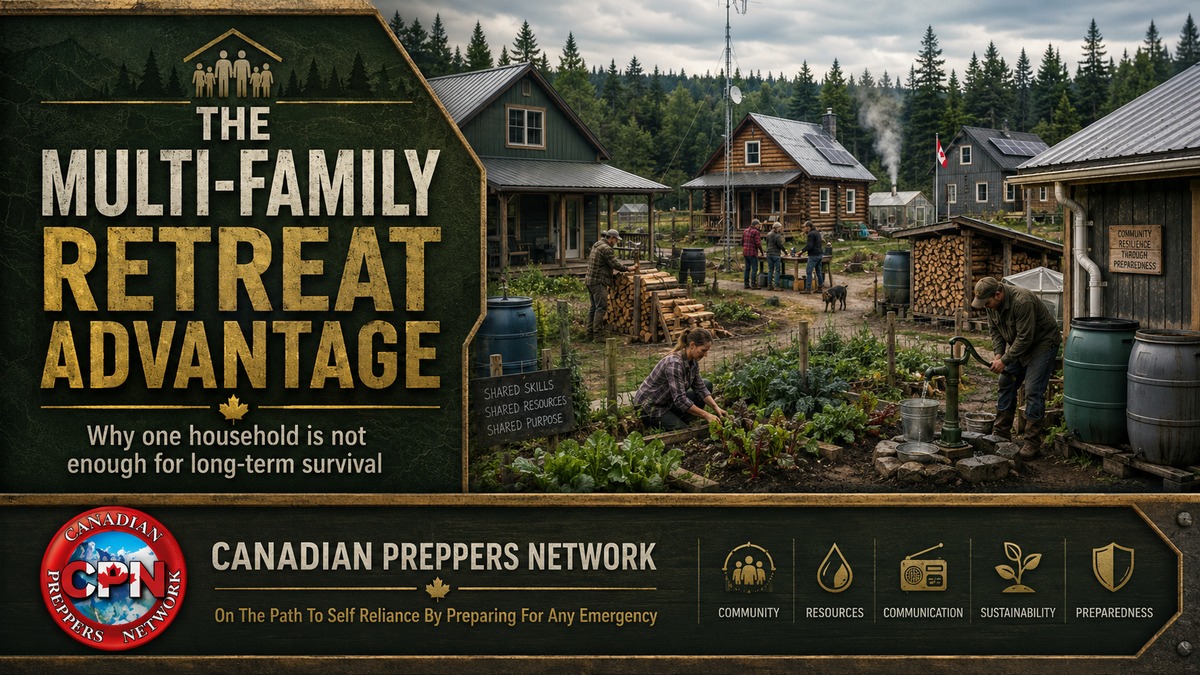
Why One Household Is Not Enough for Long-Term Survival
A multi-family retreat is the most viable long-term preparedness model.
Not the lone bugout. Not the basement stockpile. Not one exhausted household trying to become its own water department, power company, farm, repair shop, clinic, security team, school, and government.
A multi-family retreat.
That statement will bother some people. It will bother the lone-wolf survivalist who thinks independence means isolation. It will bother the homesteader who believes one family can carry every burden indefinitely. It will bother the gear-focused prepper who thinks enough stored supplies can replace labour, trust, skill, discipline, and time.
But hard times have a way of stripping away comforting myths.
One family can prepare well. One family can store food, heat with wood, raise animals, garden, filter water, run radios, repair equipment, and hold out longer than most. A prepared homestead is a serious advantage.
But one family is still one family.
One illness can cripple the workload. One injury can take out the person who knows the water system. One exhausted adult can make a bad decision. One mechanical failure can stop a critical process. One bad harvest can erase a season of work. One person’s knowledge can disappear at exactly the wrong time.
That is why the multi-family retreat deserves to be treated as the strongest form of practical long-term preparedness.
Not because it is easy.
It is not.
Not because people magically get along.
They do not.
Not because a group retreat is guaranteed to work.
Nothing is guaranteed.
But because a properly planned multi-family retreat solves the biggest long-term survival problem that almost every other model ignores:
One household cannot replace an entire support system by itself.
A stockpile buys time.
A homestead produces.
A multi-family retreat continues.
That is the difference.
A Retreat Is Not a Cabin in the Woods
The word “retreat” gets misused.
Some people hear it and imagine a hidden cabin, a private bugout location, or a place to disappear when things get ugly. That version is too small. It is also too weak.
A real retreat is not simply a place to run to. It is a working system built before it is needed.
It needs water, heat, food storage, food production, sanitation, tools, communications, medical capacity, repair skills, stored supplies, access control, firewood, maps, records, maintenance routines, and people who know how the place actually functions.
A single-family retreat may have some of those pieces.
A multi-family retreat can build depth into them.
That depth is the advantage.
One person knows radio. Another knows small engines. Another knows livestock. Another knows gardening. Another knows food preservation. Another knows carpentry. Another knows first aid. Another knows bookkeeping, inventory, cooking, teaching children, organizing work, or calming people down when stress starts cracking the group.
No one person has to be everything.
That is not weakness.
That is resilience.
The Lone Homestead Has a Breaking Point
A lone homestead is a better plan than the fantasy bugout. It is also better than assuming an urban home can handle a long-term systems failure.
But it still has a breaking point.
The work never stops.
Water has to be collected, pumped, filtered, thawed, protected, or repaired. Firewood has to be cut, split, stacked, moved, dried, and managed. Animals need feed, water, bedding, fencing, protection, breeding, health checks, and butchering. Gardens need planting, watering, weeding, pest control, harvesting, seed saving, and preservation.
Then come the repairs.
The pump fails. The roof leaks. The fence goes down. The chainsaw quits. The stove pipe needs cleaning. The battery bank acts up. The generator needs maintenance. The vehicle will not start. The hand tools dull. The well line freezes. The gate gets damaged. The greenhouse plastic tears. The pressure canner gasket fails at the worst possible time.
Meanwhile, people still need to eat. Children still need care. Older relatives still need help. Someone gets sick. Someone gets hurt. Someone stops sleeping properly. Someone becomes overwhelmed. Someone who was essential is suddenly unavailable.
That is when the lone homestead stops looking romantic.
It starts looking thin.
The problem is not that one family cannot do anything.
The problem is that one family eventually has to do everything.
That is not self-reliance.
That is a single point of failure with a garden.
The Real Currency Is Labour
Preppers like things they can count.
Buckets of food. Litres of water. Cords of wood. Watts of solar. Batteries on a shelf. Jars in a pantry. Fuel in cans. Rounds in boxes. Tools on hooks.
All of that matters.
But in a long emergency, the real currency is labour.
Who hauls the water? Who watches the children? Who checks the animals? Who cuts the wood? Who cooks? Who repairs the pump? Who preserves the harvest? Who monitors the radio? Who checks the road? Who tends the sick? Who keeps records? Who sleeps so they can take the next shift?
Modern life hides labour from us. Turn the tap, water appears. Flip the switch, lights come on. Turn the thermostat, heat arrives. Flush the toilet, waste disappears. Open the fridge, food is waiting. Order a part, and it shows up.
In a long disruption, all of that convenience turns back into work.
Water becomes a job.
Heat becomes a job.
Sanitation becomes a job.
Food becomes a job.
Security becomes a job.
Repairs become a job.
Childcare becomes a job.
Medical care becomes a job.
Communication becomes a job.
Record-keeping becomes a job.
Even rest becomes something that has to be protected.
A single family can push hard for a while. Then the cracks show. People get tired. Tired people make mistakes. They cut corners. They argue. They miss details. They damage tools. They forget steps. They take risks. They burn out.
A multi-family retreat can divide the load without destroying everyone.
That does not mean everyone does the same job. It means the retreat has enough human capacity to keep essential systems moving even when someone is injured, sick, absent, exhausted, or emotionally overloaded.
That is what long-term survival really demands.
Not just supplies.
Capacity.
Skill Redundancy Is More Important Than Gear Redundancy
Most preppers understand backup gear.
Backup water filter. Backup stove. Backup radio. Backup power. Backup heat. Backup batteries. Backup tools. Backup fuel.
But gear redundancy is not enough.
Skill redundancy matters more.
If only one person knows how the well pump works, the retreat has a weakness. If only one person knows how to pressure can safely, the retreat has a weakness. If only one person understands the radios, solar system, livestock, medical supplies, security routines, maps, or stored parts, the retreat has a weakness.
A multi-family retreat has the chance to build overlapping skill sets.
Not everyone needs to be an expert in everything. But every critical system should have more than one person who can operate it, troubleshoot it, and teach the basics to someone else.
That is the advantage.
A lone homestead often depends on one highly capable person.
A serious retreat builds capability into the group.
A Multi-Family Retreat Is Not a Commune
This point matters.
A multi-family retreat is not a commune.
It is not a vague dream of shared everything. It is not a place where rules disappear. It is not a fantasy where stress turns everyone into better people.
Stress often does the opposite.
That is why a serious retreat needs structure before pressure arrives.
Who owns the land? Who has access? Who contributes money, supplies, labour, and skills? What is communal and what remains private? Who makes decisions? What happens when relatives show up? What happens if someone refuses to work? What happens if someone creates conflict? What behaviour gets a person removed? What happens if the property owner dies, sells, divorces, or loses control of the land?
These questions are uncomfortable.
Good.
They should be answered before anyone’s family is cold, hungry, scared, and tired.
A multi-family retreat without rules is not a plan.
It is a future argument with supplies involved.
The Bugout Fantasy Dies First
Compared to a multi-family retreat, the unplanned bugout is barely a plan at all.
Evacuation is real. Sometimes leaving is necessary. Wildfires, floods, chemical spills, and local danger can force movement. Every household should have a way to leave.
But evacuating to a known destination is not the same thing as “heading for the woods.”
The woods do not care how confident you are. Winter does not care how expensive your pack is. Rural roads do not stay empty because you need them. Crown land does not become a functioning home because society is unstable.
A bugout bag helps you leave.
It does not create water, heat, sanitation, food, medical care, repair capacity, or trust.
A multi-family retreat is the opposite of panic movement.
It is a destination that has already been chosen, stocked, tested, repaired, mapped, and worked by people who know what they are doing there.
That is not running away.
That is planning ahead.
The City Has an Expiry Date
Bugging in at home is often the correct first move during a short emergency.
For most storms, outages, boil-water advisories, local disruptions, and temporary supply problems, home is where you should be. Home is where the food is. Home is where your blankets, tools, medications, documents, neighbours, and familiar routines are.
But the city depends on recovery.
Water pressure has to return. Sewage has to keep moving. Grocery trucks have to arrive. Pharmacies have to reopen. Fuel stations need fuel. Police, fire, ambulance, public works, garbage collection, and the electrical grid all have to keep functioning or come back quickly.
When systems recover, urban life can stabilize.
When recovery stalls, the city becomes a dependency trap.
Dense areas concentrate need. They consume more than they produce. They depend on outside fuel, outside food, outside water treatment, outside logistics, and outside order.
A multi-family retreat is designed around a different assumption.
What if recovery is slow?
What if services are partial?
What if supply chains favour cities, hospitals, utilities, and government first?
What if ordinary households have to provide more of their own water, heat, food, sanitation, security, and repairs for far longer than expected?
That is where retreat planning stops being extreme and starts looking practical.
Security Is Not a One-Person Job
People often talk about retreat security in shallow terms.
They imagine gates, cameras, warning signs, and bravado. But real retreat security is much broader than that.
Security is awareness. It is routine. It is communication. It is rest. It is lighting discipline. It is access control. It is tool accountability. It is food storage discipline. It is fire prevention. It is sanitation. It is knowing who belongs on the property and who does not. It is noticing changes before they become emergencies.
A single-family homestead struggles here because everyone has to sleep. Everyone has to work. Everyone gets tired. Everyone has blind spots.
A group can divide the burden.
Someone can monitor the road. Someone can check animals. Someone can maintain radio contact. Someone can keep inventory. Someone can cook. Someone can rest. Someone can repair the fence. Someone can notice smoke, tracks, damage, missing tools, a sick animal, or a change in routine.
That kind of security is not cinematic.
It is practical.
It is also much harder for one exhausted household to maintain day after day.
A retreat that requires the same two adults to be alert, productive, calm, and physically capable at all times is not secure.
It is waiting for fatigue to win.
Knowledge Has To Survive the Internet
Modern people outsource memory.
They do not learn systems deeply because they can search for answers later. They do not print instructions because videos exist. They do not keep manuals because forums exist. They do not write down procedures because the person who knows them is still around.
That is fragile.
In a serious breakdown, the internet may not be available when you need it. Search engines, videos, cloud documents, online manuals, supplier websites, and digital notes may all be out of reach. Even if a phone still works, battery life, connectivity, and stress can make digital dependence a liability.
A multi-family retreat needs a physical knowledge base.
Water system diagrams. Garden records. Livestock notes. Radio plans. Medical references. Repair instructions. Food preservation procedures. Maps. Inventories. Maintenance logs. Seed records. Tool lists. Fuel records. Printed manuals. Written procedures.
Knowledge has to survive power loss, internet loss, stress, injury, and absence.
It cannot live in one person’s head.
It cannot live only online.
A serious retreat should be able to keep functioning even when the person who usually knows the answer is asleep, injured, away from the property, or no longer available.
That is what real continuity looks like.
The Wrong Group Is Worse Than No Group
A multi-family retreat is not automatically better just because more people are involved.
The wrong group can destroy a retreat faster than bad weather.
Lazy people are a liability. Reckless people are a liability. Constant complainers are a liability. People who refuse rules are a liability. People who want access without responsibility are a liability. People who bring drama into every decision are a liability.
A retreat group must be chosen carefully.
Trust matters. Work ethic matters. Emotional control matters. Practical skills matter. Humility matters. The ability to follow procedures matters. The ability to disagree without poisoning the group matters.
This is why a retreat group cannot be built at the last minute.
You do not find out who people are by talking about preparedness over coffee.
You find out by working with them.
Split firewood together. Repair something together. Plant together. Preserve food together. Run a radio drill together. Spend bad weather together. Have the hard conversations together. See who shows up when the work is boring and nobody is watching.
A good group is a force multiplier.
A bad group is a collapse accelerant.
Why This Is Exactly What Acres of Preparedness Was Written For
This is the entire point behind Acres of Preparedness: Planning the Last Safe Place.
Preparedness cannot stop at storage shelves, gear lists, and vague bugout ideas. At some point, serious people have to ask the harder question:
Where does life continue if the normal systems do not come back quickly?
That is what separates casual preparedness from real long-term resilience.
A multi-family retreat is not just a rural property. It is water, heat, food production, storage, sanitation, access, communications, repair capacity, security, rules, trust, and shared labour built into one working system. That kind of plan does not appear overnight. It has to be designed before it is needed.
Acres of Preparedness was written for exactly that kind of thinking.
It looks beyond the fantasy of “heading for the woods” and focuses on the practical realities of choosing, planning, and developing land that can actually support people when outside systems become unreliable. Not just for a weekend. Not just for a short outage. For the kind of long-term disruption where location, water, heat, food, and human organization matter more than another tote full of gear.
The strongest retreat plan is not just about owning land.
It is about knowing what that land must do.
Can it provide water? Can it produce heat? Can it grow food? Can it support storage? Can it be accessed in bad weather? Can it support more than one household? Can it be defended without becoming a prison? Can it absorb labour, stress, illness, and failure without collapsing?
Those are the questions that matter.
For readers who are serious about moving beyond basement preparedness and into retreat-based planning, Acres of Preparedness is the next step.
Acres of Preparedness: Planning the Last Safe Place
Buy Acres of Preparedness on Amazon.ca
A bugout bag helps you leave.
A stockpile helps you wait.
A homestead helps you produce.
But a properly planned multi-family retreat gives people somewhere to continue.
That is the difference.
Final Thoughts
The strongest long-term preparedness model is not the lone bugout.
It is not the basement stockpile.
It is not the isolated homestead pretending one family can do everything forever.
The strongest model is the properly planned multi-family retreat.
Not because it is easy.
Because it is honest.
It admits that long-term survival requires labour, skill, trust, structure, security, repair capacity, food production, sanitation, communication, rest, and redundancy. It admits that one household has limits. It admits that disaster or prolonged disruption will not reward fantasy.
A multi-family retreat does not guarantee success.
But it gives preparedness something the lone homestead often lacks.
Continuity.
It can absorb injury. It can rotate labour. It can protect rest. It can preserve knowledge. It can train backups. It can divide work. It can maintain systems. It can continue after one person reaches their limit.
That is the real advantage.
A stockpile buys time.
A homestead produces.
A multi-family retreat keeps working.