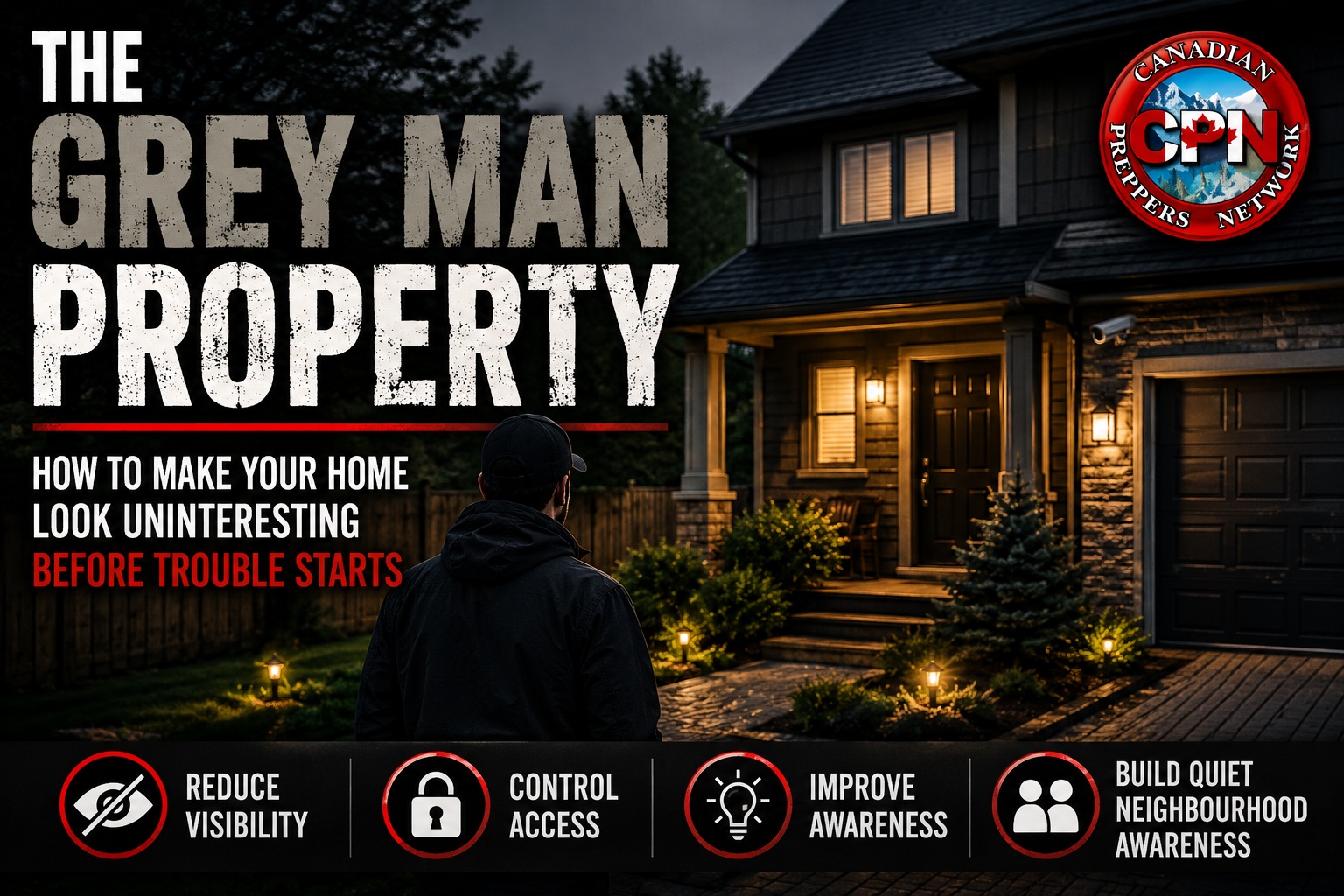
The Grey Man Property How To Make Your Home Look Uninteresting Before Trouble Starts
Disclosure: This article contains Amazon affiliate links. As an Amazon Associate, Canadian Preppers Network may earn from qualifying purchases.
There is a strange thing that happens when people begin taking home security seriously. They often make the house look more secure, but they also make it look more interesting.
New cameras appear on every corner. Warning signs go up. Boxes from expensive gear sit at the curb. A generator shows up beside the garage. Fuel cans get stacked where anyone walking past can see them. A shed gets a heavy lock, but the lock is so obvious that it draws the eye. The house may be harder to enter, but it is also telling people one dangerous thing:
There is something here worth noticing.
That is the opposite of grey man thinking.
The “grey man” idea is usually discussed in terms of personal appearance: blending in, not looking wealthy, not looking tactical, not looking like a helpless victim, and not drawing unnecessary attention. The same concept applies to property. A grey man property is not abandoned, neglected, or weak. It is simply uninteresting. It looks ordinary, occupied, maintained, and unrewarding.
For Canadian preppers, this matters because security is not only about locks, doors, and cameras. It is also about what your home quietly broadcasts to neighbours, delivery drivers, passersby, online acquaintances, tradespeople, and anyone else who sees the patterns of your life. A prepared household that advertises too much can create its own security problem.
If you want the broader framework for lawful, practical preparedness security in Canada, start with the Canadian Preppers Network Security & Defense in Canada hub. This article narrows the focus to one specific idea: making your home look less interesting before trouble starts.
Security Is Not A Costume
A common mistake in preparedness is confusing visible toughness with actual security. A home can look aggressive and still be full of weaknesses. A house can have cameras and still leave the garage open. A property can have warning signs and still leave tools, ladders, fuel, or expensive equipment in plain sight.
Real security is quieter than that.
The goal is not to make the property look like a compound. The goal is to make it look like a poor use of someone’s time. Most opportunistic problems begin with observation. Someone sees an easy approach, a predictable absence, an exposed item, a weak routine, or a visible reward. They do not need a full plan at first. They only need curiosity.
A grey man property kills curiosity.
It gives very little away. It does not display wealth. It does not display preparedness supplies. It does not show off tools, generators, food storage, fuel, radios, solar gear, or high-value purchases. It avoids both extremes: it does not look abandoned, and it does not look like a bunker.
It looks normal.
Normal is powerful.
The Difference Between Low Profile And Neglected
Low profile does not mean letting the property fall apart. In fact, neglect attracts attention of its own. A broken fence, overflowing mailbox, dark driveway, open shed, piled-up packages, uncut lawn, or snow that never gets cleared can signal absence, vulnerability, or disorder.
A grey man property should look lived in and maintained. The lawn does not need to be perfect, but it should not look abandoned. The driveway does not need to be empty, but it should not look like a storage yard for expensive equipment. The house does not need to glow like a prison yard, but it should not have deep blind spots around doors, sheds, and vehicles.
The right balance is simple: ordinary from the street, inconvenient up close.
That idea connects closely with the CPN article Hardening Without Advertising: Making Your Property Less Appealing Without Looking Like a Fortress. You want resistance without display. You want discipline without drama. You want layers that work without turning the home into a signpost that says, “prepared people live here.”
Start At The Road
The best way to audit your property is not from the front door. It is from the road.
Stand where a stranger would stand. Look at the home as if you knew nothing about the people inside. What does it reveal?
Can you see storage shelves through a garage window? Can you see a freezer, generator, fuel cans, tool chests, bicycles, power equipment, food buckets, or stacked totes? Are delivery boxes visible on the porch? Are product boxes left at the curb showing recent purchases? Does the driveway show a predictable work schedule? Are blinds open after dark, giving a clear view into living areas, work areas, or storage spaces?
Most people never perform this simple exercise. They see their own home through habit. A stranger sees information.
A grey man property reduces information. Street-facing windows should not reveal the household’s supplies, routines, or valuables. Garage windows should not act like display cases. Porch areas should not advertise every delivery. Garbage and recycling should not announce the arrival of new electronics, tools, solar equipment, cameras, radios, or other useful gear.
This is not paranoia. It is basic operational security.
Control What Windows Reveal
Windows are one of the easiest ways a home leaks information. During the day, the risk may seem minor. At night, when interior lights are on, the entire situation changes. Rooms become visible from the street, the driveway, neighbouring yards, sidewalks, and sometimes from much farther away than expected.
For preppers, this is especially important in basements, garages, spare rooms, utility rooms, and workshops. Those are often the spaces where preparedness gear accumulates. Food storage, water containers, tools, radios, batteries, medical supplies, and household backups may all end up in rooms that were never meant to be visible from outside.
Start with the simple fixes. Close blinds at night. Use curtains where needed. Add privacy film to windows that face public areas but still need light. Move obvious supplies away from street-facing glass. Avoid stacking labelled storage totes where they can be read from outside.
This is also where blackout curtains can serve more than one role. They help with privacy, light discipline, heat retention, and comfort during outages. In a grid-down situation, a brightly lit house in a dark neighbourhood may attract the wrong kind of attention. In ordinary times, the same curtains simply make the home less readable.
Do Not Let Your Garbage Talk
Most people think about home security in terms of doors and locks. They forget about garbage day.
Packaging can reveal a lot. Boxes from electronics, tools, security cameras, solar equipment, generators, food storage supplies, radios, and other high-value items tell anyone walking past what recently entered the home. Even ordinary household purchases can build a picture over time.
The fix is simple. Break down boxes. Turn them inside out where possible. Cut up packaging from expensive items. Avoid leaving brand names and product photos facing the street. If your area allows it, place sensitive packaging inside other recycling rather than leaving it as a curbside billboard.
This is not about hiding illegal activity. It is about not handing strangers an inventory list.
Make Preparedness Boring
One of the hardest parts of preparedness security is emotional. People are proud of what they build. They want to talk about the generator, the water system, the food storage, the radio setup, the new tools, the off-grid plans, and the retreat property. That is understandable. Preparedness takes effort.
But public enthusiasm can become a map.
Be careful with photos. A picture of a pantry shelf may show more than intended. A photo of a garage project may reveal tools, doors, windows, locks, vehicle plates, or property layout. A post about a weekend away may reveal absence. A marketplace listing may show the inside of a shed or garage. Even casual conversations can reveal who has supplies, who has fuel, who has backup power, and who plans to stay put during trouble.
The grey man property begins with a grey man household. Share skills more than inventory. Talk about general preparedness more than quantities. Encourage neighbours to prepare without explaining the full depth of your own setup. Be helpful without becoming the local emergency warehouse in everyone’s mind.
Preparedness should make you useful. It should not make you a target.
Lighting Should Reveal Movement, Not Wealth
Lighting is one of the most practical security upgrades, but it can be overdone. The goal is not to flood the whole property with constant light. The goal is to remove easy shadow, support safe movement, and make unusual activity more noticeable.
Motion lighting is often better than leaving everything blazing all night. It draws attention to movement. It conserves power. It also avoids creating the kind of harsh contrast where one area is bright and everything beyond it becomes darker by comparison.
For a grey man property, lighting should look normal. A porch light, a driveway light, a garage light, or a motion light near a side entrance does not look strange. It looks like ordinary home maintenance. Solar motion lights can be useful around sheds, gates, and detached structures where wiring is difficult, but they should be tested in Canadian winter conditions. Short days, snow cover, and poor sun exposure can reduce performance.
Interior lighting matters too. Simple plug-in timers can help a home look occupied when routines are predictable. They are not magic, and they do not replace neighbours, locks, or common sense, but they help avoid the obvious “nobody is home” look.
Keep Useful Things Out Of Sight
One of the easiest ways to improve property security is to stop leaving useful things where other people can use them.
Ladders, pry tools, axes, saws, fuel cans, extension cords, battery tools, jacks, shovels, and heavy yard tools should not be casually available. Even if theft is not the concern, those items can help someone access windows, sheds, garages, or vehicles.
The grey man approach is not to cover the yard in warning signs. It is to remove opportunity. Lock the shed. Store ladders out of sight. Keep tools inside. Do not leave fuel visible. Do not let the garage become a showroom. Do not leave vehicle keys, garage remotes, bags, or documents where they can be seen.
If you are working toward stronger access control, the CPN article Exterior Barriers That Restrict Access goes deeper into shaping movement around a property without making it look like a fortress.
Security Cameras Should Be Useful, Not Decorative
Cameras can be valuable, but they can also become security theatre. A camera that is dead, poorly placed, dependent on failed Wi-Fi, or never checked may create confidence without much protection. On the other hand, a few well-placed cameras that cover approaches, doors, garages, and outbuildings can support awareness and documentation.
For grey man purposes, cameras should not be the loudest feature of the house. They should be part of a wider system that includes lighting, locked storage, privacy, routines, and neighbours. In rural or off-grid settings, the power and connectivity question becomes even more important. A camera that fails when the grid fails is not much help during the exact scenario many preppers are planning for.
For more on that subject, read Off-Grid Security Cameras: Protecting Your Property When the Power Goes Out.
Neighbourhood Awareness Without Oversharing
A grey man property does not mean becoming isolated. In fact, total isolation can make a household more vulnerable. Good neighbours notice things. They notice unfamiliar vehicles, open doors, smoke, broken windows, storm damage, water leaks, strange activity, and packages sitting too long.
The key is to build trust without giving away the whole picture.
You do not need to tell neighbours how much food you store, where your fuel is, what equipment you own, or what your full emergency plan looks like. You can still be friendly. You can still help. You can still exchange phone numbers with a trusted neighbour, keep an eye on each other’s homes, and encourage basic readiness.
Community is part of preparedness. Oversharing is not.
The Nighttime Test
Every grey man property audit should include a nighttime walkaround.
Do it safely, from normal areas where you are allowed to be. Look at the house after dark. Which rooms are visible? Which windows glow? Which parts of the driveway are hidden? Which doors sit in shadow? Can someone approach the shed without being noticed? Are valuable items silhouetted in the garage? Does the house look empty when everyone is asleep? Does it look unusually bright compared to every other house on the street?
The nighttime profile of a home is often very different from the daytime profile. A property that seems private during the day may reveal far too much after dark. A side entrance that seems harmless may become the obvious weak point at night. A basement window may become a display case. A parked vehicle may sit in a blind spot.
This is where the best fixes are often cheap: curtains, timers, motion lights, cleaned-up sightlines, locked gates, better storage habits, and moving supplies away from visible areas.
Preparedness Gear For A Grey Man Property
The best first step is always a walkaround and a routine change. Gear comes second. When you do buy security-related items, focus on things that reduce visibility, improve awareness, and support ordinary household discipline without making the property look like a bunker.
Low-Profile Security Buying Box
These are not flashy items. That is the point. They help make a home more private, more controlled, and less interesting from the outside.
- Blackout curtains for street-facing rooms, bedrooms, storage areas, and light discipline during outages.
- Window privacy film for basement windows, garage windows, workshops, and ground-floor rooms that still need daylight.
- Wireless driveway alarms for early awareness on rural properties, long driveways, side lanes, or detached outbuildings.
- Solar motion sensor lights for sheds, side doors, gates, woodpiles, and other areas where wired lighting is inconvenient.
- Plug-in light timers to create normal-looking interior lighting patterns when routines are predictable.
What To Stop Doing This Week
If you want a simple starting point, stop doing the things that advertise your household.
Stop leaving packaging from expensive purchases in plain view. Stop posting supply photos with identifiable backgrounds. Stop leaving tools and ladders outside. Stop letting garage windows show everything inside. Stop leaving blinds open at night in rooms full of visible gear. Stop talking casually about how much food, fuel, cash, or equipment you have stored.
Then start doing the boring things.
Close curtains. Lock sheds. Keep the garage closed. Use ordinary lighting. Keep the property maintained. Move supplies out of view. Build quiet neighbour awareness. Keep useful tools secured. Make the house look occupied, normal, and unrewarding.
That is grey man security at the property level.
The Retreat Angle
This same principle applies even more strongly to rural retreats and homesteads. A remote property can be peaceful, but it can also be easier to observe without being challenged. Gates, lanes, outbuildings, fuel storage, gardens, livestock areas, solar gear, workshops, and stored materials all reveal information.
A retreat should not look abandoned, but it should not look like a prize either. It should look maintained, ordinary, and difficult to casually approach. The strongest retreat security is not one dramatic feature. It is layered privacy, controlled access, community awareness, stored supplies kept out of sight, and routines that do not advertise when the property is empty.
If you are thinking beyond the suburban home and toward a serious long-term retreat, that is the kind of planning covered in Acres of Preparedness: Planning the Last Safe Place. The same rule applies at every scale: the more prepared you are, the less you should advertise.
Final Thoughts
The grey man property is not weak. It is not fearful. It is not antisocial. It is simply disciplined.
It does not show off supplies. It does not turn preparedness into decoration. It does not make the home look like a target, a fortress, or a warehouse. It reduces information, reduces opportunity, and reduces curiosity.
Good security is often boring. That is why it works.
Make the house look normal. Make the routines solid. Make the weak points less obvious. Make the supplies harder to see. Make the property less rewarding to study.
Before trouble starts, the best security upgrade may be this: stop giving strangers a reason to care.