
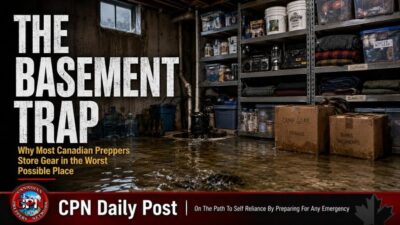
Most Canadian homes have one obvious place where preparedness supplies end up: the basement.
It makes sense at first. The basement is out of the way. It is cooler than the main floor. It has open wall space, utility shelving, storage rooms, mechanical equipment, and all the forgotten corners where buckets, bins, tools, food storage, camping gear, radios, blankets, and medical kits slowly accumulate.
The problem is that the basement is also the first place many homes fail.
In a Canadian emergency, the basement is often where water enters, power fails, sewage backs up, mould starts, furnaces shut down, freezers die, and critical supplies become unreachable right when they are needed most. The same room many families use as their preparedness headquarters can become a cold, wet, contaminated mess in a single night of spring rain, rapid snowmelt, sewer backup, or sump pump failure.
That does not mean the basement should never be used for storage. It means basement storage needs to be treated as a risk zone, not a safe zone.
Preparedness is not just about what you own. It is about whether you can still use it after the emergency begins.
The Basement Feels Safe Because It Is Hidden
One reason basements become prepper storage areas is psychological. Supplies feel secure when they are tucked away. A stack of buckets, bins, cases, and shelves gives the impression of order. You can close the door, go upstairs, and feel like the household is prepared.
But hidden does not mean protected.
A basement can hide small leaks for months. It can hide humidity problems until cardboard softens and metal rusts. It can hide slow foundation seepage behind stored boxes. It can hide sump pump weakness until the pump is needed for hours at a time. It can also hide the fact that the family’s most important supplies are sitting below grade, below the flood line, and below the first layer of practical access.
That matters in Canada because many emergencies arrive with water before they arrive with anything else. Spring thaw, heavy rainfall, overwhelmed municipal drains, rural culverts plugged with ice, and sudden storms can all push water toward the lowest part of the home.
If your food storage, water treatment supplies, power station, radios, spare clothing, bedding, and documents are all downstairs, a basement flood does not just damage property. It can wipe out the household’s emergency system.
For broader home-shelter planning, this connects directly with the CPN Shelter & Heat hub here:
This also pairs well with the recent CPN floodproofing article:
When Your Home Stops Being Safe: Floodproofing and Emergency Shelter Decisions in Canada
The Worst Items to Store Low
Not all basement storage carries the same risk. A box of old Christmas decorations is not the same as your emergency food supply. A tote full of spare work clothes is not the same as your household documents, radios, first aid gear, or backup power.
The worst items to store directly on a basement floor are the items that either absorb water, become unsafe after contamination, or are needed immediately during an evacuation or power outage.
Cardboard is the first obvious failure. It wicks moisture, softens quickly, grows mould easily, and offers almost no protection from seepage. If your preps are still stored in cardboard shipping boxes, they are not really stored. They are staged for failure.
Paper documents are another weak point. Insurance papers, passports, property records, printed contact lists, maps, manuals, medical information, and preparedness plans should never be treated as basement clutter. If they matter during an emergency, they should be protected from water and easy to grab.
Textiles are also vulnerable. Sleeping bags, wool blankets, spare winter clothing, thermal layers, towels, and bedding all have value during a shelter emergency, but they are also excellent at absorbing moisture. Once they get wet in a contaminated basement, they may become useless or require serious cleaning before they can be safely used.
Electronics are even more obvious. Radios, power banks, solar generators, chargers, inverters, battery packs, flashlights, and communication gear do not belong near the basement floor. Even if they survive moisture, corrosion and battery damage can turn “stored and ready” into “dead and disappointing.”
Food is where the basement question gets more complicated. A cool basement can be excellent for some food storage, but only if the food is sealed, elevated, protected from pests, protected from humidity, and not sitting in a known water path. Buckets, #10 cans, mylar bags, dehydrated foods, freeze-dried foods, and home-canned goods all need different storage conditions, but none of them benefit from sitting in a damp corner beside a floor drain.
For longer-term water and sanitation planning, the same logic applies. Stored water is useful, but storage location matters. If all of your water containers are in the lowest part of the house and that part of the house floods, the plan is weaker than it looks.
Water Collection & Purification in Canada
Water Is Not the Only Threat
Basement flooding gets most of the attention, but water is only one part of the problem.
Humidity is slower and less dramatic, which makes it easier to ignore. A basement can remain technically “dry” while still being damp enough to damage supplies over time. Metal rusts. Labels peel. Cardboard weakens. Fabrics smell musty. Batteries corrode. Leather and canvas degrade. Stored food containers become harder to inspect. Mould can start in hidden corners long before the room looks like a disaster.
Temperature swings matter too. A basement may be cool in summer, but in a winter power outage, it can become an uncomfortable and potentially damaging environment. If the home loses heat, the basement may hold some ground temperature, but pipes, stored liquids, batteries, and equipment can still be affected depending on insulation, air leakage, and duration.
Then there is access. During a serious storm or flood warning, the basement may be the last place you want to spend time sorting supplies. If water is already entering, if the power is unstable, if the sump is running continuously, or if there is any chance of electrical contact with water, digging around downstairs for emergency gear becomes a bad plan.
Preparedness supplies should reduce stress. They should not require a last-minute basement rescue mission.
The Three-Level Storage Rule
A better system is to divide preparedness storage into three levels: immediate access, elevated basement storage, and deep reserve.
Immediate-access supplies belong on the main floor or near an exit. This includes the household grab-and-go kit, flashlights, headlamps, radios, first aid kit, key documents, cash, vehicle keys, seasonal outerwear, pet supplies, and anything needed if the family has to leave quickly. Public Safety Canada recommends keeping emergency kits portable and accessible, and that advice matters even more when the basement itself may be the hazard.
Elevated basement storage is for supplies that can safely stay downstairs but should never sit directly on the floor. This includes sealed food buckets, canning supplies, tools, hardware, spare water containers, camp gear, and some household reserves. The key is elevation, protection, and inspection. Shelving should keep supplies well above minor seepage levels, and bins should be water-resistant enough to protect contents from splashing, dampness, and short-term exposure.
Deep reserve storage is for items you do not need in the first hour of an emergency but still want protected for long-term resilience. This might include spare parts, extra buckets, bulk supplies, seasonal gear, and backup systems. These items can be stored less conveniently, but they still need protection from dampness, pests, rust, and neglect.
The mistake is treating everything as deep reserve.
Your flashlight should not be buried behind six totes. Your insurance papers should not be in a basement filing cabinet. Your battery radio should not be sitting beside the sump pit. Your wool blankets should not be in a cardboard box on concrete. Your emergency plan should not be stored in the same room most likely to flood.
Build the Basement Like It Will Get Wet
The most useful mindset is simple: assume the basement will get wet eventually.
That does not mean assuming total destruction. It means designing the storage system so that a small flood, sewer backup, sump failure, or foundation seepage does not instantly ruin your preparedness supplies.
Start by getting everything important off the floor. Even a few inches of elevation is better than nothing, but serious storage should use proper shelving. Metal or heavy-duty plastic shelving is better than loose piles. Keep the lowest shelves for items that can tolerate some risk, and move critical supplies higher.
Next, get rid of cardboard wherever possible. Cardboard is fine for shipping. It is poor long-term basement storage. Use clear plastic totes where visibility matters and stronger waterproof or weather-resistant bins where protection matters more. Label bins clearly on more than one side so they can be found quickly.
Keep food in sealed containers. Mylar bags, oxygen absorbers, food-grade buckets, gamma lids, #10 cans, and sealed jars all have their place, but the outer storage layer still matters. A sealed bucket sitting in water may survive better than cardboard, but that does not mean it should be stored in the lowest corner of the house.
Create a flood line. If your basement has ever had water, mark the height. Then store critical supplies above that point. If your basement has never flooded, use the height of window wells, floor drains, sump location, and local risk as clues. The idea is to stop pretending the floor is neutral. In a basement, the floor is the danger zone.
The Sump Pump Is Not a Preparedness Plan
A working sump pump is useful. It is not a guarantee.
Sump pumps depend on electricity, maintenance, discharge lines, float switches, pit condition, and the volume of water entering the system. During the exact storms that cause flooding, power outages are common. If the pump stops, clogs, overheats, loses power, or cannot keep up, the basement can change quickly.
A basement storage plan should include early warning. Water alarms are inexpensive compared to the cost of losing stored food, tools, communications gear, and documents. A simple water leak alarm near the sump, water heater, floor drain, laundry area, or known seepage point can give you time to respond before the problem spreads.
Backup power also matters, but it needs to be realistic. A battery backup sump pump, generator-supported pump, or properly planned inverter system can help, but only if it is installed correctly and maintained. A backup system that has not been tested is just another assumption.
The Government of Canada identifies sump pumps and backflow valves as practical home flood-risk reduction measures. That matters, but they work best as part of a broader drainage and storage strategy, not as an excuse to keep critical supplies on the floor.
Do Not Risk Yourself to Save Gear
This is where preppers sometimes need a reality check.
No tote, radio, battery pack, food bucket, freezer, or tool chest is worth getting injured over. A flooded basement can involve electrical hazards, contaminated water, structural concerns, sharp debris, sewage, mould, and unstable footing. If water is entering the basement and there is any possibility of electrical contact, the priority is safety, not salvage.
Government flood guidance warns against attempting to shut off electricity if water is present, because water and live electrical systems can be deadly. That means you should not be wading through water to rescue gear while extension cords, appliances, outlets, or powered equipment are nearby.
The correct time to protect basement supplies is before the water arrives.
That means storage changes now, not during a storm. It means moving critical items upstairs now, not when the sump alarm is screaming. It means putting documents in waterproof storage now, not when the basement stairs are wet. It means checking shelves, bins, pumps, drains, and humidity before the emergency season peaks.
Preparedness is not heroics. It is boring risk reduction done early.
What Should Stay Upstairs
Every household should have a core emergency layer that never lives in the basement.
At minimum, keep a portable kit near the main living area or exit. That kit should include lighting, radio, first aid, basic food, water, medications, copies of important documents, phone charging options, spare glasses if needed, pet essentials, and seasonally appropriate clothing. If the family needs to leave, you should not have to go downstairs first.
Keep some emergency water upstairs as well. Many families store all water in the basement because it is heavy and inconvenient. That is understandable, but not ideal. A few cases, jugs, or containers stored on the main level can make the first hours easier if basement access is unsafe.
Keep communication tools upstairs. A weather radio, battery radio, spare phone charger, power bank, flashlight, and headlamp should be accessible without entering a storage room.
Keep warmth upstairs. In a shelter-and-heat emergency, blankets, sleeping bags, wool layers, gloves, hats, and emergency bivvy bags should be where people are, not buried in a damp storage area.
The basement can support the plan. It should not be the whole plan.
What Can Stay in the Basement
Some supplies are still well suited to basement storage if handled properly.
Bulk food storage can stay there if the basement is dry, cool, pest-controlled, and organized. Sealed buckets, properly packed dry goods, canning supplies, dehydrated foods, and freeze-dried foods can all benefit from stable temperatures, but they should be elevated and inspected regularly.
Tools can stay downstairs if rust is controlled. That means moisture control, better containers, and occasional inspection. A tool chest in a damp basement may look fine until the day you need it.
Water containers can be stored downstairs, but again, not directly in a known flood path. Bulk water is heavy, so basement storage is common. Just make sure the containers are clean, sealed, accessible, and not positioned where a small flood can contaminate caps, spouts, or transfer pumps.
Camping gear can stay there if packed in bins instead of soft bags on concrete. Sleeping pads, tents, tarps, camp stoves, and cookware are useful household backup items, but they should not be allowed to mildew between seasons.
The rule is simple: if it stays in the basement, it must be protected from water, lifted off the floor, labelled, and checked.
The Basement Storage Audit
A good basement audit does not need to be complicated.
Walk downstairs and ask one question: if three inches of water appeared tonight, what would I lose?
That question changes how you see the room.
Look at the floor first. Anything touching concrete is suspect. Cardboard, bags, loose fabric, paper, electronics, extension cords, and low-value clutter tend to accumulate at floor level. Clear it. Replace it. Elevate it. Throw out what is already compromised.
Then look at the walls. Are supplies pushed against foundation walls where moisture can collect? Are shelves blocking cracks, stains, or seepage signs? Are you storing bins in front of the very areas you need to inspect?
Then look at the sump, floor drain, laundry area, water heater, and basement windows. These are not just utility areas. They are risk points. Keep important supplies away from them.
Finally, look at your access path. Could you get to your emergency supplies in the dark? Could another family member find the right bin? Are the labels readable? Are the most important items buried behind seasonal junk?
A preparedness basement should be boring, clean, raised, labelled, and inspectable.
If it looks like a panic closet, it needs work.
Basement Preparedness Buying Box
The goal here is not to buy more random gear. The goal is to protect the gear you already own and make the basement less likely to destroy your preparedness plan.
Basement Storage & Flood Protection Gear
Heavy-duty waterproof storage bins
Useful for documents, clothing, radios, blankets, and smaller emergency supplies that should not be exposed to damp basement air.
Search Amazon.ca for heavy-duty waterproof storage bins
5-tier metal or heavy-duty plastic shelving
The fastest basement upgrade is getting food, tools, and emergency supplies off the concrete and into an organized system.
Search Amazon.ca for heavy-duty storage shelving
Water leak alarms
Place these near the sump pump, floor drain, water heater, laundry area, basement freezer, and any known seepage point. Early warning can save supplies.
Search Amazon.ca for water leak alarms
Basement water sensors
A broader search than “water leak alarm,” useful for finding simple alarms, smart sensors, and multi-pack detectors.
Search Amazon.ca for basement water sensors
Battery backup sump pump systems
A sump pump is only as useful as its ability to run when the power fails. Backup systems should be researched carefully and installed properly.
Search Amazon.ca for battery backup sump pump systems
Sump pump battery backup
This alternate wording catches more Amazon results if the full system search is too narrow.
Search Amazon.ca for sump pump battery backup options
Moisture meter
A moisture meter helps identify damp materials, hidden problems, and areas that need attention before visible damage appears.
Search Amazon.ca for moisture meters
Basement dehumidifier
Humidity control protects food storage, tools, fabrics, documents, and the structure of the home itself. Choose capacity based on basement size and dampness.
Search Amazon.ca for basement dehumidifiers
Waterproof document bag or fire/water-resistant document box
Important papers should not be stored loose in a filing cabinet below grade. Keep originals or copies protected and easy to grab.
Search Amazon.ca for waterproof document storage
Clear storage totes
Clear totes make it easier to see what is stored where, especially for lower-priority items that do not need fully waterproof storage but still need organization.
Search Amazon.ca for clear heavy-duty storage totes
Contractor garbage bags
After a minor water event, cleanup becomes easier when heavy bags, gloves, and basic protective supplies are already on hand.
Search Amazon.ca for heavy-duty contractor bags
The Real Preparedness Lesson
The basement is not the enemy. Lazy basement storage is the enemy.
A basement can be a useful part of a Canadian preparedness system. It can hold food, tools, water, repair supplies, seasonal gear, and deep reserves. But it should never be treated as an automatically safe place just because it is out of sight.
If your basement floods, can you still access light, heat, water, documents, first aid, and communication?
If the answer is no, your supplies are not arranged for an emergency. They are arranged for convenience.
That is the trap.
Preparedness is not measured by how much gear you can stack downstairs. It is measured by how much capability remains after the house is under stress.
Move the critical items up. Raise the basement supplies. Get rid of cardboard. Add water alarms. Control humidity. Protect documents. Test the sump system. Keep the first 72 hours accessible without going below grade.
Because when the rain is heavy, the power is flickering, and the sump pump is working harder than usual, the basement should not be where your preparedness plan goes to drown.


One Comment