
A core CPN reference guide.
Stored food is only useful if you can still turn it into meals
Most prepper pantries look good on a shelf.
Buckets of rice. Beans stacked deep. Flour, oats, pasta, lentils, canned meat, dehydrated vegetables, freeze-dried meals, sugar, salt, and coffee. It all feels reassuring until the power is out, the stove is dead, the microwave is useless, the electric kettle is silent, and every meal now depends on fire, fuel, tools, water, and time.
That is where many food storage plans quietly break down.
A pantry is not a meal plan. A stocked basement is not a kitchen. A year’s worth of dry goods is not a year’s worth of edible food unless the household can grind it, soak it, boil it, bake it, simmer it, season it, clean up after it, and repeat the process day after day without normal utilities.
This is why cooking deserves a serious place inside food preparedness.
The real question is not only, “How much food do I have?”
The better question is, “Can I still cook this food when everything easy is gone?”
That question changes the entire pantry.
It pushes the prepper beyond calories and into actual use. It forces a look at fuel, manual tools, cookware, water demand, smoke, smell, labour, safety, and the difference between food that stores well and food that cooks well under bad conditions.
For Canadian preppers, especially those dealing with winter, rural distance, storms, fuel interruptions, and long supply chains, this is not a small detail. It is the link between food storage and food security.
The broader food system is covered in the CPN Food Procurement & Storage hub, but today’s focus is narrower and more practical.
When the grid is gone, how do you actually cook?
The Pantry Has To Match The Kitchen You Still Have
A grid-down kitchen is not the same as a normal kitchen without electricity.
In normal times, a person can keep dry beans in storage and assume they are easy food. In a long outage, those same beans may need sorting, soaking, long boiling, extra water, and a reliable heat source. Whole wheat stores better than flour, but it becomes a problem if there is no manual grain mill. Rice is simple, but it still needs water, heat, a covered pot, and fuel. Pasta cooks quickly, but it wastes more water unless that water is reused. Freeze-dried meals are convenient, but they demand hot water and become expensive if treated as a staple.
This does not mean these foods are bad.
It means stored food needs to be matched to the cooking system.
A family that has only a small butane stove should not build its entire emergency diet around foods that need hours of simmering. A rural household with a wood cookstove can plan differently. Someone with a rocket stove and cast iron Dutch oven has options that an apartment dweller may not. A household relying on propane must think hard about fuel storage, ventilation, and how quickly fuel disappears when every hot drink, every pot of beans, and every wash-up depends on it.
Food storage and cooking equipment must be planned together.
That means the pantry should include a mix of fast-cooking foods, long-simmer foods, ready-to-eat foods, preserved meals, ingredients for baking, and foods that can be eaten cold if necessary.
It also means the kitchen needs layers.
One method is not enough.
Layer One: No-Cook And Low-Cook Food
The first layer is the food that does not need much cooking at all.
This is the layer that matters during the first hours or days of disruption, when everyone is tired, information is unclear, and setting up an outdoor cooking station may not be realistic. It is also the layer that protects fuel.
Canned meat, canned fish, peanut butter, crackers, granola, dried fruit, nuts, ready-to-eat soups, canned beans, canned pasta, shelf-stable milk, jerky, hard candy, instant oats, powdered drink mixes, and similar foods all have a place. They may not be glamorous, but they keep people fed when cooking is inconvenient, unsafe, or not worth the fuel.
The mistake is treating no-cook food as weakness.
It is actually the shock absorber.
In a serious grid-down event, the first meals should be simple. Eat the refrigerated food first if it is safe. Use up leftovers. Keep everyone stable. Save the complicated cooking for when the situation is understood and the household has shifted into a routine.
Low-cook food is just as important.
Couscous, instant rice, quick oats, ramen, dehydrated soup mixes, instant mashed potatoes, red lentils, parboiled rice, and small pasta shapes cook faster than many bulk staples. They use less fuel and less time. They are especially useful when paired with canned meat, dehydrated vegetables, bouillon, spices, and fats.
A prepper pantry should not be built entirely around quick foods, but quick foods buy time.
And in a collapse, time is a resource.
Layer Two: Indoor Backup Cooking
The second layer is controlled indoor cooking.
This is where many preppers think first: camp stoves, butane burners, propane stoves, alcohol stoves, fondue burners, and other compact systems. They can be extremely useful, but they need to be treated with respect.
Indoor cooking during a power outage requires ventilation, stable placement, safe fuel storage, and carbon monoxide awareness. Some devices are suitable for indoor use when used exactly as intended. Others are not. The distinction matters.
This is not the place for improvised stupidity.
Any indoor backup cooking system should be tested before it is needed. The household should know how long a fuel canister lasts, how many meals it can realistically produce, how much heat it gives off, how stable the pot support is, and whether the cookware actually fits.
A single burner is useful, but it changes meal planning.
One-pot meals become the standard. Soups, stews, rice bowls, oatmeal, bannock, pasta, skillet meals, and pressure-canned foods shine here. Anything that requires multiple burners, long prep, and delicate timing becomes less realistic.
This is another reason home-canned meals are valuable. A shelf-stable jar of stew, chili, meat sauce, soup, or beans can be heated quickly instead of built from scratch every time. Done properly, pressure canning turns fuel-hungry ingredients into fast meals later.
The CPN article on grid-up food storage options touches on the role of canning, dehydrating, root cellaring, freezing, and freeze drying.
The trick is thinking one step further.
Preserve food now in a way that saves fuel later.
Layer Three: Outdoor Cooking
The third layer is outdoor cooking.
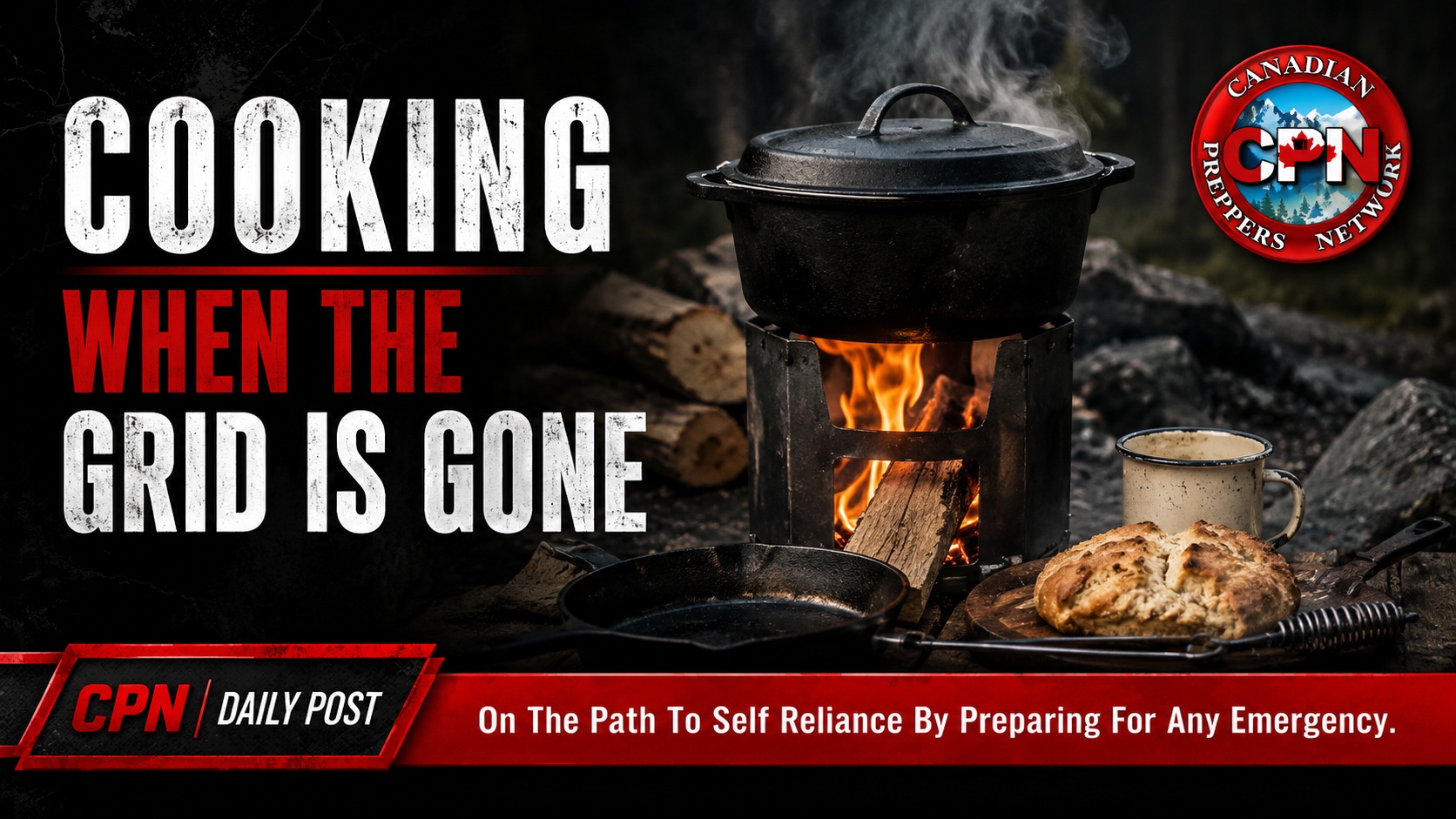
This is where the household moves from emergency eating into a more durable rhythm. Outdoor cooking may involve a propane barbecue, charcoal grill, rocket stove, fire pit, wood stove, camp oven, Dutch oven, smoker, or improvised summer kitchen.
The advantage is obvious: more fuel options, less indoor risk, more space, and the ability to use wood or charcoal.
The disadvantage is also obvious: weather, smoke, smell, security, attention, and labour.
In a short outage, cooking outside is no big deal. In a long disruption, it becomes a pattern that other people can see and smell. A household that cooks large meals outdoors every evening may be advertising both food and fuel. That does not mean outdoor cooking should be avoided, but it does mean it should be managed.
Cook earlier in the day when possible. Use lids to save fuel and reduce smell. Prepare larger batches when heat is already running. Choose sheltered cooking areas that block wind. Keep the setup low, controlled, and efficient. Do not build a bonfire when a small rocket stove or charcoal bed will do the job.
This is where charcoal deserves serious attention.
Charcoal burns hotter and cleaner than an open wood fire, stores well when kept dry, and can support controlled cooking in a grill or Dutch oven setup. For longer-term homestead resilience, making charcoal from local wood can become part of the system.
CPN has covered this directly in When Propane Runs Out: Making And Using Charcoal On The Homestead.
Charcoal is not magic, and it is not free. It requires wood, time, equipment, and care. But it is more manageable than open-fire cooking for many meals, and it gives the prepper another layer between stored food and an empty plate.
The Rocket Stove Advantage
Rocket stoves are worth separating from ordinary outdoor fires.
A good rocket stove burns small sticks efficiently. Instead of needing split firewood or a large fire pit, it can run on twigs, scraps, prunings, and small fuel gathered from the property. That makes it useful when propane is gone, charcoal is being conserved, and the household still needs to boil water or cook a pot of food.
The advantage is fuel efficiency.
The disadvantage is feeding and attention.
A rocket stove is not usually a “walk away and simmer all afternoon” tool. Someone has to manage the fire. Pots can blacken. Wind matters. Rain matters. Winter use can be awkward. Still, as a fuel-stretching tool, it deserves a place in the grid-down cooking plan.
The best use is simple cooking: boiling water, cooking rice, heating soup, frying small amounts, making coffee, or starting a larger cooking process before moving food into an insulated cooker.
That last point matters.
A rocket stove can bring food to a boil. A retained-heat cooker can finish the job.
Retained-Heat Cooking Saves Fuel
One of the most overlooked grid-down cooking methods is retained-heat cooking.
The idea is simple. Bring food to a boil, then place the covered pot into an insulated container so the trapped heat continues cooking the food without active flame. This can be done with a purpose-built thermal cooker, a haybox-style setup, a heavily insulated box, or even blankets arranged safely around a sealed pot.
This is not fast food.
It is fuel-saving food.
Beans, rice, stews, soups, oatmeal, and grains can often be started with a short burn and then left to finish. The household uses less fuel, produces less smoke, and spends less time actively cooking.
In a long disruption, small savings compound.
A few minutes of fuel saved at breakfast, lunch, and supper becomes days or weeks of extra cooking capacity over time. That matters when resupply is gone and every canister, log, and bag of charcoal has a replacement cost measured in labour.
Manual Tools Are Not Optional
Many pantries depend quietly on electric appliances.
Grain mills. Coffee grinders. Mixers. Blenders. Food processors. Can openers. Vacuum sealers. Bread machines. Electric pressure cookers. Microwaves. Freezers. Refrigerators. Dehydrators.
When the grid goes down, some of these tools vanish instantly.
That is why a serious food plan needs manual backups.
A manual can opener is not exciting, but it is essential. A second manual can opener is even better. A hand grain mill can turn stored wheat into flour. A mortar and pestle can crush spices, grains, herbs, and dried foods. A box grater, hand whisk, dough scraper, cast iron pan, Dutch oven, sharp knives, cutting boards, stainless bowls, and heavy spoons all matter more than people think.
The more basic the tool, the more valuable it becomes.
The household should be able to make bannock, flatbread, porridge, soup, stew, rice, beans, skillet meals, and hot drinks without electricity. That does not require a gourmet kitchen. It requires reliable, durable tools that do not depend on a plug.
A prepper who stores wheat but cannot grind wheat has not stored flour.
A prepper who stores coffee beans but cannot grind coffee has stored a morale problem.
A prepper who stores #10 cans but cannot open them safely has stored frustration.
Manual tools turn stored ingredients back into food.
Water Is Part Of Cooking
Cooking consumes water.
This sounds obvious until the tap stops working.
Dry beans need soaking and boiling. Rice needs water. Pasta needs water. Oats need water. Dehydrated and freeze-dried foods need water. Pots need washing. Hands need washing. Utensils need washing. Spills happen. Burned food wastes both food and cleanup water.
This is why water planning and food planning cannot be separated.
The more dry food a household stores, the more water it must be able to collect, filter, store, and heat. Freeze-dried food is light and convenient, but it is not water-free food. Dry staples are efficient, but they move part of the storage burden from food to water.
Cooking methods can reduce that burden.
Use lids. Avoid excess boiling water. Reuse pasta water in soup or bread when appropriate. Cook one-pot meals. Scrape cookware clean before washing. Keep a dedicated wash station. Use a small amount of hot soapy water instead of filling a sink. Plan meals that produce broth instead of waste water.
A household that cannot manage cooking water will burn through stored water faster than expected.
Baking Without A Modern Oven
Bread is comfort, calories, and routine.
But most modern bread habits assume a powered oven, electric mixer, and stable indoor kitchen. In a grid-down situation, baking has to change.
Flatbreads are the easiest place to start. Bannock, tortillas, skillet bread, chapati-style breads, pancakes, biscuits, and simple yeast or sourdough pan breads are more realistic than standard oven loaves. They can be cooked in a cast iron pan, Dutch oven, reflector oven, covered skillet, or improvised outdoor setup.
The point is not to recreate a bakery.
The point is to keep stored flour useful.
A Dutch oven can become one of the most valuable pieces of cookware in the entire system. With coals above and below, it can bake bread, roast meat, cook stews, make cobblers, heat leftovers, and function as a rugged all-purpose pot.
Cast iron has drawbacks. It is heavy. It needs care. It is not ideal for every acidic food. But in a long disruption, durability matters. A cast iron Dutch oven does not care if the power is out.
Fuel Planning Has To Be Honest
Stored food often lasts longer than stored fuel.
That is the uncomfortable truth.
A few small fuel canisters may look like preparedness, but daily cooking burns through them quickly. A propane barbecue is useful until the tank is empty. Firewood works if it is dry, accessible, and replaceable. Charcoal works if it is stored dry and rationed. Alcohol fuel works for light cooking, but not necessarily for a family’s full kitchen routine.
Fuel planning needs honest testing.
Cook real meals using the backup system. Track how much fuel is used. Try breakfast, supper, coffee, dishwater, and a pot of beans. Do it in cold weather. Do it in wind. Do it when tired. Do it without reaching for the electric kettle “just this once.”
This kind of test exposes weak points quickly.
Maybe the stove is too slow. Maybe the pot is too wide. Maybe the fuel runs out faster than expected. Maybe the food plan is too dependent on boiling. Maybe the household needs more canned meals and fewer dry beans. Maybe the outdoor cooking spot is miserable in winter. Maybe the cook needs gloves that still allow safe handling.
A blackout power system can help with lighting, charging, refrigeration, and communication, but heat-heavy cooking is usually better handled through direct fuel methods rather than trying to run an electric kitchen from batteries.
The CPN Blackout Power Buying Guide is useful background for separating electrical priorities from cooking and heating priorities.
The broader Energy Production hub also helps frame why energy planning has to be layered.
Do not assume “I have solar” means “I can cook normally.”
In most household systems, that is not realistic.
Build A Grid-Down Menu Before You Need It
The best way to fix this problem is to create a grid-down menu.
Not a fantasy menu.
A real one.
Write down seven breakfasts, seven lunches, and seven suppers that can be made without grid power using stored food, stored water, backup cookware, and realistic fuel. Then test them.
Breakfast might be oats, bannock, powdered milk, dried fruit, tea, or coffee.
Lunch might be soup, canned fish, crackers, rice with canned meat, lentils, or leftovers.
Supper might be chili, stew, rice and beans, pasta with canned sauce, Dutch oven bread, pressure-canned meat and potatoes, or a thick soup made from dehydrated vegetables and broth.
Now calculate what those meals require.
How much water? How much fuel? How many pots? How much cleanup? How long does it take? Can one person cook it while also dealing with animals, children, security, weather, or illness? Can the ingredients be rotated? Will the household actually eat it?
This turns preparedness from theory into a working system.
It also exposes the foods nobody wants. Appetite fatigue is real. A pantry full of food people resent eating will become a morale problem, especially under stress.
Food storage should include salt, sugar, spices, sauces, fats, bouillon, tea, coffee, hot chocolate, vinegar, baking powder, yeast, and comfort foods. These are not luxuries. They keep basic staples edible.
Buying Box: Grid-Down Cooking Tools Worth Having
As an Amazon Associate, Canadian Preppers Network may earn from qualifying purchases.
Manual grain mill
Useful for turning stored wheat, corn, and other grains into usable flour without electricity.
Cast iron Dutch oven
One of the most versatile pieces of cookware for coals, wood heat, camp kitchens, and long-term outdoor cooking.
Rocket stove
A fuel-efficient way to cook with small sticks, scrap wood, and gathered biomass when propane is being conserved.
Thermal cooker / retained-heat cooker
Helps stretch fuel by finishing soups, stews, grains, and beans after the pot has been brought to temperature.
Heavy-duty manual can opener
A basic but critical tool for any pantry built around canned meat, vegetables, soups, sauces, or emergency meals.
Cast iron skillet
Useful for flatbreads, bannock, eggs, meat, reheating leftovers, and cooking over uneven heat sources.
Stainless steel stock pot
Important for soups, stews, boiling water, rendering, batch cooking, and preparing larger meals.
Camp coffee percolator
A morale tool that works over flame, coals, camp stoves, and outdoor cooking setups.
Heat-resistant gloves
Useful for handling Dutch ovens, cast iron, firewood, stove doors, grill grates, and hot cookware safely.
Final Thought
Stored food is only half the system.
The other half is the ability to turn that food into hot, safe, morale-sustaining meals when the easy kitchen is gone.
That means fuel. It means water. It means manual tools. It means cookware that can survive real heat. It means simple recipes. It means testing meals before the emergency. It means knowing which foods cook fast, which foods waste fuel, which foods need too much water, and which foods your household will actually eat.
A pantry should not be a museum of sealed containers.
It should be a working kitchen waiting for bad conditions.
Because when the grid is gone, dinner does not care how impressive the storage room looks.
Dinner only cares whether you can still cook.


One Comment