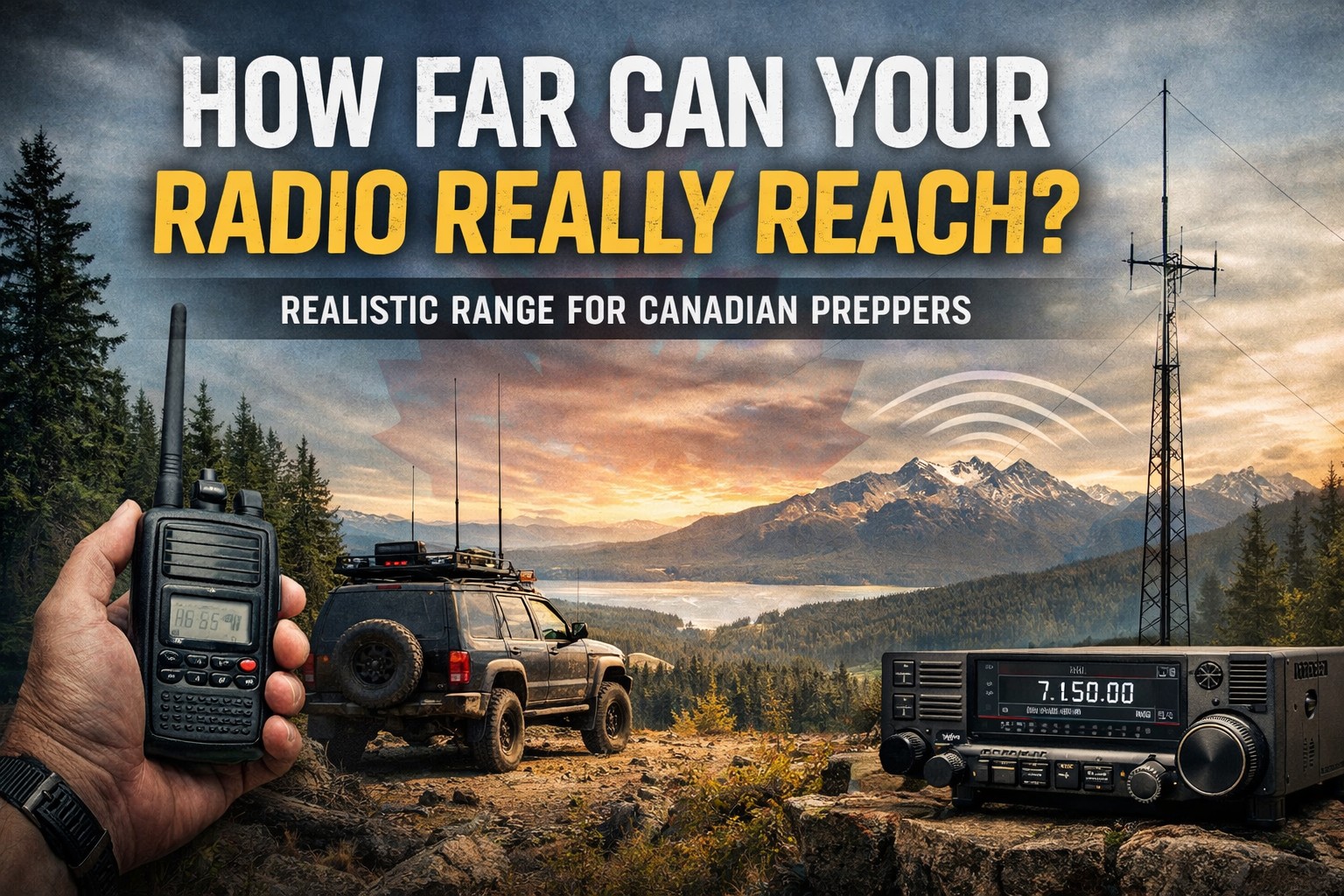
When people buy handheld radios, the packaging often promises impressive range claims: “Up to 35 miles!” or “50 km range!” Anyone who has actually used these radios in the real world quickly discovers those numbers are marketing fiction.
For Canadian preppers, understanding realistic radio range is critical. If you are building a family communication plan, coordinating with neighbours, or maintaining contact with a retreat location, you need to know what will actually work in the forests, hills, and weather conditions typical across much of Canada.
Let’s take a practical look at what different radio systems can really do.
Licence-Exempt UHF Handheld Radios
In Canada, the distinction between FRS and GMRS used in the United States does not apply. These radios operate as licence-exempt personal radios, generally limited to 2 watts with fixed antennas.
These are the common “bubble-pack” radios sold in outdoor stores and hardware shops. They are extremely useful for short-range communication between family members, especially during power outages, camping trips, or when working around a rural property.
A dependable example is the Motorola Talkabout series, which includes weather alerts and good battery life.
https://www.amazon.ca/s?k=Motorola+Talkabout+T470&tag=canadianprep-20
Typical real-world ranges:
Urban areas: 500 m – 1 km
Forest or rural terrain: 1 – 3 km
Open farmland: up to 5 km
Despite their limitations, these radios are excellent for family preparedness kits and require no licence.
If you are considering stepping beyond these simple radios, our article on amateur emergency communications explains how radio operators organize during disasters:
https://canadianpreppersnetwork.com/amateur-radio-emergency-nets-in-canada/
Amateur VHF/UHF Handheld Radios
Moving into amateur radio significantly improves capabilities.
Most handheld amateur radios operate at 5–8 watts and can use the 2-metre and 70-centimetre bands, allowing far greater range and access to repeater networks.
A widely used entry-level handheld is the Baofeng UV-5R, which provides dual-band capability at a very affordable price.
https://www.amazon.ca/s?k=Baofeng+UV-5R&tag=canadianprep-20
Typical simplex (radio-to-radio) range:
Dense forest: 3 – 5 km
Rolling terrain: 5 – 10 km
Clear line of sight: 15 km or more
With repeater access, that range can extend 50–100 km or more, depending on terrain and repeater location.
For readers interested in building communication capability as part of a broader preparedness strategy, see our guide to building resilient systems in Garden Planning for Food Security:
https://canadianpreppersnetwork.com/garden-planning-for-food-security/
Preparedness planning is not just about food and shelter—communication is what allows groups to coordinate when systems fail.
VHF Mobile and Base Station Radios
Handheld radios are convenient, but antenna height and transmitter power are what really determine communication range.
Mobile or base station radios commonly operate between 25 and 80 watts, and they use much larger antennas mounted on vehicles, towers, or rooftops.
A rugged example popular among amateur operators is the Yaesu FT-2980R VHF mobile radio.
https://www.amazon.ca/s?k=Yaesu+FT-2980R&tag=canadianprep-20
Typical ranges with proper antennas:
Simplex rural terrain: 15 – 40 km
Hilltop to hilltop: 50 km or more
Via repeaters: 100 km+
For a rural retreat or homestead, installing a base station radio with a rooftop antenna can provide reliable communication across an entire region.
HF Amateur Radio: Long-Distance Communication
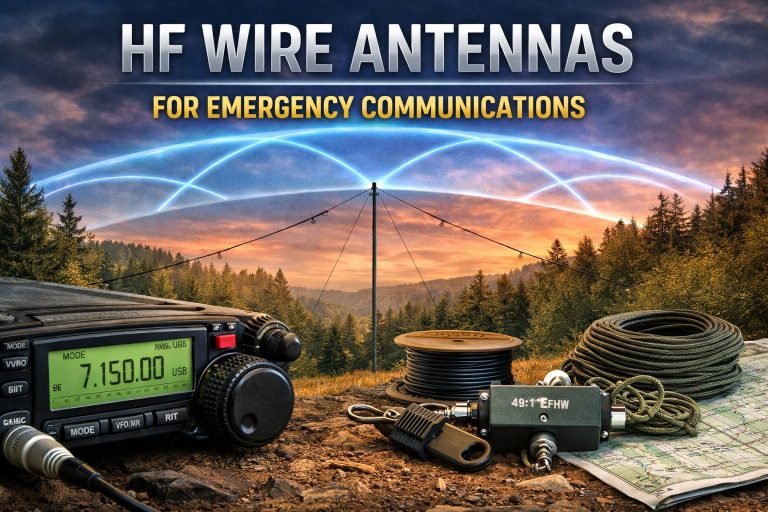
While VHF and UHF radios handle local communication, HF (high frequency) radio enables regional and international communication without relying on any infrastructure.
HF signals reflect off the ionosphere and can travel hundreds or even thousands of kilometres depending on conditions.
A compact HF option suitable for off-grid setups is the Xiegu G90 HF transceiver.
https://www.amazon.ca/s?k=Xiegu+G90&tag=canadianprep-20
Typical HF communication ranges:
Regional communication: 300 – 1,000 km
Inter-provincial communication: 1,000 – 3,000 km
International communication: global under favourable conditions
HF radio remains one of the most powerful communication tools available to civilians during large-scale emergencies.
Terrain Matters More Than Power
One of the biggest misunderstandings about radios is the belief that more power equals more range. In reality, terrain and antenna placement matter much more.
Canadian geography creates several common challenges:
Dense forest absorbs radio signals.
Rolling terrain blocks line-of-sight VHF signals.
Urban buildings create heavy signal reflections.
Improving antenna height and antenna quality often increases range far more than increasing transmitter power.
Realistic Communication Range Comparison
| System | Typical Power | Realistic Range | Best Use |
|---|---|---|---|
| Licence-exempt handheld | 0.5–2 W | 1–3 km | Family communication |
| Amateur handheld | 5–8 W | 3–10 km | Local group coordination |
| VHF mobile/base | 25–80 W | 15–40 km | Regional communication |
| HF radio | 20–100 W | Hundreds–thousands km | Long-distance contact |
Understanding these realistic limits helps preppers design layered communication systems instead of relying on a single radio.
Building a Layered Communication Plan
The most resilient approach uses multiple layers:
Licence-exempt handheld radios for family members
Amateur handheld radios for neighbourhood coordination
Vehicle or base radios for regional communication
HF radio for long-distance contact
If one system fails or infrastructure collapses, other systems remain available.
Final Thoughts
Radio communication remains one of the few technologies that allows people to stay connected without relying on cell towers or internet infrastructure.
When storms, blackouts, or disasters knock out modern communication systems, radios continue to function.
For Canadian preppers, understanding realistic range expectations is essential to building communication systems that actually work when they are needed most.