Real disruptions. Real lessons.
Preparedness is not about predicting the exact crisis. It is about being able to absorb disruption when normal systems stop behaving normally.
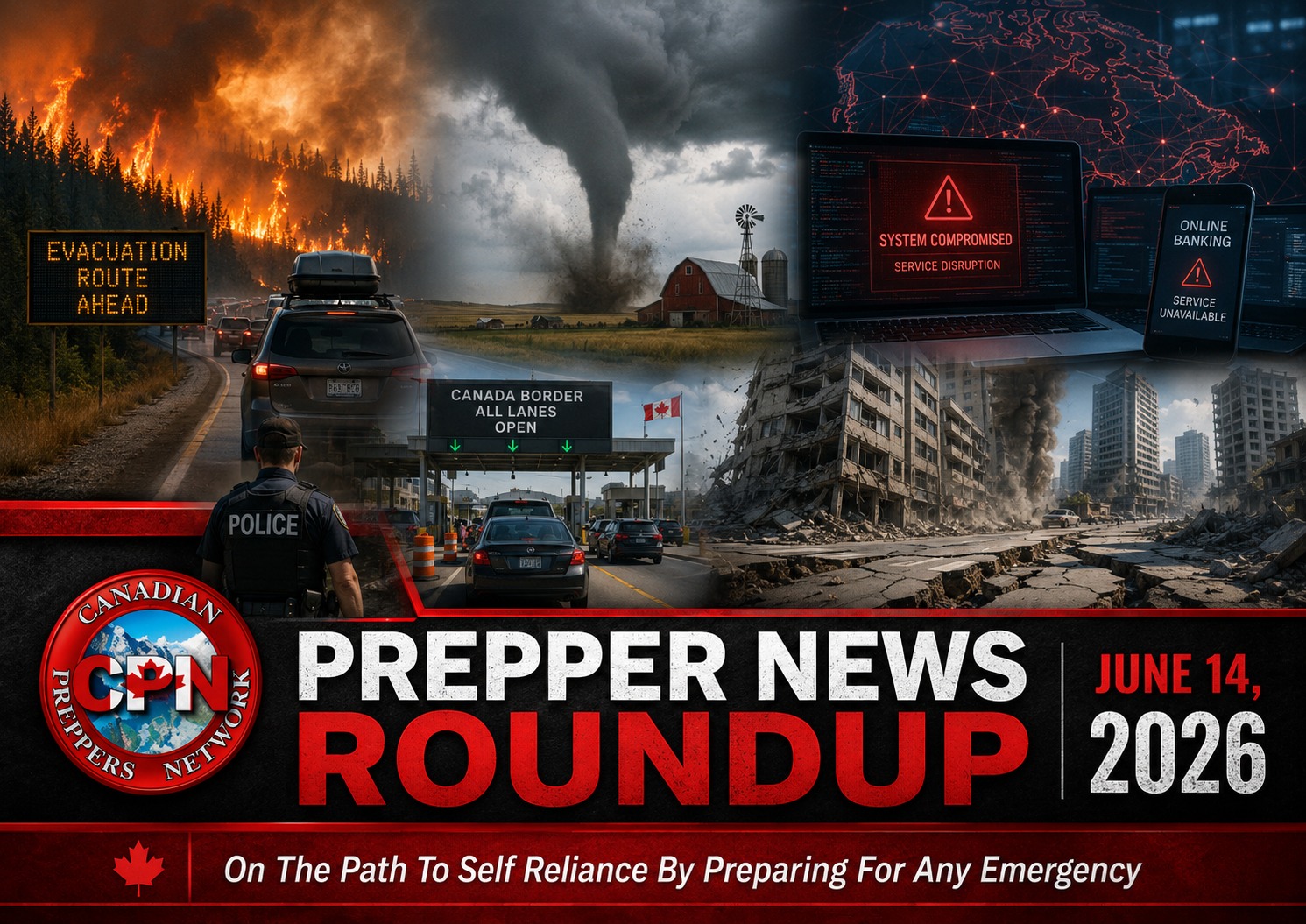
That was the common thread running through this week’s headlines. A northern Ontario First Nation was evacuated because of an active wildfire. Saskatchewan and Manitoba saw confirmed tornadoes, including a rare EF3 track near Oxbow that destroyed real structures. Cyber warnings around the World Cup moved from theory into actual spoofed domains and fraud attempts. A cyberattack disrupted several Iranian banks. Global Affairs Canada continued warning travellers that fuel shortages and regional tensions can affect flights and local services far from the original conflict zone. In Europe, a major G7 security operation showed how quickly normal movement can be restricted. Off Cuba, a rare earthquake shook areas that do not usually think of themselves as earthquake country.
None of these stories are identical. Some are local. Some are international. Some are natural disasters. Some are human-made disruptions. But for the prepared household, the lesson is the same: systems are useful, but they are not guaranteed.
Wildfire Evacuation Is Not a Theory in Northern Ontario
Canada’s wildfire season has not yet reached the scale of the worst recent years, but active fires are already forcing real decisions. The national picture matters, but for preparedness purposes, the local example matters more.
Mattagami First Nation in northern Ontario was evacuated because of the Timmins 9 wildfire, displacing about 200 residents. The fire was close enough to the community and Highway 144 that officials had to treat it as a direct public safety concern. Residents were moved out, accommodations had to be arranged in Barrie, and families had to wait while fire crews worked the line, built breaks, managed aircraft restrictions, and watched the forecast.
That is what wildfire preparedness looks like in practice. It is not just smoke on the horizon. It is a sudden decision about whether your vehicle has fuel, whether your medication is packed, whether your pet can travel, whether your documents are together, whether your family knows what is happening, and whether you have somewhere realistic to go.
The Mattagami evacuation is the current displacement example, but the structural-loss warning was already visible earlier this season in Alberta. At Thunder Lake, west of Barrhead, a fast-moving wildfire forced evacuations and destroyed several homes. Damage reports from the area described multiple residences lost and more properties damaged.
That matters because many people still imagine wildfire evacuation as a temporary smoke problem. Sometimes it is. Other times, people leave and come back to foundations, damaged outbuildings, destroyed vehicles, unsafe utilities, and restricted access while officials complete assessments.
The common mistake is treating evacuation as a last-minute event. By the time an order is issued, the thinking phase should already be over. The household should know what gets packed first, what can be abandoned, what route is preferred, what alternate route exists, who is contacted, and how the family will communicate if cell service becomes overloaded or unreliable.
This is also why wildfire kits need to be more than a generic 72-hour bag. A useful evacuation kit includes copies of important documents, prescriptions, basic hygiene supplies, chargers, cash, food, water, protective clothing, pet supplies where needed, and enough practical comfort to make several days away from home manageable. For many families, the hard part is not the first hour. It is the uncertainty afterward.
The Prairie Tornadoes Were Actual Touchdowns, Not Just Forecast Warnings
Severe-weather warnings are easy to ignore when they do not hit your road. This week, parts of Saskatchewan and Manitoba were reminded that tornado risk on the Prairies is not theoretical.
The Northern Tornadoes Project confirmed an EF1 tornado near Hirsch, Saskatchewan, from the June 6–9 severe-weather period. That tornado damaged grain bins, snapped power poles, damaged trees, and caused minor damage to a home, shed, and outbuildings.
The stronger example was the North Portal to Oxbow EF3 tornado on June 9. This was not just a funnel cloud over open fields. The tornado carved a track of about 32 kilometres through southeast Saskatchewan. Damage survey teams reported significant farm damage, including the destruction of a home and an outbuilding, damage to grain bins, multiple vehicles and trees, snapped power poles, pump jack damage, and additional minor structural damage along the track.
That EF3 rating matters. Tornadoes that strong are rare in Canada, and they are especially rare in Saskatchewan. The Northern Tornadoes Project rated the tornado with estimated maximum winds of 245 km/h, and Saskatchewan had not seen an EF3 tornado since 2010. The Weather Network also described the Oxbow tornado as Canada’s strongest since the 2023 Didsbury, Alberta tornado.
That is the difference between “there may be storms” and “the landscape was actually damaged.”
For a household, tornado preparedness is less about buying things and more about decisions made ahead of time. Where is the safest place in the house? Does everyone know it? Is there a way to receive alerts if the power goes out? Are shoes, flashlights, basic first aid supplies, and a battery bank accessible after dark? If a barn, shed, trailer, or outbuilding is damaged, can the household secure the area safely and keep people away from broken glass, sharp debris, unstable structures, and downed lines?
Tornadoes also expose weak communications planning. A warning that reaches one phone but not another is not a family warning system. A household that relies on a single device, a single app, or one person watching the sky is operating with a fragile plan.
Canadian severe weather does not need to be dramatic to be dangerous. A short track through the wrong property can destroy buildings, cut power, block roads, and turn normal evening routines into a cleanup and safety problem. Preparedness means deciding in advance what “take shelter now” actually means in your home.
World Cup Scams Are Already a Real Cyber Threat
Canada is now part of a global event environment with the 2026 FIFA World Cup underway across Canada, the United States, and Mexico. That brings crowds, public safety demands, travel pressure, rental demand, ticket demand, and cybercrime.
The FBI has already warned about spoofed FIFA-related websites being used to collect personal information and sell fake tickets or hospitality products. The Canadian Centre for Cyber Security has also warned that major-event lures can include fake tickets, fraudulent merchandise, short-term rental scams, malicious websites, event-themed phishing, fake livestreams, and other attacks designed to exploit excitement and urgency.
For preppers, the lesson is broader than soccer. Large public events create temporary pressure on systems. Hotels fill. Roads congest. Public safety resources shift. Scammers move quickly. People make rushed decisions because they think they are about to miss out.
That same pattern appears after disasters, during shortages, and around high-demand goods. Fraud thrives when people are excited, scared, rushed, or desperate.
The practical rule is simple: slow the transaction down. Do not click from a message and pay immediately. Do not assume a search result is legitimate just because it appears near the top. Do not scan random QR codes at events without thinking. Do not send personal information through a site that only looks close enough. Type known addresses directly, use official channels, verify before paying, and keep records of purchases and confirmations.
Cyber preparedness is household preparedness now. It is not just an IT department problem.
A Bank Cyberattack Shows Why Payment Resilience Matters
Another cyber story this week came from Iran, where a reported cyberattack disrupted services at four major banks. Officials said the attack targeted shared communications infrastructure and that customer data was not compromised or deleted. That distinction matters, but it does not eliminate the preparedness lesson.
A banking disruption does not need to erase your account to create a real problem. If cards do not work, transfers stall, ATMs fail, online banking is unavailable, or payment systems slow down, ordinary life gets complicated quickly.
Prepared households should not rely on a single payment method. That does not mean panic. It means having reasonable redundancy: more than one card, access to more than one financial institution where possible, a small cash reserve appropriate to the household, printed or offline copies of key account and insurance information, and a habit of keeping fuel, food, and prescriptions from running down to nothing.
Modern life encourages people to keep everything just-in-time. Just enough fuel. Just enough food until the next grocery run. Just enough money accessible through one app. Just enough medication until the refill date. That works beautifully until it does not.
Payment resilience is not exciting, but it is one of the quiet foundations of preparedness.
Global Travel Disruptions Can Reach Canadians Who Are Nowhere Near the Crisis
Global Affairs Canada has been warning travellers that fuel shortages, rationing, flight disruptions, and security risks can affect travel plans even when the traveller is not going to the Middle East. Flights can be delayed, rerouted, or cancelled. Routes can become longer. Travel costs can rise. Local transportation, goods, services, and the ability to remain in a country can all be affected.
That is an important preparedness lesson because many Canadians still think of travel disruption as something that happens only at the airport counter. In reality, the problem can start before the flight, continue through a connection, follow you into a destination, and complicate the return home.
A prepared traveller does not plan a trip with zero margin. They do not carry only one payment card. They do not pack medication in a checked bag and hope for the best. They do not assume a hotel, airline, consulate, or travel company will solve every problem quickly. They do not schedule critical obligations immediately after a return flight with no buffer.
For preppers, travel planning should look more like contingency planning. What happens if the return flight is cancelled? What happens if local fuel shortages affect taxis or buses? What happens if a card is frozen or a phone is lost? What happens if the destination becomes unstable and you need to leave earlier than planned?
You do not need to be paranoid to ask those questions. You only need to be honest about how fragile travel can be when global conditions shift.
The G7 Security Lockdown Shows How Normal Movement Can Be Restricted
In Europe, preparations around the G7 summit in Évian and expected protests in nearby Geneva created another real-world example of disruption before disaster.
Authorities prepared for tens of thousands of protesters. Border crossings were closed or controlled. Soldiers and police were deployed. Shops boarded up. Restricted zones were created. Local businesses expected losses. Residents and workers had to navigate security measures around an event that had not yet even begun.
This is an often-overlooked preparedness category: movement restriction without collapse.
Most people imagine being trapped by a storm, flood, fire, or blackout. But normal movement can also be restricted by summits, protests, police operations, border controls, major investigations, industrial accidents, public safety incidents, or sudden infrastructure closures. The result for the household can be the same: you cannot take the route you expected, cannot access the area you planned to enter, cannot reach a service you rely on, or cannot get home on schedule.
The preparedness answer is not to avoid every public event or city centre. It is to maintain awareness and avoid building plans that only work if every road, bridge, border, fuel stop, and payment system functions perfectly.
Keep alternate routes in mind. Keep vehicles from running near empty. Know where family members are. Keep a modest amount of food, water, and seasonal gear in the vehicle. Have a plan for elderly relatives, pets, and anyone who may not be able to wait comfortably for hours while adults figure things out.
A disruption does not need to be catastrophic to expose a household with no margin.
A Rare Earthquake Off Cuba Reminds Us That Unusual Does Not Mean Impossible
On June 8, a 6.1 magnitude earthquake struck off northwest Cuba and was felt across parts of Cuba, Mexico’s Yucatán Peninsula, and Florida. Reports described evacuations from buildings, emergency protocols being activated, and shaking in areas where many people do not expect earthquake activity. No major damage or tsunami warning was initially reported, but the event still mattered.
The preparedness lesson is not that every Canadian household should suddenly prepare as if it lives on a major fault line. The lesson is that risk is broader than habit.
People tend to prepare for the last emergency they personally experienced. In wildfire areas, they think about smoke and evacuation. In flood areas, they think about water. In ice storm country, they think about heat and power. In cities, they think about outages and supply interruptions. That makes sense, but it can also create blind spots.
A resilient household looks at layers. What if the power goes out? What if water service is interrupted? What if roads are blocked? What if the house is unsafe to stay in? What if communications are spotty? What if the family is separated when the event happens?
Those questions apply across disasters. The cause may change, but the household needs are familiar: water, shelter, communication, medical basics, transportation, information, and a plan.
Governments Are Rebuilding Civil Defence Because They See the Same Pattern
Europe offers one more lesson that Canadian preppers should not ignore. Germany has been moving toward a major civil defence investment, including practical shelter options, warning systems, medical infrastructure, emergency vehicles, and supplies. The important point is not that Canada should copy Germany line by line. The point is that serious governments are openly discussing resilience, continuity, public warning, sheltering, and civilian support again.
That should tell us something.
Civil defence is not a fringe topic when governments are spending real money on shelters, alerting, medical capacity, and emergency logistics. It is the public version of what prepared households have been doing privately for years: identifying weak points, building redundancy, and accepting that modern systems can be disrupted.
The prepared household does not need to wait for a national program before taking basic action. It can store water. It can improve food reserves. It can harden communications. It can keep a real first aid kit. It can maintain evacuation bags. It can know its neighbours. It can keep important documents accessible. It can practise leaving, sheltering, and communicating under stress.
Preparedness is not about replacing public systems. It is about not being helpless when those systems are overloaded.
Final Thought
This week’s stories did not point to one single crisis. They pointed to a pattern.
A wildfire forced evacuation decisions in northern Ontario. Earlier wildfire structure losses in Alberta showed how quickly evacuation can turn into permanent property loss. Tornadoes damaged parts of the Prairies, including a rare EF3 that destroyed a home and outbuilding in Saskatchewan. Cybercriminals targeted a global event before Canadians had even settled into the tournament. Banks overseas were disrupted by an attack on communications infrastructure. Canadian travellers were warned that fuel shortages and instability could affect flights and local services worldwide. European cities tightened movement around a major summit. A rare earthquake shook a region that many people do not associate with seismic risk.
Different events. Same lesson.
Preparedness is not about guessing which headline will matter next. It is about building enough household resilience that when the headline lands near you, you are not starting from zero.